Blog Archives
Q: When did you begin drawing and painting? (Question from “Cultured Focus Magazine”)

A: This is a long story because my path to becoming a professional artist has been unusually circuitous.
I grew up in a blue collar family in suburban New Jersey. My parents were both first-generation Americans and no one in my family had gone to college. I was a smart kid, who showed some artistic talent in kindergarten and earlier. At the age of 6, my sister, my cousin, and I enrolled in Saturday morning painting classes at the studio of a local artist. I continued the classes for about 8 years and became a fairly adept oil painter.
At the age of 15 my father decided that art was not a serious pursuit – he called it a hobby, not a profession – and abruptly stopped paying for my Saturday morning lessons. Unfortunately, there were no artists or suitable role models in my family. So with neither financial nor moral support to pursue art, I turned my attention to very different interests.
Cut to ten years later. When I was 25, I earned my private pilot’s license and spent the next two years amassing other flying licenses and ratings, culminating in a Boeing-727 flight engineer’s certificate.
At 29, I joined the Navy. By then I was an accomplished civilian pilot with thousands of flight hours so I expected to fly jets. However, in the early 1980s women were not allowed in combat. There were very few women Navy pilots and those few were restricted to training male pilots. There were no women pilots landing on aircraft carriers.
In the mid-1980s I was in my early 30s, a lieutenant on active duty in the Navy, working a soul-crushing job as a computer analyst on the midnight shift in a Pentagon basement. It was literally and figuratively the lowest point of my life. I was completely bored and miserable.
Remembering the joyful Saturdays of my youth when I had taken art classes with a local New Jersey painter, I enrolled in a drawing class at the Art League School in Alexandria, Virginia. Initially I wasn’t very good, but it was wonderful to be around other women and a world away from the mentality of the Pentagon. I was having fun again! I enrolled in more classes and became a very motivated full-time art student who worked nights at the Pentagon. As I studied and improved my skills, I quickly discovered my preferred medium – soft pastel on sandpaper.
Although I knew I had found my calling, for more than a year I agonized over whether or not to leave the financial security of a Navy paycheck. Finally I did make up my mind and resigned my commission, effective on September 30, 1989. With Bryan’s (my then boyfriend’s) support, I left the Navy to devote my time to making art.
I’m probably one of the few people who can name THE day I became a professional artist! That day was October 1, 1989. Fortunately, I have never needed another job. I remained in the Navy Reserve for the next 14 years, working primarily at the Pentagon for two days each month and two weeks each year. I commuted by train to Washington, DC after I moved to Manhattan in 1997. Finally on November 1, 2003, I officially retired as a Navy Commander.
Life as a self-employed professional artist is endlessly varied, fulfilling, and interesting. I have never regretted my decision to pursue art full-time.
Comments are welcome!
Q: How do you think about risk? What role has taking risks played in your life/career? (Question from Emma Jacobs, VoyageMIA.com)

A: My journey to becoming a visual artist was circuitous, to say the least. Risk-taking gave me the life and career I enjoy now.
The biggest – and scariest – risk I’ve ever taken was deciding to leave my active duty Naval career to pursue art full-time. The second most significant risk was moving to New York City in 1997. I have never regretted doing either one.
When I was 25, and a civilian, I earned my private pilot’s license and spent the next two years amassing other flying licenses and ratings, culminating in a Boeing-727 flight engineer’s certificate. Two years later I joined the Navy.
As an accomplished civilian pilot with thousands of flight hours, I had expected to fly jets in the Navy. However, women were barred from combat in those days (the 1980s) so there were very few women Navy pilots. There were no female pilots on aircraft carriers and no female Blue Angels. Women were restricted to training male pilots for combat jobs and priority was given to Naval Academy graduates. My BA was from a different university.
In the mid-1980s I was in my early 30s and a Lieutenant on active duty in the Navy. I worked a soul-crushing job as a computer analyst on the midnight shift in a Pentagon sub-basement. It was literally and figuratively the lowest point of my life. I hated my job! Not only was it boring, I was not using my hard-won flying skills. In short I was miserable – miserable and trapped because a Naval officer cannot just resign with two weeks notice.
Remembering the joyful Saturdays of my youth when I had taken art classes with a local New Jersey painter, I enrolled in a drawing class at the Art League School in Alexandria, Virginia. Initially I wasn’t very good, but it was wonderful to be around other women and a world away from the “warrior mentality” of my mostly male Pentagon co-workers. Plus, I was having fun!
Soon I enrolled in more classes and became a very motivated full-time art student who worked nights at the Pentagon. As I studied and improved my skills, I discovered my preferred medium – soft pastel on sandpaper.
Although I was certain I had found my life’s calling as a fine artist, I had grown used to a regular paycheck and the many benefits of being a Navy Lieutenant. For more than a year I agonized over whether or not to leave the Navy and lose my financial security. I’d be taking a huge risk: could I ever support myself as an artist? Was I making the dumbest mistake of my life?
Eventually, I decided I HAD TO take a leap. I simply adored making art – it challenged me to use all of my skills and talents – while I was unhappy, bored, and unfulfilled working at the Pentagon.
But once my mind was finally made up, I still could not leave. Due to geopolitical circumstances, there was a significant delay. The Navy was experiencing a manpower shortage and Congress had enacted a stop-loss order, which prevented officers from resigning for one year. I submitted my resignation effective exactly one year later: on September 30, 1989. Being stuck in a job I no longer wanted nor had the slightest interest in, was truly the longest year of my life!
Unlike most people, I can pinpoint exactly when I became an artist. I designate October 1, 1989 as the day I became a professional artist! I have never regretted my decision and I never again needed, nor had, a day job.
However, I must mention that I remained as a part-time Naval Reservist for the next 14 years, working primarily at the Pentagon for two days every month and two weeks each year. The rest of the time was my own to pursue my art career. After I moved to Manhattan in 1997, I commuted by train to Washington, DC to work for the Navy.
Finally on November 1, 2003, I officially retired as a Navy Commander. Now, I daresay, I am the rare fine artist who can point to a Navy pension as a source of income.
I love my life as an accomplished New York fine artist! With the help of two social media assistants, I work hard to make and promote the art I create. My pastel paintings and my pastel skills continue to evolve and grow, gaining wider recognition and a larger audience along the way.
In addition to making art, I have been a blogger since 2012. The audience for my blog, https://barbararachkoscoloreddust.com/ increases by 1,000 – 2,000 new subscribers each month. Today I have more than 72,000 readers!
Comments are welcome!
Pearls from artists* # 418
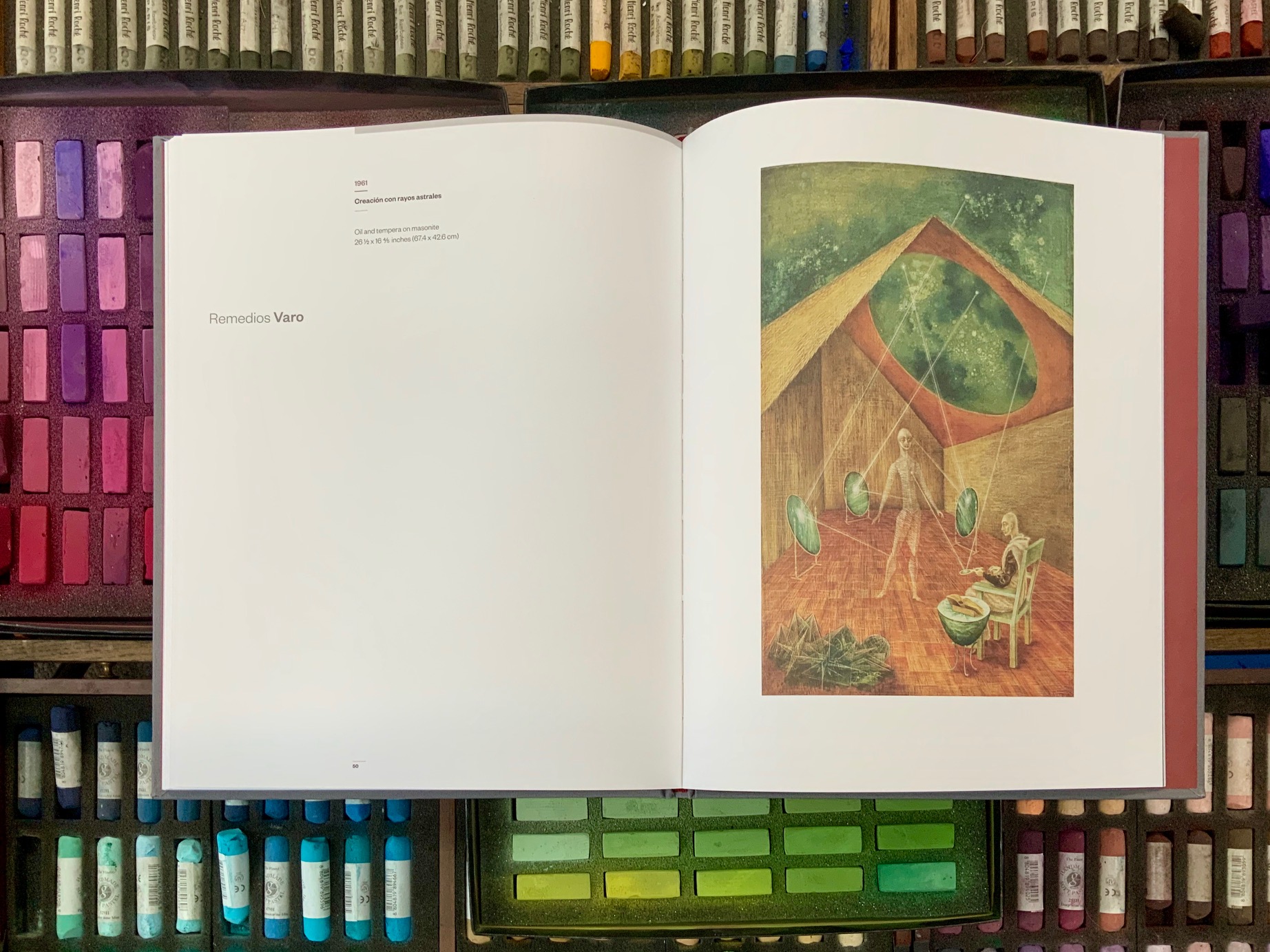
A Remedios Varo Plate from “Science and Surrealism”
*an ongoing series of quotations – mostly from artists, to artists – that offers wisdom, inspiration, and advice for the sometimes lonely road we are on.
… both Surrealism’s birth and infancy coincided with probably the most momentous period in the history of physics. The first Surrealist text, written by Andre Breton and Philippe Soupault and titled Magnetic Fields, deployed the spontaneous technique of ‘automatic writing,’ which supposedly allowed direct access to unconscious material. It appeared in 1920 but was written in the previous year, coinciding with the expedition led by the English astrophysicist, Arthur Eddington, to observe the solar eclipse from the island of Principe off the west coast of Africa. It was this journey that proved predictions set out in Einstein’s General Theory of Relativity (1916) about the gravitational deflection of light by the sun. Eddington’s experiment led not only to Einstein’s instant, mythic status as the ‘new Copernicus’ and the swift popularization of Relativity, but more specifically its appearance in the early theoretical writings of Surrealism’s principle spokesman, Breton, which helped lay the foundations of the movement. Breton’s subsequent manifesto texts of 1924 and 1929, extending his discussion of what he deemed the narrow, restrictive logic of Western though, can be situated within the same historical context that bore the revolutionary discoveries of quantum mechanics, culminating in 1927.
“Sibylline Strangeness: Surrealism and Modern Physics,” by Gavin Parkinson in Science in Surrealism, published by Gallery Wendy Norris
Comments are welcome!
Pearls from artists* # 385
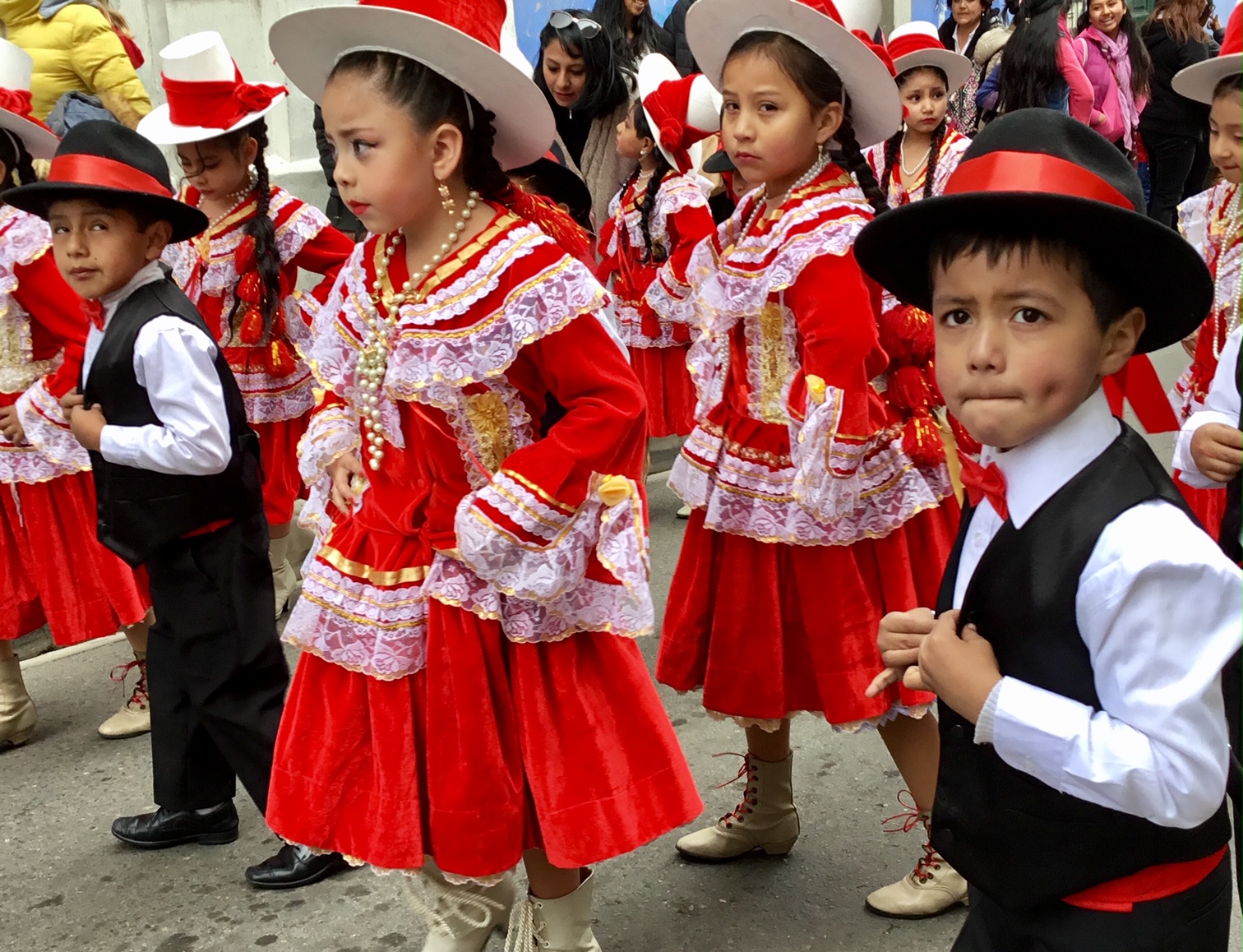
Potosí, Bolivia
* an ongoing series of quotations – mostly from artists, to artists – that offers wisdom, inspiration, and advice for the sometimes lonely road we are on.
Sunday of Carnival, the parade begins. For a whole day of celebration in music and dance, people can express their hope and fears, revive their myths and escape to a reality far from everyday life.
Thousands of spectators arrive from different parts if Bolivia and other countries. Filling the streets, they straddle benches, window ledges, balconies, cats and eve hang from walls or roofs to witness the entrance of the Carnival. Thus is the magnificent parade when Carnival makes its official entry into Oruro. The comparsas (dance troupes) dance to music for20 blocks, nearly eight lies, to the Church of the Virgin of Socavón (Virgin of the Mine). Each tries to out do the next in the brilliance of their costumes, the energy of their dancing and the power of their music. All their efforts are dedicated to the Virgin whose shrine is found on the hill called Pie de Gallo.
If there are thousands of spectators, there are also thousands of dancers from the city and other parts of the country. Among the most remarkable are the Diablos and Morenos which count for eight of the 40 or 50 participating groups. Keeping in mind that the smallest troupes have between 30 and 50 embers and the largest between 200 and 300, it is possible to calculate the number of dancers and imagine the spectacle.
… Each dance recalls a particular aspect of life in the Andes. Lifted from different periods and places, the dances offer a rich interpretation of historical events, creating an imaginative mythology for Oruro.
… Carnival blends indigenous beliefs and rituals with those introduced by the Spaniards. Both systems of belief have undergone transformations, each making allowance for the other, either through necessity or familiarity. The Christianity fought from Europe becomes loaded with new meanings while the myths and customs of the Andes accommodate their language and creativity to the reality of their conquered world. The process can be seen as a struggle culminating in a ‘mestizaje’ or new cultural mix.
El Carnaval de Oruro by Manuel Vargas in Mascaras de los Andes Bolivianos, Editorial Quipus and Banco Mercantil
Comments are welcome!


 barbararachkoscoloreddust.com