Blog Archives
Pearls from artists* # 680

“Sacrificial” (on the wall) and “Trickster” (on the floor)
*an ongoing series of quotations – mostly from artists, to artists – that offers wisdom, inspiration, and advice for the sometimes lonely road we are on.
What makes a work transcendent and powerful is a personal intensity, an ‘extra’ quality. Yet that intensity is exclusive to each artist: extra strangeness, subtlety, causticity, bravado, sensuality, rawness, grandiosity, succinctness, mystery, vulnerability, truth, etc. For an individual artist to infuse an object or an experience with their own ‘extra’ quality requires not only skill or ideas, but the profound benevolence of consistently delivering in spades.
It is this passion and genuine feeling, specific to each creator, that lives on in the art as a gift. It is wrapped up in the work, forever suspended in time. The artist says,
Here… everything I possessed in this moment is embodied in this object… All skills I have painstakingly learned, all of the knowledge I possess, the joy and pain I have felt and all the experiences I have lived. I spun these into the perfect, most sublime form, and packed it up, but for you to unwrap anytime you need sustenance. It will nourish, comfort, and surround you, because you have chosen it.
Each viewer selects which works of art speak to them… which embodied feelings, concepts, and knowledge they value. An empathic connection is forged through the art object or experience. What is love, but to say to someone, ‘you are truly seen and understood?’ Art offers this as well, by reaching out to puncture through the membrane of our emotional isolation, to articulate how we feel in the moments when we cannot find words. It tells the artist and viewer alike, ‘You are not alone. You are not alone in how your brain works. You are not alone in the pain you feel. You are not alone in what you notice or appreciate, or in how much love you have to give.’
Pour that love into an art object. It can handle all the devotion you pack into it, and more.
Kate Kretz in Art From Your Core: A Holistic Guide to Visual Voice
Comments are welcome!
Pearls from artists* # 655

*an ongoing series of quotations – mostly from artists, to artists – that offers wisdom, inspiration, and advice for the sometimes lonely road we are on.
My creative friends are some of the most hard-working, motivated people I know. While many non-artists have nine-to-five jobs and then relax at home, our work is never done. Yet, we are bombarded with tropes in books, movies, and television suggesting that we have chosen a ‘slacker’ profession. Even wildly successful artists can have family members who think they are self-absorbed, or that they should ‘get a real job.’ According to genius and award-winning filmmaker, Werner Herzog, his brother still routinely makes fun of his profession (Brooks, 2020). Some may call us selfish and tell us that we are only looking for attention, or feeding our egos. They may ask, “When are you going to grow up?” or ignorantly proclaim, “How nice it must be to only work when you want to.” Regardless of intention, this is not support.
Kate Kretz in Art From Your Core: A Holistic Guide to Visual Voice
Comments are welcome!
Pearls from artists* # 648

“Apparition,” soft pastel on sandpaper, 58” x 38”
*an ongoing series of quotations – mostly from artists, to artists – that offers wisdom, inspiration, and advice for the sometimes lonely road we are on.
I prefer to speak in terms of the artist’s voice. Voice is deeper, manifested from the very core of your being. It is a synthesis of the experiences, intellectual concepts, and aesthetic interests you possess, executed in your distinctive way, in the formal, emotional, and intellectual language of your chosen medium. When successful, the realization of your voice follows a gestalt principle. The combination of your ideas and the work’s physical embodiment is greater than the sum of its parts and distinguishes your outcome from everyone else’s. If we wrote down a single concept and handed it to a dozen artists, we would get very different responses from each of them, and some works would be a stronger synthesis of ideas and execution. As Frank Stella once said, “There are no good ideas for paintings, there are only good paintings… the painting IS the idea (Saltz, 2020:42).”
The art that we recognize as having singular, identifying features, those formal aspects that allow us to immediately see a work as ‘a David Wojnarowicz’ or ‘a Julie Mehretu,’ were not the product of a singular flash of brilliance. These qualities evolved as part of a sustained, life-long, ever-deepening investigation to articulate their specific and singular vision. Our voice comes from tapping into the depths of our own consciousness, then distilling the most powerful aspects of that awareness. Voice also expands and deepens over time. It evolves along with the artist.
Kate Kretz in Art From Your Core: A Holistic Guide to Visual Voice
Comments are welcome!
Pearls from artists* # 631

*an ongoing series of quotations – mostly from artists, to artists – that offers wisdom, inspiration, and advice for the sometimes lonely road we are on.
I could see motion when I looked at Julie’s work. Her hand had moved there, in that way. She’d chosen this blue over that one. Seeing the act of creation – the way a work doesn’t come out fully formed but grows by fits and starts – made we aware of how delicate and fragile an artwork was. How improbable it was that it existed. Someone had agonized over this square inch. They’d poured themselves into that flink of a line. I thought of the bewildering piles of supplies I’d seen in studios: Vaseline, turpentine, wax, Q-tips, chopsticks, marble dust. It’s not magic that makes a piece. All the Hollywood visions of possessed artists throwing pieces together in a trance-like state overlooked the fact that this was work. Each piece may have started with an idea, but there was more to it than that. “An idea is not a painting,” Julie said, as she worked, her nose practically grazing the canvas. She was already thinking ahead to how she’d fix the brushyness of the tights, maybe go over the shoes again. The soul of the artwork needed a body. Seeing Julie work gave me a path to follow into the piece.
Bianca Bosker in Get the Picture: A Mind-Bending Journey Among the Inspired Artists and Obsessive Art Fiends Who Taught Me How to See
Comments are welcome!
Pearls from artists* # 605

*an ongoing series of quotations – mostly from artists, to artists – that offers wisdom, inspiration, and advice for the sometimes lonely road we are on.
At first the concept of the unconscious was limited to denoting the state of repressed or forgotten contents. Even with Freud, who makes the unconscious – at least metaphorically – take the stage as the acting subject, it is really nothing but the gathering place of forgotten and repressed contents, and has a functional significance thanks only to these. For Freud, accordingly, the unconscious is of an exclusively personal nature, although he was aware of its archaic and mythological thought forms.
A more or less superficial layer of the unconscious is undoubtedly personal. I call it the personal unconscious. But this personal unconscious rests upon a deeper layer, which does not derive from personal experience and is not a personal acquisition but is inborn. This deeper layer I call the collective unconscious. I have chosen the term “collective” because this part of the unconscious is not individual but universal; in contrast to the personal psyche, it has contents and modes of behavior that are more or less the same everywhere and in all individuals. It is, in other words, identical in all men and thus constitutes a common psychic substrate of a suprapersonal nature which is present in every one of us.
Carl Jung in The Archetypes and the Collective Unconscious, translated by RFC Hull
Comments are welcome!
Pearls from artists* # 595

Film still from “Barbara Rachko: True Grit,” directed by Jennifer Cox, Moto Films LLC
*an ongoing series of quotations – mostly from artists, to artists – that offers wisdom, inspiration, and advice for the sometimes lonely road we are on.
One of the great paradoxes of the writing life is that our words – chosen carefully, so thoughtfully, with deep focus and concentration – those words once on the page go dead on us. Language is ours only when we are forming sentences, moving elements around, grappling with punctuation, speaking words aloud, feeling them on our lips. While we are shaping a scene into something we can hear and touch and see, that scene lives and breathes. We are inside language like painters, we are working in our medium: the tempera, the thin line, the wet oil on canvas, still in process, still alive.
But once we commit – once those words dry like paint, are affixed to the page – it becomes nearly impossible to see them. This? We think to ourselves. Our most loathsome critic emerges with a swirl of her cape. Really? What the hell is this? The sentences appear to have been written in another language – a dark dream language, tucked into some musty, inaccessible corner of our psyche. Attempting to discern its meaning is a bit like looking at our own face in the mirror. It is at once so familiar as to be invisible, and so intimate that we turn away, baffled, ashamed.
Can we ever see ourselves, really? Can we read ourselves?
It is a powerful conundrum because without the ability to see our writing afresh we cannot do the necessary work. How do we know whether a problem lies with the work, or with our inability to enter it? We need clarity, but not coldness. Openness, but not attachment. We want optimism, but that optimism must not go hand in hand with discernment. We’re not looking for a cheerleader, nor a fault-finding judge. We want to read ourselves with equanimity.
Dani Shapiro in Still Writing: The Pleasures and Perils of a Creative Life
Comments are welcome!
Pearls from artists* # 585
*an ongoing series of quotations – mostly from artists, to artists – that offers wisdom, inspiration, and advice for the sometimes lonely road we are on.
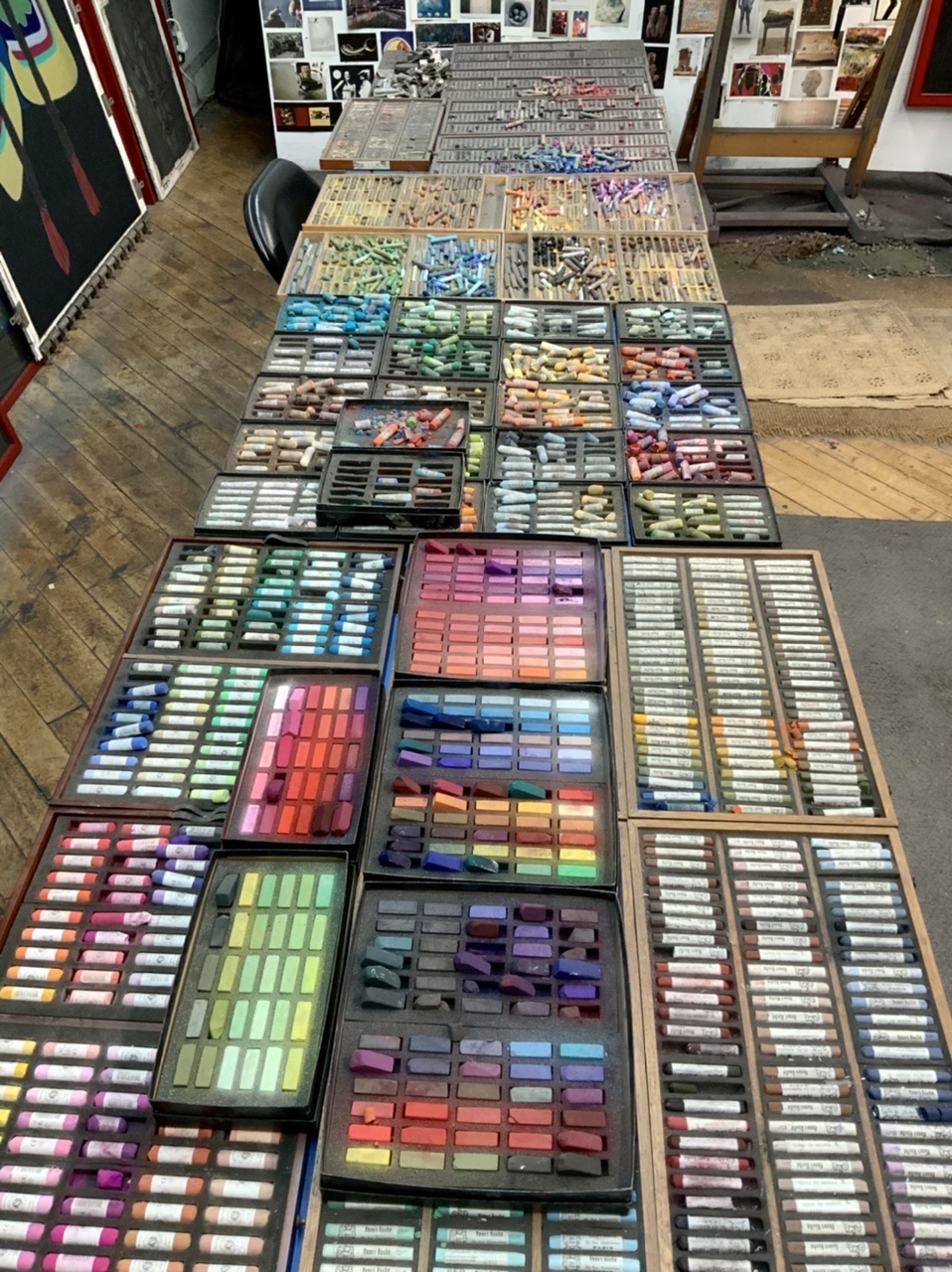
Improvisation, composition, writing, painting, theater, invention, all creative acts are forms of play, the starting place of creativity in the human growth cycle, and one of the great primal life functions. Without play, learning and evolution are impossible. Play is the taproot from which original art springs; it is the raw stuff that the artist channels and organizes with all his learning and technique. Technique itself springs from play, because we can acquire technique only by the practice of practice, by persistently experimenting and playing with our tools and testing their limits and resistances. Creative work is play; it is free speculation using the materials of one’s chosen form. The creative mind plays with the objects it loves. Artists play with color and space. Musicians play with sound and silence. Eros plays with lovers. Gods play with the universe. Children play with everything they can get their hands on.
Stephen Nachmanovitch in Free Play: Improvisation in Life and Art
Comments are welcome!
Pearls from artists* # 358
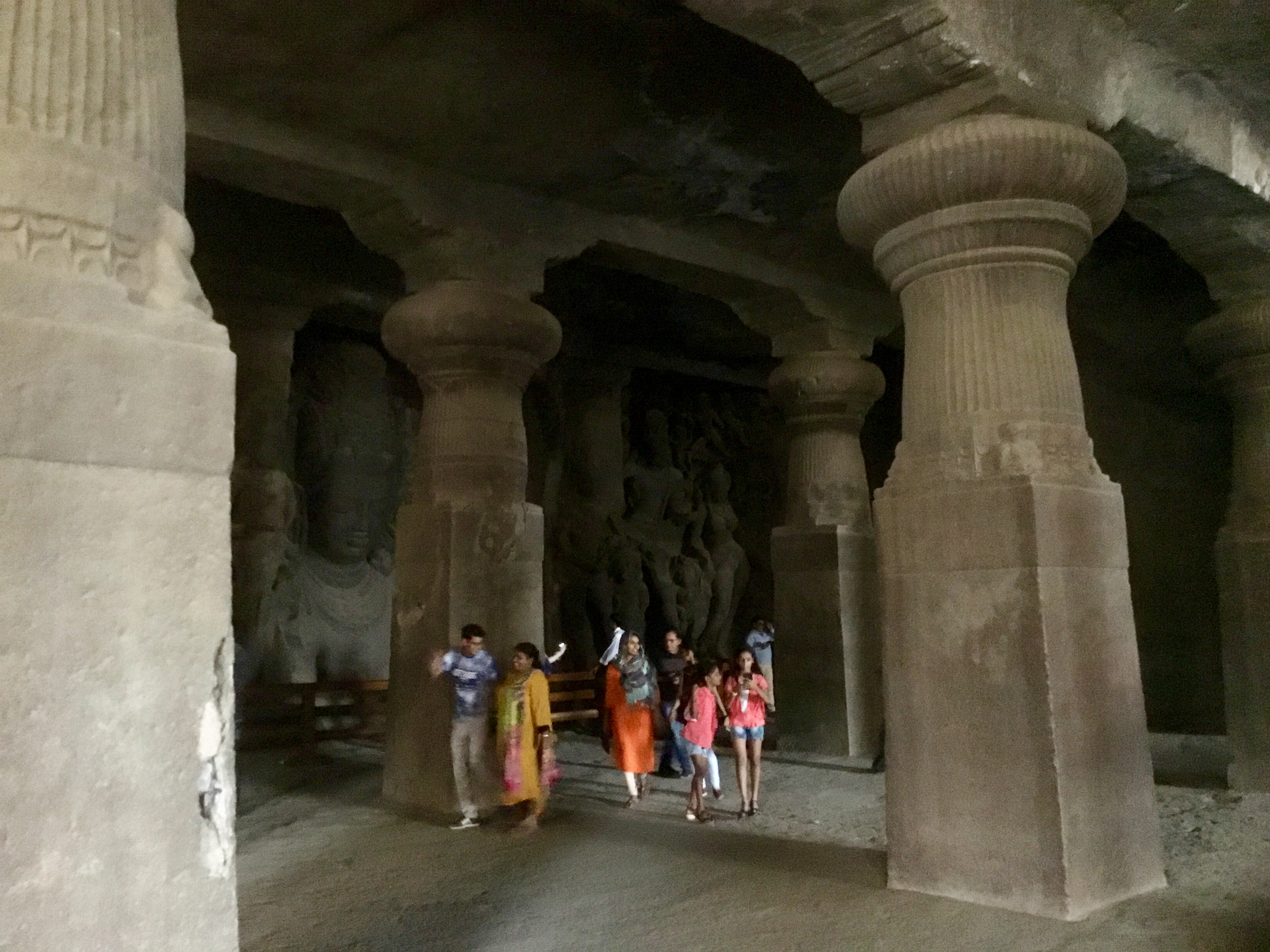
Elephanta Caves, India
*an ongoing series of quotations – mostly from artists, to artists – that offers wisdom, inspiration, and advice for the sometimes lonely road we are on.
According to [Rudolph] Arnheim, the way in which we reach out for and grasp the “object we see, either in our immediate range of perception or through the medium of photography, is dependent upon who we are and what we recognize from past experience.” The visual imprint of an image, an object, or a scene upon the eye is not at all “objective.” In the image-making process of thinking, we see, sort, and recognize according to the visual phenomenology of our own experience. What people notice in the “same” image – be it an image of a dancing Siva or a film of a Hindu festival procession – depends to some extent on what they can recognize from the visual experience of the past. In the case of film, of course, it also depends on what the photographer has seen and chosen to show us. Arnheim writes that the eye and the mind, working together in the process of cognition, cannot simply note down images that are “already there.” “We find instead that direct observation, far from being a mere ragpicker, is an exploration of the form-seeking, form-imposing mind, which needs to understand but cannot until it casts what it sees into manageable models.”
Diana L. Eck in Darsan: Seeing the Divine Image in India
Comments are welcome!
Pearls from artists* # 98
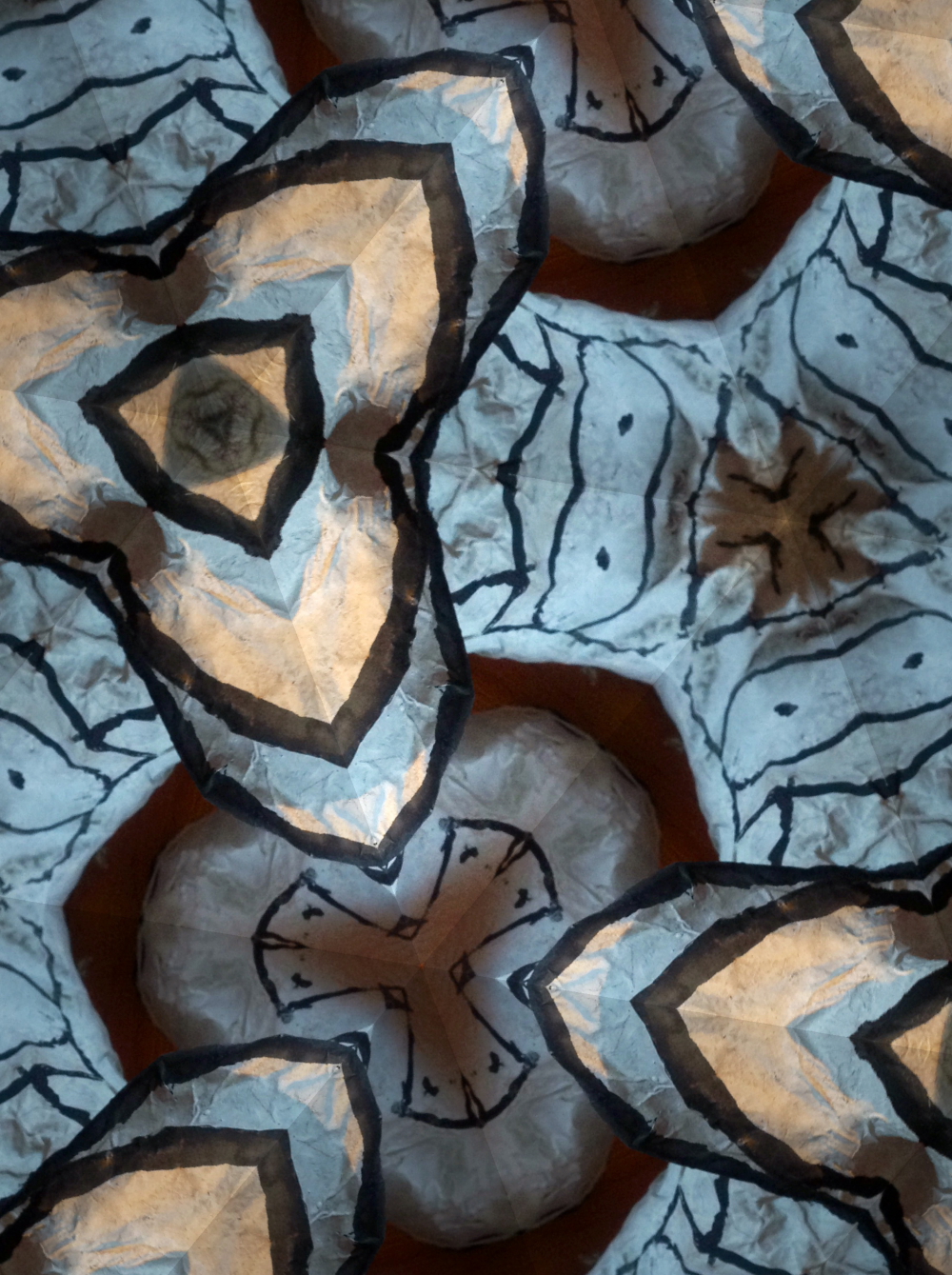
Teleidoscope
* an ongoing series of quotations – mostly from artists, to artists – that offers wisdom, inspiration, and advice for the sometimes lonely road we are on.
A work of art can start you thinking about some aesthetic or philosophical problem; it can suggest some new method, some fresh approach to fiction. But the relationship between reading and writing is rarely so clear-cut…
To be truthful, some writers stop you dead in your tracks by making you see your own work in the most unflattering light. Each of us will meet a different harbinger of personal failure, some innocent genius chosen by us for reasons having to do with what we see as our own inadequacies. The only remedy to this I have found is to read a writer whose work is entirely different from another, though not necessarily more like your own – a difference that will remind you of how many rooms there are in the house of art.
Francine Prose in Reading Like a Writer: A Guide for People Who Love Books and for Those Who Want to Write Them
Comments are welcome!
Pearls from artists* # 84

My Alexandria living room
* an ongoing series of quotations – mostly from artists, to artists – that offers wisdom, inspiration, and advice for the sometimes lonely road we are on.
I have a stockpile of sculptures, paintings, and drawings – every work of art I have made that has not sold – in a storage space for which I pay every month as regularly as I pay my utility bills. This is a sensible arrangement, as I can leave this work to my children. Most of the time I never give it a thought, but this morning it flashed across my mind that if it were blown away I would be bereaved in a way that would hurt me very much. I have not been inordinately materialistic, but I am attached to my house, to my inherited belongings, and to the things that I have chosen for myself. All these objects add complexity to my emotional ties to people with whom I have shared, and share, my life, and to my aspirations for myself.
Anne Truitt in Turn: The Journal of an Artist
Comments are welcome!


 barbararachkoscoloreddust.com