Blog Archives
Pearls from artists* # 626

*an ongoing series of quotations – mostly from artists, to artists – that offers wisdom, inspiration, and advice for the sometimes lonely road we are on.
This is why, when writers who are just starting out ask me when it gets easier, my answer is never. It never gets easier. I don’t want to scare them, so I rarely say more than at, but the truth is that, if anything, it gets harder. The writing life is filled with predictable uncertainties, but with the awareness that we are always starting over. That everything we will ever write will be flawed. We may have written one book, or many, but all we know – if we know anything at all – is how to write the book we’re writing. All novels are failures. Perfection itself would be a failure. All we can hope is that we will fail better. That we will not fall prey to the easy enchantments of repeating what may have worked in the past. I try to remember that the job – as well as the plight, and the unexpected joy – of the artist is to embrace uncertainty, to be sharpened and honed by it. Each time we come to the end of a piece of work, we have failed as we have leapt – spectacularly, brazenly – into the unknown.
Dani Shapiro in Still Writing: The Perils and Pleasures of a Creative Life
Comments are welcome!
Q: Many artists can’t bear to face a blank canvas. How do you feel about starting a new piece?

Starting a 26” x 20”pastel painting!
A: That’s an interesting question because I happen to be re-reading The War of Art by Steven Pressfield and this morning I saw this:
You know, Hitler wanted to be an artist. At eighteen he took his inheritance, seven hundred kronen, and moved to Vienna to live and study. He applied to the Academy of Fine Arts and later to the school of architecture. Ever see one of his paintings? Neither have I. Resistance beat him. Call it overstatement but I’ll say it anyway: it was easier for Hitler to start World War II than it was for him to face a blank square of canvas.
I’ve never understood this fear of “the blank canvas” because I am always excited about beginning a new painting. When you think about it, artists can often say, “In the history of the planet no one has ever made what I am about to make!” Once again I am looking at something new on my easel, even if it is only a blank 26” x 20” piece of sandpaper clipped to a slightly larger piece of foam core.
Unlike artists who are paralyzed before “a blank canvas,” I am energized by the imagined possibilities of all that empty space! I spend three or four months on a pastel painting so this experience of looking at a blank piece of paper on my easel happens three or four times a year at most.
Excluding travel to remote places, which is essential to my work and endlessly fascinating, the first day I get to spend blocking in a new painting is the most exhilarating part of my whole creative process. It’s when I feel the freest! I select the pastel colors quickly, without thinking too much about them, first imagining them, then feeling, looking, and reacting intuitively, always correcting and trying to make the painting look better and better!
Comments are welcome!
Pearls from artists* # 611
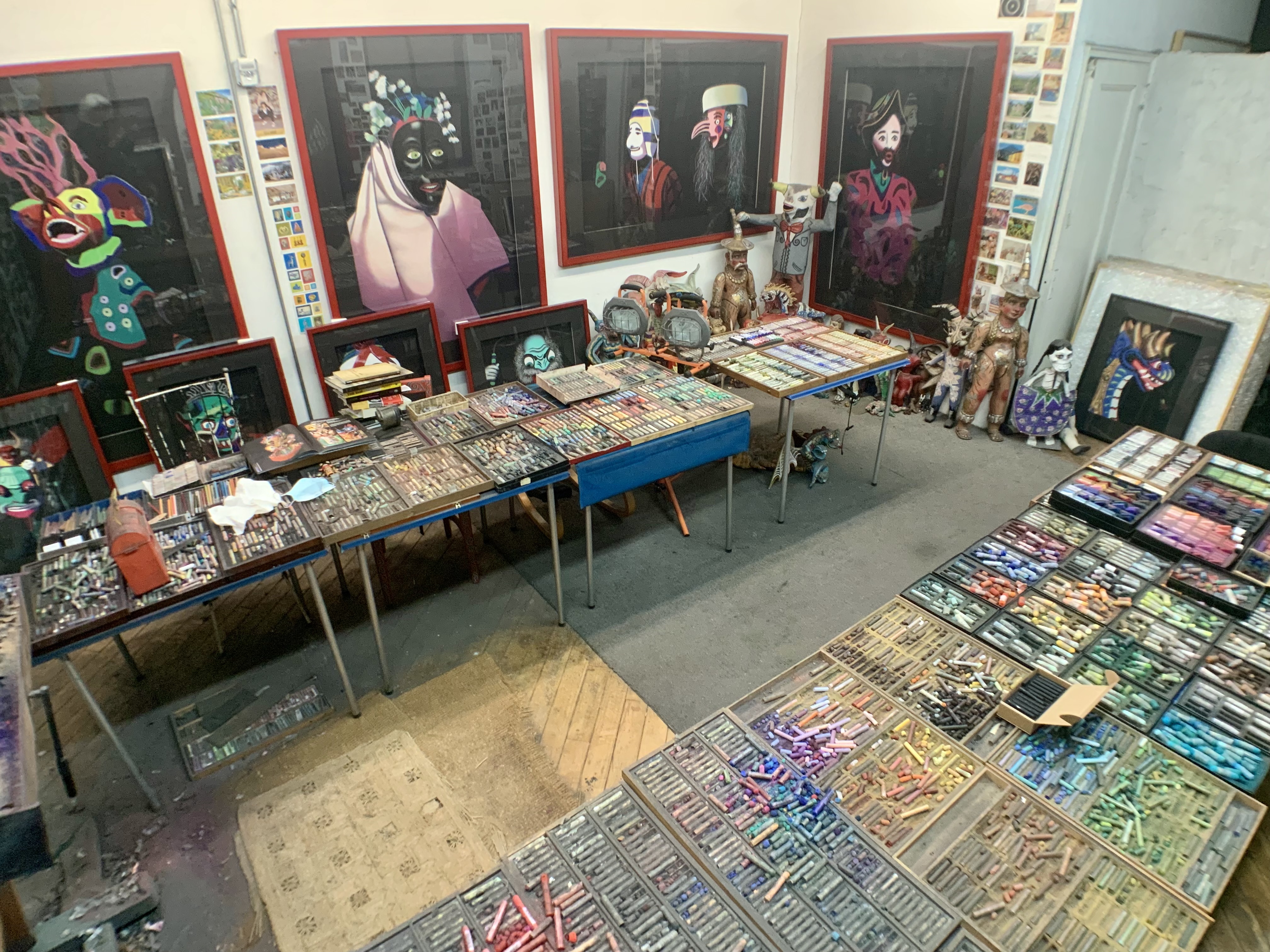
Barbara’s Studio
*an ongoing series of quotations – mostly from artists, to artists – that offers wisdom, inspiration, and advice for the sometimes lonely road we are on.
This common participation in the Trinity of Line, Form, and Color has founded a promiscuous fellowship which, while promoting the respect for skill, promotes to a far greater degree the misunderstanding of art. For skill in itself is but a sleight of hand. In a work of art one does not measure its extent but counts himself happiest when he is unaware of its existence in the contemplation of the result. Among those who decorate our banks and hotels you will find many who can imitate the manner of any master, living or dead, far better than the master could imitate himself, but they have no more knowledge of his soul than they have knowledge of their own. We will know how little skill avails, how ineffective are its artifices in filling the lack of true artistic motivation. His “less is more,” is Robert Browning’s famous evaluation of this problem in comparing the imperfections of Raphael’s art to the impecability of Del Sarto’s, “I should rather say that it will be more difficult to improve the mind of the master who makes such mistakes than to repair the work he has spoilt,” Leonardo wrote. Neither Giotto nor Goya exhibited half the skill of Coreggio or Sargent, either in the complexity of their undertaking or the apparent virtuosity of execution. The artist must have the particular skill to achieve his particular ends. If he has more, we are fortunate not to know it, for the exhibition of excess would only mar his art. You may be sure that the artist whose method is muddled betrays less his technical inadequacy than the incoherence of his own intentions.
Mark Rothko in The Artist’s Reality: Philosophies of Art
Comments are welcome!
Pearls from artists* # 586

Starting a new one!
*an ongoing series of quotations – mostly from artists, to artists – that offers wisdom, inspiration, and advice for the sometimes lonely road we are on.
The page is your mirror. What happens inside you is reflected back. You come face-to-face with your own resistance, lack of balance, self-loathing, and insatiable ego – and also with your singular vision, guts, and fortitude. No matter what you’ve achieved the day before, you begin each day at the bottom of the mountain. Isn’t this true for most of us? A surgeon about to perform a difficult operation is at the bottom of the mountain. A lawyer delivering a closing argument. An actor waiting in the wings. A teacher on the first day of school. Sometimes we may think that we’re in charge, or that we have things figured out. Life is usually right there, though, ready to knock us over when we get too sure of ourselves. Fortunately, if we have learned the lessons that years of practice have taught us, when this happens, we endure. We fail better. We sit up, dust ourselves off, and begin again.
Dani Shapiro in Still Writing: The Perils and Pleasures of a Creative Life
Comments are welcome!
Q: Why do you sometimes depict the same subject matter twice?

“Trickster” (left) and “Sacrificial,” while the latter was in-progress
A: It is fascinating to play around with scale. For starters, it helps demonstrate how my pastel techniques and my approach to the subject matter are evolving. I’ve noticed that I always see and depict more details the second time around.
Typically, I prefer the second pastel painting over the first one depicting the same subject. Man Ray famously said:
“There is no progress in art, any more than there is progress in making love. There are simply different ways of doing it.”
I disagree with him. I am an optimist who believes that artists cannot help but improve over time. It’s one of the things that gets me into my studio: the idea that my creative process and my ways of using pastel are changing for the better. I like to think this represents some sort of creative progress. But still I sometimes have to wonder, is the idea of ‘progress’ just something artists tell ourselves in order to keep going?
Comments are welcome!
Pearls from artists* # 545

*an ongoing series of quotations – mostly from artists, to artists – that offers wisdom, inspiration, and advice for the sometimes lonely road we are on.
… in the pursuit of better behavior and moral action, we’ve cut ourselves off from instinct. But it’s gone too far. Today, we know that we’re in our heads too much. It’s not hard to see that something has been lost by placing so much of our attention into devices. Our overstimulated culture is a bird that feels like it has nowhere to land. Many people feel like, or operate as though, they’ve lost feeling for life.
Gary Bobroff in Carl Jung: Knowledge in a Nutshell
Comments are welcome!
Q: Contemporary art has become very diverse and multidisciplinary in the last few decades. Do you welcome this trend? Is this trend part of your art practice? (Question from artamour)
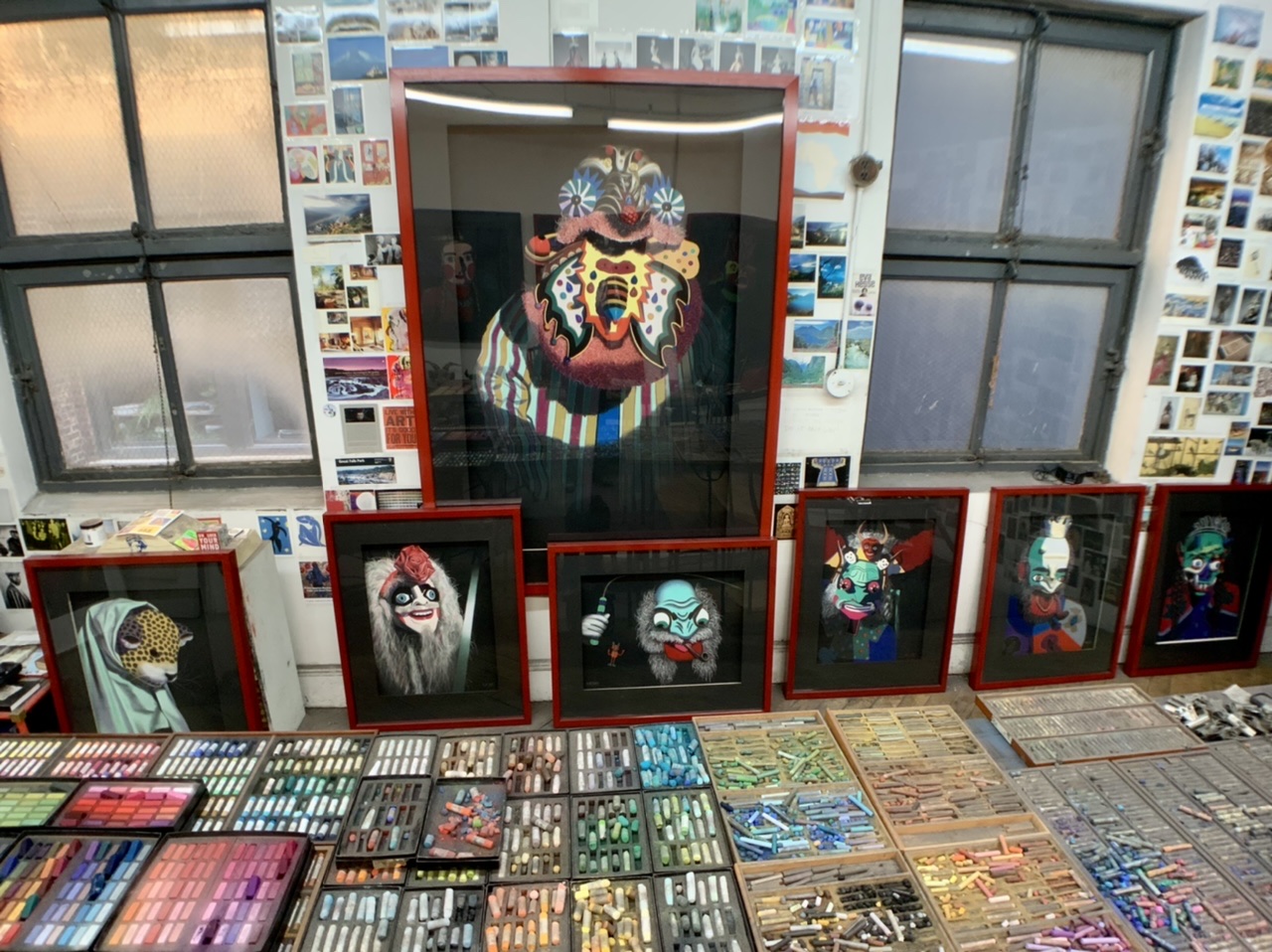
A: By definition trends in art come and go and I don’t see how any self-respecting artist can or should pay much attention to them. I continue to do my own thing, refining my soft pastel techniques, following wherever my interests, inspiration, and subject matter lead, all the while striving to become a better artist.
Comments are welcome!
Pearls from artists* # 484

*an ongoing series of quotations – mostly from artists, to artists – that offers wisdom, inspiration, and advice for the sometimes lonely road we are on.
[Walter] Murch: We hope we become better editors with experience! Yet you have to have an intuition about the craft to begin with: for me, it begins with, Where is the audience looking? What are they thinking? As much as possible, you try to be the audience. At the point of transition from one shot to another, you have to be pretty sure where the audience’s eye is looking, where the focus of attention is. That will either make the cut work or not.
[Michael] Ondaatje: So before you make the cut, if you feel the audience is looking towards point X, then you cut to another angle where the focus of attention is somewhere around that point X.
The Conversation: Walter Murch and the Art of Editing Film by Michael Ondaatje
This passage in Ondaatje’s book resonates because I work similarly to refine and construct each pastel painting. My goal is to move the viewer’s eye around in an engaging and interesting way. This part of my process is subtle so I suspect that most of my audience neither appreciates nor even suspects that I have done it.
Comments are welcome!
Q: When did you start using the sandpaper technique and why (Question from “Arte Realizzata”)

A: In the late 1980s when I was studying at the Art League School in Alexandria, VA, I enrolled in a three-day pastel workshop with Albert Handel, an artist known for his southwest landscapes in pastel and oil paint. I had just begun working with soft pastel and was experimenting with paper. Handel suggested I try Ersta fine sandpaper. I did and nearly three decades later, I’ve never used anything else.
This paper is acid-free and accepts dry media, mainly pastel and charcoal. It allows me to build up layer upon layer of pigment and blend, without having to use a fixative. The tooth of the paper almost never gets filled up so it continues to hold pastel. (On the rare occasion when the tooth DOES fill up, which sometimes happens with problem areas that are difficult to resolve, I take a bristle paintbrush, dust off the unwanted pigment, and start again). My entire technique – slowly applying soft pastel, blending and creating new colors directly on the paper, making countless corrections and adjustments, rendering minute details, looking for the best and/or most vivid colors – evolved in conjunction with this paper.
I used to say that if Ersta ever went out of business and stopped making sandpaper, my artist days would be over. Thankfully, when that DID happen, UArt began making a very similar paper. I buy it in two sizes – 22″ x 28″ sheets and 56″ wide by 10-yard-long rolls. The newer version of the rolled paper is actually better than the old, because when I unroll it, it lays flat immediately. With Ersta I would lay the paper out on the floor for weeks before the curl would give way and it was flat enough to work on.
Comments are welcome!
Pearls from artists* # 462
*an ongoing series of quotations – mostly from artists, to artists – that offers wisdom, inspiration, and advice for the sometimes lonely road we are on.
It seems contradictory to call an artist both shy and conceited, introverted and extraverted, empathic and self-centered, highly independent and hungry for community – until we realize that all of these qualities can be dynamically present in one and the same person.
Indeed, this dynamism regularly perplexes and buffets the artist. He may begin to consider himself crazy for longing to perform even though public performance frightens him, or neurotic for feeling competent at the piano but incompetent in the world. He may come to possess the vain hope that he can live quietly, like other people, his personality statically integrated in some fashion, and then feel like a failure when the contradictory forces at play in him prevent him from feeling relaxed even for a minute. Once he realizes, however, that this puzzling contradiction is his personality, he is better able to accept himslef and to understand his motives and actions.
Eric Maisel in “A Life in the Arts: Practical Guidance and Inspiration for Creative and Performing Artists”
Comments are welcome!


 barbararachkoscoloreddust.com