Blog Archives
Pearls from artists* # 638

Barbara’s Studio
*an ongoing series of quotations – mostly from artists, to artists – that offers wisdom, inspiration, and advice for the sometimes lonely road we are on.
I was in the presence of a woman [Grace Hartigan] who had sacrificed everything, including her only child, to be what she was: an artist. The rewards had been few, beyond a life well-lived (not materially, but spiritually) and the recognition in her waning years that she had been honest about who she was and what she needed. A rare accomplishment for a woman of any generation, it was particularly so of hers, when servitude to family was the only goal toward which a “healthy” woman was to aspire. Grace was living proof that, on the contrary, a life dreamed could be a life lived. All it took was courage, commitment, and humor. I remember both of us laughing a lot that afternoon. Though the subject was serious, the stories Grace told were fantastic and the woman who recounted them was as wild as the twenty-six-year-old who had abandoned everything in 1948 to paint, though she wasn’t even sure how.
Mary Gabriel in Ninth Street Women
Comments are welcome!
Pearls from artists* # 633

The Studio
*an ongoing series of quotations – mostly from artists, to artists – that offers wisdom, inspiration, and advice for the sometimes lonely road we are on.
… as he makes clear repeatedly throughout the text, there can be no such thing as a revolution in art. The “plastic process” as he [Mark Rothko] labels, it – the development of art – is inherently evolutionary. An artist can react against it, but there is no way to be outside it; it is the fabric with which he or she weaves. Technique, ways of seeing, representing, and balancing, are all in a common pool from which the artist draws.
Christopher Rothko in The Artist’s Reality: Philosophies of Art by Mark Rothko
Comments are welcome!
Pearls from artists* # 629

Barbara’s Studio
*an ongoing series of quotations – mostly from artists, to artists – that offers wisdom, inspiration, and advice for the sometimes lonely road we are on.
I kept coming back to [Ellen] Dissanayake. She’s for banning the word art altogether on the grounds it’s uselessly vague, and argues we shouldn’t treat art as a thing but as a behavior. Art, she claims, occurs anytime we take ordinary things and transform them into extraordinary experiences through a process she calls “making special.” Making special happens when words turn into poetry, flesh gets painted for a shaman’s ceremony, a B-flat meets a middle G to form the tune in a Peking opera. I liked her definition, which seemed less arbitrary than others I’d read and didn’t turn up its nose at blockbuster movies or Super Bowl halftime shows – which Dissanayake calls “the arts of our time.” As she sees it, art results from several key “operations” … Artists repeat… formalize… exaggerate… elaborate… and manipulate expectation… Break dancing, leading a tea ceremony, designing Grand Theft Auto – to Dissanayake, it’s art, art, and more art.
Bianca Bosker in Get the Picture: A Mind-Bending Journey Among the Inspired Artists and Obsessive Art Fiends Who Taught Me How to See
Comments are welcome!
Q: What inspires you to create? (Question from “Cultured Focus Magazine”)
A: You remember the expression, to whom much is given, much is expected? Having discovered around the age of 5 or so that I could draw anything I could see, I know I have been given a tremendous gift. I remember being completely surprised as a kid to realize that not everyone can do this.
Therefore, I feel a kind of sacred obligation to develop my abilities as far as possible, to make the most of my short time on this earth. It is a thrill to see not only what is going to happen next in the studio, but also in my life. For example, I have become a world traveler. I wonder, which new country will I visit next?
Comments are welcome!
Q: When did you begin drawing and painting? (Question from “Cultured Focus Magazine”)

A: This is a long story because my path to becoming a professional artist has been unusually circuitous.
I grew up in a blue collar family in suburban New Jersey. My parents were both first-generation Americans and no one in my family had gone to college. I was a smart kid, who showed some artistic talent in kindergarten and earlier. At the age of 6, my sister, my cousin, and I enrolled in Saturday morning painting classes at the studio of a local artist. I continued the classes for about 8 years and became a fairly adept oil painter.
At the age of 15 my father decided that art was not a serious pursuit – he called it a hobby, not a profession – and abruptly stopped paying for my Saturday morning lessons. Unfortunately, there were no artists or suitable role models in my family. So with neither financial nor moral support to pursue art, I turned my attention to very different interests.
Cut to ten years later. When I was 25, I earned my private pilot’s license and spent the next two years amassing other flying licenses and ratings, culminating in a Boeing-727 flight engineer’s certificate.
At 29, I joined the Navy. By then I was an accomplished civilian pilot with thousands of flight hours so I expected to fly jets. However, in the early 1980s women were not allowed in combat. There were very few women Navy pilots and those few were restricted to training male pilots. There were no women pilots landing on aircraft carriers.
In the mid-1980s I was in my early 30s, a lieutenant on active duty in the Navy, working a soul-crushing job as a computer analyst on the midnight shift in a Pentagon basement. It was literally and figuratively the lowest point of my life. I was completely bored and miserable.
Remembering the joyful Saturdays of my youth when I had taken art classes with a local New Jersey painter, I enrolled in a drawing class at the Art League School in Alexandria, Virginia. Initially I wasn’t very good, but it was wonderful to be around other women and a world away from the mentality of the Pentagon. I was having fun again! I enrolled in more classes and became a very motivated full-time art student who worked nights at the Pentagon. As I studied and improved my skills, I quickly discovered my preferred medium – soft pastel on sandpaper.
Although I knew I had found my calling, for more than a year I agonized over whether or not to leave the financial security of a Navy paycheck. Finally I did make up my mind and resigned my commission, effective on September 30, 1989. With Bryan’s (my then boyfriend’s) support, I left the Navy to devote my time to making art.
I’m probably one of the few people who can name THE day I became a professional artist! That day was October 1, 1989. Fortunately, I have never needed another job. I remained in the Navy Reserve for the next 14 years, working primarily at the Pentagon for two days each month and two weeks each year. I commuted by train to Washington, DC after I moved to Manhattan in 1997. Finally on November 1, 2003, I officially retired as a Navy Commander.
Life as a self-employed professional artist is endlessly varied, fulfilling, and interesting. I have never regretted my decision to pursue art full-time.
Comments are welcome!
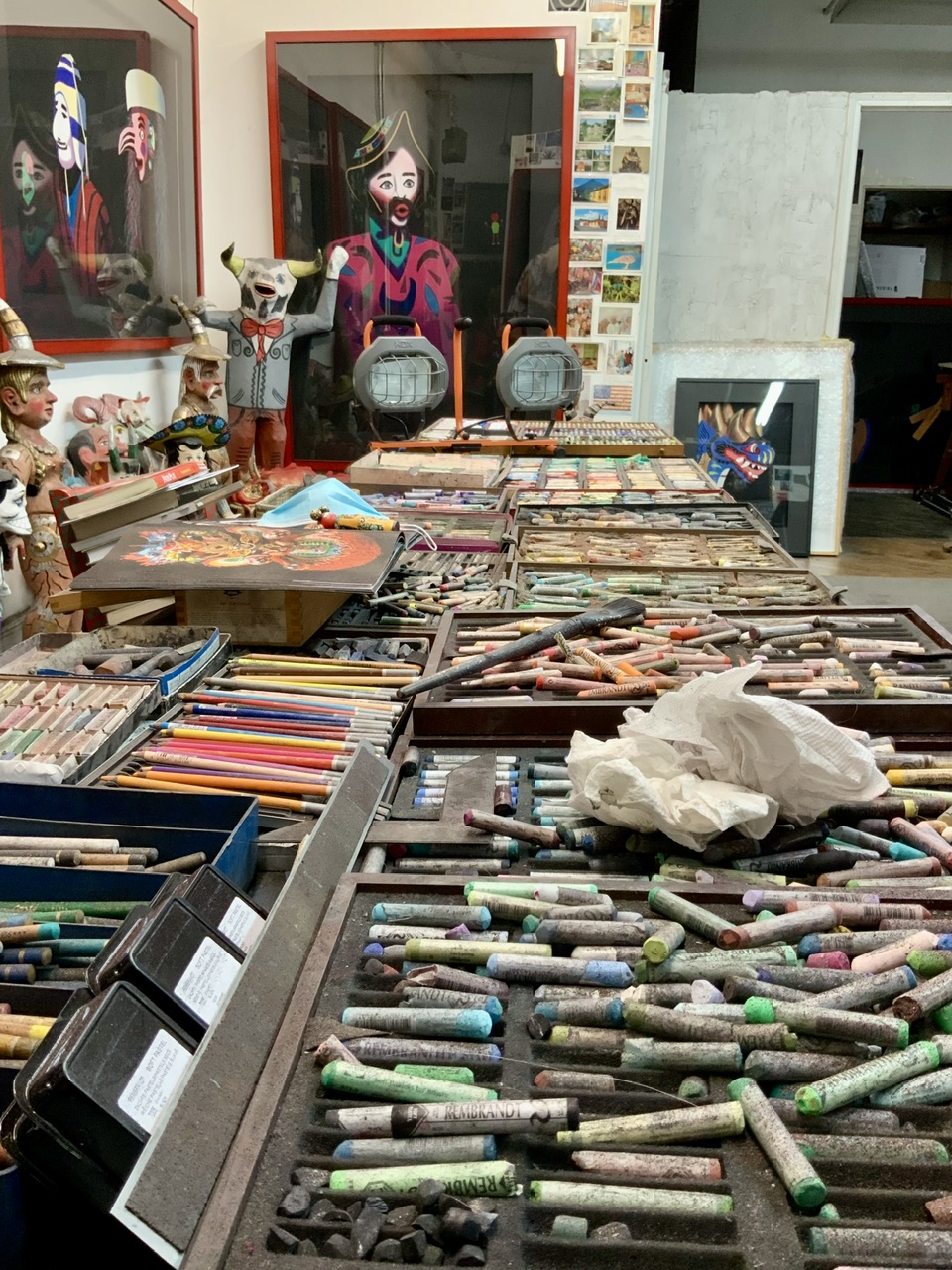
Q: How large is your collection of Mexican folk art objects?

Part of my collection
A: I began collecting these figures in the early 1990s. I haven’t counted them, but my guess is that I have amassed around 200 pieces of various sizes. This includes some Guatemalan figures. I went to Guatemala in 2009 and 2010. Since I divide my time between a house in Alexandria, VA, an apartment in Manhattan, and a studio in Chelsea, a portion of my folk art collection resides in each of these places.
Since 2017 I have been creating pastel paintings in the “Bolivianos” series, which exclusively use my photographs of Bolivian Carnival masks as source material. Occasionally, I will add one of my smaller Mexican or Guatemalan figures to improve and enrich a painting’s composition. Otherwise, my Mexican collection sits gathering dust. My thinking and my ideas, not to mention my travels, have evolved and just naturally moved on with time.
Comments are welcome!
Pearls from artists* # 623

The Studio
*an ongoing series of quotations – mostly from artists, to artists – that offers wisdom, inspiration, and advice for the sometimes lonely road we are on.
Jealousy? Hmmm. Jealousy links up with competition. It’s hard to compete, really compete, in the art world. That’s why award ceremonies are a little suspect. Athletes can compete. I don’t know how much you can really compete as an artist. You can compete with yourself.
You are an explorer. You understand that every time you go into the studio you are after something that does not yet exist. Maybe it’s the same for a runner. I don’t know. But with running, or swimming, or gymnastics, or tennis, the achievement is measurable. Forget about competition. Rather, commit yourself to find out the true nature of your art. How does it really work; what’s the essence of it? Go for that thing that no one can teach you. Go for that communion, that real communion with your soul, and the discipline of expressing that communion with others. That doesn’t come from competition. That comes from being one with what you are doing. It comes from concentration, and from your own ability to be fascinated endlessly with the story, the song, the jump, the color you are working with.
I know this sounds a little monkish or even sort of “holier than thou,” but I really do believe it. And that said, jealousy is a human sentiment. Few of us are above it. John Lahr, a writer, told me that the major emotion in Los Angeles is envy. I have to say he’s probably right. And a lot of it has to do with how close or far from an Academy Award one is. And LA, the capital of smoke and mirrors, would have sone believe that the award is just a step away. When you drive down Hollywood Boulevard, some of the dreamers look as though the dream ate them alive.
Anna Deavere Smith in Letters to a Young Artist: Straight-Up Advice on Making a Life in the Arts
Comments are welcome!
Pearls from artists* # 622
In the studio
*an ongoing series of quotations – mostly from artists, to artists – that offers wisdom, inspiration, and advice for the sometimes lonely road we are on.
Divining meaning from a painting is not so simple that it can be codified in a book, and [Mark] Rothko certainly would not have wanted such a guide to his work. So much of understanding his work is personal, and so much of it is made up of the process of getting inside the work. It is like the “plastic journey” he describes in his “Plasticity” chapter – you must undertake a sensuous adventure within the world of the painting in order to know it at all. He cannot tell you what his paintings, or anyone else’s, is about. You have to experience them. Ultimately, if he could have expressed the truth – the essence of these works – he probably would not have bothered to paint them. As his works exemplify, writing and painting involve different kinds of knowing.
Christopher Rothko in The Artist’s Reality: Philosophies of Art by Mark Rothko
Comments are welcome!
Pearls from artists* # 620

Barbara’s Studio
*an ongoing series of quotations – mostly from artists, to artists – that offers wisdom, inspiration, and advice for the sometimes lonely road we are on.
A painting lives by companionship, expanding and quickening in the eyes of the sensitive observer. It dies by the same token. It is therefore a risky and unfeeling act to send it out into the world.
Mark Rothko in The Artist’s Reality: Philosophies of Art
Comments are welcome!
Q: You seem very disciplined. Do you ever have a day when you just can’t get excited about going to the studio to work?

Signing “Narcissist”
A: That happens occasionally, but I usually still go to the studio to work. You know the expression, “99% of life is just showing up”? Well, of course I have to show up at my studio to accomplish anything so I still try to keep fairly regular studio hours – 6 to 7 hours a day, 4 or 5 days a week. And that’s not to mention all the other work – answering email, checking social media, writing blog posts, etc. – which I tend to do at lunchtime, in the evenings, and on my days off from the studio.
When you are an artist there is always work to do and for some of it, no one else can do it because no one else knows the work from the inside the way the maker does. I like what Twyla Tharp says in her book, “The Creative Habit.” In order to progress an artist needs good work habits that become a daily routine. And Chuck Close used to say, “Inspiration is for amateurs,” meaning a professional works whether she’s in the mood or not. I completely agree so I keep working and slowly moving ahead.
As Tchaikovsky wrote in a letter to a friend:
We must always work, and a self-respecting artist must not fold his hands on the pretext that he is not in the mood. If we wait for the mood, without endeavoring to meet it halfway, we easily become indolent and apathetic. We must be patient, and believe that inspiration will come to those who can master their disinclination. A few days ago I told you I was working every day without any real inspiration. Had I given way to my disinclination, undoubtedly I should have drifted into a long period of idleness. But my patience and faith did not fail me, and today I felt that inexplicable glow of inspiration of which I told you; thanks to which I know beforehand that whatever I write today will have power to make an impression, and to touch the hearts of those who hear it.
Quoted in Eric Maisel’s A Life in the Arts: Practical Guidance and Inspiration for Creative and Performing Artists.
Comments are welcome!



