Blog Archives
Q: When you left the Navy you worked on commission as a portrait artist. Why don’t you accept commissions now?

Barbara’s studio
A: As I have often said, I left the active duty Navy in 1989, but stayed in the Reserves. The Reserves provided a small part-time income and the only requirement was that I work one weekend a month and two weeks each year. Plus, I could retire after 13 more years and receive a pension. (In 2003 I retired from the Navy Reserve as a Commander). The rest of the time I was free to pursue my studio practice.
For a short time I made a living making commissioned photo-realist portraits in soft pastel on sandpaper. However, after a year I became very restless. I remember thinking, “I did not leave a boring job just to make boring art!” I lost interest in doing commissions because what I wanted to accomplish personally as an artist did not coincide with what portrait clients wanted. I finished my final portrait commission in 1990 and never looked back.
To this day I remain reluctant to accept a commission of any kind. So I am completely free to paint whatever I want, which is the only way to evolve as a serious, deeply committed artist.
Comments are welcome!
Q: Can you describe your entire body of work in six words or less?
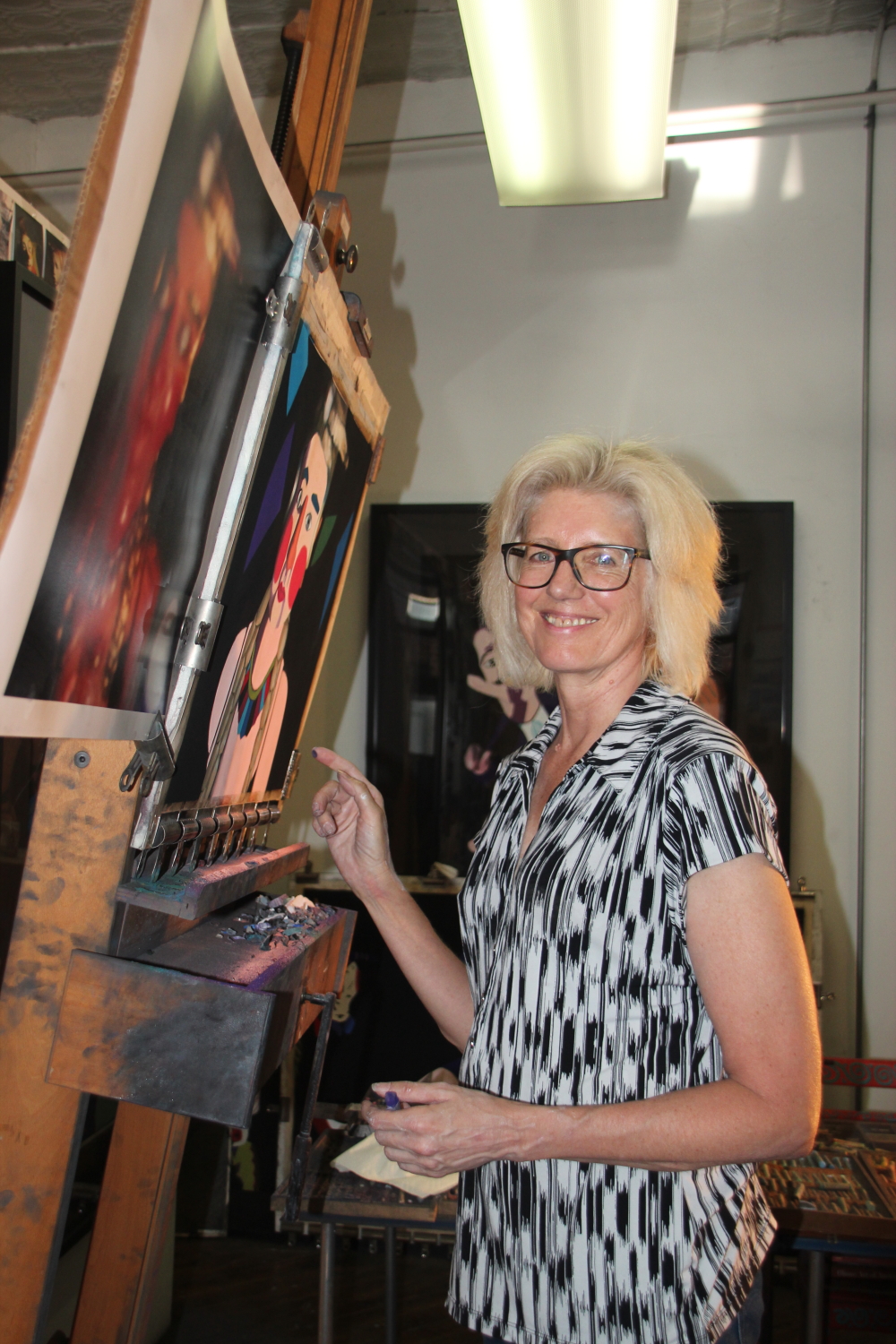
In the studio, Photo: Britta Konau
A: Only if I forget what it took to get me to this point! I remember all too well the long periods of study, hard work, self-doubt, self-nurturing, disappointments, setbacks, risks, focus, drive, discipline, joy, detours, fallow periods, rejections, perseverance, etc. that have gone into sustaining an art career for nearly thirty years. There are no blueprints and few role models for a successful artist’s life. (Even the meaning of “success” as an artist is difficult to define). I invite others, who surely can be more objective, to attempt a summation of my entire body of work in a few words.
Comments are welcome!
Q: How long does it take you to complete a pastel-on-sandpaper painting?
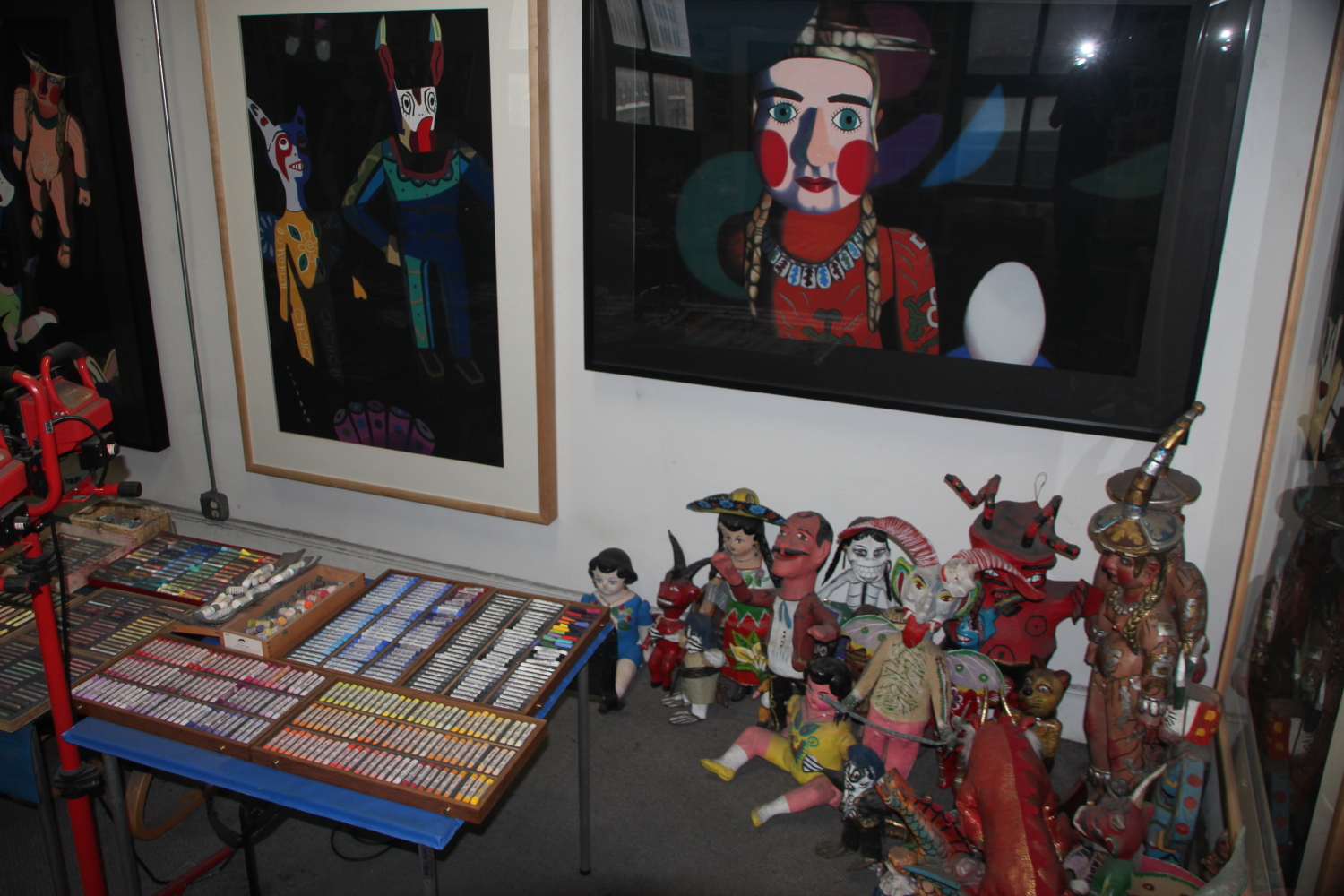
Barbara’s studio
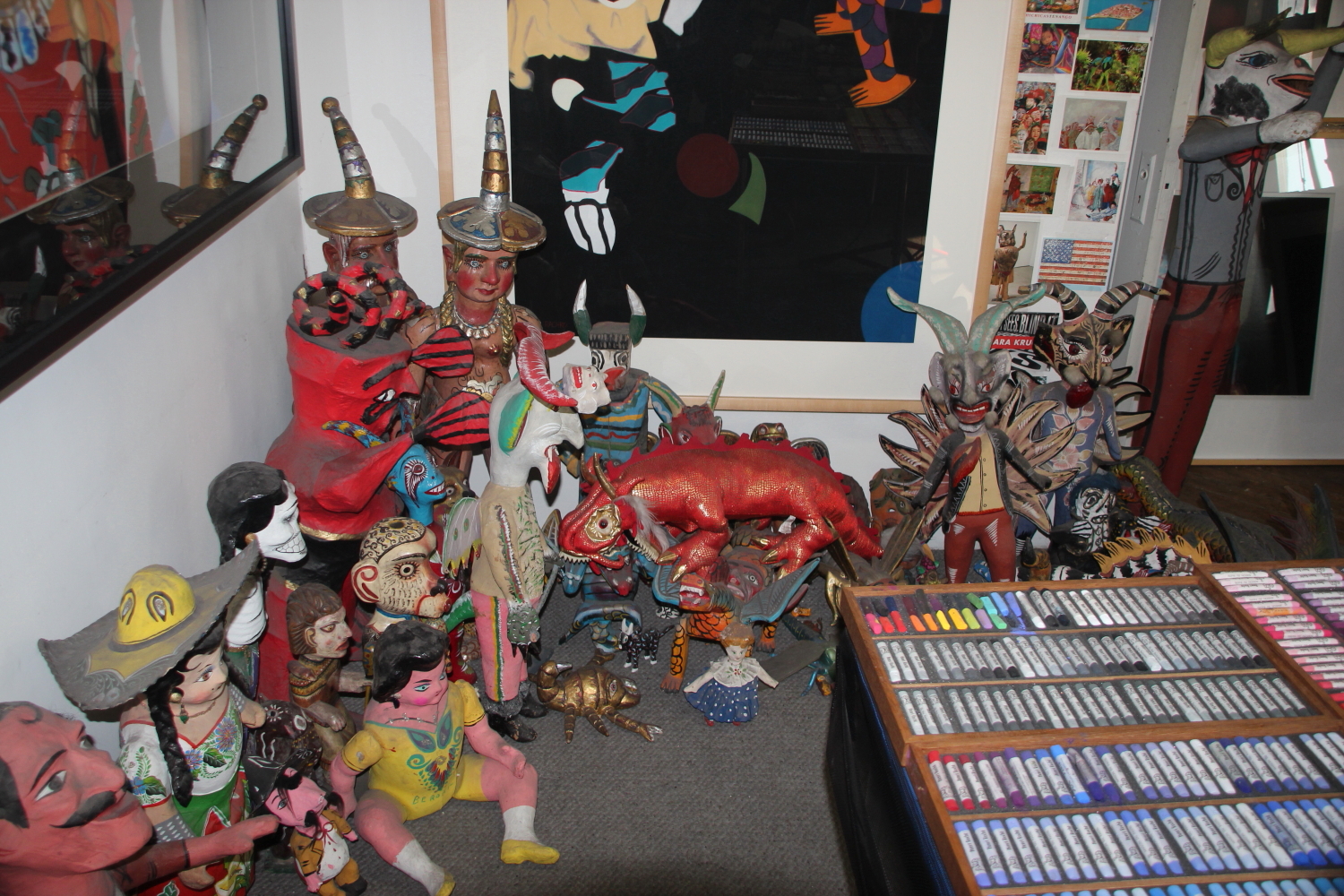
A: Mine is a slow and labor-intensive process. First, there is foreign travel to find the cultural objects – masks, carved wooden animals, paper mâché figures, and toys – that are my subject matter. If they are heavy I ship them home.
Next comes planning exactly how to photograph them, lighting and setting everything up, and shooting a roll of 220 film with my Mamiya 6 camera. I still like to use an analog camera for my fine art work, although I am rethinking this. I have the film developed, decide which image to use, and order a 20” x 24” reference photograph from Manhattan Photo on West 20th Street.
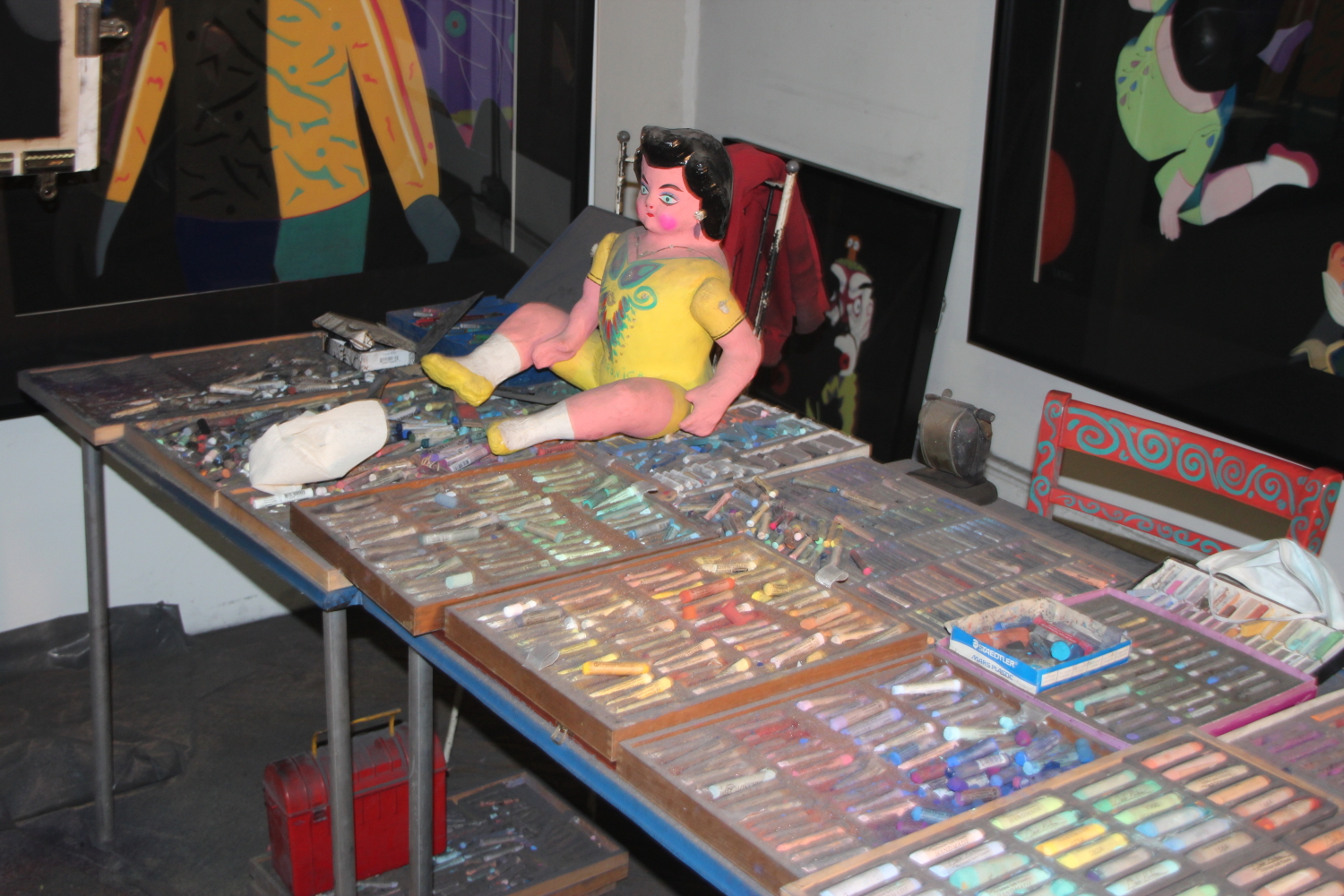
Then I am ready to start. I work on each pastel-on-sandpaper painting for approximately three months. I am in my studio 7 to 8 hours a day, five days a week. During that time I make thousands of creative decisions as I apply and layer soft pastels (I have 8 tables-worth to choose from!), blend them with my fingers, and mix new colors directly on the sandpaper. A finished piece consists of up to 30 layers of soft pastel. My self-invented technique accounts for the vivid, intense color that often leads viewers of my originals to look very closely and ask, “What medium is this?” I believe I am pushing soft pastel to its limits, using it in ways that no other artist has done.
Comments are welcome!
Pearls from artists* # 100
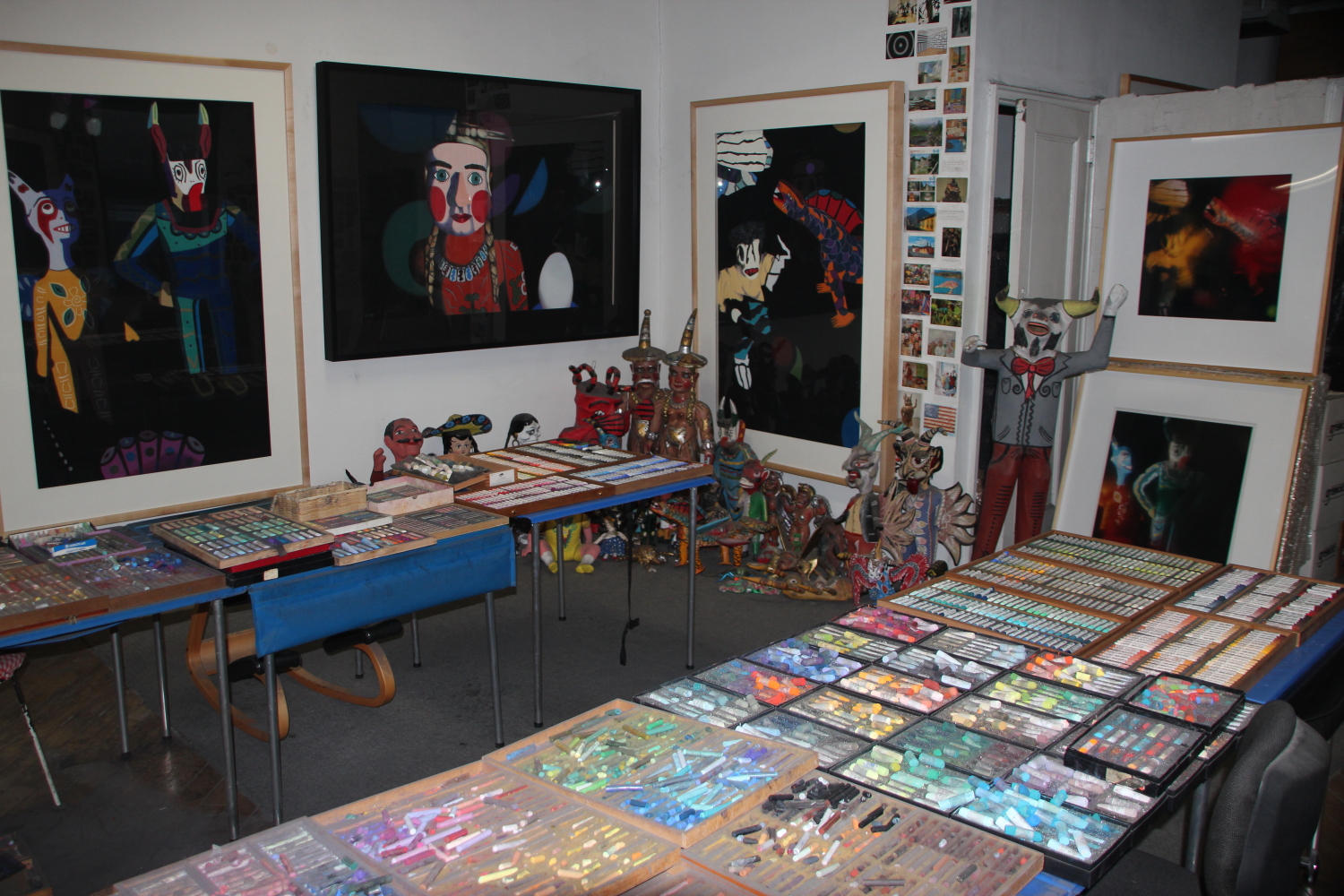
Barbara’s studio
* an ongoing series of quotations – mostly from artists, to artists – that offers wisdom, inspiration, and advice for the sometimes lonely road we are on.
I think it’s terribly important that people have always made structures that are better and more rigorous and more demanding than we as an audience can live up to for every single moment. Serious art should be better than you are. I think my plays are more lucid, more rigorous, than I, Richard, am in my life. I’m a stumble bum like all the rest of us. Create art that is better than you are able to manifest in normal life.
Richard Foreman in Anne Bogart’s Conversations with Anne: Twenty-four Interviews
Comments are welcome!
Pearls from artists* # 99

Barbara’s studio
* an ongoing series of quotations – mostly from artists, to artists – that offers wisdom, inspiration, and advice for the sometimes lonely road we are on.
I think there are two very interesting stages in creative work. One is confusion and one is boredom. They generally both mean that there’s a big fish swimming under the water. As Rilke said, “Live the questions.” And not judge that there’s something wrong about confusion, because the people who are working, say, on the cure for leprosy – they work for years and years in a state of confusion, and very often they don’t find the cure. They find something completely different. But they keep living the question. Confusion is absolutely essential to the creative process. If there was no confusion, why do it? I always feel that all of us have questions we’re asking all our lives, for our work, and if we ever found the answer, we’d stop working. We wouldn’t need to work anymore.
Boredom – if you’ve ever been in therapy, you’d know that when you start getting bored, that’s really important. The therapist sits up; there’s something going on, because the wall that you come against – that’s where the real gold is. It’s really precious.
Andre Gregory (from My Dinner with Andre) in Anne Bogart, Conversations with Anne: Twenty-four Interviews
Comments are welcome!
Q: How long have you been working in your current studio?
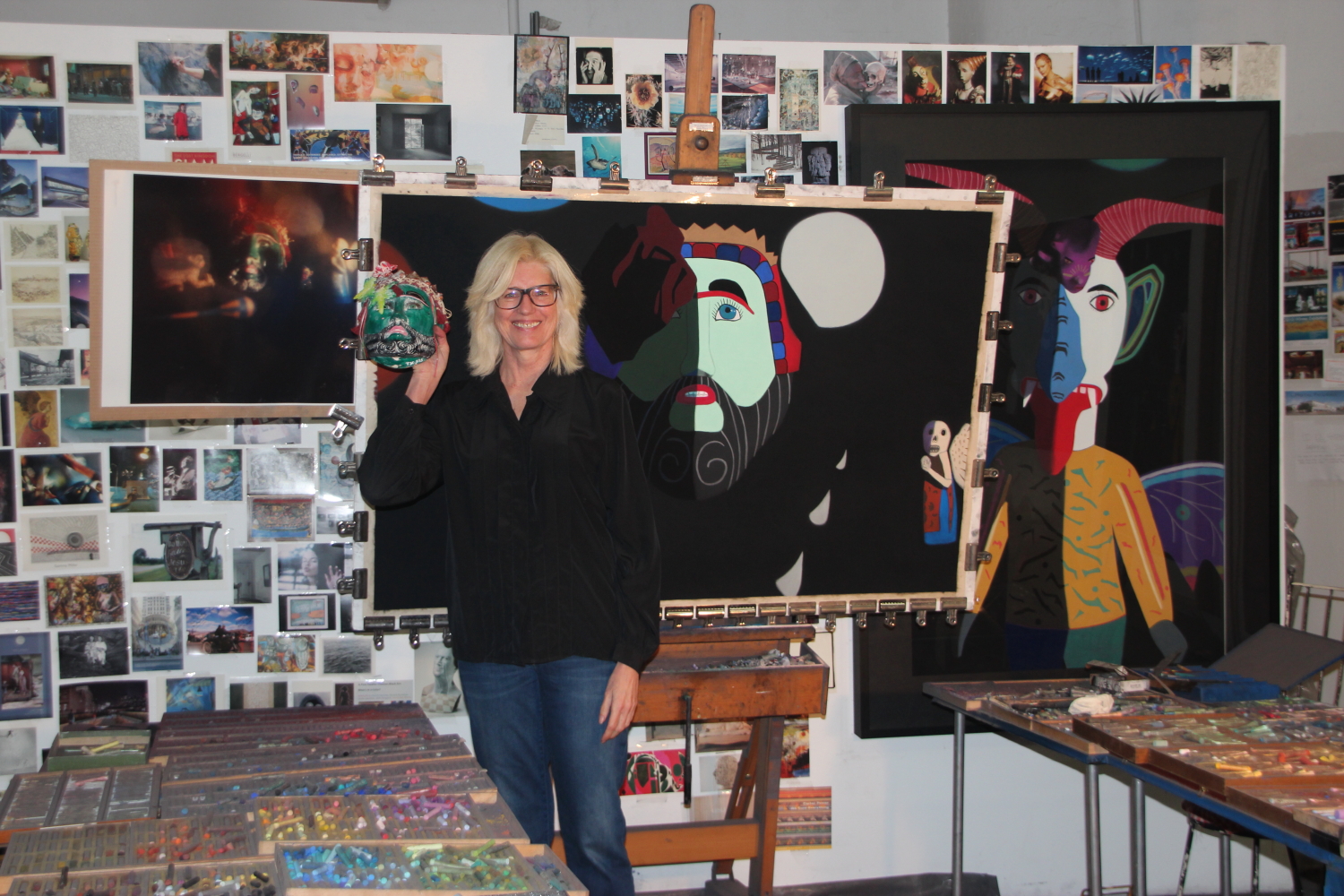
Barbara in her studio; Photo: Elliott Jones
A: I have been in my West 29th Street space for seventeen years, but from the beginning, in the mid-1980’s, I had a studio. My first one was in the spare bedroom of the Alexandria, Virginia, house that I shared with Bryan and that I still own. For about three years in the 1990s I had a studio on the third floor of the Torpedo Factory Art Center, a building in Alexandria that is open to the public. People come in, watch artists work, and occasionally buy a piece of art.
In April 997 an opportunity to move to New York arose and I didn’t look back. By then I was showing in a good 57th Street gallery, Brewster Arts Ltd. (the gallery focused exclusively on Latin American artists; I was thrilled with the company I was in; the only fellow non-Latina represented by owner, Mia Kim, was Leonora Carrington), and I had managed to find a New York agent, Leah Poller, with whom to collaborate. I looked at only one other space before finding my West 29th Street studio. An old friend of Bryan’s from Cal Tech rented the space next door and he had told us it was available. Initially the studio was a sublet. The lease-holder was a painter headed to northern California to work temporarily for George Lucas at the Lucas Ranch. After several years she decided to stay so I was able to take over the lease.
My studio continues to be an oasis in a chaotic city, a place to make art, to read, and to think. I love to walk in the door every morning and always feel more calm the moment I arrive. It’s my absolute favorite place in New York!
Comments are welcome!
Q: How would you define art?

Barbara’s studio
A: At its core all art is communication. I personally believe that without the component of communication, there is no art. The expression of human creative skill and imagination becomes art when it is appreciated for its beauty, complexity, emotional power, evocativeness, etc. A sympathetic and understanding audience is essential.
Why might artists fail to communicate? Perhaps they haven’t mastered their medium sufficiently to elicit a reaction from the viewer. Perhaps the viewer lacks the necessary artistic, cultural, or intellectual background to understand and appreciate what the artist is communicating. Maybe the viewer is distracted or preoccupied and not looking or thinking deeply enough. There are many reasons.
Comments are welcome!
Pearls from artists* # 87
Studio
* an ongoing series of quotations – mostly from artists, to artists – that offers wisdom, inspiration, and advice for the sometimes lonely road we are on.
One evening, after one false start too many, I just gave up. Sitting at a bar, feeling a bit burned out by work and by life in general, I just started drawing on the backs of business cards for no reason. I didn’t really need a reason. I just did it because it was there, because it amused me in a kind of random, arbitrary way.
Of course it was stupid. Of course it was not commercial. Of course it wasn’t going to go anywhere. Of course it was a complete and utter waste of time. But in retrospect, it was this built-in futility that gave it its edge. Because it was the exact opposite of all the “Big Plans” my peers and I were used to making. It was so liberating not to have to think about all of that, for a change.
It was so liberating to be doing something that didn’t have to have some sort of commercial angle, for a change.
It was so liberating to be doing something that didn’t have to impress anybody, for a change.
It was so liberating to be free of ambition, for a change.
It was so liberating to have something that belonged just to me and no one else, for a change.
It was so liberating to feel complete sovereignty, for a change. To feel complete freedom, for a change. To have something that didn’t require somebody else’s money, or somebody else’s approval, for a change.
And of course, it was then, and only then, that the outside world started paying attention.
The sovereignty you have over your work will inspire far more people than the actual content ever will. How your own sovereignty inspires other people to find their own sovereignty, their own sense of freedom and possibility, will give the work far more power than the work’s objective merits ever will.
Your idea doesn’t have to be big. It just has to be yours alone. The more the idea is yours alone, the more freedom you have to do something really amazing.
The more amazing, the more people will click with your idea. The more people click with your idea, the more this little thing of yours will snowball into a big thing.
That’s what doodling on the backs of business cards taught me.
Hugh MacLeod in Ignore Everybody: and 39 Other Keys to Creativity
Comments are welcome!
Pearls from artists* # 85
Studio
* an ongoing series of quotations – mostly from artists, to artists – that offers wisdom, inspiration, and advice for the sometimes lonely road we are on.
Credo
I believe in art.
I do not believe in the “art world” as
it is today.
I do not believe in art as a commodity.
Great art is in exquisite balance. It is
restorative.
I believe in the energy of art, and through
the use of that energy, the artist’s ability
to transform his or her life and, by ex-
ample, the lives of others.
I believe that through our art, and through
the projection of transcendent imagery, we
can mend and heal the planet.
Audrey Flack in Art & Soul: Notes on Creating
Comments are welcome!


 barbararachkoscoloreddust.com
Q: What is the reality of the art world today? Do people experience it enough?
Aug 2
Posted by barbararachkoscoloreddust
West 29th Street studio
A: I cannot comment on the art world today or the experience of other people. I can only speak for myself. I am completely devoted to my work; my entire life revolves around art. When I’m not in my studio creating, I am reading about art, thinking about it, gaining inspiration from other artists and from artistic travel, working out new ideas, going to museum and gallery exhibitions, trying to understand the business side of things, etc. Art is a calling and I personally experience it enough as my work continues to evolve!
Comments are welcome!
Share this:
Posted in 2014, An Artist's Life, Art in general, Black Paintings, Creative Process, Inspiration, New York, NY, Pastel Painting, Photography, Studio, Working methods
2 Comments
Tags: art, art world, artistic, business, calling, comment, completely, continues, creating, devoted, enough, evolve, Exhibitions, experience, gaining, gallery, going, grow, ideas, inspiration, life, museum, people, personally., reading, reality, revolves, speak, Studio, thinking, today, travel, trying, understand, West 29th Street, work, working