Blog Archives
Q: Would you please share your current bio?

A: Here it is.
Barbara Rachko, born in 1953 in Paterson, New Jersey, is a contemporary painter based in New York City, renowned for her large pastel-on-sandpaper paintings inspired by Bolivian Carnival masks. With nearly 40 years dedicated to revolutionizing pastel as a fine art medium, Rachko’s influential blog, Barbara Rachko’s Colored Dust, has garnered over 229,000 subscribers. She is the subject of the acclaimed documentary “Barbara Rachko: True Grit,” available on YouTube, and her ebook “From Pilot to Painter” captures her inspiring journey from a former pilot to an accomplished artist.
Rachko’s work explores the vibrant cultural heritage of Bolivian Carnival masks, and Mexican and Guatemalan folk art. Her meticulous attention to detail is showcased in notable series such as Bolivianos, Black Paintings, and Domestic Threats. In 2023, she was featured in a documentary that premiered at the Newport Beach Film Festival, earning the Audience Award and Best in Category Award, further cementing her impact on contemporary art.
Her solo exhibitions include the Joy Pratt Markham Gallery at Walton Arts Center (AR), Louise Jones Brown Gallery at Duke University (NC), Olin Gallery (VA), and La MaMa La Galleria (NY). She trained in photography at the International Center of Photography in New York and studied drawing and pastel techniques at the Art League School in Alexandria, VA. Her works are held in private collections worldwide and have been showcased at prestigious art fairs, including Art Basel Miami, Moon Art Fair in Hamburg, and Art Busan in Korea, affirming her global influence in pastel painting.
Comments are welcome!
Pearls from artists* # 679
*an ongoing series of quotations – mostly from artists, to artists – that offers wisdom, inspiration, and advice for the sometimes lonely road we are on.
PC: In your painting, you’ve always kept this speed of movement. One senses that you work something out slowly, deep down, that it’s hard work, but there’s always something fresh about its expression
HM: That’s because I revise my notion several times over. People often add or superimpose completing things without changing their plan, whereas I rework my plan every time. I always start again, working from the previous state. I try to work in a contemplative state, which is very difficult: contemplation is inaction and I act in contemplation.
In all the studies I’ve made from my own ideas, there’s never been a faux pas because I’ve always unconsciously had a feeling for the goal; I’ve made my way toward it the way one heads north, following the compass. What I’ve done, I’ve done by instinct, always with my sights on a goal I still hope to reach today. I’ve completed my apprenticeship now. All I ask is four or five years to realize the goal.
PC: Delacroix said that too. Great artists never look back.
HM: Delacroix also said – ten years after he’d left the place – “I’m just beginning to see Morocco.” He needed the perspective. Rodin said to an artist, “You need to stand back a long way for sculpture.” To which the student replied, “Master, my studio is only ten meters wide.”
Chatting With Henri Matisse: The Lost 1941 Interview, Henri Matisse with Pierre Courthion, edited by Serge Guilbaut
Comments are welcome!
Q: What would you be if you were not an artist?

The studio with pastel paintings in progress!
A: I honestly have no idea, but whatever it might be, there is a good chance that I’d be bored! In my younger days boredom was a strong motivator. I left the active duty Navy out of boredom. I couldn’t bear not being intellectually challenged (most of my jobs consisted of paper-pushing), not using my flying skills (at 27 I was a licensed commercial pilot and Boeing 727 flight engineer), and not developing my artistic talent. In what surely must be a first, by spending a lot of time and money training me for jobs I hated, the Navy turned me into a hard-working artist! And once I left the Navy there was no plan B. There was no time to waste. It was “full speed ahead.”
Art is a calling. You do not need to be told this if you are among those who are called. It’s all about “the work,” that all-consuming focus of an artist’s life. If a particular activity doesn’t make you a better artist, you avoid it. You work hard to nourish and protect your gifts. As artists we invent our own tasks, learn whatever we need in order to progress, and complete projects in our own time. It is life lived at its freest.
My art-making has led me to fascinating places: Mexico, Guatemala, Brazil, Chile, Easter island, Argentina, Uruguay, France, England, Italy, Bali, Java, India, Bhutan, and more; and to in-depth studies of intriguing subjects: drawing, color, composition, art and art history, the art business, film and film history, photography, mythology, literature, music, jazz history, and archaeology, particularly that of ancient Mesoamerica (the Olmec, Zapotec, Mixtec, Aztec, Maya, etc.). And this rich mixture continually grows! For anyone wanting to spend their time on earth learning and meeting new challenges, there is no better life than that of an artist.
I SO agree with this exchange that I read years ago between between Trisha Brown and Mikhail Baryshnikov in the New York Times. I wrote it on a piece of paper and taped it to my studio wall:
Trisha: How do you think we keep going? Are we obsessed?
Mikhail: We do it because there’s nothing better. I’m serious. Because there is nothing more exciting than that. Life is so boring, that’s why we are driven to the mystery of creation.
Comments are welcome.
Pearls from artists* # 677

Barbara’s Studio
*an ongoing series of quotations – mostly from artists, to artists – that offers wisdom, inspiration, and advice for the sometimes lonely road we are on.
… in Japan, in the native Shinto religion of the land, where the rites are extremely stately, musical, and imposing, no attempt has been made to reduce their “affect images” to words. They have been left to speak for themselves – as rites, as works of art – through the eyes to the listening heart. And that, I would say, is what we, in our own religious rites, had best be doing, too. Ask an artist what his picture “means,” and you will not soon ask such a question again. Significant images render insights beyond speech, beyond the kinds of meaning speech defines. And if they do not speak to you, that is because you are not ready for them, and words will only serve to make you think you have understood, thus cutting you off altogether. You don’t ask what a dance means, you enjoy it. You don’t ask what the world means, you enjoy it. You don’t ask what you mean, you enjoy yourself; or at least, so you do when you are up to snuff.
Joseph Campbell in Myths to Live By
Comments are welcome!
Pearls from artists* # 676
In the Studio
*an ongoing series of quotations – mostly from artists, to artists – that offers wisdom, inspiration, and advice for the sometimes lonely road we are on.
Henry James once said, ‘The great thing […] the sense of having done the best […] the sense which is the real life of the artist and the absence of which is his death, is having drawn from his own instrument the finest music that nature had hidden in it, of having played it as it should be played. He either does that or he doesn’t […]. and if he doesn’t he isn’t worth speaking of.
Kate Kretz in Art From Your core: A Holistic Guide to Visual Voice
Comments are welcome!
Pearls from artists* # 672

Barbara’s Studio
*an ongoing series of quotations – mostly from artists, to artists – that offers wisdom, inspiration, and advice for the sometimes lonely road we are on.
Beware of first impressions; try to have more presence of mind.
You should not be deceived by the eager promises of your best friends, by offers of help from influential people, or by the interest which men of talent seem to take in you, into thinking that there is anything real in what they say – real in the way of results, I mean. Many people are full of good intentions when they speak, but their eagerness subsides appreciably when it comes to action, like blusterers, or people who make angry scenes […]. And you, yourself, try to be more cautious in the way you welcome people, and above all, avoid these ridiculous attentions; they’re only offered on the impulse of the moment.
Cultivate a well-ordered mind, it’s your only road to happiness; and to reach it, be orderly in everything, even in the smallest details.
The Journal of Eugène Delacroix, edited by Hubert Wellington
Comments are welcome!
Pearls from artists* # 670

*an ongoing series of quotations – mostly from artists, to artists – that offers wisdom, inspiration, and advice for the sometimes lonely road we are on.
I’ve had to keep defining and defending myself as a writer every single day of my adult life – constantly reminding and re-reminding my soul and the cosmos that I’m very serious about the business of creative living, and that I will never stop creating, no matter what the outcome, and no matter how deep my anxieties and insecurities may be.
Over time I’ve found the right tone of voice for these assertions, too. It’s best to be insistent, but affable. Repeat yourself, but don’t get shrill. Speak to your darkest and most negative interior voices the way a hostage negotiator speaks to a violent psychopath: calmly, but firmly. Most of all, never back down. You cannot afford to back down. The life you are negotiating to save, after all, is your own.
Elizabeth Gilbert in Big Magic: Creative Living Beyond Fear
Comments are welcome!
Q: Why do you have so many pastels?

Barbara’s Studio
A: Our eyes can see infinitely more colors than the relative few that are made into pastels. When I layer pigments onto the sandpaper substrate, I mix new colors directly on the paper. The short answer is, I need lots of pastels so that I can make new colors.
I have been working exclusively with soft pastel for 40 years. Whenever I feel myself getting into a rut in how I select and use my colors, I look around for new materials to try. Fortunately, new brands of soft pastels are continually coming onto the market. There are pastels that are handmade by artists – I love discovering these – and new colors manufactured by well-known pastel companies. Some sticks of soft pastel are oily, some are buttery, some more powdery, some crumble easily, some are more durable. Each one feels distinct in my hand.
Furthermore, they each have unique mixing properties. It’s an under-appreciated science that I stumbled upon (or maybe I invented it, I’m not sure since I cannot know how other pastel painters work). In this respect soft pastel is very different from other paint media. Oil painters, for example, need only a few tubes of paint to make any color in the world. I don’t go in much for studying color theory as a formal discipline. If you want to really understand and learn how to use color, try soft pastel and spend 10,000+ hours (the amount of time Malcolm Gladwell says, in his book, “Outliers,” that it takes to master a skill) figuring it all out for yourself!
Comments are welcome.
Q: Do you have any rituals that you do in the mornings before you begin working?

Art From Your Core by Kate Kretz
A: When I arrive at the studio in the morning it’s rare for me to immediately start working. Usually I read something art-related. At the moment I’m rereading Art From Your Core: A Holistic Guide to Visual Voice by Kate Kretz. This is a fabulous book for visual artists. It is a must-read and has become my current art bible! As usual I am struggling to understand aspects of the art business and figure out what’s next to get my work appreciated and collected by a new audience. Art From Your Core reminds why I decided to make art in the first place and what I need to do to continue to improve. It helps reconnect with forgotten parts of myself and is a much-needed reminder of what I love most about being an artist.
Balancing the creative and business aspects of my art practice is an ongoing struggle. I imagine this is true for most artists. Both jobs are so important. An artist needs an appreciative audience – very few artists devote their lives to art-making so that the work will remain in a closet – but I also believe this (from a note hand-written years ago that I tacked to the studio wall): “Just make the work. None of the rest matters.”
Comments are welcome.


 barbararachkoscoloreddust.com
Pearls from artists* # 673
Oct 22
Posted by barbararachkoscoloreddust
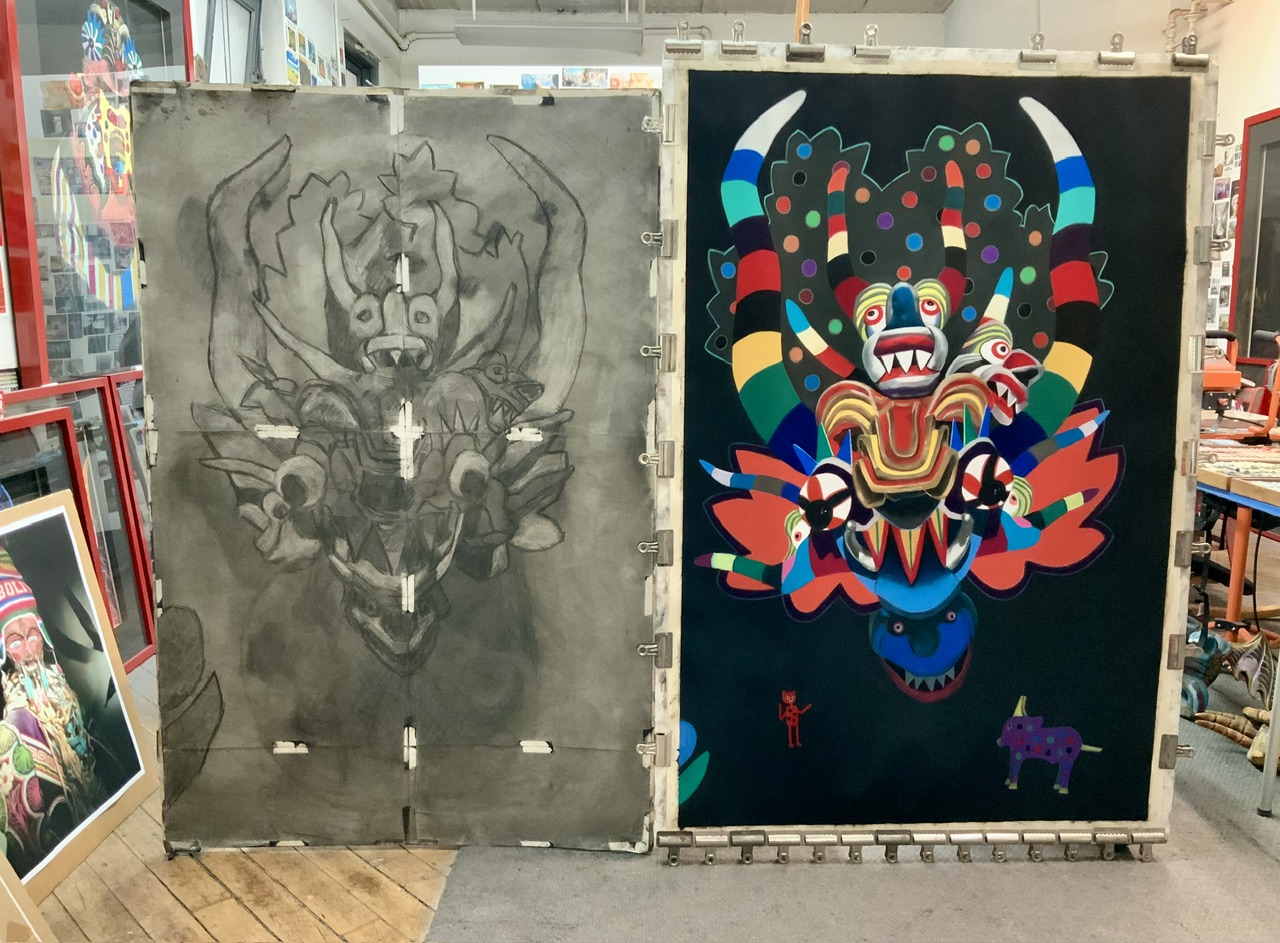
Barbara’s Studio
*an ongoing series of quotations – mostly from artists, to artists – that offers wisdom, inspiration, and advice for the sometimes lonely road we are on.
You may occasionally have the opportunity to publicly comment about the work, which helps to shape its life, but others will also interpret, criticize, and project their own agendas onto it. You must learn to be ok with that. You cannot follow your art around, explaining it and defending it. Once released, the life of your work depends on all sorts of factors completely out of your control. Separating your ego and self-worth from what you produce can be challenging, but it is essential. It protects your vital studio activity from the damaging effects of the outside world. Letting go of the old work also frees you up to move forward and focus on the next great idea.
Kate Kretz in Art From Your Core: A Holistic Guide to Visual Voice
Comments are welcome!
Share this:
Posted in 2025, An Artist's Life, Inspiration, Pearls from Artists, Quotes, Studio
Comments Off on Pearls from artists* # 673
Tags: activity, agendas, around, ”Art From Your Core: A Holistic Guide to Visual Voice”, challenging, comment, completely, control, criticize, damaging, defending, depends, effects, essential, explaining, factors, follow, forward, interpret, Kate Kretz, letting, occasionally, opportunity, others, outside, produce, project, protects, released, self-worth, separating, Studio