Blog Archives
Q: Why do you make art?

Barbara’s studio
A: This is an excellent question and one I like to revisit because with all the day-to-day frustrations and disappointments that are a normal part of an artist’s life, it is easy to forget what is important.
First, I make art because I have a gift and a desire to share it with others. To not develop, express, and share all that I have to say through my work is unthinkable.
Second, I make art because it is what gives my life direction and purpose. I believe that each human being has his or her own quest, driven by passion, to fulfill a certain duty. Recall Joseph Campbell’s, “The Hero’s Journey.” I need to make art in order to feel that I am living up to my highest potential.
Third, for inexplicable reasons (to me, anyway) soft pastel is an undervalued medium. I fell in love with pastel above all other media and hope to demonstrate that great art can be created with it. This is one of the drives that keeps me steadily working.
Comments are welcome!
Q: How do you know when a series has ended?

“A Promise, Meant to be Broken,” soft pastel on sandpaper, 58″ x 38″
A: I suppose it’s when there is nothing left to say within a particular body of work. The urgency to add something I haven’t tried vanishes. Usually I can’t even think of anything I haven’t tried.
I knew with certainty that the “Domestic Threats” series was finished while “A Promise Meant to be Broken” was still on my easel. It’s no accident that I included a self-portrait. This painting was my way of saying good-bye to an important body of work – literally turning my back on it – and summing up where the work had taken me.
For artists each series is a creative journey with a beginning, a middle, and an end. At a certain point it’s over. Then you build on what you’ve accomplished and move on to create something new. The connection between new work and old may not always be obvious, but one thing is certain: all the previous work laid the groundwork for what you make today.
Comments are welcome!
Pearls from artists* # 137

“She Embraced It and Grew Stronger,” soft pastel on sandpaper, 58″ x 38″
* an ongoing series of quotations – mostly from artists, to artists – that offers wisdom, inspiration, and advice for the sometimes lonely road we are on.
I was a determined young woman. I was driven. My problem was not in being an artist. I didn’t realize how much my being a woman would get in the way of being an artist in the world. I wasn’t aware of it. I was just doing my thing. My pain came from being treated like I was a bad woman, in my personal life. That being driven and assertive and doing my vision was really bad because I was not a supporter and a nurturer of men. The men were the ones who made me feel bad. It could just be that they were not strong men. It was very painful and the way that I took it was as if there was something the matter with me. Yet, there was no way I was not going to pursue my vision. It was not negotiable.
Conversations with Meredith Monk by Bonnie Marranca
Comments are welcome!
Pearls from artists* # 134

“Bryan,” soft pastel on sandpaper, 22″ x 28″, 1988
* an ongoing series of quotations – mostly from artists, to artists – that offers wisdom, inspiration, and advice for the sometimes lonely road we are on.
You never want to forget your roots. Going back to your roots is very important so you don’t get carried away from something essential. Otherwise, you move farther and farther away from the hands-on approach to making art. It is very important to go back to the beginnings at all times. You spiral back.
Conversations with Meredith Monk by Bonnie Marranca
Comments are welcome!
Q: How do you achieve such richness of color in your pastel-on-sandpaper paintings?
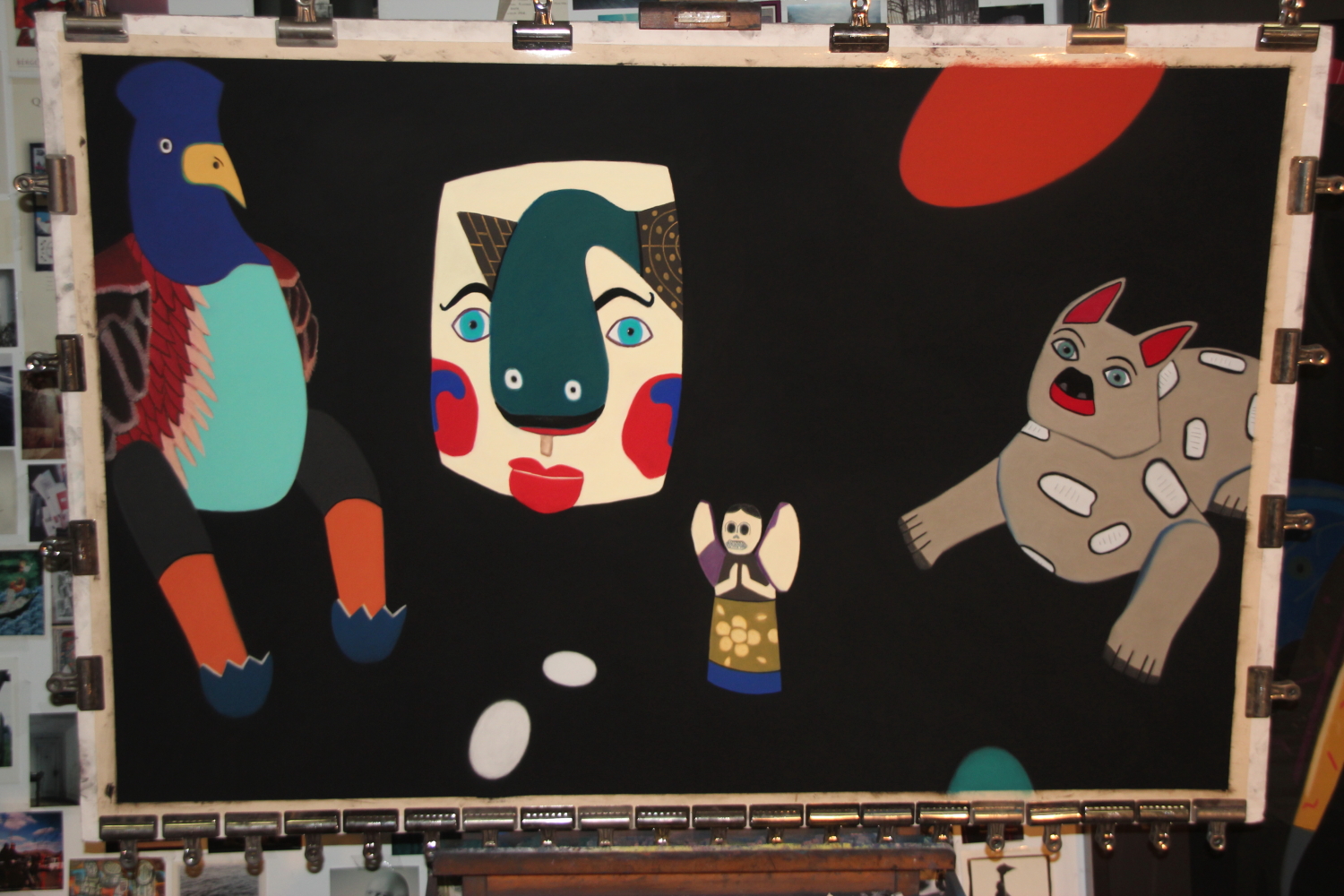
“Motley,” soft pastel on sandpaper, 38″ x 58″
A: This results from the several months of studio time and many layers of soft pastel that go into creating each painting. In a sense my technique is analogous to glazing done by the Old Masters. They slowly built up layers of thin paint to achieve a high degree of finish. Colors were not mixed physically, but optically. I gradually build up layers of soft pastel, as many as 30, to create a pastel painting. After a color is applied, I blend it with my fingers and push it into the sandpaper’s tooth. It mixes with the color beneath to create a new color, continually adding richness, saturation, and intensity to the overall painting.
Comments are welcome!
Q: You have written about how you came to your current subject matter, but what led you away from photorealism to work that while not exactly abstract, leans more in that direction?
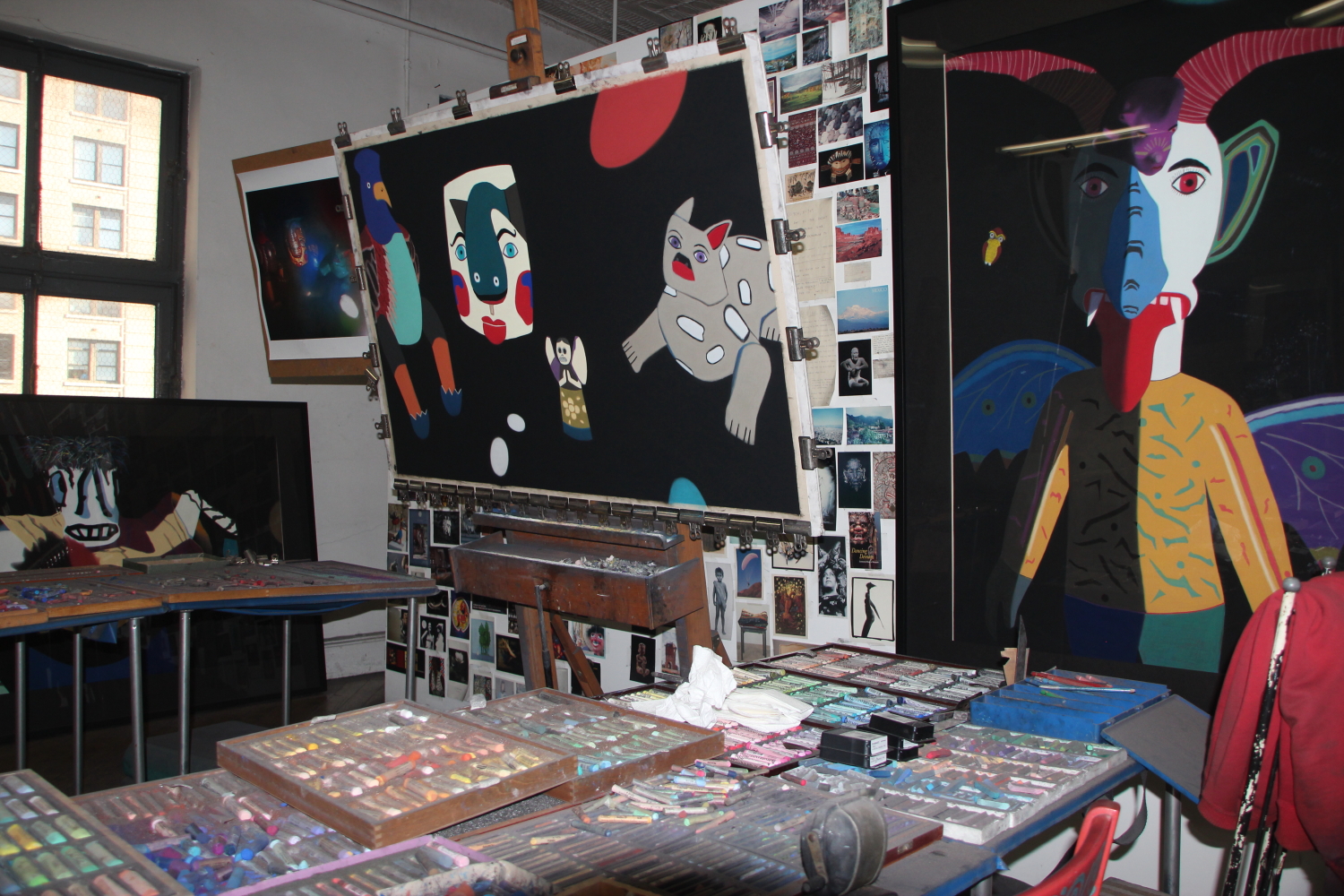
Barbara’s studio
A: Once I had achieved a high degree of technical facility with soft pastel, there was not much more to be gained from copying reality. Cameras do an excellent job of that so what would be the point?
Ultimately, all art lies in following an experience through to the end. Art is in the choices one makes. A visual artist’s private decisions about what to include and what to leave out become her unique inimitable style. Years ago I made a conscious decision to abandon photorealism. Since then I have been on a journey to work more from imagination and direct experience and less from physical reality.
It’s funny. I have always worked from photographs. Because I have a strong work ethic and substantial technical skill, I often feel like a slacker if I do not put in all the details that I see in the reference photo. That’s why the journey has been so slow, I think, as I convince myself it’s really ok to omit more and more details.
Comments are welcome!
Q: You took classes at The Art League School in Alexandria, VA in the late eighties studying intensely with Lisa Semerad and Diane Tesler. How have these experiences impacted on the way you currently produce your artworks? By the way, I sometimes wonder if a certain kind of formal training in artistic disciplines could even stifle a young artist’s creativity. What do you think?
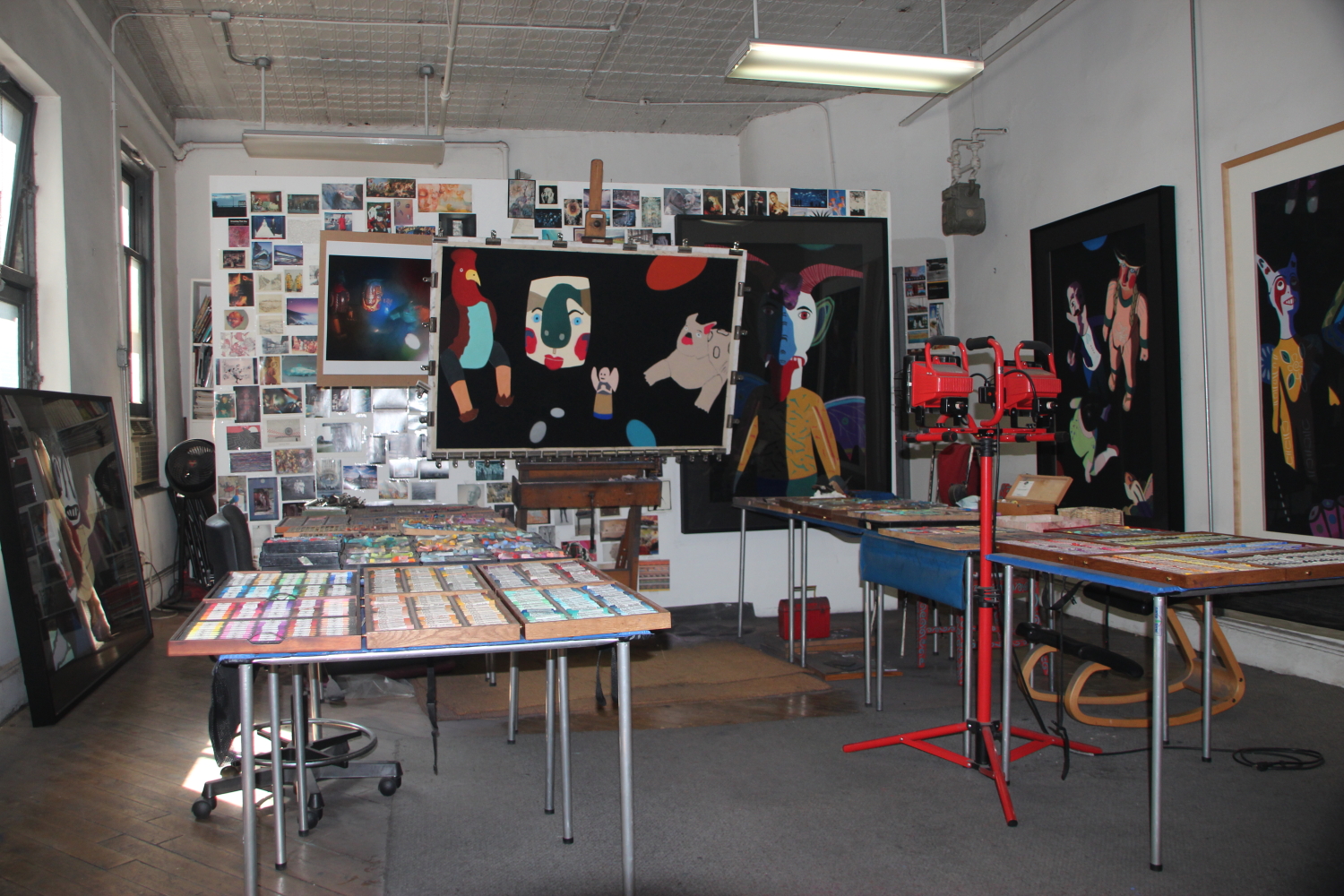
Barbara’s studio
A: From studying with Lisa and Diane I gained an excellent technical foundation and developed my ability to draw and depict just about anything in soft pastel. They were both extremely effective teachers and I worked hard in their classes. I probably got my work ethic from them. Without Diane and Lisa I doubt I would have gained the necessary skills nor the confidence to move to New York to pursue my art career.
Needless to say, I believe developing excellent technical skills is paramount. Artists can, and should, go ahead and break the rules later, but they won’t be able to make strong work, expressing what they want, without a firm foundation. Once you have the skills, you can focus on the things that really make your work come alive and speak to an appreciative audience.
Comments are welcome!
Q: How did you prepare yourself to change careers and work as a professional artist?
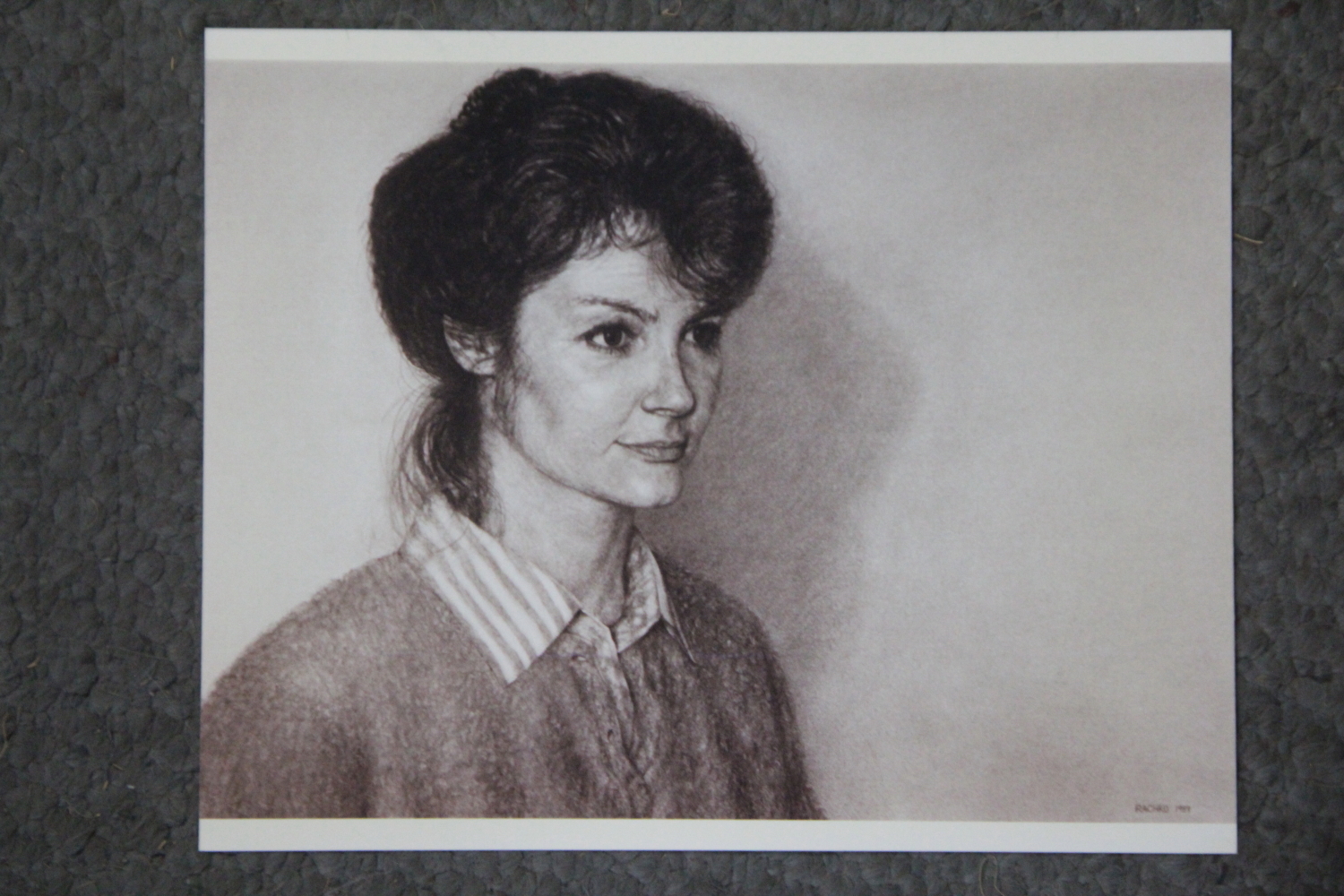
“Krystyn,” charcoal, 22″ x 30″, 1989
A: At the age of 33 I was a Lieutenant in the Navy, working as computer analyst at the Pentagon. I was very unhappy with my job. I began looking for something else to do and discovered The Art League School in Alexandria, VA. I enrolled in classes with Lisa Semerad, then spent the next two years developing my drawing skills using black and white media (charcoal, pencils, conte crayon, etc.).
After that I moved on to color media and began studying soft pastel with Diane Tesler. During this time I was still in the Navy, working the midnight shift at the Pentagon and taking art classes during the day. I was a very motivated student.
After three years or so I was getting quite proficient as an artist, entering local juried shows, winning prizes, garnering press coverage, etc. Prior to my career change, I worked hard to develop my portrait skills. I really didn’t know how I could make a living other than by making commissioned portraits. I volunteered to run a weekly life drawing class at The Art League School in Alexandria, VA, where I made hundreds of figure drawings using charcoal.
I spent a semester commuting between Washington, DC and New York to study artistic anatomy at the New York Academy of Art. I spent another semester studying gross anatomy with medical students at Georgetown University Medical School. Over time I became skilled at making photo-realistic portraits. In 1989 I resigned from the Navy and have worked full-time as a visual artist ever since.
Comments are welcome!
Q: Where do you want your work to go in the future?
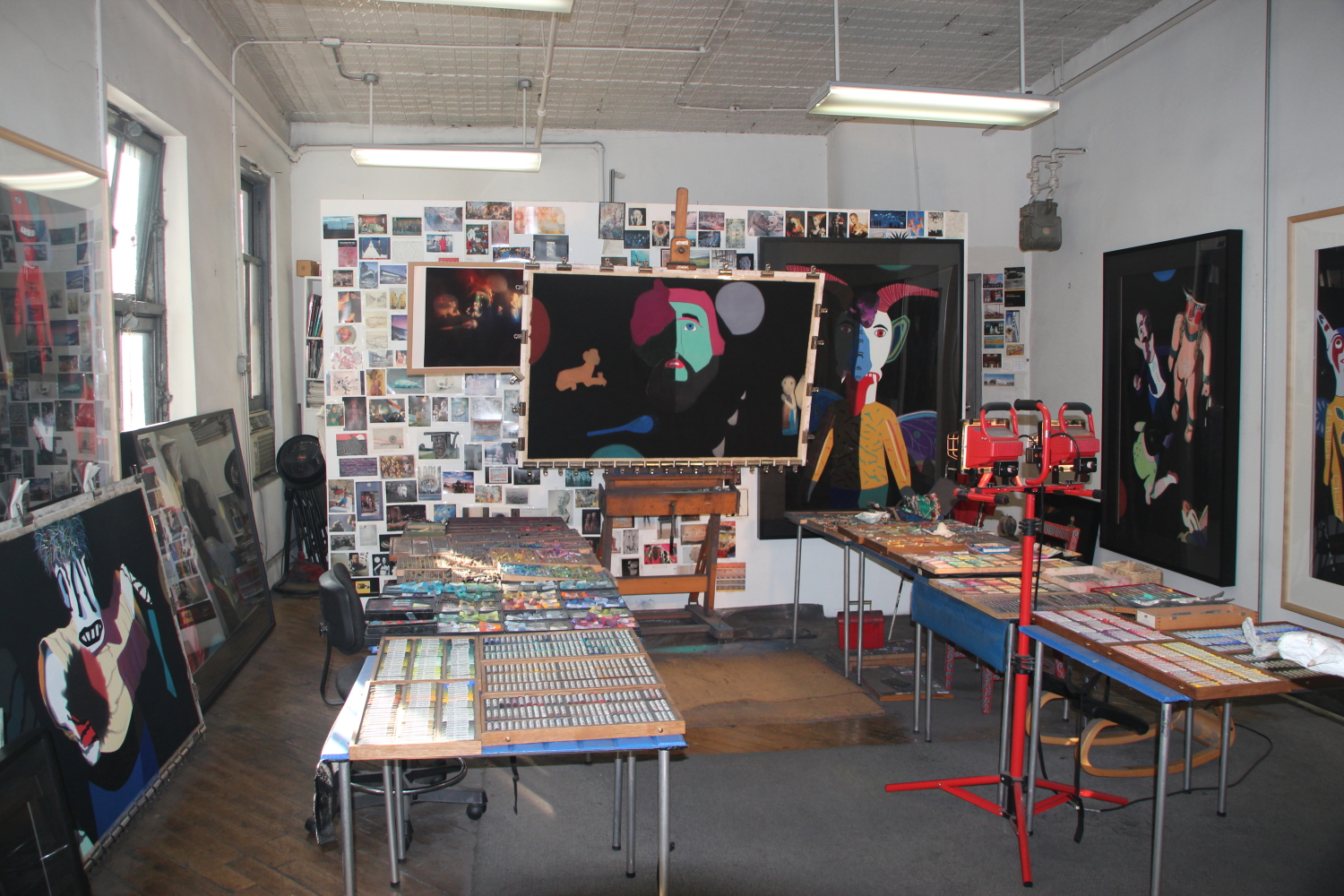
Barbara’s studio
A: Recently I answered a question about why I create, but now that I think about it, the same answer applies to what I want to do as an artist in the future:
~ to create bold and vibrant pastel paintings and photographs that have never existed before
~ to continue to push my primary medium – soft pastel on sandpaper – as far as I can and to use it in more innovative ways
~ to create opportunities for artistic dialogue with people who understand and value the work to which I am devoting my life
The last has always been the toughest. I sometimes think of myself as Sisyphus because expanding the audience for my art is an ongoing uphill battle. Many artist friends tell me they feel the same way about building their audience. It’s one of the most difficult tasks that we have to do as artists. I heard Annie Leibovitz interviewed on the radio once and remember her saying that after 40 years as a photographer, everything just gets richer. Notice that she didn’t say it gets any easier; she said, “it just gets richer.” I have been a painter for nearly 30 years and a photographer for 11. I agree completely. All artists have to go wherever our work goes. Creating art and watching the process evolve is an endlessly fascinating intellectual journey. I wouldn’t want to be spending my time on earth doing anything else!
Comments are welcome!
Q: What impact do you hope to have on viewers of your work?
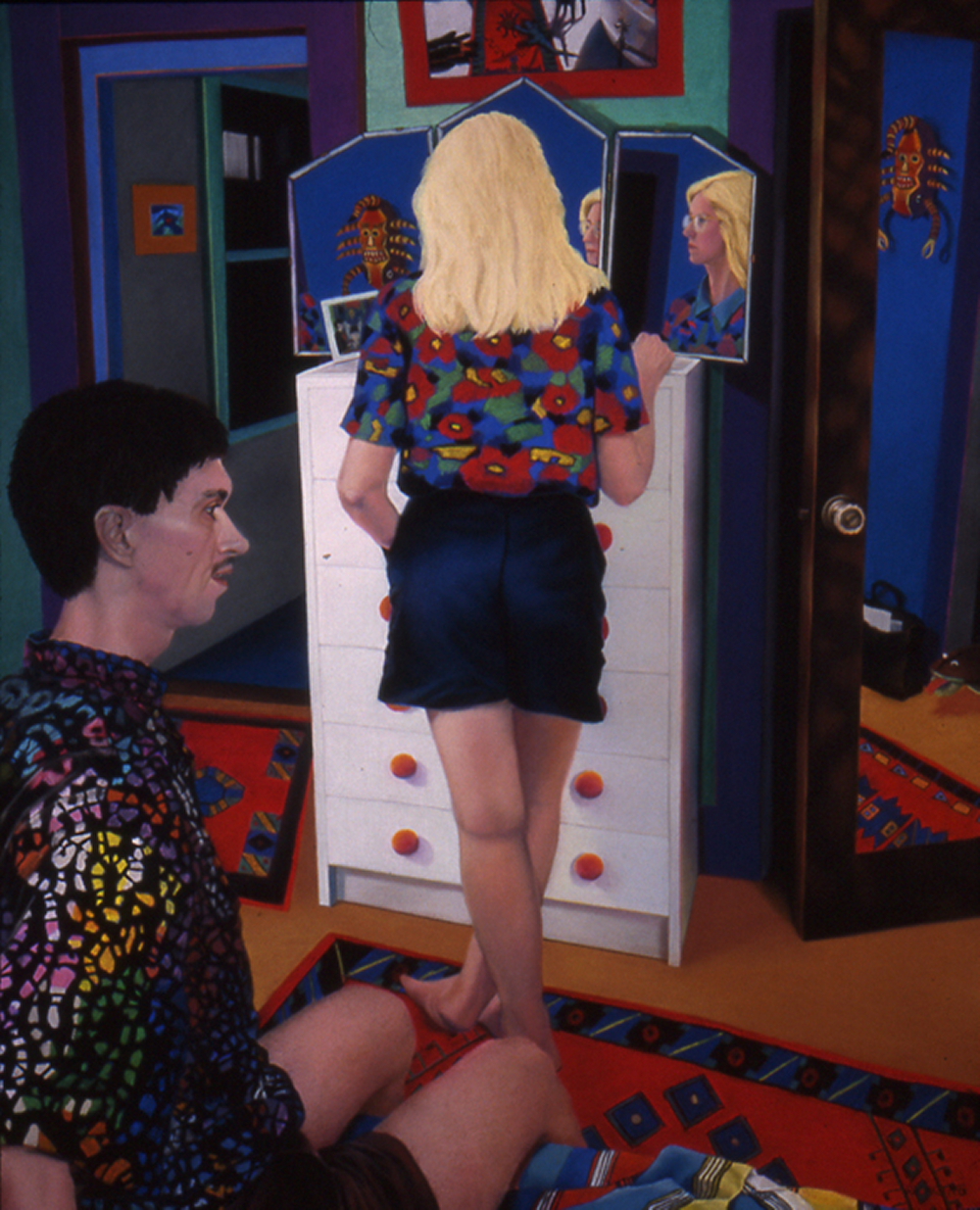
“Us and Them,” soft pastel on sandpaper, 47″ x 38″, 1993
A: I am pushing soft pastel to its limits, using it in ways that no artist has done before. I want people to see what is possible to accomplish with this medium. Because I have experienced unspeakable heartache – the loss of my husband on 9/11, onboard the high-jacked airplane that crashed into the Pentagon – when viewers learn about my life story, I hope to serve as an inspiration to keep forging ahead regardless of what tragedies life may bring. These are the main reasons that I wrote my eBook.
Comments are welcome!


 barbararachkoscoloreddust.com