Blog Archives
In celebration of the 13th anniversary of my blog three days from now, I am republishing the very first post from July 15, 2012. Q: What does it take to be an artist, especially one living and working in New York?
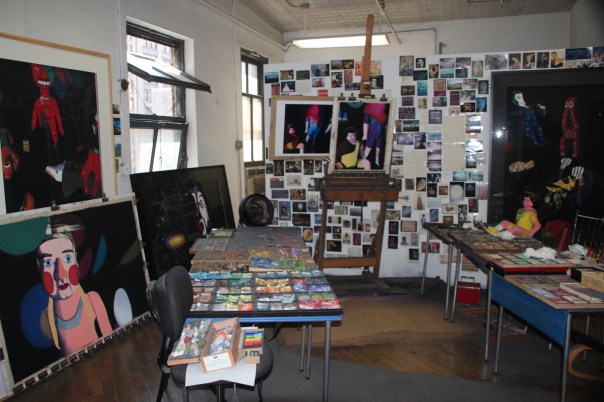
Barbara’s Studio (in 2012) with works in progress.
A: The three Big P’s – Patience, Persistence, and Passion. Without all three you will not have the stamina to work tirelessly for very little external reward. You can expect help from no one.
There are so many obstacles to art-making and countless reasons to just give up. When you really think about it, it’s amazing that great art gets made at all. So why do we do it? Above all it’s about making our time on earth matter, about devotion to our innate gifts and love of our hard-fought creative process.
And, my God, it even gets harder as we get older! So what do we do? We dig in that much deeper. It’s a most noble and sacred calling – you know when you have it – and that’s what separates those of us who are in it for the long haul from the wimps, fakers, and hangers-on. I say to my fellow artists who continue to work despite the endless challenges, we are all true heroes!
These words still ring true and it’s good, even for me, to occasionally be reminded.
Most importantly, THANK YOU to my 222,000+ subscribers for taking this journey with me. When I began this blog in 2012, I had no idea it would prove to be so popular… WOW!
Comments are welcome!
Q: Is there anything you wish you could change about life as a visual artist?

Barbara’s Studio
A: While there is much to admire and maybe even envy about being an artist, it does have some downsides. Among these, for me, is that enormous amounts of solitude are required to create art. I wish this were not the case.
Our work is entirely unique and because it starts as an idea in our heads, we must work solo to bring it into the world. We spend our days pondering, looking, and reacting, rather than speaking to anyone. As typical workdays go, it is rather odd.
I sometimes envy filmmakers who require collaboration with a large team of experts in order to practice their art. They have fellow professionals with whom they can discuss their ideas and they can solicit advice on how to make improvements. Artists rarely have this luxury.
On the other hand, visual artists don’t have to wait for anyone else to do their jobs before we can get to work. We don’t have to deal with personality conflicts or other people’s agendas. Our individual creative process is generally free of obstacles created by others. When you really think about it, the only thing that is required of an artist is to go to the studio and get to work! We are free to make our own rules and our own schedules, and, creatively speaking, are largely responsible for our own advances and setbacks.
Comments are welcome!
Q: Why art? (Question from “Arts Illustrated”)

A: I love this question! I remember being impressed by Ursula von Rydingsvard’s exhibition at the National Museum of Women in the Arts a few years ago. What stayed with me most was her wall text, “Why Do I Make Art by Ursula von Rydingsvard.” There she listed two dozen benefits that art-making has brought to her life.
I want to share some of my own personal reasons for art-making here, in no particular order. My list keeps changing, but these are true at least for today.
1. Because I love the entire years-long creative process – from foreign travel whereby I discover new source material, to deciding what I will make, to the months spent in the studio realizing my ideas, to packing up my newest pastel painting and bringing it to my Virginia framer’s shop, to seeing the framed piece hanging on a collector’s wall, to staying in touch with collectors over the years and learning how their relationship to the work changes.
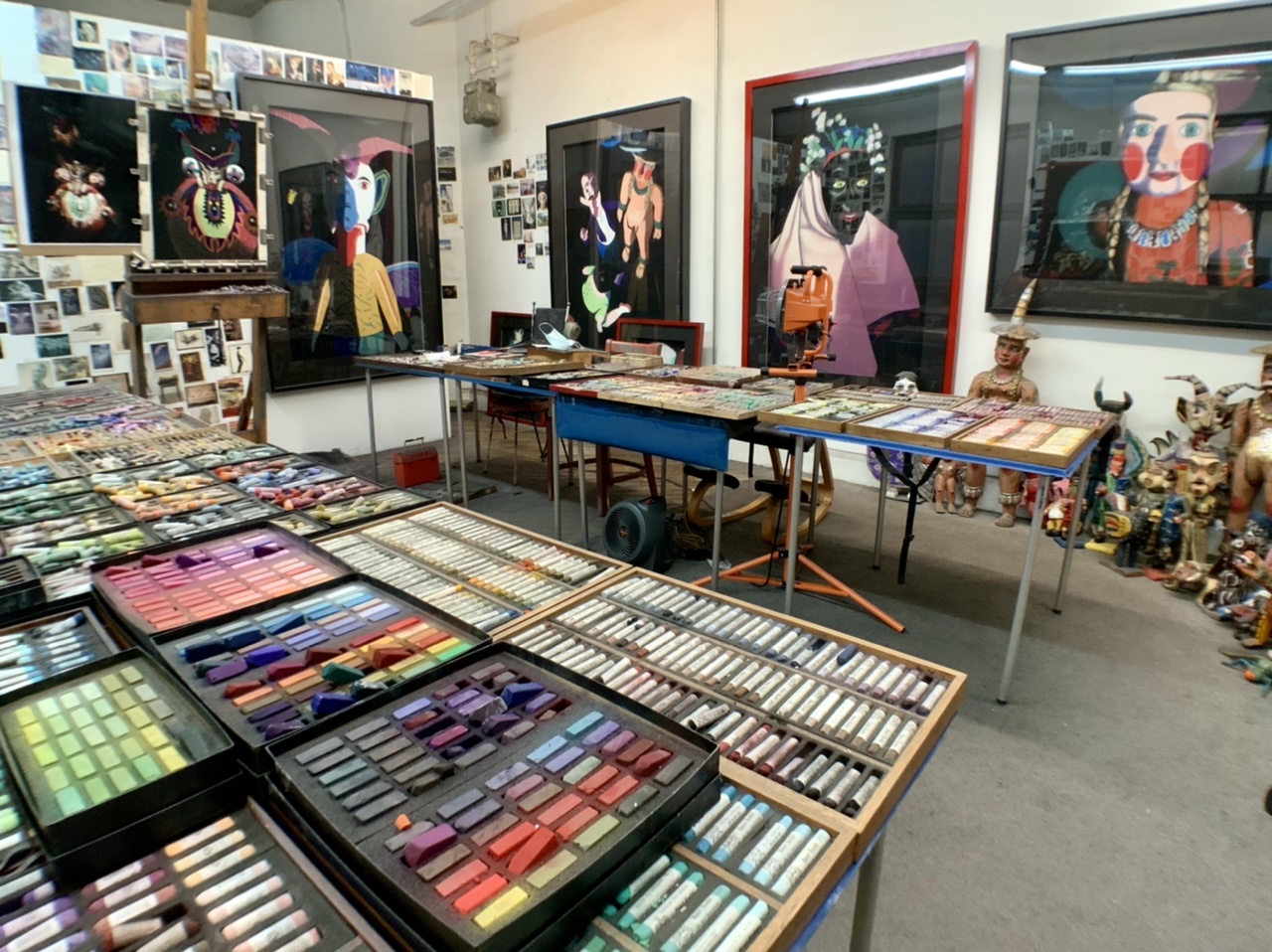
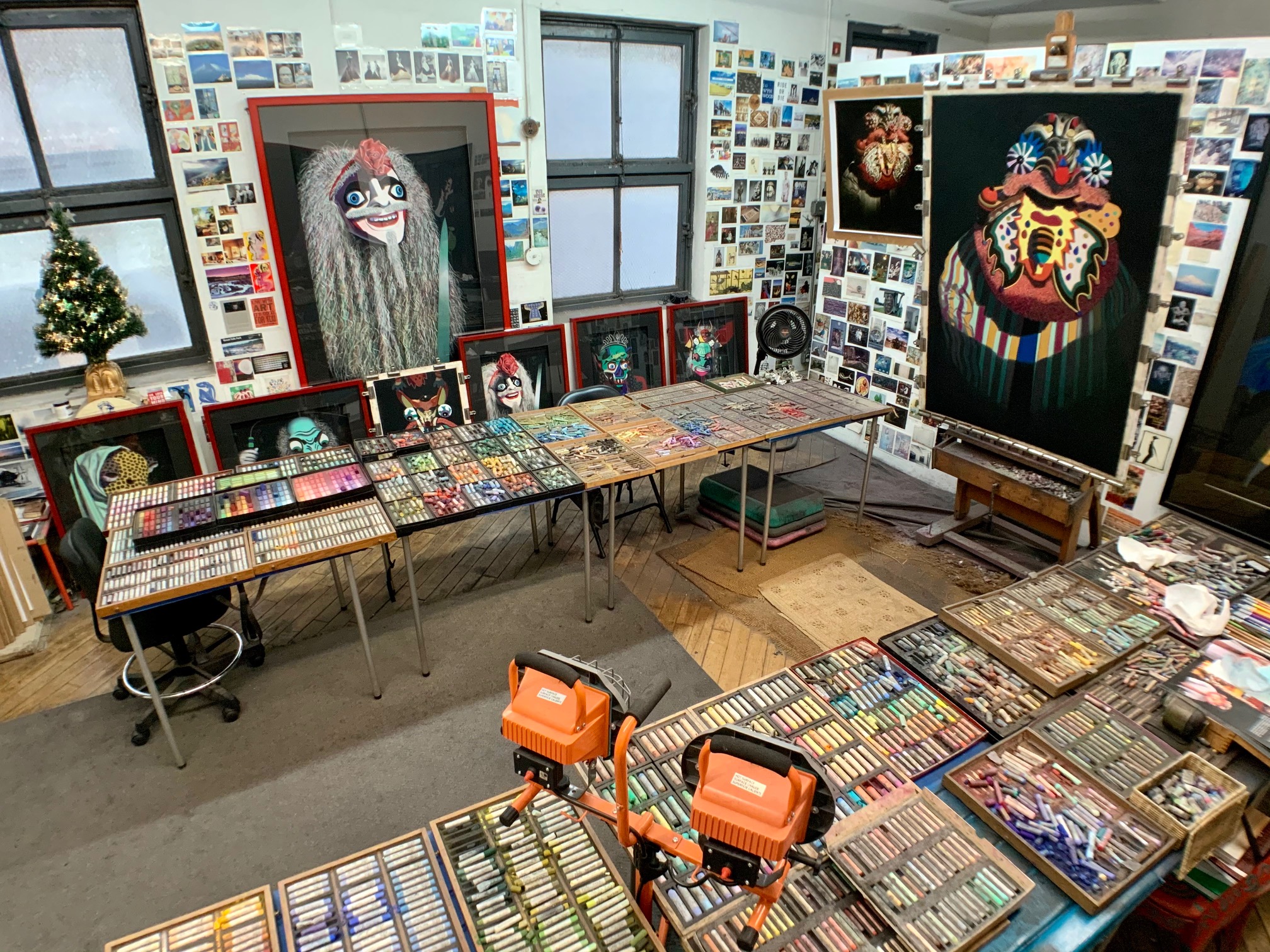
2. Because I love walking into my studio in the morning and seeing all of that color! No matter what mood I am in, my spirit is immediately uplifted.
3. Because my studio is my favorite place to be… in the entire world. I’d say that it is my most precious creation. It’s taken more than twenty-two years to get it this way. I hope I never have to move!
4. Because I get to listen to my favorite music all day.
5. Because when I am working in the studio, if I want, I can tune out the world and all of its urgent problems. The same goes for whatever personal problems I am experiencing.
6. Because I am devoted to my medium. How I use pastel continually evolves. It’s exciting to keep learning about its properties and to see what new techniques will develop.
7. Because I have been given certain gifts and abilities and that entails a sacred obligation to USE them. I could not live with myself were I to do otherwise.
8. Because art-making gives meaning and purpose to my life. I never wake up in the morning wondering, how should I spend the day? I have important work to do and a place to do it. I know this is how I am supposed to be spending my time on earth.
9. Because I have an enviable commute. To get to my studio it’s a thirty-minute walk, often on the High Line early in the morning before throngs of tourists have arrived.
10. Because life as an artist is never easy. It’s a continual challenge to keep forging ahead, but the effort is also never boring.
11. Because each day in the studio is different from all the rest.
12. Because I love the physicality of it. I stand all day. I’m always moving and staying fit.
13. Because I have always been a thinker more than a talker. I enjoy and crave solitude. I am often reminded of the expression, “She who travels the farthest, travels alone.” In my work I travel anywhere.
14. Because spending so much solitary time helps me understand what I think and feel and to reflect on the twists and turns of my unexpected and fascinating life.
15. Because I learn about the world. I read and do research that gets incorporated into the work.
16. Because I get to make all the rules. I set the challenges and the goals, then decide what is succeeding and what isn’t. It is working life at its most free.
17. Because I enjoy figuring things out for myself instead of being told what to do or how to think.
18. Because despite enormous obstacles, I am still able to do it. Art-making has been the focus of my life for thirty-nine years – I was a late bloomer – and I intend to continue as long as possible.
19. Because I have been through tremendous tragedy and deserve to spend the rest of my life doing exactly what I love. The art world has not caught up as much as I would like yet, but so be it. This is my passion and my life’s work and nothing will change that.
20. Because thanks to the internet and via social media, my work can be seen in places I have never been to and probably will never go.
21. Because I would like to be remembered. The idea of leaving art behind for future generations to appreciate and enjoy is appealing.
Comments are welcome!
Q: How do you persist despite the haters, nay-sayers, etc.? (Question from Bold Journey Publishing)

Barbara’s Studio
A: There are so many obstacles to art-making and countless reasons to just give up. When you really think about it, it’s amazing that great art gets made at all. So why do we do it? For artists I believe it’s all about making our time on earth matter, about devotion to our innate gifts, and a deep love of our hard-fought creative process.
I have been a full-time professional artist for 37 years. How and why do successful artists persist? It helps a lot to be stubborn! We just keep digging in that much deeper. Making art is a most noble and sacred calling – you know this if you are one of the called – and that’s what separates those of us who are in it for the long haul from the wimps, fakers, and hangers-on. I say to my fellow artists who continue to work despite the endless challenges, we artists who continue to struggle every day for recognition of our gifts are true heroes!
These words below by Mary Gabriel in Ninth Street Women, published in 2017, ring true for artists. It’s good, even for me, to occasionally reread them and be reminded.
The obstacles faced by women who hoped to leave a mark on humankind have, through the millennium, varied in height but not in stubborn persistence. And yet, a great many women have stubbornly ignored them. The desire to put words on a page or marks on a canvas was greater than the accrued social forces that told them they had no right to do so, that they were excluded by their gender from that priestly class called artist. The reason, according to Western tradition, was as old as creation itself: For many, God was the original artist and society had assigned its creator a gender – He. The woman who dared to declare herself an artist in defiance of centuries of such unwavering belief required monstrous strength, to fight not for equal recognition and reward but for something at once more basic and vital: her very life. Her art was her life. Without it, she was nothing. Having no faith that society would broaden its views on artists by dethroning men and accommodating women, in 1928 [Virginia] Woolf offered her fellow writers and painters a formula for survival that allowed them to create, if not with acceptance, then at least unimpeded. A woman artist, she said, needed but two possessions: “money and a room of her own.”
Furthermore, I think I persist because I do not believe in “big breaks.” Big breaks may sometimes happen, but in my experience an artist’s life is made up of single-minded dedication, persistence, hard work, and lots of small breaks. I recently finished reading “Failing Up: How to Take Risks, Aim Higher, and Never stop Learning” by Leslie Odom, Jr. I like what he has to say to artists here:
The biggest break is the one you give yourself by choosing to believe in your wisdom, in what you love, and in the gifts you have to offer the waiting world.
Comments are welcome!
Pearls from artists* # 589

Barbara’s studio… where plenty of mistakes happen!
*an ongoing series of quotations – mostly from artists, to artists – that offers wisdom, inspiration, and advice for the sometimes lonely road we are on.
In school, in the workplace, in learning an art or sport, we are taught to fear, hide or avoid mistakes. But mistakes are of incalculable value to us. There is first the value of mistakes as the raw material of learning. If we don’t make mistakes, we are unlikely to make anything at all. Tom Watson, for many years the head of IBM, said “Good judgment comes from experience. Experience cones from bad judgment.” But more important, mistakes and accidents can be the irritating grains that become pearls; they present us with unforeseen opportunities, they are fresh sources of inspiration in and of themselves. We come to regard our obstacles as ornaments, as opportunities to be exploited and explored.
Seeing and using the power of mistakes does not mean that anything goes. Practice is rooted in self-correction and refinement, working toward clearer and more reliable technique. But when a mistake occurs, we can treat it either as an invaluable piece of data about our technique or as a grain of sand around which we can make a pearl.
Stephen Nachmanovitch in Free Play: Improvisation in Life and Art
Comments are welcome!
Pearls from artists* # 575

Barbara’s Studio
*an ongoing series of quotations – mostly from artists, to artists – that offers wisdom, inspiration, and advice for the sometimes lonely road we are on.
Creativity is a harmony of opposite tensions… As we ride through the flux of our own creative processes, we hold onto both poles. If we let go of play, our work becomes ponderous and stiff. If we let go of the sacred, our work loses its connection to the ground on which we live.
Knowledge of the creative process cannot substitute for creativity, but it can save us from giving up on creativity when the challenges seem too intimidating and free play seems blocked. If we know that our inevitable setbacks and frustrations are phases of the natural cycle of creative processes, if we know that our obstacles can become our ornaments, we can persevere and bring our desires to fruition. Such perseverance can be a real test, but there are ways through, there are guideposts. And the struggle, which is guaranteed to take a lifetime, is worth it. It is a struggle that generates incredible pleasure and joy. Every attempt we make is imperfect; yet each one of these imperfect attempts is an occasion for a delight unlike anything else on earth.
The creative path is a spiritual path. The adventure is about us, about the deep self, the composer in all of us, about originality, meaning not that which is all new, but that which is fully and originally ourselves.
Stephen Nachmanovitch in Free Play: Improvisation in Life and Art
Comments are welcome!
Pearls from artists* # 557

*an ongoing series of quotations – mostly from artists, to artists – that offers wisdom, inspiration, and advice for the sometimes lonely road we are on.
It is true that art, while indebted to tradition, is usually at odds with it; art is about the thrill of mutiny. Young painters and sculptors are particularly unwilling to be hampered by the past, especially if that past is encased in the cement shoes of gender. But familiarity with tradition can be liberating for an artist because it provides a map illustrating the route other people have taken, which is especially valuable at the start of such a perilous journey. Male artists can inspire and instruct, surely. Artistic concerns are gender neutral. But there are social and personal issues a woman artist faces that cannot be found in the stories of men; these are the obstacles confronted and obstacles overcome. The poet Adrienne Rich wrote, “For spiritual values and a creative tradition to continue unbroken we need concrete artifacts, the work of hands, written words to read, images to look at, a dialogue with brave and imaginative women who came before us.” It’s instructive as well as comforting to know how other women have managed and what other women have dared. It’s also gratifying to find in their stories an occasional energizing dose of inspiration.
Mary Gabriel in Ninth Street Women
Comments are welcome!
Pearls from artists* # 478

*an ongoing series of quotations – mostly from artists, to artists – that offers wisdom, inspiration, and advice for the sometimes lonely road we are on.
Artists, because of the demands of their personality, their sense of personal mission, and their need to create or perform, are driven people. Mixed with the love of work can be a terrible pressure to work. For many artists, and especially for the most productive ones, the line between love and obsession and between love and compulsion blurs or disappears entirely. Are such artists free or are they slaves to their work?
In The Artist and Society the psychiatrist Lawrence Hatterer said of such an artist:
His most recognizable trait is his recurring daily preoccupation with translating artistic activity into accomplishment. The consuming intensity of this artistic pursuit brooks no interference or obstacles. His absorption with the creative act is such that he experiences continually what the average artist feels only infrequently when he reaches unusual levels of creative energy with accompanying output. He appears to be incapable of willful nonproductivity.
This is Picasso working for 72 hours straight. This is van Gogh turning out 200 finished paintings during his 444 days in Arles. The artist who is “incapable of willful nonproductivity” is a workaholic for whom little in life, apart from his artistic productivity and accomplishment, may have any meaning.
Eric Maisel in A Life in the Arts: Practical Guidance and Inspiration for Creative and Performing Artists
Comments are welcome!
Pearls from artists* # 459
*an ongoing series of quotations – mostly from artists, to artists – that offers wisdom, inspiration, and advice for the sometimes lonely road we are on.
Naturally we want freedom, flow and harmony in our work. These are qualities that give it eloquence. But we cannot find this flow by avoiding the obstacles that arise upon starting out. We welcome the resistances and then apply our God given ammunition – our imagination, energy and will – and finally watch the obstacles dissolve. Only then can we enjoy the new-found freedom and flow until the next obstacle appears. And the struggle begins anew. And hence, the paradox: we cultivate resistance in order to free our path of resistance. Real power is the removal of resistance from your path.
Anne Bogart in A Director Prepares: Seven Essays on Art and Theatre
Comments are welcome!
Pearls from artists* # 451
*an ongoing series of quotations – mostly from artists, to artists – that offers wisdom, inspiration, and advice for the sometimes lonely road we are on.
Your attitude towards resistance determines the success of your work and your future. Resistance should be cultivated. How you meet these obstacles that present themselves in the light of any endeavor determine the direction of your life and career.
Allow me to propose a few suggestions about how to handle the natural resistances that your circumstances might offer. Do not wait for enough time or money to accomplish what you think you have in mind. Work with what you have right now. Work with the architecture you see around you right now. Do not what for what you assume is the appropriate, stress-free environment in which to generate expression. Do not wait for maturity or insight or wisdom. Do not wait till you are sure you know what you are doing. Do not wait until you have enough technique. What you do now, what you make of your present circumstances will determine the quality of your future endeavors.
And, at the same time, be patient.
Anne Bogart in A Director Prepares: Seven Essays on Art and Theatre
Comments are welcome!


 barbararachkoscoloreddust.com