Blog Archives
Pearls from artists* # 715

*an ongoing series of quotations – mostly from artists, to artists – that offers wisdom, inspiration, and advice for the sometimes lonely road we are on
Whenever we must solve a big problem, such as the art/money challenge, it is worthwhile to look inward, to see where we may be complicit in perpetuating the problem. While artists are not always valued in our society, we also get what we settle for. Although we must eat and pay rent or mortgages like everyone else, non-artists often try to persuade us that we do not deserve to earn a living wage, because we enjoy our job. In the United States, we are often asked to work for free in a way that other professionals are not.
Consider trying to get an accountant to work ‘for the exposure.’ In many cases, artists go to college, even graduate school, to learn our profession. Many of us are still paying off student loans. We put in thousands of hours to develop our skills. We may win awards or grants that distinguish us from other artists. It is up to us to put a stop to the devaluation of our profession. Artists who agree to work for free, or for a pittance, are essentially strikebreakers on a picket line. As a group, we should be fighting in solidarity to raise standards of living and respect for our collective profession by refusing to work for less. When we agree to bad conditions, we devalue ourselves, and enable a dysfunctional system that perpetuates the exploitation of artists.
Kate Kretz in Art From Your Core: A Holistic Guide to Visual Voice
Comments are welcome!
Pearls from artists* # 711
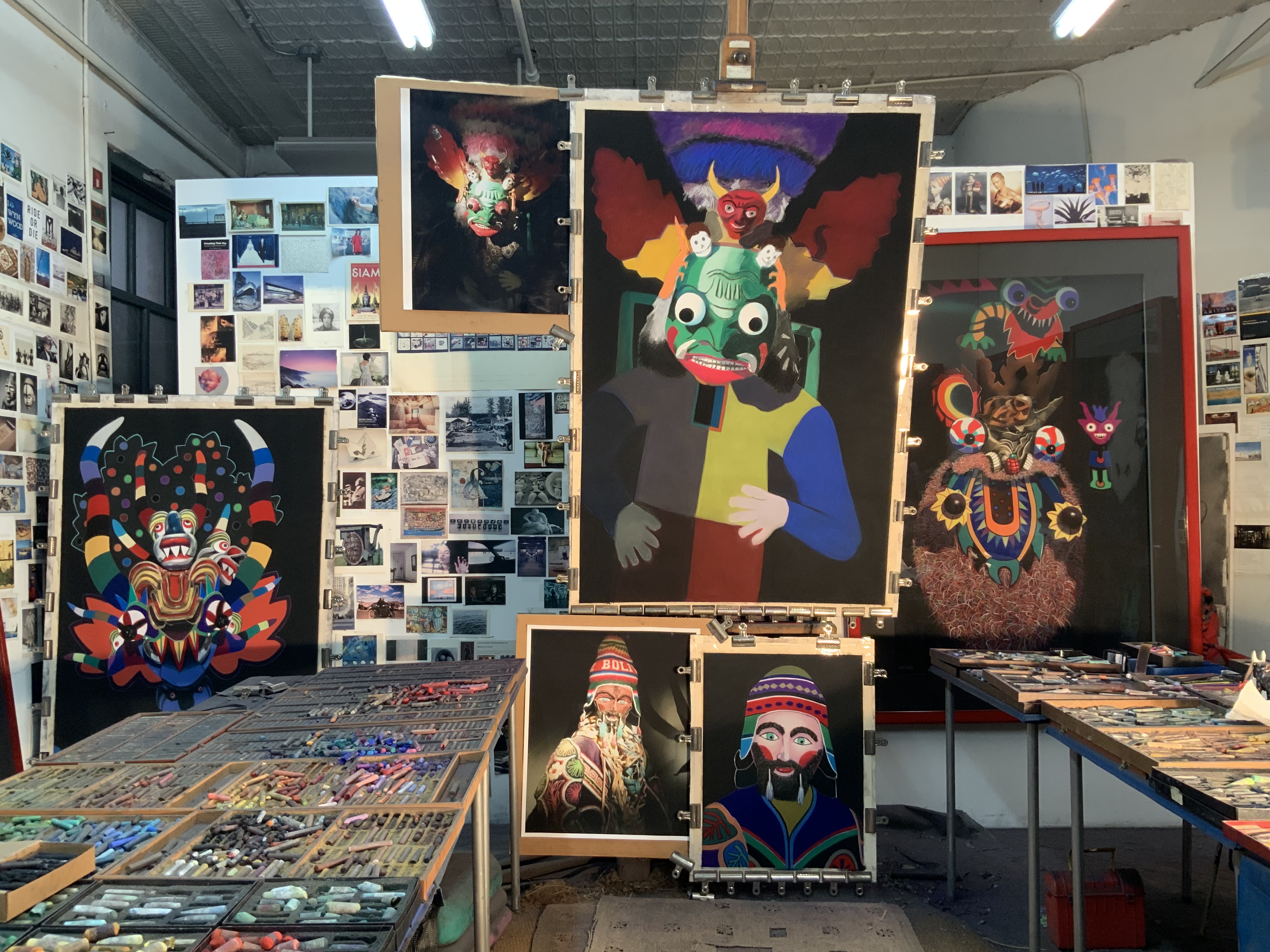
Barbara’s Studio
*an ongoing series of quotations – mostly from artists, to artists – that offers wisdom, inspiration, and advice for the sometimes lonely road we are on
The people considered ‘most accomplished’ in our culture pass through a standardized education conveyor belt to be indoctrinated into a cutthroat hamster wheel success ladder. Yet the production and consumption of those goods are destroying the planet that sustains our very lives. Those who question the absurdity of these choices are considered deviant. Try to carve a different path for yourself that makes sense to you, and every societal force conspires to push you back into that absurd groove that virtually everyone else swerved into long ago.
Artists also deal with vocation specific stress. We confront repeated rejection in a way that most other professionals do not. Our relationships may suffer from family members who fail to understand how art careers ‘work.’ They may resent that we bring in little money. There is often a maddening lack of congruity between artists’ abilities, sustained hard work, and reward. Engineers who excel at their job can make a good living, while highly skilled creatives may never reap financial benefits, even after a lifetime of effort. Frequently, artists must reckon with the success of others who have far less talent, depth, and dedication, while endlessly struggling to keep their own practice afloat. Finally, although many people suffer from early trauma and manage to survive and move on, it is in the nature of sone artists’ work to repeatedly re-expose themselves to pain through their practice.
Kate Kretz in Art From Your Core: A Holistic Guide to Visual Voice
Comments are welcome!
Q: Is there anything you wish you could change about life as a visual artist?

Barbara’s Studio
A: While there is much to admire and maybe even envy about being an artist, it does have some downsides. Among these, for me, is that enormous amounts of solitude are required to create art. I wish this were not the case.
Our work is entirely unique and because it starts as an idea in our heads, we must work solo to bring it into the world. We spend our days pondering, looking, and reacting, rather than speaking to anyone. As typical workdays go, it is rather odd.
I sometimes envy filmmakers who require collaboration with a large team of experts in order to practice their art. They have fellow professionals with whom they can discuss their ideas and they can solicit advice on how to make improvements. Artists rarely have this luxury.
On the other hand, visual artists don’t have to wait for anyone else to do their jobs before we can get to work. We don’t have to deal with personality conflicts or other people’s agendas. Our individual creative process is generally free of obstacles created by others. When you really think about it, the only thing that is required of an artist is to go to the studio and get to work! We are free to make our own rules and our own schedules, and, creatively speaking, are largely responsible for our own advances and setbacks.
Comments are welcome!
Pearls from artists* # 161

Whitney Museum
* an ongoing series of quotations – mostly from artists, to artists – that offers wisdom, inspiration, and advice for the sometimes lonely road we are on.
It is the artist’s innate sensitivity that makes him special and different from other professionals. Society expects the artist to be more compassionate and understanding in order to bring out that which will enlighten, inspire and encourage life in his work. His vocation should not just be for art’s sake.
Where the average person sees an old beat-up shark, the artist sees a symbol of beauty in aging and imagines bringing out those qualities that the shark has sheltered over the ages, by means of artistic creation. To the intelligent and sensitive artist, the homeless man lying on the street corner is a symbol that reminds us of what we, as a society, should be doing to better our living.
Sensitivity comes into play when leaves that appear to the general viewer to be uniformly green are seen by the sensitive artist to be different shades, tones, and subtle nuances of green. Without sensitivity, special and important characteristics of nature will be out of our sight and out of reach to the viewing layman. Only the obvious, the average and the common will reveal themselves to the insensitive artist. The endurance of certain works will depend on what the artist has captured with the help of his sensitivity and because of the ideas behind the work.
Samuel Adoquei in Origin of Inspiration: Seven Short Essays for Creative People
Comments are welcome!
Pearls from artists* # 158

“Dichotomy,” soft pastel on sandpaper, 38″ x 58″
* an ongoing series of quotations – mostly from artists, to artists – that offers wisdom, inspiration, and advice for the sometimes lonely road we are on.
It is the artist’s innate sensitivity that makes him special and different from other professionals. Society expects the artist to be more compassionate and understanding in order to bring out that which will enlighten, inspire and encourage life in his work. His vocation should not just be art for art’s sake.
Where the average person sees an old beat-up shark, the artist sees a symbol of beauty in aging and imagines bringing out those qualities that the shark has sheltered over the ages by means of artistic creation. To the intelligent and sensitive artist, the homeless man lying on the street corner is a symbol that reminds us of what we, as a society, should do to better our living.
Sensitivity comes into play when leaves that appear to the general viewer to be uniformly green are seen by the sensitive artist to be different shades, tones and nuances of green. Without sensitivity, special and important characteristics of nature will be out of sight and out of reach to the viewing layman. Only the obvious, the average and the common will reveal themselves to the insensitive artist. The endurance of certain works will depend on what the artist has captured with the help of his sensitivity and because of the ideas behind the work.
Samuel Adoquei in Origin of Inspiration: Seven Short Essays for Creative People
Comments are welcome!
Q: How do you document your work?
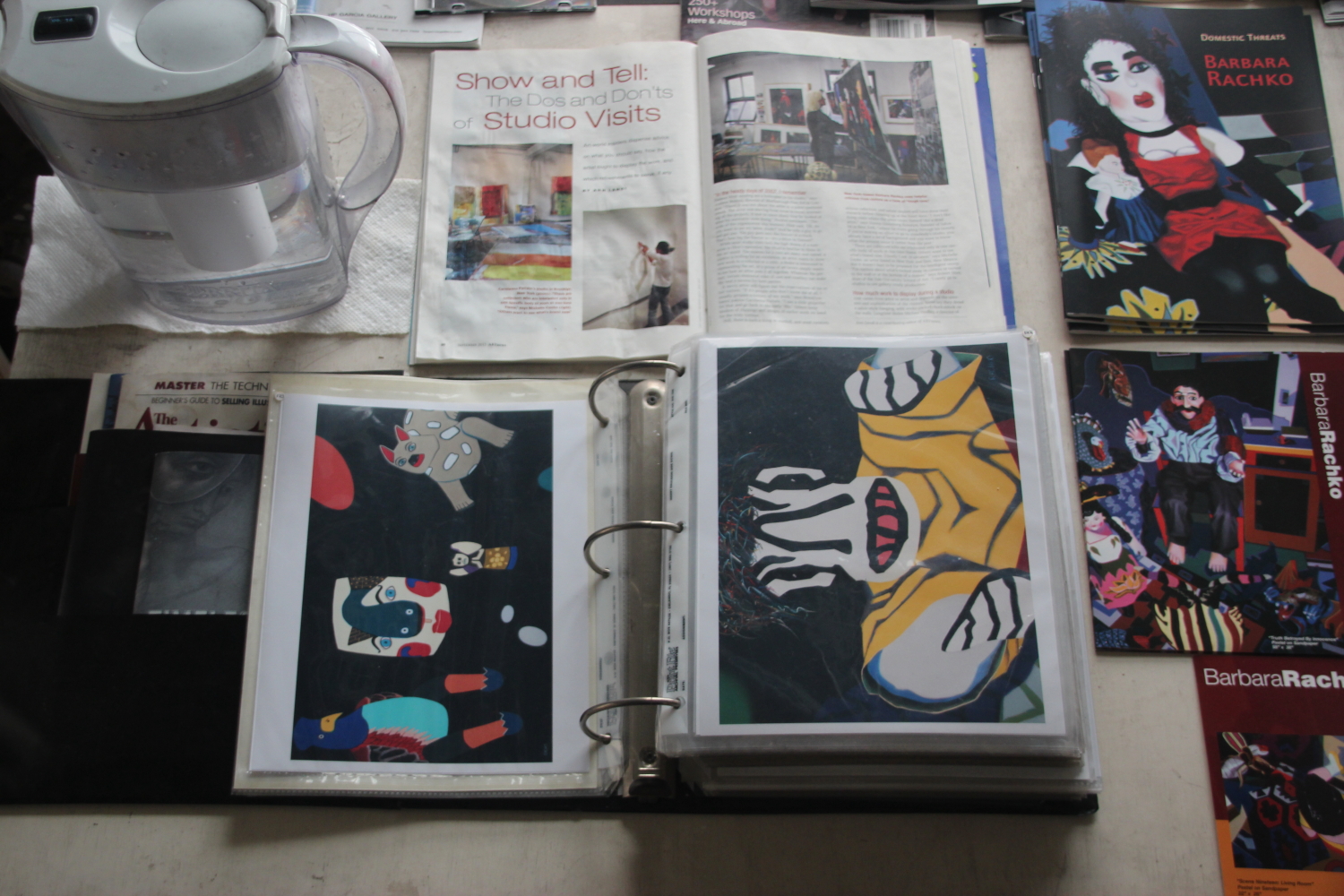
Barbara’s portfolio book
A: I have been a professional artist for thirty years so some things have changed and some haven’t. I have a portfolio book of 8 x 10 photographs of all my pastel paintings. Since my process is slow and meticulous, the latest, “Troublemaker,” is pastel painting number 124.
I have always gotten my work professionally photographed. Until 2001 my husband Bryan was my photographer and since then I have hired three people. To document older work I have slides, 4 x 5 transparencies, and color and black and white 4 x 5 negatives. I continued with slides and film longer than many artists, but finally switched to digital files a few years ago when buying film and processing it became difficult.
Comments are welcome!



