Blog Archives
Q: Over your 40-year career as an artist, you have managed to keep presentation, technical, subject matter, conceptual consistencies in your art practice and work. How do you manage to filter out inspirations that might be luring at that moment but do not support your art practice? For example, you master pastel works. There must have been moments when you might have been inspired to make oil works. How do you keep such inspirations aside. (Question from Vedica Art Studios and Gallery)

A: About thirty-five years ago, when my pastel paintings were becoming larger—around 60” x 40”—I had to choose between transitioning to oil on canvas or continuing with pastel. Framing was the main concern. I wasn’t certain large pastels could be framed, and even if they could, the cost might be prohibitive. However, I had already fallen in love with pastel and knew no other medium could offer such vibrant colors or velvety textures. Determined, I resolved the framing issue (art-making is fundamentally problem-solving), committed myself fully to soft pastel, and have continued inventing and refining techniques ever since.
My goal from the beginning has always been improvement as an artist. If an activity doesn’t contribute to my growth—as a person or as an artist—I typically don’t pursue it. Time and energy are finite resources, so I try to use them wisely.
Comments are welcome!
Pearls from artists* # 680

“Sacrificial” (on the wall) and “Trickster” (on the floor)
*an ongoing series of quotations – mostly from artists, to artists – that offers wisdom, inspiration, and advice for the sometimes lonely road we are on.
What makes a work transcendent and powerful is a personal intensity, an ‘extra’ quality. Yet that intensity is exclusive to each artist: extra strangeness, subtlety, causticity, bravado, sensuality, rawness, grandiosity, succinctness, mystery, vulnerability, truth, etc. For an individual artist to infuse an object or an experience with their own ‘extra’ quality requires not only skill or ideas, but the profound benevolence of consistently delivering in spades.
It is this passion and genuine feeling, specific to each creator, that lives on in the art as a gift. It is wrapped up in the work, forever suspended in time. The artist says,
Here… everything I possessed in this moment is embodied in this object… All skills I have painstakingly learned, all of the knowledge I possess, the joy and pain I have felt and all the experiences I have lived. I spun these into the perfect, most sublime form, and packed it up, but for you to unwrap anytime you need sustenance. It will nourish, comfort, and surround you, because you have chosen it.
Each viewer selects which works of art speak to them… which embodied feelings, concepts, and knowledge they value. An empathic connection is forged through the art object or experience. What is love, but to say to someone, ‘you are truly seen and understood?’ Art offers this as well, by reaching out to puncture through the membrane of our emotional isolation, to articulate how we feel in the moments when we cannot find words. It tells the artist and viewer alike, ‘You are not alone. You are not alone in how your brain works. You are not alone in the pain you feel. You are not alone in what you notice or appreciate, or in how much love you have to give.’
Pour that love into an art object. It can handle all the devotion you pack into it, and more.
Kate Kretz in Art From Your Core: A Holistic Guide to Visual Voice
Comments are welcome!
Pearls from artists* # 675

Working
*an ongoing series of quotations – mostly from artists, to artists – that offers wisdom, inspiration, and advice for the sometimes lonely road we are on.
Before, I’d never really had a taste for anything much. The things people wanted me to do left me cold. But the moment I had that paint box in my hands, I felt that this was my life. Like a cow given a sight of grass, I just headed straight into it, to the understandable despair of my father, who’d put me through other subjects. I was entranced; this was it. Here was a sort of Paradise regained, where I was completely free, alone and at peace – whereas in other things that I’d been made to do, I’d always been a bit bored and ill at ease.
For me, it was the same experience, but with soft pastel. – BR
Chatting with Henri Matisse: The Lost 1941 Interview edited by Serge Guilbaut
Comments are welcome!
Pearls from artists* # 672

Barbara’s Studio
*an ongoing series of quotations – mostly from artists, to artists – that offers wisdom, inspiration, and advice for the sometimes lonely road we are on.
Beware of first impressions; try to have more presence of mind.
You should not be deceived by the eager promises of your best friends, by offers of help from influential people, or by the interest which men of talent seem to take in you, into thinking that there is anything real in what they say – real in the way of results, I mean. Many people are full of good intentions when they speak, but their eagerness subsides appreciably when it comes to action, like blusterers, or people who make angry scenes […]. And you, yourself, try to be more cautious in the way you welcome people, and above all, avoid these ridiculous attentions; they’re only offered on the impulse of the moment.
Cultivate a well-ordered mind, it’s your only road to happiness; and to reach it, be orderly in everything, even in the smallest details.
The Journal of Eugène Delacroix, edited by Hubert Wellington
Comments are welcome!
Q: Do you have any rituals that you do in the mornings before you begin working?

Art From Your Core by Kate Kretz
A: When I arrive at the studio in the morning it’s rare for me to immediately start working. Usually I read something art-related. At the moment I’m rereading Art From Your Core: A Holistic Guide to Visual Voice by Kate Kretz. This is a fabulous book for visual artists. It is a must-read and has become my current art bible! As usual I am struggling to understand aspects of the art business and figure out what’s next to get my work appreciated and collected by a new audience. Art From Your Core reminds why I decided to make art in the first place and what I need to do to continue to improve. It helps reconnect with forgotten parts of myself and is a much-needed reminder of what I love most about being an artist.
Balancing the creative and business aspects of my art practice is an ongoing struggle. I imagine this is true for most artists. Both jobs are so important. An artist needs an appreciative audience – very few artists devote their lives to art-making so that the work will remain in a closet – but I also believe this (from a note hand-written years ago that I tacked to the studio wall): “Just make the work. None of the rest matters.”
Comments are welcome.
Q: Does your work look different to you on days when you are sad, happy, etc.?

Barbara’s Studio
A: I am much more critical on days when I am sad so that the faults, imperfections, and things I wish I had done better stand out. Fortunately, all of my work is framed behind plexiglas so I can’t easily go back in to touch up perceived faults. I am reminded of the expression, “Always strive to improve, whenever possible. It is ALWAYS possible!” However, I’ve learned that re-working a painting is a bad idea. You are no longer deeply involved in making it and the zeitgeist has changed. The things you were concerned with are gone: some are forgotten, others are less urgent.
For most artists our work is autobiography. Art is personal. When I look at a completed pastel painting, I usually remember exactly what was happening in my life as I created it. Each piece is a snapshot – maybe a time capsule, if anyone could decode it – that reflects and records a particular moment. When I finally pronounce a piece finished and sign it, that’s it, THE END. It’s as good as I can make it at that point in time. I’ve incorporated everything I was thinking about, what I was reading, how I was feeling, what I valued, art exhibitions I visited, programs that I heard on the radio or watched on television, music that I listened to, what was going on in New York, in the country, and in the world.
It is still a mystery how this heady mix finds its way into the work. During the time that I spend on it, each particular painting teaches me everything it has to teach. A painting requires months of looking, reacting, correcting, searching, thinking, re-thinking, revising. Each choice is made for a reason and together these decisions dictate what the final piece looks like. On days when I’m sad I tend to forget that. On happier days I remember that the framed pastel paintings that you see have an inevitability to them. If all art is the result of one’s having gone through an experience to the end, as I believe it is, then the paintings could not, and should not, look any differently.
Comments are welcome.
Pearls from artists* # 636

*an ongoing series of quotations – mostly from artists, to artists – that offers wisdom, inspiration, and advice for the sometimes lonely road we are on.
Some artists will rework a piece for half a lifetime before they know it is finished. An improviser may have to practice for years before being able to play a totally spontaneous minute of music in which every detail is right for its own fleeting moment. The great scientists and scholars are not those who publish or perish at any cost, but rather those who are willing to wait until the pieces of the puzzle come together in nature’s own design. The fruits of improvising, composing, writing, inventing, and discovering may flower spontaneously, but they arise from soil that we have prepared, fertilized, and tended in the faith that they will ripen in nature’s own time.
Stephen Nachmanovitch in Free Play: Improvisation in Life and Art
Comments are welcome!
Pearls from artists* # 628

Beginning
*an ongoing series of quotations – mostly from artists, to artists – that offers wisdom, inspiration, and advice for the sometimes lonely road we are on.
We have nothing to go by, but still, we must begin. It requires chutzpah – the Yiddish word for that ineffable combination of courage and hubris – to put down one word, then another, perhaps even accumulate a couple of flimsy pages, so few that they don’t even firm the smallest of piles, and call it the beginning of a novel. Or memoir. Or story. Or anything, really rather than a couple of flimsy pages.
When I’m between books, I feel as if I will never have another story to tell. The last book has wiped me out, has taken everything from me, everything I understand and feel and know and remember, and … that’s it. There’s nothing left. A low-level depression sets in. The world hides its gifts from me. It has taken me years to realize that this feeling, the one of the well being empty, is as it should be. It means I’ve spent everything. And so I must begin again.
I wait.
I try to be patient. I remember Colette, who wrote that her most essential art was “not that of writing, but the domestic task of knowing how to wait, to conceal, to save up crumbs, to reglue, regild, change the worst into the not-so-bad, how to lose and recover in the same moment that frivolous thing, a taste for life.” Colette’s words, along with those of a few others, have migrated from one of my notebooks to another for over twenty years now. It’s wisdom I need to remember – wisdom that is easy to forget.
Dani Shapiro in Still Writing: The Perils and Pleasures of a Creative Life
Comments are welcome!
Q: Can you elaborate on the title of your very first series, “Domestic Threats”?

A: All of the paintings in this series are set in places where I reside or used to live, either a Virginia house or New York apartments, i.e., domestic environments. Each painting typically contains a conflict of some sort, at least one figure who is being menaced or threatened by a group of figures. So I named the series “Domestic Threats.”
Depending on what is going on in the country at a particular moment in time, however, people have seen political associations in my work. When my husband, Bryan, was killed on 9/11, many people thought the title, “Domestic Threats,” was prescient. They have ascribed all kinds of domestic terrorism associations to it, but that is not really what I had in mind. For a time some thought I was hinting at scenes of domestic violence, but that also is not what I had intended. “Domestic Threats” seems to be fraught with associations that I never considered, but it’s an apt title for this body of work.
Comments are welcome!
Pearls from artists* # 613
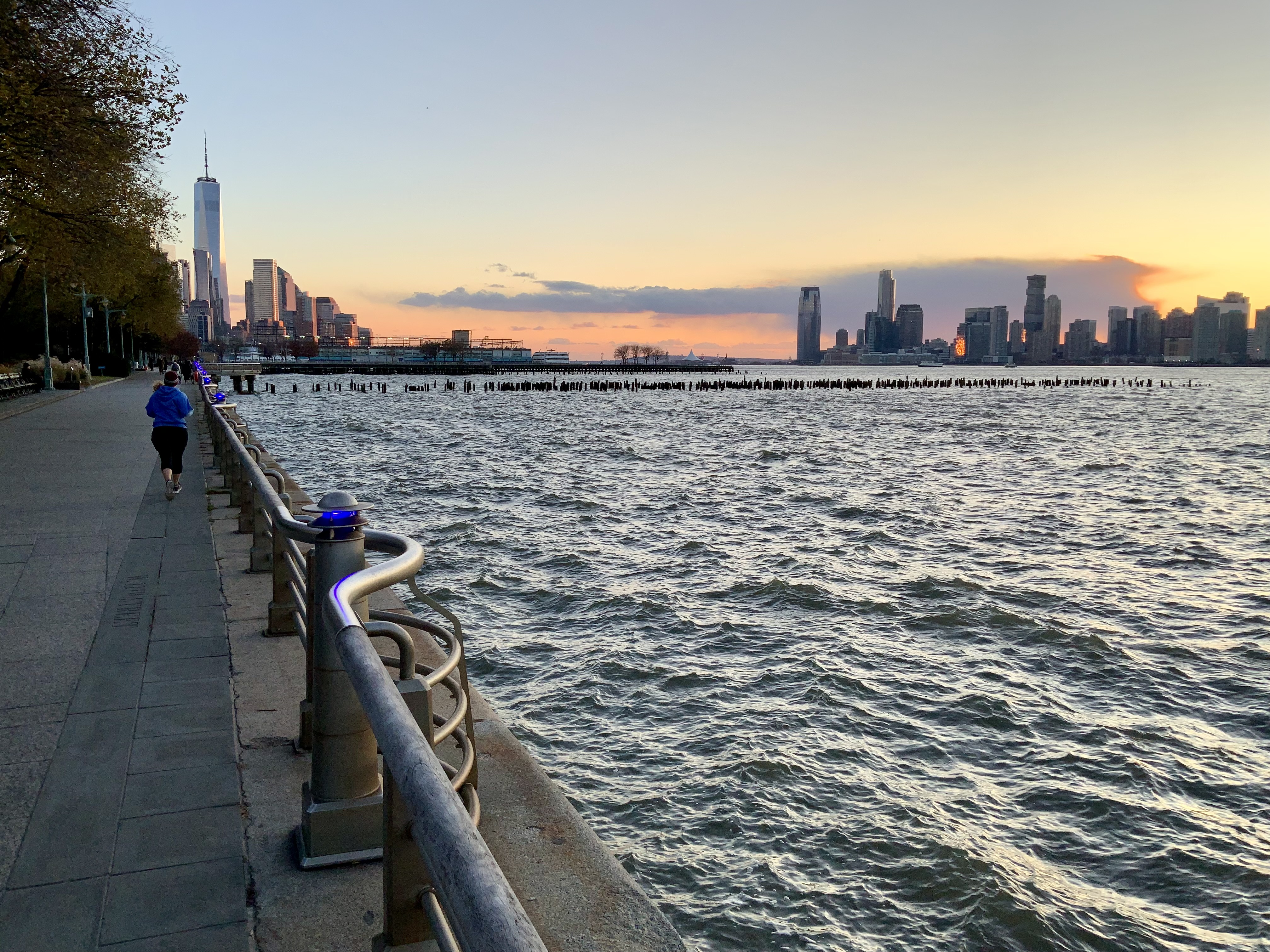
New York NY
*an ongoing series of quotations – mostly from artists, to artists – that offers wisdom, inspiration, and advice for the sometimes lonely road we are on.
A painting is a statement of the artist’s notions of reality in terms of plastic speech. In that sense the painter must be likened to the philosopher rather than to the scientist. For science is a statement of the laws that govern a specific phenomenon or category of matter or energy within the specified units and conditions of its operation. Philosophy, however, must combine all these specialized truths within a single system. It is because of this broad scope that Aristotle gives preeminence to the philosopher in the introduction to his Metaphysics, for he tells us that every man except the philosopher is an authority within his specific field, whereas the philosopher must have the acute knowledge that each man has in his own field plus the ability to relate all these fields to the operations of universality and eternity.
Therefore art, like philosophy, is of its own age; for the partial truths of each age differ from those of other ages, and the artist, like the philosopher, must constantly adjust eternity, as it were, to all the specifications of the moment. Art, too, creates at different times the notions of reality that the artist, as a man of the age, must inherit and develop and consider real along with the other intellectually conscious men of his time. His language, which is his plastic means, will also adjust itself to the possibility of making these notions manifest in their most coherent possibilities. The reality of the artist, therefore, reflects the understanding of his times, even as his creations shape those understandings. We posit this without wishing to attempt to untangle here the series of causes and effects, a process which would probably obscure more than it certified.
Mark Rothko in The Artist’s Reality: Philosophies of Art
Comments are welcome!


 barbararachkoscoloreddust.com