Blog Archives
Q: You read books on Friedrich Nietzsche and other philosophers. How has philosophy and your personal experience shaped the latest series, Bolivianos? (Question from Vedica Art Studios and Gallery)

A: It’s difficult to pinpoint how philosophy specifically shaped my work because my curiosity spans so many subjects. Some critics have described me as a Renaissance woman, remarking on my wide-ranging and voracious reading. It’s true—I’m genuinely interested in practically everything!
In pursuit of making art, I have undertaken in-depth studies of numerous intriguing fields: drawing, color, composition, gross anatomy, art and art history, the art business, film history, photography, psychology, mythology, literature, philosophy, religion, music, jazz history, and archaeology—particularly ancient Mesoamerica (Olmec, Zapotec, Mixtec, Aztec, and Maya) and South America (the Inca and their ancestors).
Since the early 1990s, my inspiration and subject matter have come primarily from international travel to remote parts of the globe, especially Mexico, Central America, and South America. Travel is by far the best education! By visiting distant destinations, I have developed a deep reverence for people and cultures around the world. People everywhere are connected by our shared humanity.
These travels, supplemented by extensive research at home, are essential parts of my creative process. Research can be solitary and demanding, but I truly enjoy it. I want to know as much as possible, and this curiosity generates ideas for new work, propelling me into unexplored creative realms.
Foreign travel always expands our ways of thinking. This rich mixture of creative influences continually evolves and finds its way into my pastel paintings. Working, learning, evolving, and growing—I am perpetually curious and can hardly imagine a better way to spend my time on Earth!
Comments are welcome!
Pearls from artists* # 640

*an ongoing series of quotations – mostly from artists, to artists – that offers wisdom, inspiration, and advice for the sometimes lonely road we are on.
When an artist changes and develops over the years, as is natural to any creative person, such change is met by howls of protest from the marketers. Sometimes an artist (or teacher, scientist, or spiritual guru) starts with something extraordinary, becomes a star, and then their gift is either frozen or perverted.
The growing and risky edge of creative work is devalued, treated as a frill or extracurricular activity decorating the routine of ordinary life. There are few mechanisms available for the artist to construct a self-sustaining way of living and working. “One gathers,” says Virginia Woolf,
“from the enormous modern literature of confession and self-analysis that to write a book of genius is almost always a feat of prodigious difficulty. Everything is against the likelihood that it will come from the writer’s mind whole and entire. Generally, material circumstances are against it. Dogs will bark; people will interrupt; money must be made; health will break down. Further, accentuating all these difficulties and making them harder to bear is the world’s notorious indifference. It does not ask people to write poems and novels and histories; it does not need them. It does not care whether Flaubert finds the right word or whether Carlyle scrupulously verifies this or that fact. Naturally, it will not pay for what it does not want. And so the writer, Keats, Flaubert, Carlyle, suffers, especially in the creative years of youth, every form of distraction and discouragement. A curse, a cry of agony, rises from those books of analysis and confession. “Mighty poems in their misery dead” – that is the burden of their song. If anything comes through in spite of all this, it is a miracle, and probably no book is born entire and uncrippled as it was conceived.”
Stephen Nachmanovitch in Free Play: Improvisation in Art and Life
Comments are welcome!
Q: Is there a particular challenge you are currently facing? (Question from “Bold Journey”)

A: Yes! It’s one that has been unresolved for a few years now, but I just keep working on it. Now I have a new and valuable tool. A short documentary, “Barbara Rachko: True Grit” tells the story of my life and work. Our film recently premiered at the Newport Beach Film Festival in California, where we won the Audience Award and the Best in Category Award. You can view it here. https://www.youtube.com/watch?v=JJWLy84kXI0
The online audience for my paintings keeps steadily growing. I am represented by galleries in the UK, India, Sweden, and in the US. However, I do not have commensurate gallery representation in New York City, the world’s art capital, and New York is where I live and work. I hope to change this situation very soon!
Comments are welcome!
Pearls from artists* # 604
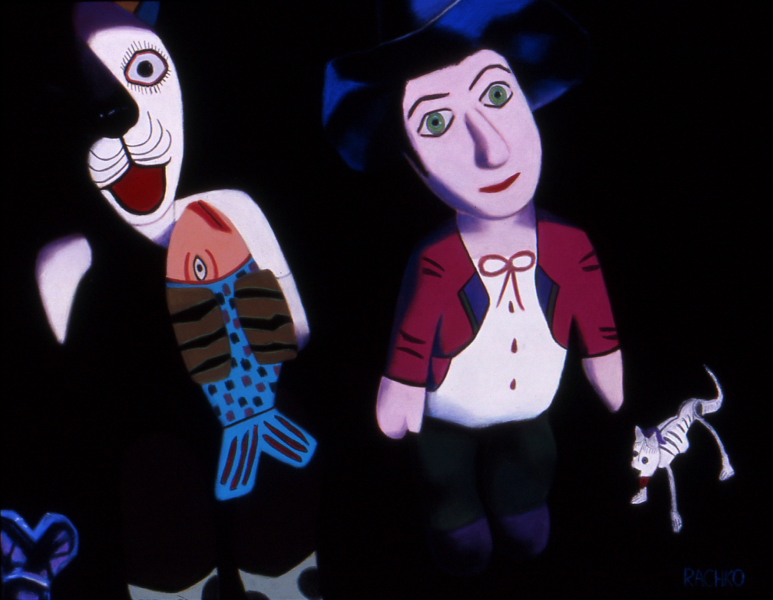
*an ongoing series of quotations – mostly from artists, to artists – that offers wisdom, inspiration, and advice for the sometimes lonely road we are on.
In dealing with unconscious mind, we’re dealing with an ocean full of rich, invisible life forms swimming underneath the surface. In creative work we’re trying to catch one of these fish; but we can’t kill the fish, we have to catch it in a way that brings it to life. In a sense we bring it amphibiously to the surface so it can walk around visibly; and people will recognize something familiar because they’ve got their own fish, who are cousins to your fish. Those fish, the unconscious thoughts, are not passively floating “down there;” they are moving, growing, and changing on their own, and our conscious mind is but an observer or interloper. That is why Jung calls the depths of the unconscious the “objective psyche.”
Stephen Nachmanovitch in Free Play: Improvisation in Life and Art
Comments are welcome!
Pearls from artists* # 597

Barbara’s Studio
*an ongoing series of quotations – mostly from artists, to artists – that offers wisdom, inspiration, and advice for the sometimes lonely road we are on.
From earliest childhood, the boys had been treated differently from their sister. They were allowed more freedom, encouraged to play outdoors and to engage in rough and tumble, and their lives were expanded early on when, at the age of seven, each was sent to St. Mary’s, the prep school of Stonyhurst College. It seemed as if the boys were being readied for adventure and excitement, but while their horizons were opening up, Leonora [Carrington] felt hers were being closed down – or more specifically, never explored. Her role, which was clear even when she was in the nursery, was to keep safe: not to rock any boats, not to take any chances. What they sought to teach her was that she should sit a certain way and behave a certain way: she should be supportive, helpful, polite. She should listen, especially to men, she should have traditional skills, such as playing music and speaking French. Drawing and painting, for which she showed altitude from an early age, were fine within reason. What harm could there be in Prim [Lenora] creating pictures? Especially if those pictures were of flowers and trees, family members and characters from fairy stories.
But art was Leonora’s secret weapon – and she hid it in plain sight, because her parents did not have the faintest idea where her talents might lead. Art, for them, was unthreatening and pretty. They had no idea that this skill their daughter was developing would be one the key to another life entirely; still less that art could never be a validation of the status quo, but meant a radical reappraisal of everything in the artists sight.
So what Leonora practiced in the nursery at Crookhey was the subversive silence of smoldering rebellion. Spared by the inherent unfairness that gave Pat, Gerard, and Arthur so much freedom; stoked by the growing realization that she had a talent that would lead, eventually, to Liberty. “I always painted, and I always knew it was what I would do,” she said many years later. As the Jesuits who educated her brothers at Stonyhurst might have said (but didn’t): show me a girl aged seven, and I will show you the woman.
Joanna Moorhead in Surreal Spaces: The Life and Art of Leonora Carrington
Comments are welcome!
Q: Who is your core audience for your blog? What do you want people to know about your art that you have not created visually? (Question from “Arte Realizzata”)

A: As I understand it, my core audience here (currently 77,000+ and growing!) is an international group of artists and art aficionados looking for hope, inspiration, and probably, motivation to keep making art. Unfortunately, ours is a world that too often misunderstands and under-appreciates the difficult, essential, and sometimes lonely work undertaken by artists. Hopefully, my blog makes readers think, “If Barbara can keep making art under these conditions and continue to thrive after what she’s been through, maybe I can, too!”
Comments are welcome!

Q: How do you stay motivated to create new work?
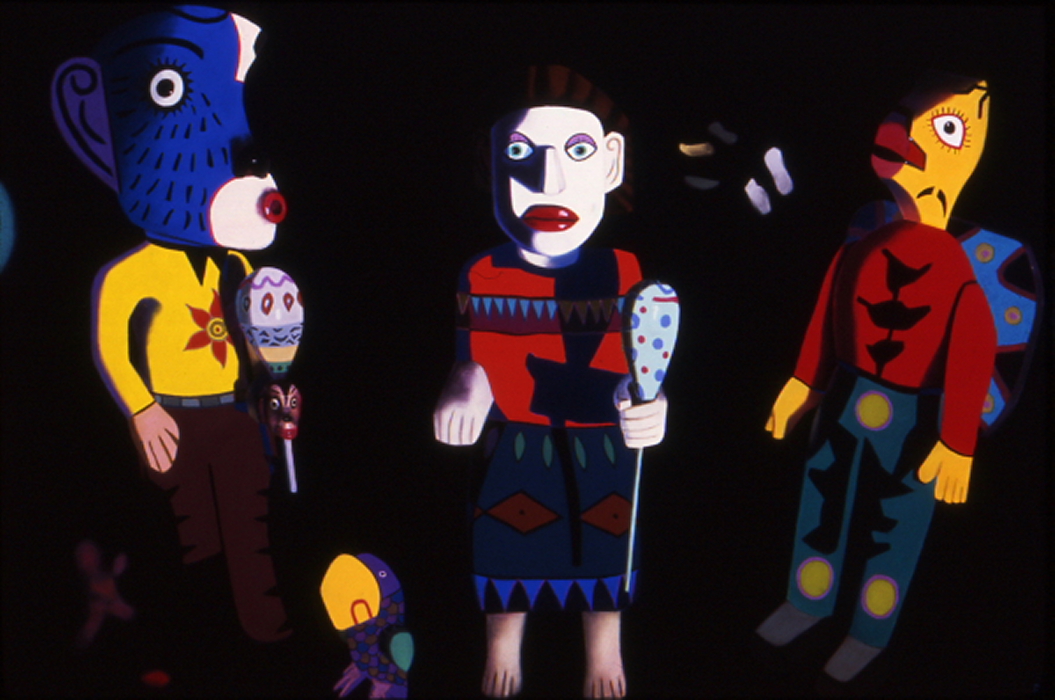
“False Friends,” 50” x 70,” one of Cheryll and John’s pastel paintings
A: There are many reasons to continue to make art. First, I am fascinated by my months- if not years-long creative process. It begins with travel to remote destinations and ends in framed pastel paintings in my studio, hanging in galleries, at art fairs, in collectors’ homes, etc. Each new pastel painting is another thread in an expanding tapestry that is my entire body of work. It’s fascinating to never know where the process, or the paintings, will end up nor who will be touched by the work.
My pastel paintings continue to garner appreciation among a growing list of collectors. Here’s a recent email from a couple that has been collecting my work from the beginning.
hello barbara,
merry christmas!
we are thrilled and thrilled and thrilled for your good news from miami and naples.
. . . “tense peace, a tumultuous stillness” . . .
we know we love you and we love your work.
how lucky are we to live with your work in our home, in our lives.
we love to read how others describe it.
thanks for sharing.
happy us to have you and your art in our lives,
love to you,
john & cheryll
your work stopped me in my tracks decades ago.
the sight of your work never left me.
i knew that i had to have it near me at some time, no matter what the cost.
i began immediately to negotiate with john.
you know the story . . .
i promised that i would not buy a single thing for five years if i could have one piece of your art.
i held true for the five years and beyond, adding three more pieces of your work.
if we had the wherewithal, your work would be on every floor.
there is never a day that goes by without thinking how brilliant that work is and how it has enriched our deepest sense of visual joy.
we see the rain pouring down, the snow falling, the clouds scudding by, in false friends.
i admit, we don’t allow the sun to shine on them. i couldn’t bear for her to be damaged.
your thoughtful, brilliant words kept us from changing the highly-reflective plexi to something that would have dulled the drama of us walking in front of and being a part of the work.
we still have those words.
it took about one-half of one second for my thinking to change.
and, man, are we grateful.
it never occurred to us that your work wouldn’t be sought after.
always, we walk into a museum and see your work on the walls.
on the walls of the hemi-cycle at the corcoran.
on the walls of the whitney.
on the walls of the met breurer.
on any large white space that would allow each piece to breathe.
we have always known, deep in our marrow that your work is singular.
you have always had our hearts . . . since the second i walked into the torpedo factory, a first-grade teacher with a first-grade teacher’s salary, and knew that i’d sell my honda civic and walk rather than not have in reality, the frogs thought they were men (i know that the title of the piece is something like that . . . the decades have blurred the words).
so, we waited and then . . .
sigh . . .
all the best to you.
we are excited out of our ever-loving minds for you.
but . . . we’ve always known . . .
love,
c & j
Comments are welcome!
Q: I have been always fascinated with the re-contexualizing power of Art and with the way some objects or even some concepts often gain a second life when they are “transduced” on a canvas or in a block of marble. So I would like to ask you if in your opinion, personal experience is an absolutely indespensable part of a creative process. Do you think that a creative process could be disconnected from direct experience?
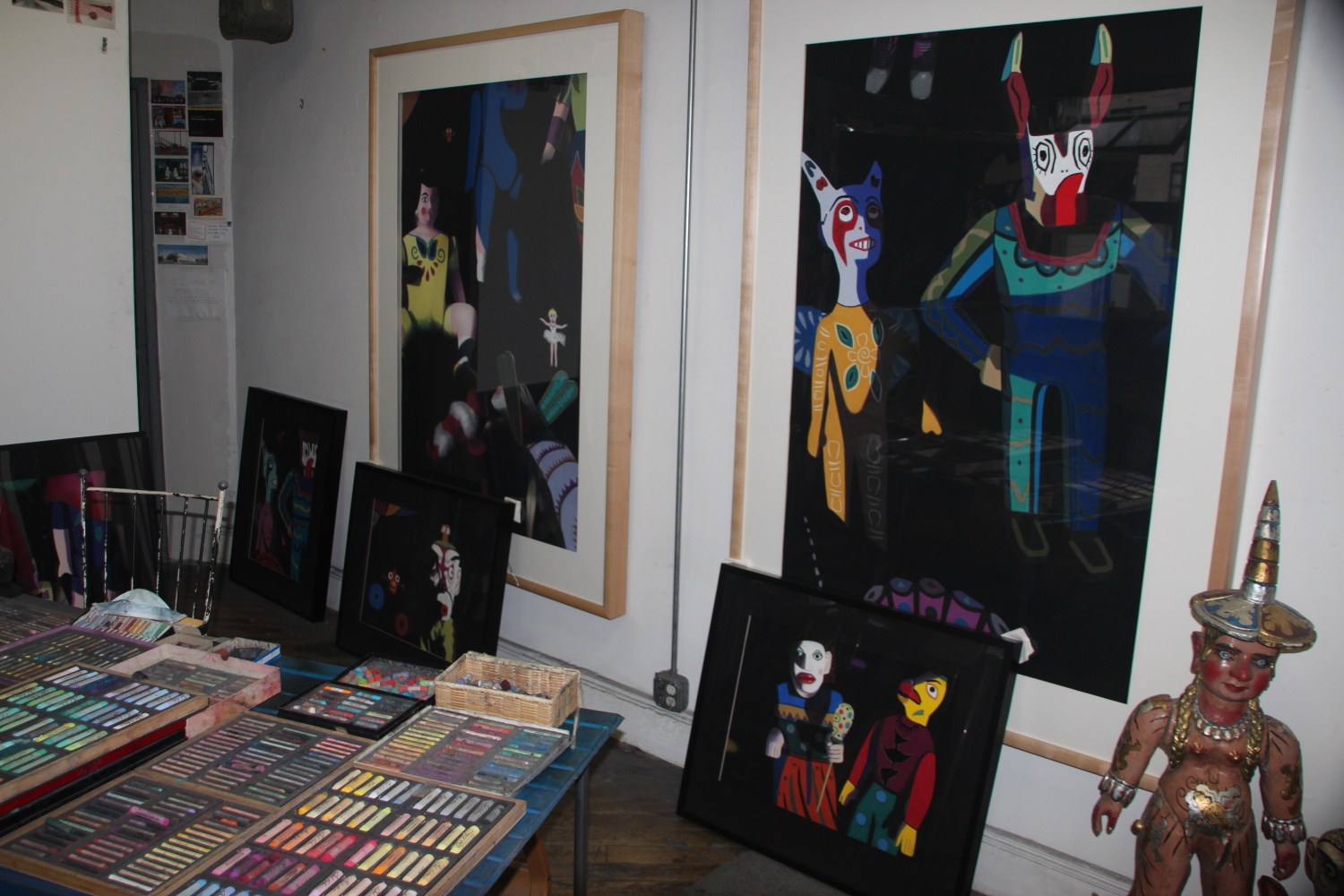
Barbara’s studio
A: Certainly personal experience is an indispensable and inseparable part of the creative process. For me art and life are one and I suspect that is true for most artists. When I look at each of my pastel paintings I can remember what was going on in my life at the time I made it. Each is a sort of veiled autobiography waiting to be decoded and in a way, each is also a time-capsule of the larger zeitgeist. It’s still a mystery how exactly this happens but all lived experience – what’s going on in the world, books I’m reading and thinking about, movies I’ve seen that have stayed with me, places I’ve visited, etc. – overtly and/or not so obviously, finds its way into the work.
Life experience also explains why the work I do now is different from my work even five years ago. In many ways I am not the same person.
The inseparableness of art and life is one reason that travel is so important to my creative process. Artists always seek new influences that will enrich and change our work. To be an artist, indeed to be alive, is to never stop learning and growing.
Comments are welcome!
Pearls from artists # 19
View from the balcony
* an ongoing series of quotations – mostly from artists, to artists – that offers wisdom, inspiration, and advice for the sometimes lonely road we are on.
What one writes at twenty-one is a cry, does one think of a cry that it ought to have been cried differently? The language is still so thin about one in these years, the cry pierces through and just takes along what is left clinging to it. The development will always be this, that one makes one’s language fuller, thicker, firmer (heavier), and of course there is sense in that only for one who is sure that the the cry too is growing in him ceaselessly, irresistibly, so that later, under the pressure of countless atmospheres, it will issue evenly from every pore of the almost impenetrable medium…
Talent, you understand, scarcely has significance any more in our day, since a certain dexterity of expression has become general, where is it not? Hence succeeding still means something only where the highest, utmost is achieved, and then one is again liable to think that just this unsurpassable something, once it appears in person, is in itself successful.
And so there is no real ground for concern, only that we want never to remain behind our heart and never to be in advance of it: that is probably needful. Thus we arrive at everything, each at what is his.
Jane Bannard Greene and M.D. Herter Norton editors, Letters of Rainer Maria Rilke 1910 – 1926
Comments are welcome!


 barbararachkoscoloreddust.com