Blog Archives
Pearls from artists* # 631

*an ongoing series of quotations – mostly from artists, to artists – that offers wisdom, inspiration, and advice for the sometimes lonely road we are on.
I could see motion when I looked at Julie’s work. Her hand had moved there, in that way. She’d chosen this blue over that one. Seeing the act of creation – the way a work doesn’t come out fully formed but grows by fits and starts – made we aware of how delicate and fragile an artwork was. How improbable it was that it existed. Someone had agonized over this square inch. They’d poured themselves into that flink of a line. I thought of the bewildering piles of supplies I’d seen in studios: Vaseline, turpentine, wax, Q-tips, chopsticks, marble dust. It’s not magic that makes a piece. All the Hollywood visions of possessed artists throwing pieces together in a trance-like state overlooked the fact that this was work. Each piece may have started with an idea, but there was more to it than that. “An idea is not a painting,” Julie said, as she worked, her nose practically grazing the canvas. She was already thinking ahead to how she’d fix the brushyness of the tights, maybe go over the shoes again. The soul of the artwork needed a body. Seeing Julie work gave me a path to follow into the piece.
Bianca Bosker in Get the Picture: A Mind-Bending Journey Among the Inspired Artists and Obsessive Art Fiends Who Taught Me How to See
Comments are welcome!
Pearls from artists* # 593
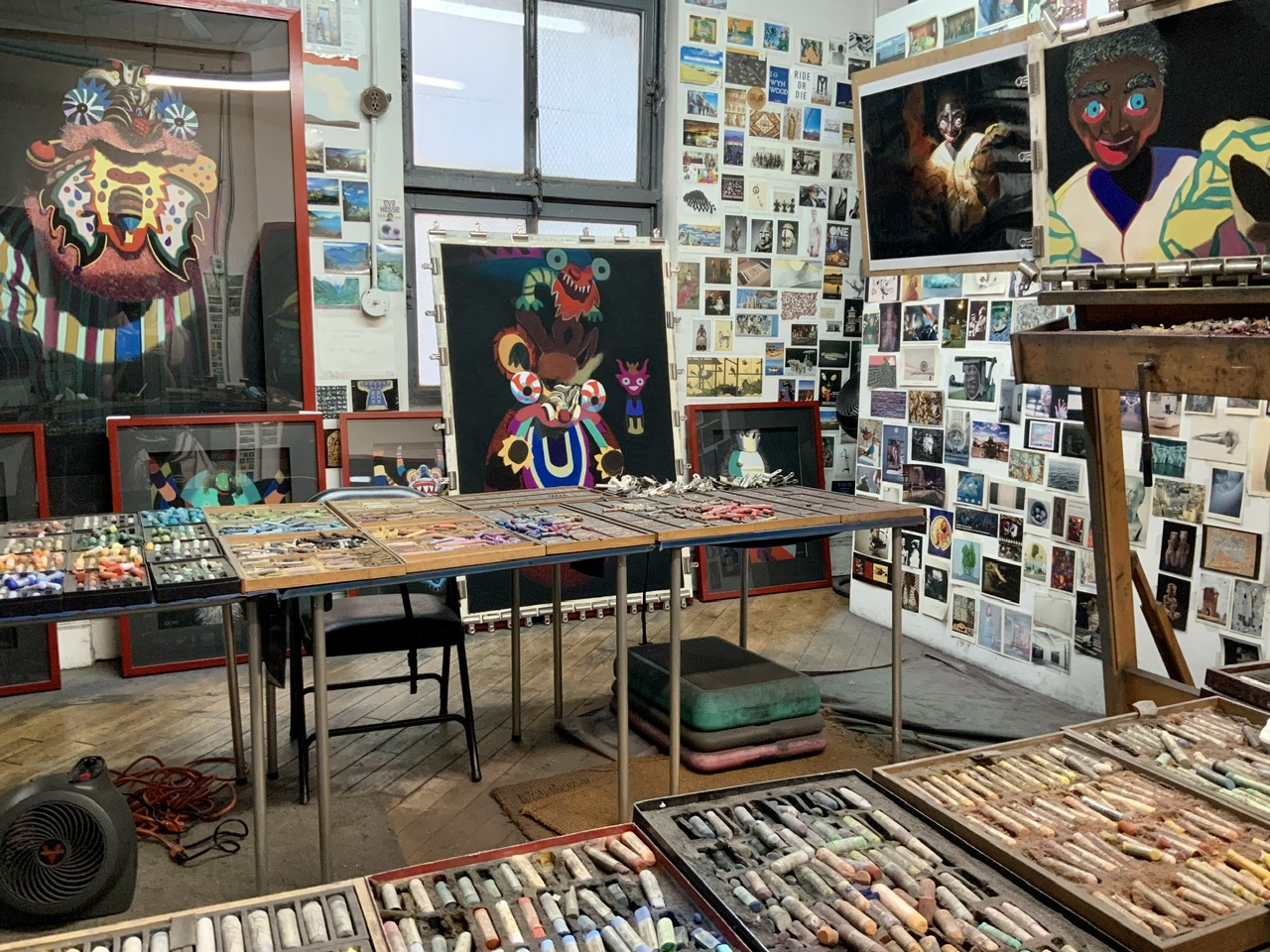
Barbara’s Studio with work in progress
*an ongoing series of quotations – mostly from artists, to artists – that offers wisdom, inspiration, and advice for the sometimes lonely road we are on.
Falling in love with beauty or with someone else’s artwork that touches us is easy. We can experience the rapture of it and go home. But falling in love with our instrument or with our work is more like falling in love with a person, in that we experience the rapture and delight of the discovery, but then we are saddled with the effort of fulfillment, with love’s labors and the hard lessons in which illusions are stripped away, in which we confront difficult pieces of self-knowledge, in which we have to stretch our physical, emotional, intellectual stamina to its limits, in which our patience and our ability to persevere and transcend ourselves are tested.
Stephen Nachmanovitch in Free Play: Improvisation in Life and Art
Comments are welcome!
Pearls from artists* # 592
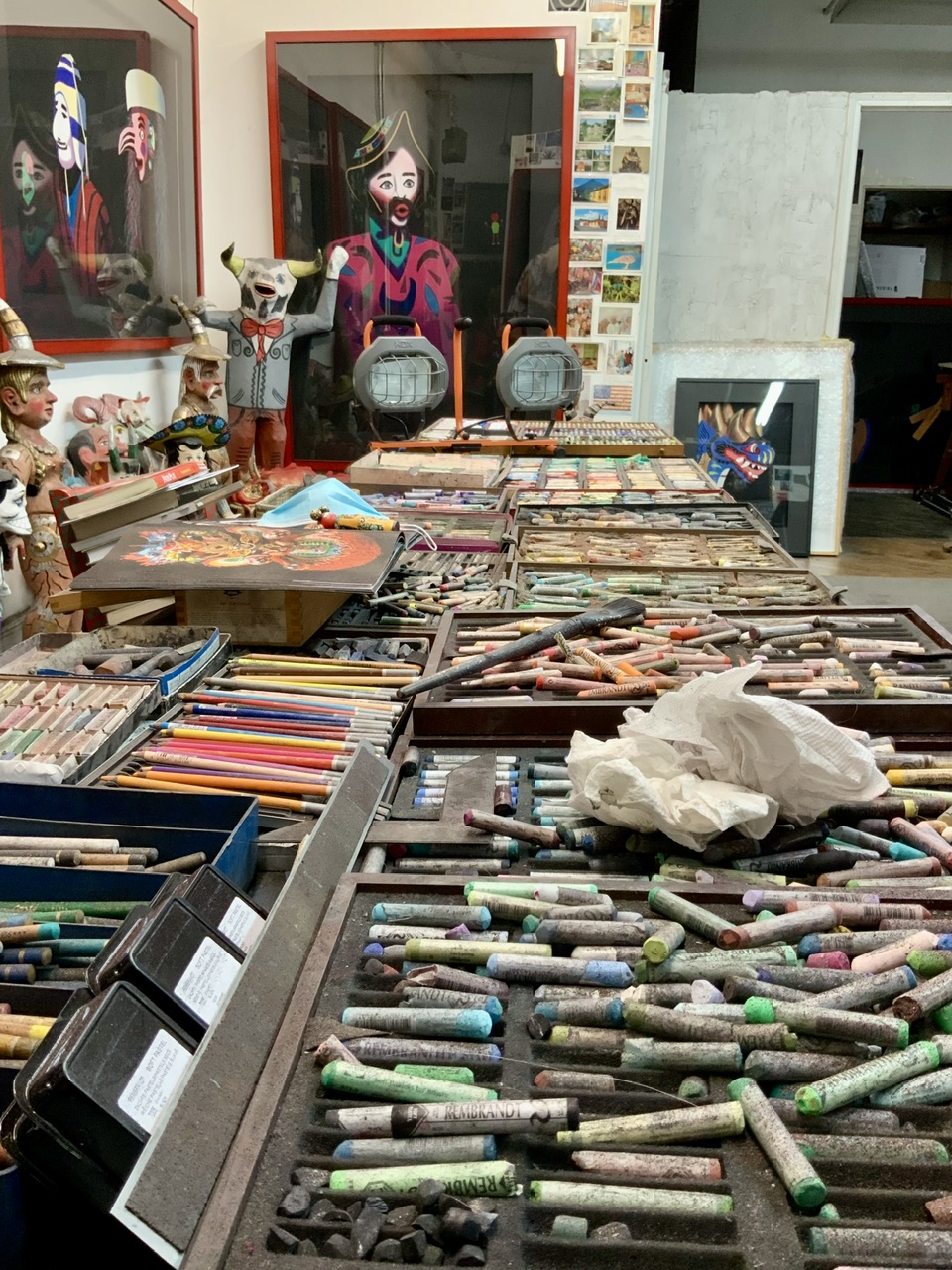
The Studio
*an ongoing series of quotations – mostly from artists, to artists – that offers wisdom, inspiration, and advice for the sometimes lonely road we are on.
There are millions of ways of composing and structuring artwork. Each piece, whether improvised or written down, danced or painted, can evolve its own structure, its own world. The word creative comes from “to make grow,” as in the act of cultivating plants. We grow or evolve a set of rules to incorporate the unfolding of our imagination. We create new rules of progression, fresh channels in which play can flow.
Stephen Nachmanovitch in Free Play: Improvisation in Life and Art
Comments are welcome!
Pearls from artists* # 588

Screen shot from “Barbara Rachko: True Grit” Photo: Jennifer Cox
*an ongoing series of quotations – mostly from artists, to artists – that offers wisdom, inspiration, and advice for the sometimes lonely road we are on.
The structure of the hand is not… “just anything;” the fingers have certain characteristic relationships, certain ranges of relative movement, certain kinds of crossing, torquing, jumping, sliding, pressing, releasing movements that guide the music to come out a certain way. Graceful work uses those patterns and instinctively moves through them and out as we find ever-fresh combinations. The shape and size of the human hand brings powerful but subtle laws into every kind of art, craftsmanship, mechanical work, and into our ideas and feelings as well. There is a continuous dialogue between hand and instrument, hand and culture. Artwork is not thought up in consciousness and then, as a separate phase, executed by the hand. The hand surprises us, creates and solves problems on its own. Often enigmas that battle our brains are dealt with easily, unconsciously, by the hand.
Stephen Nachmanovitch in Free Play: Improvisation in Life and Art
Comments are welcome!
Pearls from artists* # 472
*an ongoing series of quotations – mostly from artists, to artists – that offers wisdom, inspiration, and advice for the sometimes lonely road we are on.
A remark by Kurt Anderson suggests how the Internet discourages patient gazing: “Waiting a while to get everything you want… was a definition of maturity. Demanding satisfaction right this instant, on the other hand, is a defining behavior of seven-year-olds. The powerful appeal of the Web is not just the ‘community’ it enables but its instantane-ity… as a result… delayed gratification itself came to seem quaint and unnecessary.” A survey commissioned by the Visitor Studies Association reveals the impact of impatience. On average, the survey found, Americans spend between six and ten seconds looking at individual works in museums. (Is it just a coincidence that six to ten seconds is also the average time browsers perch on any given Web page?) Yet how many hours a day do we spend absorbed by one or another electronic screen? For the Los Angeles artist Ed Ruscha (born 1937) brief encounters won’t suffice. When somebody asked, “How can you tell good art from bad?” Ruscha replied, “With a bad work you immediately say, ‘Wow!’ But afterwards, you think, ‘Hum? Maybe not.’ With a good work, the opposite happens.” Time is lodged at the heart of Ruscha’s formula, as the artwork becomes part of our temporal experience. In order to know what is good, we need to take a breather. Even to know what is bad, we need to pause.
Arden Reed in Slow Art: The Experience of Looking, Sacred Images to James Turrell
Comments are welcome!
Pearls from artists* # 469

*an ongoing series of quotations – mostly from artists, to artists – that offers wisdom, inspiration, and advice for the sometimes lonely road we are on.
I feel artists are at the cutting edge of everything created by humans in our society. I would love for artists, young and old, to remember that for the Art World to exist, the first thing that is necessary is art. No gallerist, museum director, preparatory, or museum guard would have a job without an artwork having been created.
Without remembering this, artists can lose sight of their power and worth. We begin to believe that the Art World came first and that we need to change, appropriate, adjust, or edit ourselves and our work to fit into this world. This does not need to happen, and should not happen.
Stephanie Diamond, artist, New York, NY, in Art/Work: Everything You Need to Know (And Do) As You Pursue Your Art Career by Heather Darcy Bhandari and Jonathan Melber
Comments are welcome!
Pearls from artists* # 268

The Lightning Field, Quemado, NM
* an ongoing series of quotations – mostly from artists, to artists – that offers wisdom, inspiration, and advice for the sometimes lonely road we are on.
Visit 1: October 18 and 19, 2003, continued
The long drive through the New Mexico landscape from Albuquerque to Quemado to The Lightning Field is a gradual slide towards emptiness, a prelude. Or a subtle preparation for the eyes and mind. The practicalities of the cabin provide simple accommodations that address basic needs to maximize focus and minimize distraction.
At The Lightning Field, my experience of space began with the rational structure of the grid, which was eventually exposed by less rational behavior.
The artwork locates the physical environment in space, and my perception of the work began with the regularity of the grid. The repeated unit of the pole was not significant, only its holistic engagement between human scale and the landscape of the sky. Then the effects of light, the anticipation of cycles of change through the course of the day and night, the possibility of the unpredictable.
Laura Raicovich in At The Lightning Field
Comments are welcome!
Q: Can you discuss your process, including how you actually use Mexican and Guatemalan folk art figures in your art?

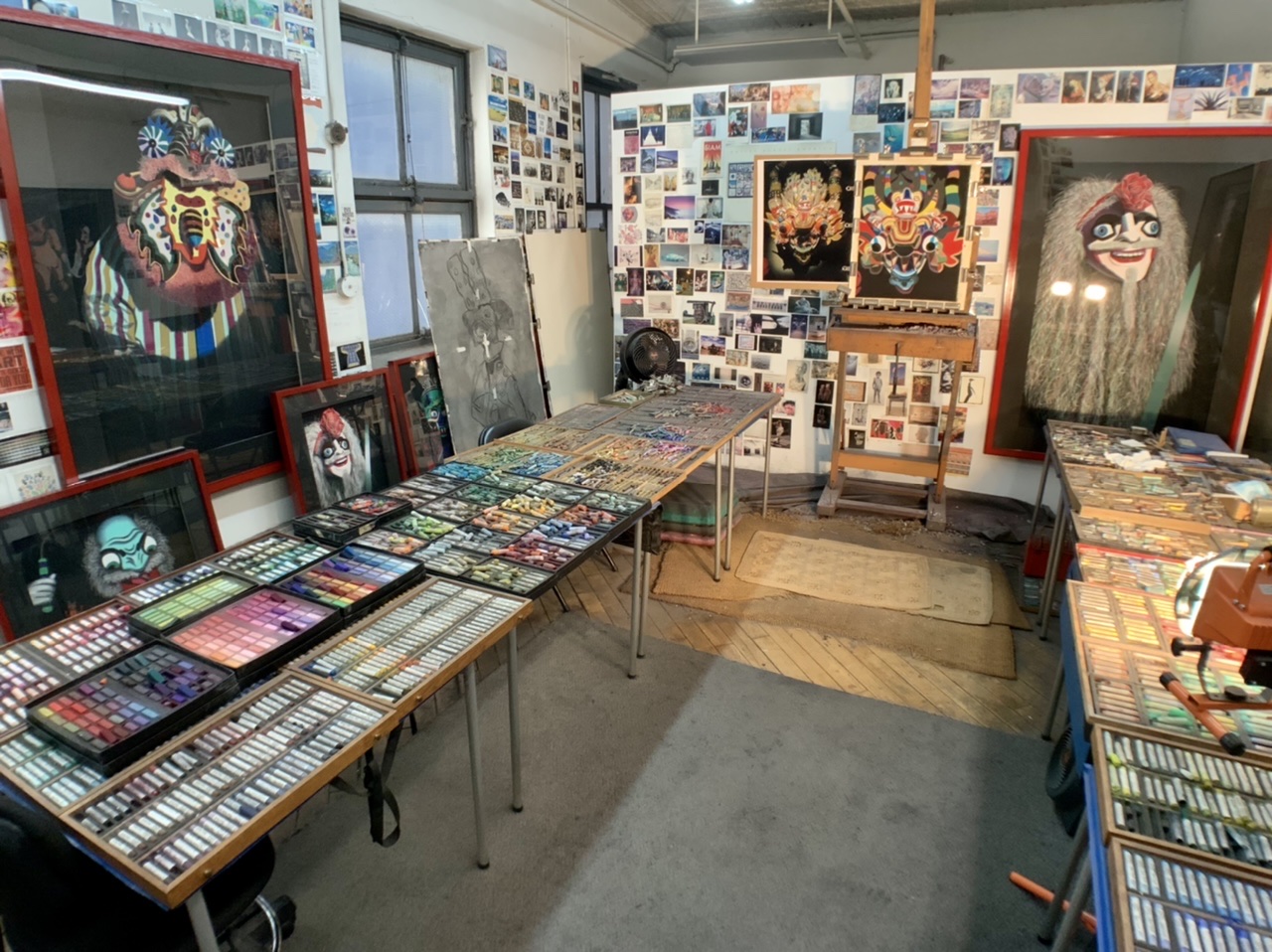
A corner of Barbara’s studio
A: When I set up the figures to photograph for a painting, I work very intuitively, so how I actually cast them in an artwork is difficult to say. Looks count a lot – I select an object and put it in a particular place, look at it, move it or let it stay, and sometimes develop a storyline. I spend time arranging lights and looking for interesting cast shadows. With my first “Domestic Threats” series, all of this was done so that Bryan, my late husband, or I could shoot a couple of negatives with his Toyo Omega 4″ x 5″ view camera. For my “Black Paintings” series, begun in 2007, I shoot medium format negatives with a Mamiya 6 camera.
I always look at a 20″ x 24″ photograph for reference as I make a pastel-on-sandpaper painting, plus I also work from the ‘live’ objects. The photograph is mainly a catalyst because finished paintings are always quite different from their associated reference photos. Also, since I spend months creating them, the paintings’ interpretative development goes way beyond that of the photo.
I once completed 6 large (58” x 38”) pastel paintings in a single year, but more recently 4 or 5 per year is common. It takes approximately 3 months to make each one. During that time I layer and blend together as many as 25 to 30 layers of pastel. Of course, the colors get more intense as the painting progresses and the pigment accumulates on the sandpaper.
Comments are welcome!
Q: How do you begin a photograph?

Untitled chromogenic print, 24″ x 24″, edition of 5
A: It always begins in my mind long before I actually start making it. By the time I take the photograph, I’ve already thought deeply about the possibilities, the formal arrangements, meanings, etc. so that setting up the objects, lighting them, and clicking the shutter feels like a reward after a long thought process. My fine art photographs are finished works in themselves. However, when I select one to use as reference for a pastel painting, a different but related process of working out my ideas and translating them into pastel occurs over the next several months spent in the studio. Of course, in that case the photo becomes only the starting point for an entirely new artwork.
Comments are welcome!
Q: What is it about soft pastel that you find so intriguing that you use it as your primary fine art medium?

Some of Barbara’s pastels
A: For starters it’s the medium that I fell in love with many years ago. I recently read this article online, “What is Pastel?” by Mike Mahon, and will quote it because it neatly sums up what I love about working with pastel.
Pastel is the most permanent of all media when applied to conservation ground and properly framed. Pastel has no liquid binder that may cause it to oxidize with the passage of time as oftentimes happens with other media.
In this instance, Pastel does not refer to pale colors, as the word is commonly used in cosmetic and fashion terminology. The pure, powdered pigment is ground into a paste with a minimum amount of gum binder, rolled into sticks and dried. The infinite variety of colors in the Pastel palette range from soft and subtle to hard and brilliant.
An artwork is created by stroking the stick of dry pigment across an abrasive ground, embedding the color in the “tooth” of the ground. If the ground is completely covered with Pastel, the work is considered a Pastel painting; whereas, leaving much of the ground exposed produces a Pastel sketch. Techniques vary with individual artists. The Pastel medium is favored by many artists because it allows a spontaneous approach. There is no drying time, therefore, no change in color occurs after drying as it does in other media.
Did you know that a particle of Pastel pigment seen under a microscope looks like a diamond with many facets? It does! Therefore, Pastel paintings reflect light like a prism. No other medium has the same power of color or stability.
Historically, Pastel can be traced back to the 16th century. Its invention is attributed to the German painter, Johann Thiele. A Venetian woman, Rosalba Camera, was the first to make consistent use of Pastel. Chardin did portraits with an open stroke, while La Tour preferred the blended finish. Thereafter, a galaxy of famous artists—Watteau, Copley, Delacroix, Millet, Manet, Renoir, Toulouse Lautrec, Vuillard, Bonnard, Glackens, Whistler, Hassam, William Merritt Chase—used Pastel for a finished work rather than for preliminary sketches.
Pastels from the 16th century exist today, as fresh as the day they were painted. Edgar Degas was the most prolific user of Pastel and its champion. His protégé, Mary Cassat, introduced Pastel to her friends in Philadelphia and Washington, and thus to the United States. In the Spring of 1983, Sotheby Parke Bernet sold at auction, two Degas Pastels for more than $3,000,000 each! Both Pastels were painted about 1880.
Note: Do not confuse Pastel with “colored chalk.” Chalk is a porous, limestone substance impregnated with dyes, whereas, Pastel is pure pigment—the same as is used in other permanent painting media.
Today, Pastel paintings have the stature of oil and watercolor as a major fine art medium. Many of our most renowned, living artists have distinguished themselves in Pastel and have enriched the art world with this beautiful medium.
So knowing all this, I often wonder, why don’t more artists use pastel? Is it because framing is a big issue? Works on paper need to be framed and pastel paintings have unique problems (see my April 27, 2013 blog post). Second only to the cost of maintaining a studio in New York City, frames are my single largest business expense. Sometimes I am grateful that pastel is a very slow medium. I typically finish 4 or 5 paintings in a year, which means I only have to pay for 4 or 5 frames!
Comments are welcome!


 barbararachkoscoloreddust.com