Blog Archives
Q: You take 3-4 months to complete one artwork. How do you plan a series such as Bolivianos over a year’s timeline and over the years? (Question from Vedica Art Studios and Gallery)

A: Bolivianos is my third series, and like the previous two, it naturally evolves from one painting to the next. There wasn’t a long-term plan involved, and I doubt such detailed planning would even be practical. Many artists likely work this way—finishing one project and then beginning another. As with Bolivianos, I typically have ideas for the next two or three paintings, but little concept beyond that.
The main impetus for Bolivianos was to continue work I began in the early 1990s. During a visit to La Paz, I captured a series of stunning photographs, inspiring me to translate them into a major pastel series. Each painting leads to ideas about the next, guiding the entire series’ evolution and shaping my understanding of its meaning. Both the series and my insights deepen as I engage further with the subject matter. The Bolivian Carnival masks I photographed provided the starting point for a long and continuing intellectual journey.
Comments are welcome!
Q: Over your 40-year career as an artist, you have managed to keep presentation, technical, subject matter, conceptual consistencies in your art practice and work. How do you manage to filter out inspirations that might be luring at that moment but do not support your art practice? For example, you master pastel works. There must have been moments when you might have been inspired to make oil works. How do you keep such inspirations aside. (Question from Vedica Art Studios and Gallery)

A: About thirty-five years ago, when my pastel paintings were becoming larger—around 60” x 40”—I had to choose between transitioning to oil on canvas or continuing with pastel. Framing was the main concern. I wasn’t certain large pastels could be framed, and even if they could, the cost might be prohibitive. However, I had already fallen in love with pastel and knew no other medium could offer such vibrant colors or velvety textures. Determined, I resolved the framing issue (art-making is fundamentally problem-solving), committed myself fully to soft pastel, and have continued inventing and refining techniques ever since.
My goal from the beginning has always been improvement as an artist. If an activity doesn’t contribute to my growth—as a person or as an artist—I typically don’t pursue it. Time and energy are finite resources, so I try to use them wisely.
Comments are welcome!
Q: Have you noticed any common characteristics among the people who collect your work?

“Poseur,” soft pastel on sandpaper, 70” x 50” framed
A: Yes! They are fascinating people living lives devoted to nonstop learning, adventurous travel, and other proactive pursuits. Collectors of my work typically range in age from 40 to around 80. They are college graduates with advanced degrees. Sometimes they don’t have kids, which is why they have disposable income and time to pursue their interests in art and culture.
When I meet them (presuming my work was sold through a gallery or other third party), we usually have much to talk about – art, art history, photography, cinema, film history, dance, drama, music, travel, archaeology, Mexico, Central and South America, Bali – the list goes on and on. With so much in common, we quickly become good friends!
Comments are welcome!
Q: You use so many pastels in your work. Do you have a favorite?

Barbara’s Studio
A: When people ask if I have a favorite pastel among the thousands in my studio, I am quick to answer, “Rembrandt black pastel!” This is the single color that I use the most. I buy them by the dozens because it takes many layers of pigment – applied and hand-blended together, one on top of the other, on sandpaper – to achieve the intense black backgrounds that distinguish my “Bolivianos” series of pastel paintings. Typically, I use up a minimum of two or three Rembrandt pastels to create these backgrounds. A few years ago one New York art critic cleverly dubbed them, “Barbara’s black-grounds.” How cool is that!
Comments are welcome!
Q: Can you elaborate on the title of your very first series, “Domestic Threats”?

A: All of the paintings in this series are set in places where I reside or used to live, either a Virginia house or New York apartments, i.e., domestic environments. Each painting typically contains a conflict of some sort, at least one figure who is being menaced or threatened by a group of figures. So I named the series “Domestic Threats.”
Depending on what is going on in the country at a particular moment in time, however, people have seen political associations in my work. When my husband, Bryan, was killed on 9/11, many people thought the title, “Domestic Threats,” was prescient. They have ascribed all kinds of domestic terrorism associations to it, but that is not really what I had in mind. For a time some thought I was hinting at scenes of domestic violence, but that also is not what I had intended. “Domestic Threats” seems to be fraught with associations that I never considered, but it’s an apt title for this body of work.
Comments are welcome!
Q: What would you say collectors of your work have in common?
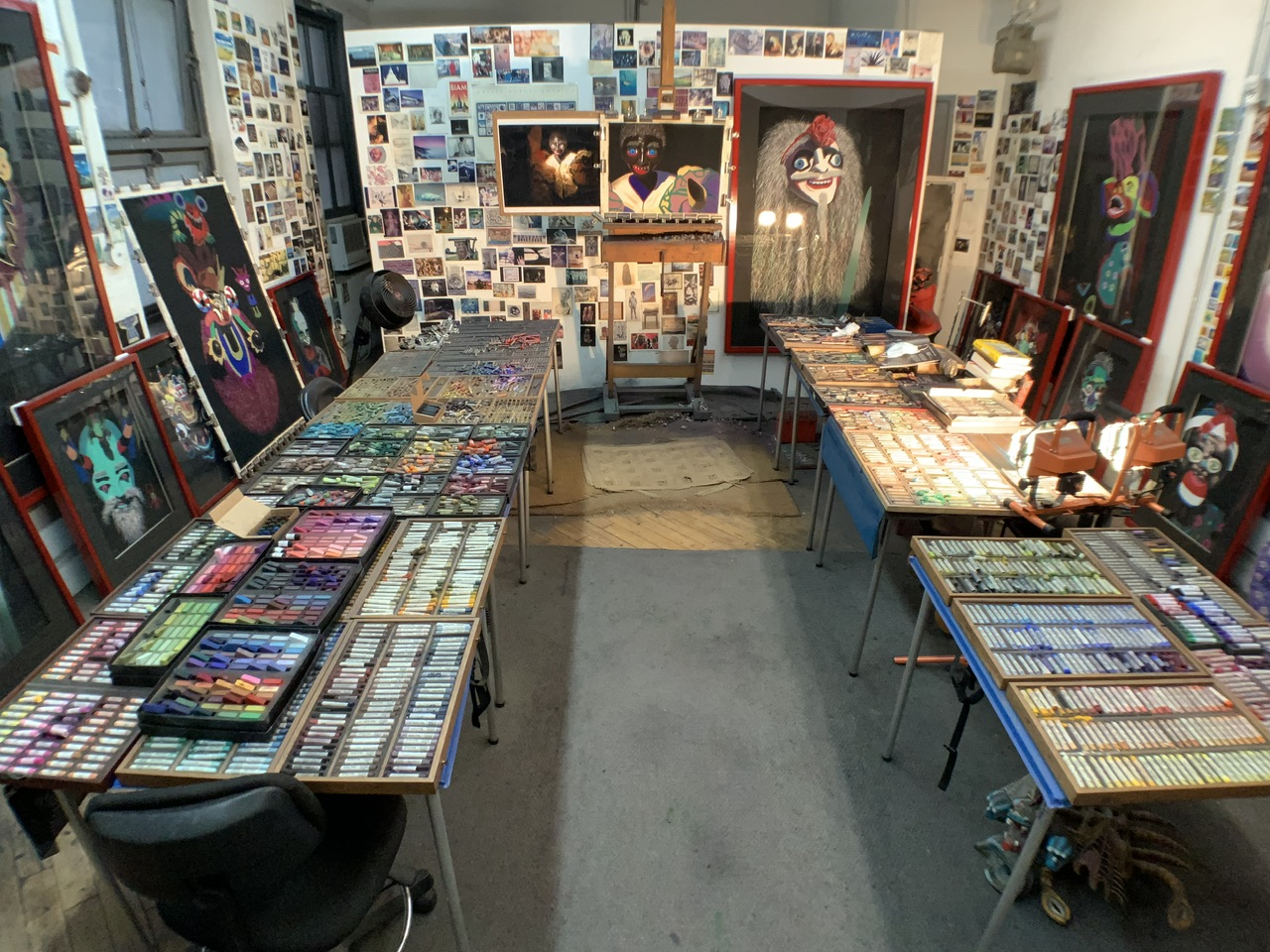
Barbara’s Studio
A: That’s a great question! I’d say that collectors of my work typically range in age from about 40 to their late 70s, they are college graduates with advanced degrees, they often don’t have kids, which is why they have disposable income and time to pursue their interests in art and culture. When I meet them (presuming my work was sold through a gallery or other third party), we usually have much to talk about – art, art history, photography, cinema, film history, dance, drama, music, travel, archaeology, Mexico, Central and South America, India, Asia – the list goes on and on.
Comments are welcome!
Q: What do your collectors have in common?

Screenshot from “Barbara Rachko: True Grit,” Photo: Jennifer Cox
A: Generally speaking, the people who collect my work typically range in age from about 40 to the late 70s, they are college graduates with advanced degrees, and they often don’t have kids, which is why they have disposable income and time to pursue their interests in art and culture. When I meet them (presuming my work was sold through a gallery or other third party), we usually have much to talk about – art, art history, photography, cinema, film history, dance, drama, music, travel, archaeology, Mexico, Central and South America, Bali, India – the list goes on and on.
Comments are welcome!
Q: What does it feel like when you dop off a pastel painting at your Virginia framer’s shop? Are you sorry to see it go? (Question from Caroline Golden)
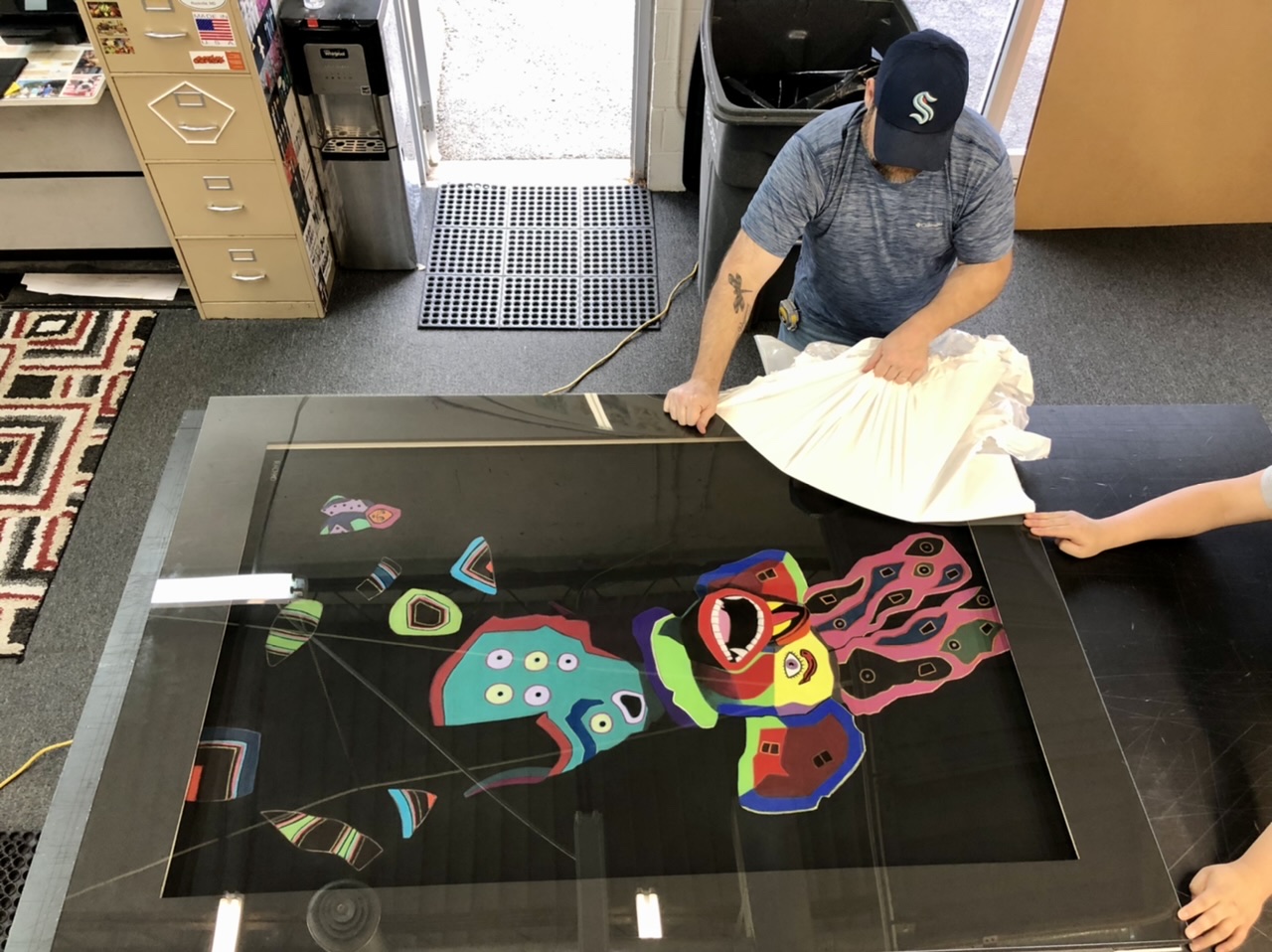
A: Actually, just the opposite since I have been looking at it on my easel for more than three months. Typically, I’m glad to say goodbye – temporarily – because I know when I pick it up in a month, I will have gained some distance and can begin to see and think about it more objectively. I can start reflecting on how this pastel painting relates to my overall body of work.
Comments are welcome!
Q: What art project(s) are you working on currently? What is your inspiration or motivation for this? (Question from artamour)
A: While traveling in Bolivia in 2017, I visited a mask exhibition at the National Museum of Ethnography and Folklore in La Paz. The masks were presented against black walls, spot-lit, and looked eerily like 3D versions of my Black Paintings, the series I was working on at the time. I immediately knew I had stumbled upon a gift. To date I have completed seventeen pastel paintings in the Bolivianos series. One awaits finishing touches, another is in progress, and I am planning the next two, one large and one small pastel painting.
The following text is from my “Bolivianos” artist’s statement.
“My long-standing fascination with traditional masks took a leap forward in the spring of 2017 when I visited the National Museum of Ethnography and Folklore in La Paz, Bolivia. One particular exhibition on view, with more than fifty festival masks, was completely spell-binding.
The masks were old and had been crafted in Oruro, a former tin-mining center about 140 miles south of La Paz on the cold Altiplano (elevation 12,000’). Depicting important figures from Bolivian folklore traditions, the masks were created for use in Carnival celebrations that happen each year in late February or early March.
Carnival in Oruro revolves around three great dances. The dance of “The Incas” records the conquest and death of Atahualpa, the Inca emperor when the Spanish arrived in 1532. “The Morenada” dance was once assumed to represent black slaves who worked in the mines, but the truth is more complicated (and uncertain) since only mitayo Indians were permitted to do this work. The dance of “The Diablada” depicts Saint Michael fighting against Lucifer and the seven deadly sins. The latter were originally disguised in seven different masks derived from medieval Christian symbols and mostly devoid of pre-Columbian elements (except for totemic animals that became attached to Christianity after the Conquest). Typically, in these dances the cock represents Pride, the dog Envy, the pig Greed, the female devil Lust, etc.
The exhibition in La Paz was stunning and dramatic. Each mask was meticulously installed against a dark black wall and strategically spotlighted so that it became alive. The whole effect was uncanny. The masks looked like 3D versions of my “Black Paintings,” a pastel paintings series I have been creating for ten years. This experience was a gift… I could hardly believe my good fortune!
Knowing I was looking at the birth of a new series – I said as much to my companions as I remained behind while they explored other parts of the museum – I spent considerable time composing photographs. Consequently, I have enough reference material to create new pastel paintings in the studio for several years. The series, entitled “Bolivianos,” is arguably my strongest and most striking work to date.”
Comments are welcome!
Q: How many pastel paintings do you have in progress now?
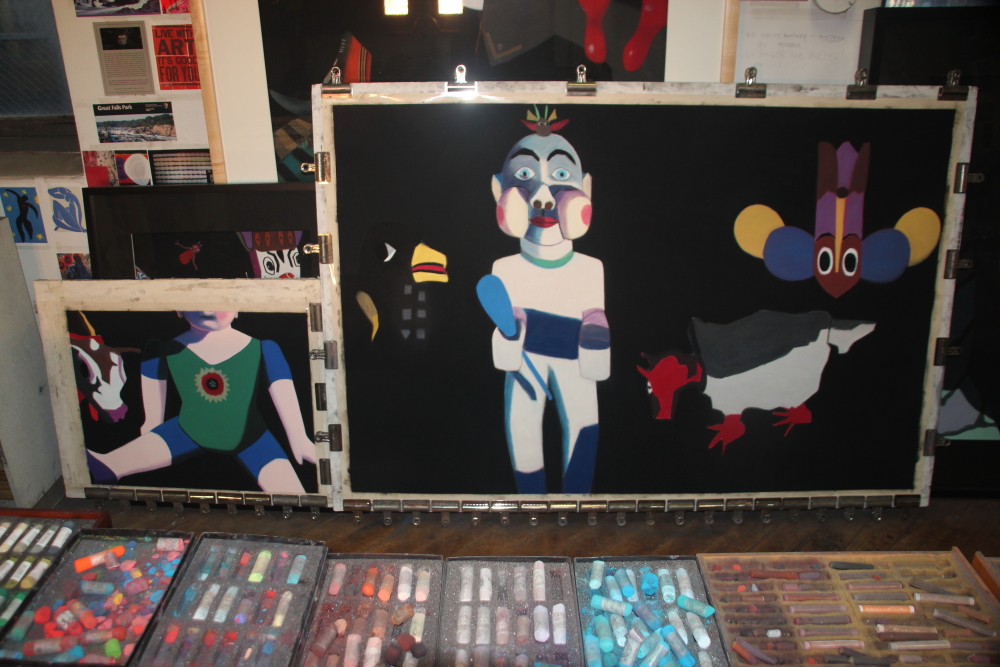
Work in progress
A: Making pastel-on-sandpaper paintings is a slow and meticulous process. I work full-time in my studio so that in a good year I can produce five finished pieces. Typically two are in progress at a time so that I can switch off when problems develop.
A downside to looking at a painting for months is that there comes a point when I can’t see the flaws any more. Then it’s definitely time to take a break.
When I put a painting that has been resting back onto my easel, I see it with fresh eyes again. Areas that need work immediately stand out. Problem areas become easily resolvable because I have continued to think about them while the painting was out of my sight.
Comments are welcome!


 barbararachkoscoloreddust.com