Blog Archives
Pearls from artists* # 693

*an ongoing series of quotations – mostly from artists, to artists – that offers wisdom, inspiration, and advice for the sometimes lonely road we are on.
Earlier I wrote that I as an artist must concern myself with painting and not waste energy on trying to decipher other people’s intentions or motives. I still believe this to be correct.
(My main purpose in life is to paint, this is my profession. I am most happy when I am alone in the studio working. The other problems of politics exist outside my studio.)
note: I am not sure of this. I am sure of one thing that I am most happy when I am alone working in the studio. The distance between art + politics is one of grey. I have thought of my involvement in art as being one of combat—the paintings are weapons designed to destroy oppressors i.e., the establishment. Art is none of This! Art is Art.
A painting does not represent anything but itself. It shouldn’t look like anything else or make for any allusions. A painting is a painting just as a Rose is a Rose! May God bless Gertrude Stein!
Jack Whitten Notes From the Woodshed
Comments are welcome!
Pearls from artists* # 655

*an ongoing series of quotations – mostly from artists, to artists – that offers wisdom, inspiration, and advice for the sometimes lonely road we are on.
My creative friends are some of the most hard-working, motivated people I know. While many non-artists have nine-to-five jobs and then relax at home, our work is never done. Yet, we are bombarded with tropes in books, movies, and television suggesting that we have chosen a ‘slacker’ profession. Even wildly successful artists can have family members who think they are self-absorbed, or that they should ‘get a real job.’ According to genius and award-winning filmmaker, Werner Herzog, his brother still routinely makes fun of his profession (Brooks, 2020). Some may call us selfish and tell us that we are only looking for attention, or feeding our egos. They may ask, “When are you going to grow up?” or ignorantly proclaim, “How nice it must be to only work when you want to.” Regardless of intention, this is not support.
Kate Kretz in Art From Your Core: A Holistic Guide to Visual Voice
Comments are welcome!
Q: When did you begin drawing and painting? (Question from “Cultured Focus Magazine”)
A: This is a long story because my path to becoming a professional artist has been unusually circuitous.
I grew up in a blue collar family in suburban New Jersey. My parents were both first-generation Americans and no one in my family had gone to college. I was a smart kid, who showed some artistic talent in kindergarten and earlier. At the age of 6, my sister, my cousin, and I enrolled in Saturday morning painting classes at the studio of a local artist. I continued the classes for about 8 years and became a fairly adept oil painter.
At the age of 15 my father decided that art was not a serious pursuit – he called it a hobby, not a profession – and abruptly stopped paying for my Saturday morning lessons. Unfortunately, there were no artists or suitable role models in my family. So with neither financial nor moral support to pursue art, I turned my attention to very different interests.
Cut to ten years later. When I was 25, I earned my private pilot’s license and spent the next two years amassing other flying licenses and ratings, culminating in a Boeing-727 flight engineer’s certificate.
At 29, I joined the Navy. By then I was an accomplished civilian pilot with thousands of flight hours so I expected to fly jets. However, in the early 1980s women were not allowed in combat. There were very few women Navy pilots and those few were restricted to training male pilots. There were no women pilots landing on aircraft carriers.
In the mid-1980s I was in my early 30s, a lieutenant on active duty in the Navy, working a soul-crushing job as a computer analyst on the midnight shift in a Pentagon basement. It was literally and figuratively the lowest point of my life. I was completely bored and miserable.
Remembering the joyful Saturdays of my youth when I had taken art classes with a local New Jersey painter, I enrolled in a drawing class at the Art League School in Alexandria, Virginia. Initially I wasn’t very good, but it was wonderful to be around other women and a world away from the mentality of the Pentagon. I was having fun again! I enrolled in more classes and became a very motivated full-time art student who worked nights at the Pentagon. As I studied and improved my skills, I quickly discovered my preferred medium – soft pastel on sandpaper.
Although I knew I had found my calling, for more than a year I agonized over whether or not to leave the financial security of a Navy paycheck. Finally I did make up my mind and resigned my commission, effective on September 30, 1989. With Bryan’s (my then boyfriend’s) support, I left the Navy to devote my time to making art.
I’m probably one of the few people who can name THE day I became a professional artist! That day was October 1, 1989. Fortunately, I have never needed another job. I remained in the Navy Reserve for the next 14 years, working primarily at the Pentagon for two days each month and two weeks each year. I commuted by train to Washington, DC after I moved to Manhattan in 1997. Finally on November 1, 2003, I officially retired as a Navy Commander.
Life as a self-employed professional artist is endlessly varied, fulfilling, and interesting. I have never regretted my decision to pursue art full-time.
Comments are welcome!
Pearls from artists* # 548
*an ongoing series of quotations – mostly from artists, to artists – that offers wisdom, inspiration, and advice for the sometimes lonely road we are on.
We who work in the arts are at risk of being in a popularity contest rather than a profession. If that fact causes you despair, you should probably pick another profession. Your desire to communicate must be bigger than your relationship to these chaotic and unfair realities. Ideally, we must be even more ‘professional’ than lawyers, doctors, accountants, hairdressers. We have to create our own standards of discipline.
All of the successful artists I know are very disciplined and very organized. Even if they don’t look organized, they have their own order.
Anna Deavere Smith in Letters to a Young Artist: Straight Up Advice on Making a Life in the Arts – for Actors, Performers, Writers, and Artists of Every Kind
Comments are welcome!
Pearls from artists* # 424
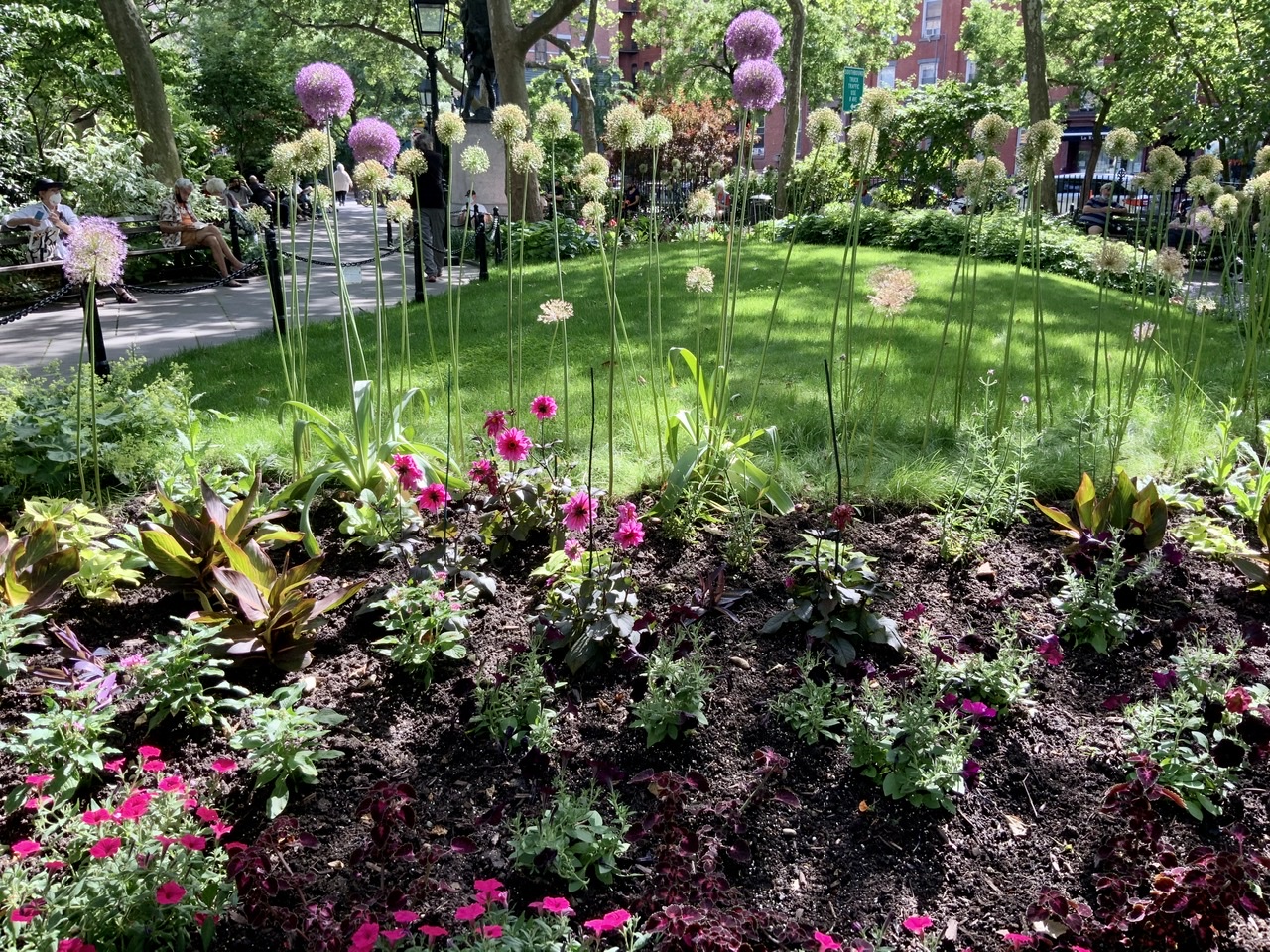
New York, NY
*an ongoing series of quotations – mostly from artists, to artists – that offers wisdom, inspiration, and advice for the sometimes lonely road we are on.
What the unproductive artist describes as his failure of will or insufficient motivation may rather be an absence in his belief system of the meaningfulness of art or of the art-making he’s presently doing. The most salient difference between the regularly blocked artist and the regularly productive artist may not be the greater talent of the latter, but the fact that the productive artist possesses and retains his missionary zeal.
Carlos Santana likened artists to “warriors in the trenches who have the vision of saving us from going over the edge.” The artist who possesses this vision will pursue his art even if he sometimes blocks. The artist who is less certain about the sacredness of his profession or the value of his work is hard-pressed to battle for art’s sake.
Eric Maisel in A Life in the Arts: Practical Guidance and Inspiration for Creative and Performing Artists
Comments are welcome!
A: Would you agree that there are more opportunities for women artists these days?
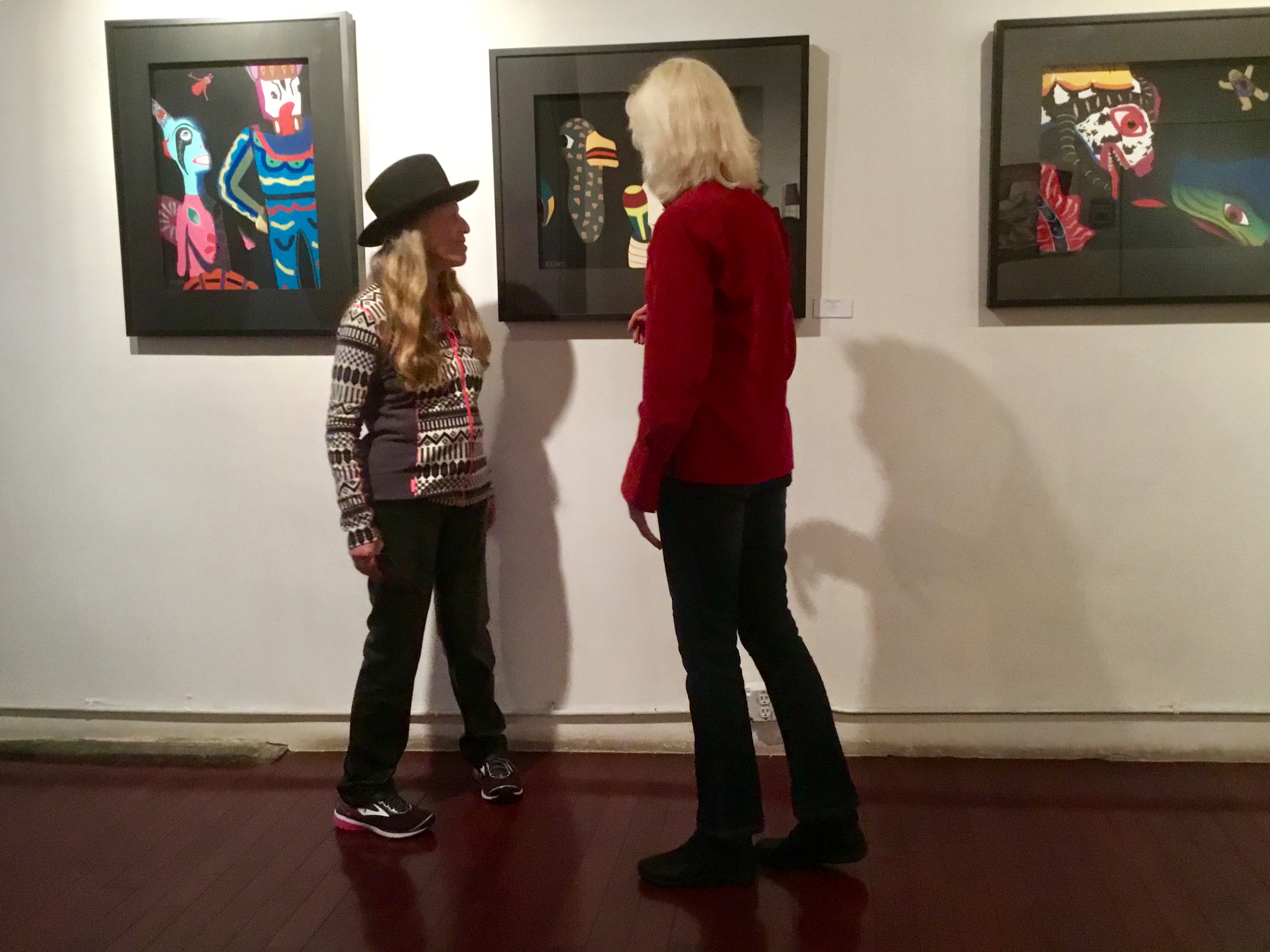
At Salomon Arts in Tribeca
A: It’s true that there are more opportunities now for women artists. Indeed, there are more opportunities for ALL artists. Social media has helped immensely in that it allows artists to take charge of our own careers, making us less dependent on the approval, largesse, and/or validation of art world gatekeepers.
However, at the highest levels of our profession, there are many inequities. As more women become art museum directors, collectors of contemporary art, and leaders whose taste matters, the status of all female artists is bound to improve to become more aligned with that of males.
Comments are welcome!
Q: What do you think are the most important qualities in an artist?

“Big Deal,” soft pastel on sandpaper, 58″ x 38″
A: Two essentials immediately come to mind. I believe imagination and curiosity are very important qualities, not only for artists, but for anyone who hopes to look back on a well-lived life. As Lauren Bacall famously said, “Imagination is the highest kite one can fly.”
It is curiosity that keeps people laser-focused on a lifetime journey of learning. I’d venture to say that curiosity is the not-so-secret quality of accomplished people in every profession. We humans can never know enough!
Comments are welcome!
Q: I just got home from my first painting experience… three hours and I am exhausted! Yet you, Barbara, build up as many as 30 layers of pastel, concentrate on such intricate detail, and work on a single painting for months. How do you do it?
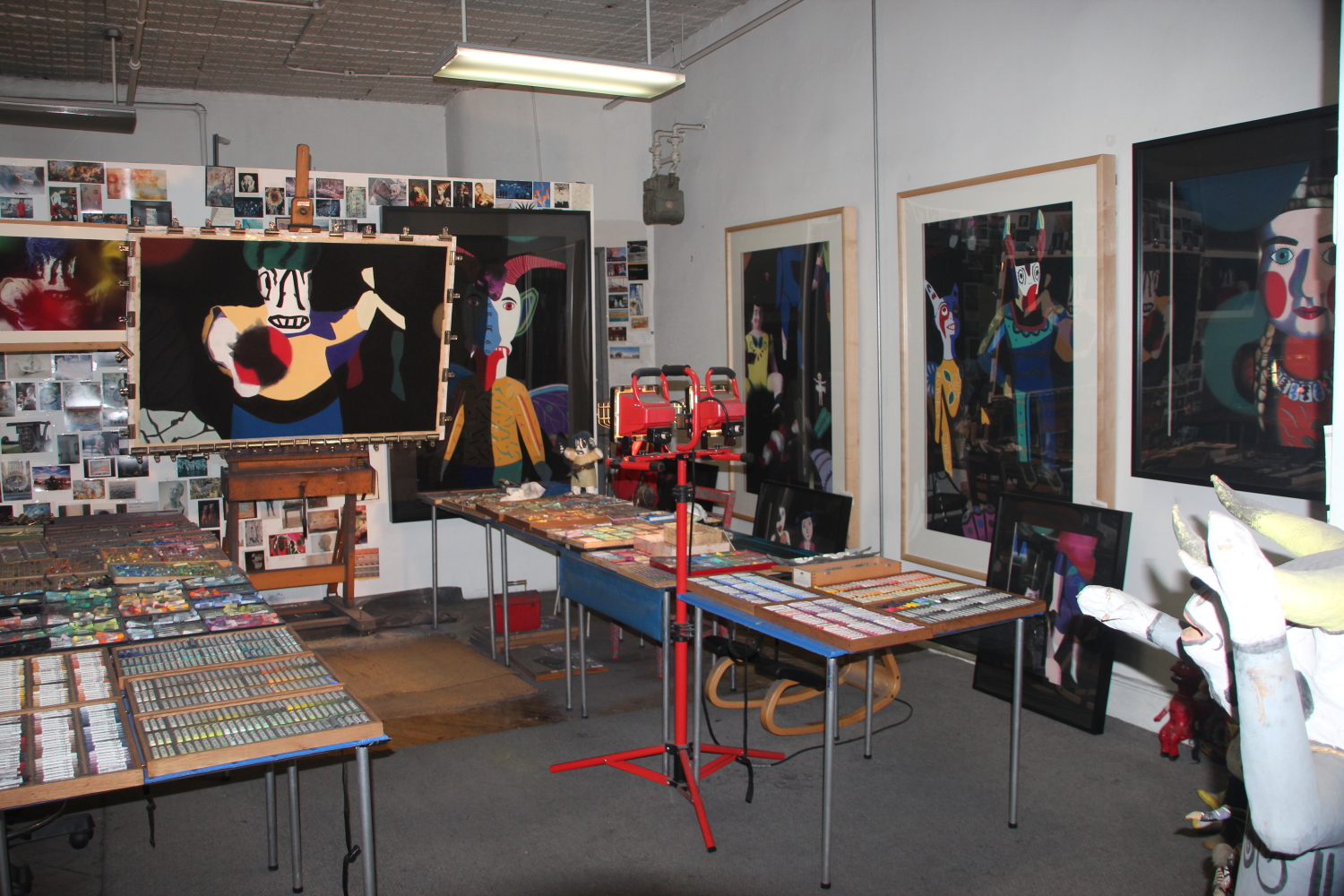
Barbara’s studio
A: The short answer is that I absolutely love making art in my studio and on the best days I barely even notice time going by!
Admittedly, it’s a hard road. Pursuing life as an artist takes a very special and rare sort of person. Talent and having innate gifts are a given, merely the starting point. We must possess a whole cluster of characteristics and be unwavering in displaying them. We are passionate, hard-working, smart, devoted, sensitive, self-starting, creative, hard-headed, resilient, curious, persistent, disciplined, stubborn, inner-directed, tireless, strong, and on and on. Into the mix add these facts. We need to be good business people. Even if we are, we are unlikely to make much money. We are not respected as a profession. People often misunderstand us: at best they ignore us, at worst they insult our work and us, saying we are lazy, crazy, and more.
The odds are stacked against any one individual having the necessary skills and stamina to withstand it all. So many artists give up, deciding it’s too tough and just not worth it, and who can blame them? This is why I believe artists who persevere over a lifetime are true heroes. It’s why I do all I can to help my peers. Ours is an extremely difficult life – it’s impossible to overstate this – and each of us finds our own intrinsic rewards in the work itself. Otherwise there is no reason to stick with it. Art is a calling and for those of us who are called, the work is paramount. We build our lives around the work until all else becomes secondary and falls away. We are in this for the duration.
In my younger days everything I tried in the way of a career eventually became boring. Now with nearly thirty years behind me as a working artist, I can still say, “I am never bored in the studio!” It’s difficult to put into words why this is true, but I know that I would not want to spend my time on this earth doing anything else. How very fortunate that I do not have to do so!
Comments are welcome!
Pearls from artists* # 51

Road to Roden Crater in Arizona
* an ongoing series of quotations – mostly from artists, to artists – that offers wisdom, inspiration, and advice for the sometimes lonely road we are on.
The most demanding part of living a lifetime as an artist is the strict discipline of forcing oneself to work steadily along the nerve of one’s own most intimate sensitivity. As in any profession, facility develops. In most this is a decided advantage, and so it is with the actual facture of art; I notice with interest that my hand is more deft, lighter, as I grow more experienced. But I find that I have to resist the temptation to fall into the same kind of pleasurable relaxation I once enjoyed with clay. I have in some subtle sense to fight my hand if I am to grow along the reaches of my nerve.
And here I find myself faced with two fears. The first is simply that of the unknown – I cannot know where my nerve is going until I venture along it. The second is less sharp but more permeating: the logical knowledge that the nerve of any given individual is as limited as the individual. Under its own law, it may just naturally run out. If this happens, the artist does best, it seems to me, to fall silent. But by now the habit of work is so ingrained in me that I do not know if I could bear the silence.
Anne Truitt in Daybook: The Journal of an Artist
Pearls from artists* # 28
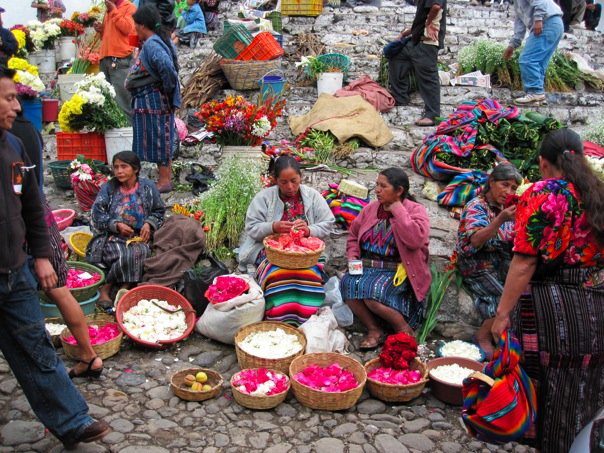
Flower sellers in Chichicastenango, Guatemala
* an ongoing series of quotations – mostly from artists, to artists – that offers wisdom, inspiration, and advice for the sometimes lonely road we are on.
We have talked a good deal about our duty, and how we could attain the right goal, and we came to the conclusion that in the first place our aim must be to find a steady position and a profession to which we can entirely devote ourselves. It is wise to do so, for life is but short and time passes quickly; if one is master of one thing and understands one thing well, one has at the same time insight into and understanding of many things.
One must especially have the end in mind, and the victory one would gain after a whole life of work and effort is better than one that is gained earlier. Whoever lives sincerely and encounters much trouble and disappointment, but is not bowed down by them, is worth more than one who has always sailed before the wind and has only relative prosperity. One must never trust the occasion when one is without difficulties.
Irving Stone with Jean Stone, editors, Dear Theo: The Autobiography of Vincent Van Gogh
Comments are welcome!


 barbararachkoscoloreddust.com