Blog Archives
Pearls from artists* # 491
*an ongoing series of quotations – mostly from artists, to artists – that offers wisdom, inspiration, and advice for the sometimes lonely road we are on.
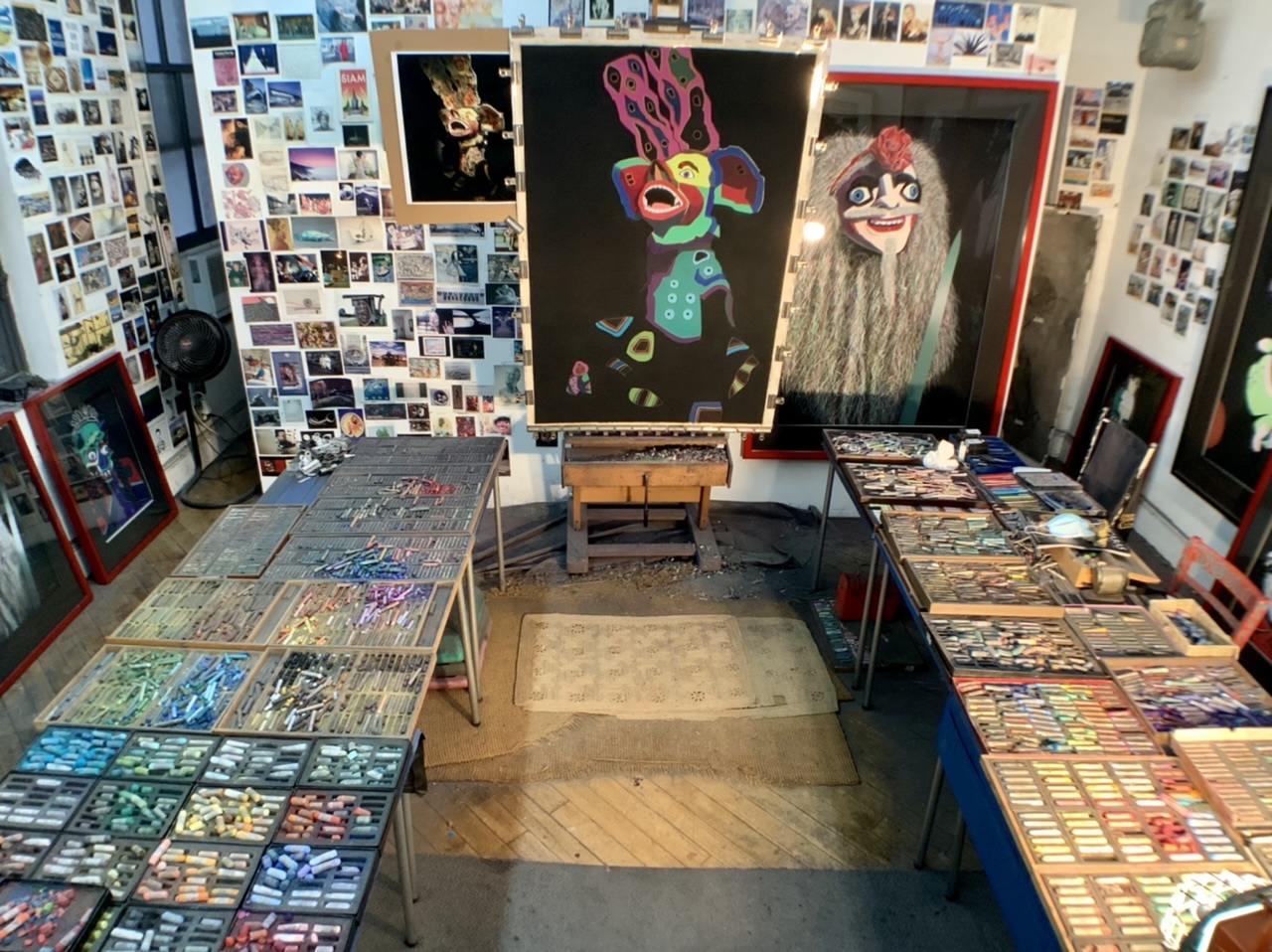
We look at ancient Egyptian painting today and may find it slightly comic, but what the Egyptians were trying to do with the figure was reveal the various aspects of the person’s body in the most characteristic aspect. The face is in profile because that reveals the most about the person’s face, but the shoulders are not in profile, they’re facing the viewer, because that’s the most revealing angle for the shoulders. The hips are not in profile, but the feet are. It gives a strange, twisted effect, but it was natural to the Egyptians. They were painting essences, and in order to paint an essence you have to paint it from its most characteristic angle. So they would simply combine the various characteristic essences of the human body. This was a piece of spiritual art. It wasn’t trying to reproduce photographic reality, it was trying to reproduce and combine all the essential features of a person within one figure.
Walter Murch in The Conversations: Walter Murch and the Art of Editing Film by Michael Ondaatje
Comments are welcome!
Pearls from artists* # 485
*an ongoing series of quotations – mostly from artists, to artists – that offers wisdom, inspiration, and advice for the sometimes lonely road we are on.
[Michael] Ondaatje: It’s an odd thing: I’ve heard you talk about the importance of ambiguity in film, and the need to save that ambiguous quality which exists in a book or painting, and which you think a film does not often have. And at the same time in a mix you are trying to “perfect” that ambiguity.
[Walter] Murch: I know. It’s a paradox. And one of the most fruitful paradoxes, I think, is that even when the film is finished, there should be unsolved problems. Because there’s another stage, beyond the finished film: when the audience views it. You want the audience to be co-conspirators in the creation of this work, just as much as the editor or the mixers or the cameraman or actors are. If by some chemistry you actually did remove all ambiguity in the final mix – even though it had been ambiguous up to that point – I think you would do the film a disservice. But the paradox is that you have to approach every problem as if it’s desperately important to solve it. You can’t say, I don’t want to solve this because it’s got to be ambiguous. If you do that, then there’s a sort of hemorrhaging of the organism.
O: And more of a confusion.
M: Yes. I keep thinking about it, and it’s a wonderful dilemma: you have to acknowledge that there must be unsolved problems at each stage. As hard as you work, you must have this secret, unspoken hope that one very significant problem will remain unsolved. But you never know what that will be until the film is done. You can almost define a film by the problem it poses, that it can’t answer itself, that it asks the audience to solve.
The Conversations: Walter Murch and the Art of Editing Film by Michael Ondaatje
Comments are welcome!
Pearls from artists* # 477
*an ongoing series of quotations – mostly from artists, to artists – that offers wisdom, inspiration, and advice for the sometimes lonely road we are on.
Although he produced thousands of works of art in his pitifully short time on earth, Vincent [van Gogh] – as, following his own example, we shall call him – failed to sell a single painting in his lifetime, despite the fact that his brother Theo was a prominent Paris art dealer who, among other business coups, made a fortune for Claude Monet. Although he suffered through periods of deepest doubt, Vincent knew that one day his work would be recognized for its true worth. All the same, he could not have dreamed that his jarringly revolutionary paintings would one day rise so high in popular regard.
John Banville in His Own Worst Enemy, The New York Review of Books, May 13, 2021
Comments are welcome!
Pearls from artists* # 471

*an ongoing series of quotations – mostly from artists, to artists – that offers wisdom, inspiration, and advice for the sometimes lonely road we are on.
Impresario Peter Sellars remarks how “Vermeer [spent] hours, days, and weeks painting a small corner of a small room in an act of ritualistically informed meditation that leads to new possibilities of awareness and love.” The time of making, Sellars adds, influences the time of viewing: “The act [of painting] itself opens up and refines consciousness by slowing down time as it focuses the eye.” Sellars’ language of ritual and meditation anticipates my purposes. He associates painting not only with materiality but also with spiritual practices – indeed, he yokes the two: “The act of painting has always been charged with shamanic energies. Using bits of animal bone, hair, and sinew, mixing them with earth, and applying them steadily and with great concentration to a cave wall, a parchment, or a human face is an act of calling and recalling.”
Arden Reed in Slow Art: The Experience of Looking, Sacred Images to James Turrell
Comments are welcome!
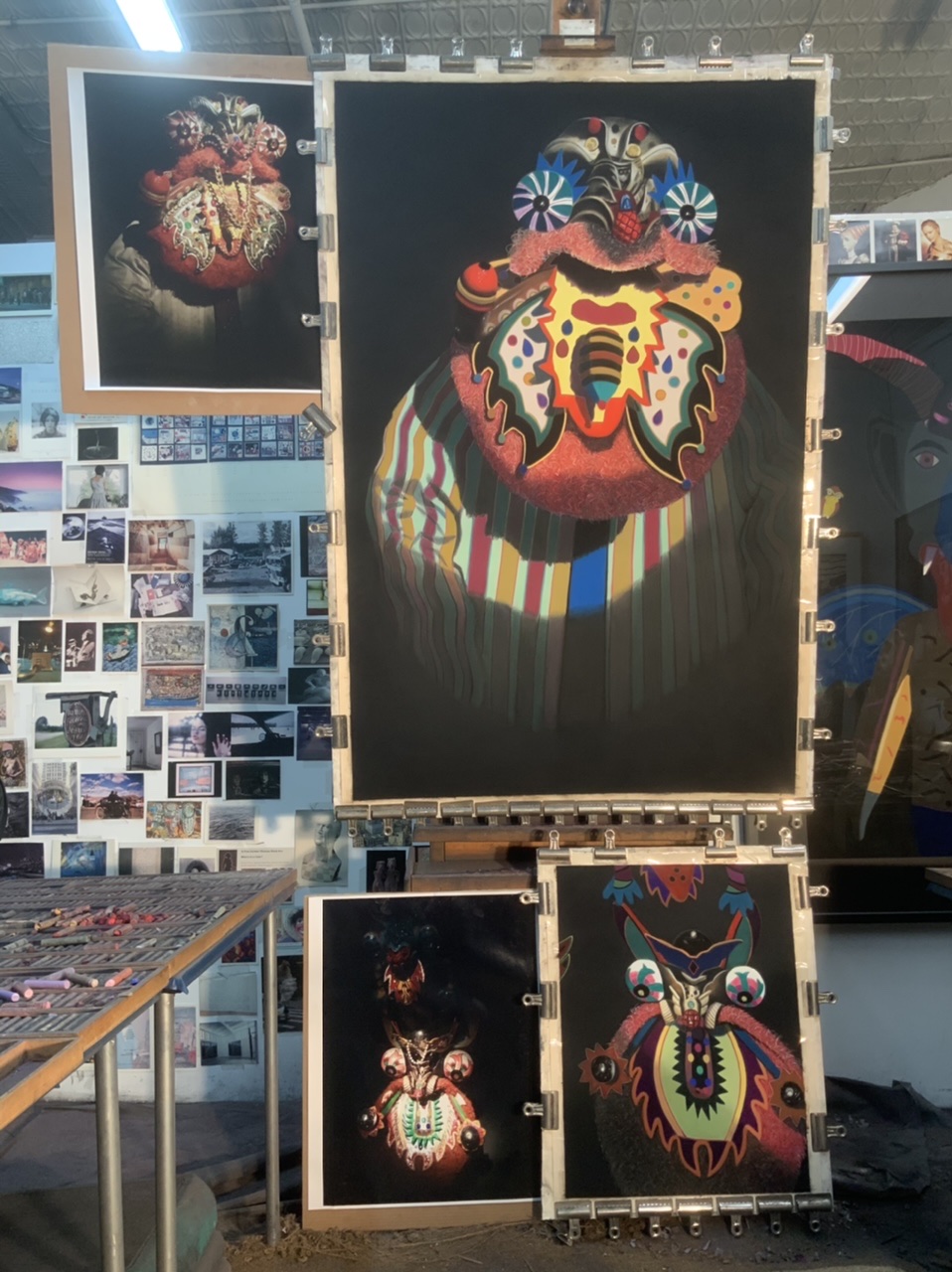
Q: What’s on the easel today?
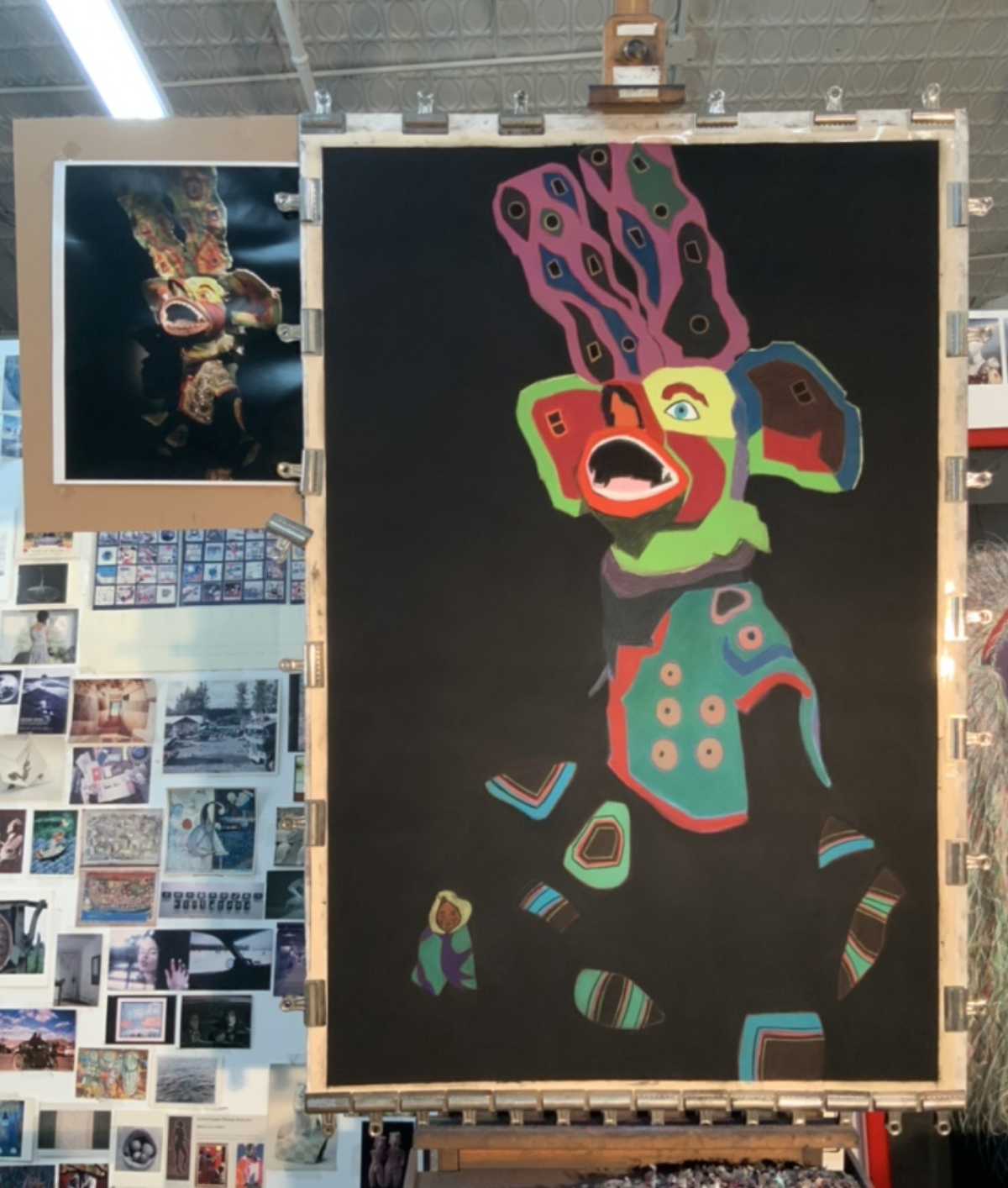
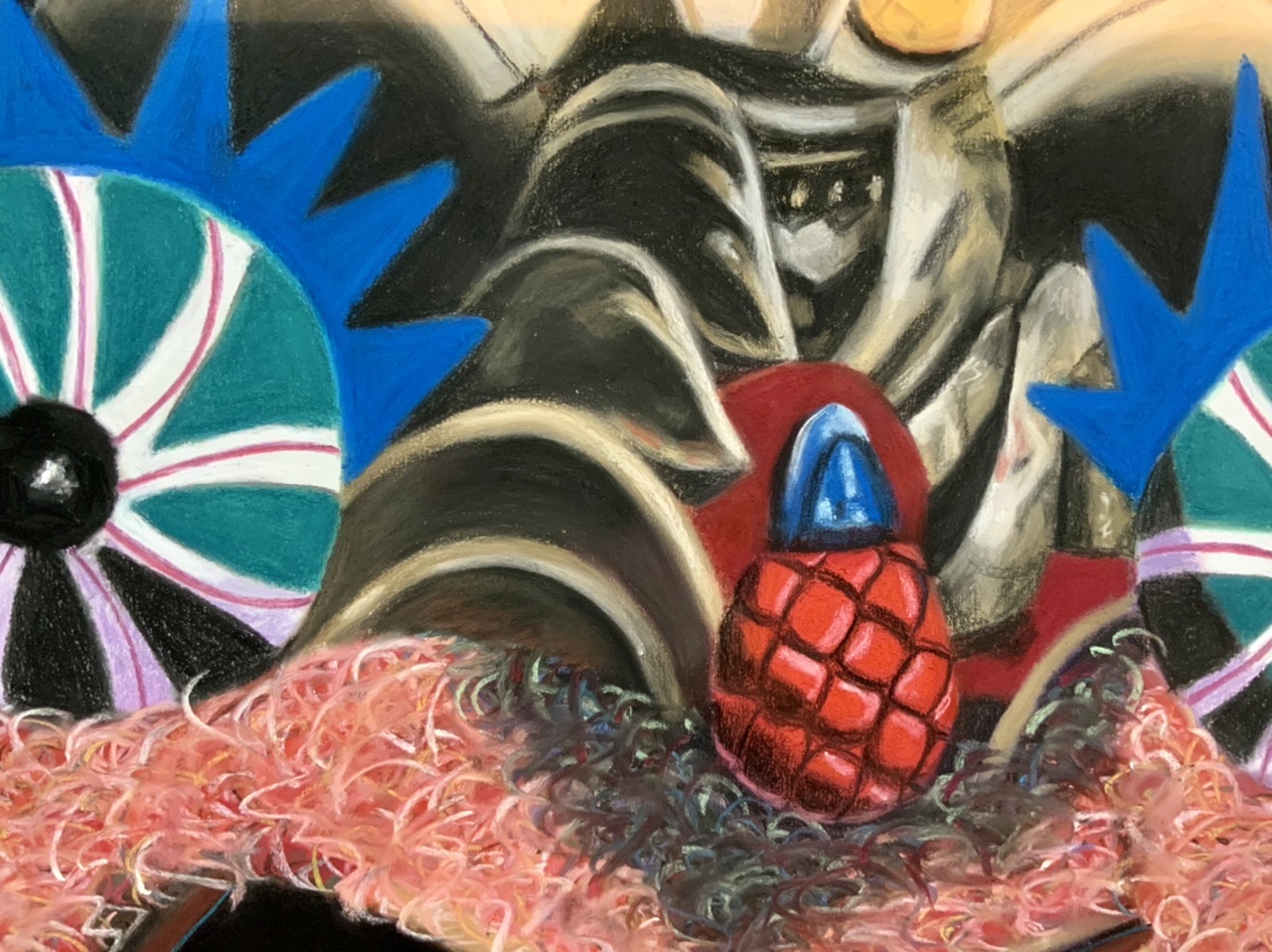
A: I continue slowly working on an untitled 58” x 38” pastel-on-sandpaper painting that is part of the acclaimed “Bolivianos” series.
Comments are welcome!
Pearls from artists* # 460
*an ongoing series of quotations – mostly from artists, to artists – that offers wisdom, inspiration, and advice for the sometimes lonely road we are on.
Precious realm of painting! That silent power that speaks at first only to the eyes and then seizes and captivates every faculty of the soul! Here is your real spirit; here is your own true beauty, beautiful painting, so much insulted, so much misunderstood and delivered up to fools who exploit you. But there are still hearts ready to welcome you devoutly, souls who will no more be satisfied with mere phrases than with inventions and clever artifices. You have only to be seen in your masculine and simple vigor to give pleasure that is pure and absolute. I confess that I have worked logically, I, who have no love for logical painting. I see now that my turbulent mind needs activity, that it must break out and try a hundred different ways before reaching the goal towards which I am always straining. There is an old leaven working in me, some black depth that must be appeased. Unless I am writhing like a serpent in the coils of a pythoness I am cold. I must recognize this and accept it, and to do so is the greatest happiness. Everything good that I have ever done has come about in this way. No more ‘Don Quixotes’ and such unworthy things!
The Journal of Eugene Delacroix edited by Hubert Wellington
Comments are welcome!
Pearls from artists* 457
*an ongoing series of quotations – mostly from artists, to artists – that offers wisdom, inspiration, and advice for the sometimes lonely road we are on.
In Italy on the Prixe de Rome, he [Phillip Guston] traveled, studied Piero and Tiepolo and drew everywhere. His marks bunched up in quavering confederations and eventually left their subject matter behind. The trouble with figurative art, he concluded, was that it “vanishes into recognition.” Remove the recognizable and you can begin to see the push and pull of impulse, recanting, and reconfiguration that constitute painting and, by extension, life itself.
Susan Tallman in Philip Guston’s Discomfort Zone, The New York Review of Books, January 14, 2021
Comments are welcome!
Q: How has photography changed your approach to painting?

A: Except for many hours spent in life-drawing classes and still life setups that I devised when I was learning my craft in the 1980s, I have always worked from photographs. My late husband, Bryan, would shoot 4” x 5” negatives of my elaborate “Domestic Threats” setups using his Toyo-Omega view camera. I rarely picked up a camera except when we were traveling. After Bryan was killed on 9/11, I inherited his extensive (film) camera collection – old Nikons, Leicas, Graphlex cameras, etc. – and needed to learn how to use them. Starting in 2002 I enrolled in a series of photography courses (about 10 over 4 years) at the International Center of Photography in New York. I learned how to use all of Bryan’s cameras and how to make my own big color prints in the darkroom.
Early on I discovered that the sense of composition, color, and form I had developed over many years as a painter translated well into photography. The camera was, and is, just another medium with which to express ideas. Pastel painting will always be my first love. However, pastel paintings take months of work, while photography offers instant gratification, especially with my current preferred camera, an iPad Pro.
Comments are welcome!
Pearls from artists* # 446

*an ongoing series of quotations – mostly from artists, to artists – that offers wisdom, inspiration, and advice for the sometimes lonely road we are on.
What stops us in our tracks? I am rarely stopped by something or someone I can instantly know. In fact, I have always been attracted to the challenge of getting to know what I cannot instantly categorize or dismiss, whether an actor’s presence, a painting, a piece of music, or a personal relationship. It is the journey towards the object of attraction that interests me. We stand in relation to one another. We long for the relationship that will change our vistas. Attraction is an invitation to an evanescent journey, to a new way of experiencing life or perceiving reality.
An authentic work of art embodies intense energy. It demands response. You can either avoid it, shut it out, or meet it and tussle. It contains attractive and complicated energy fields and a logic all its own. It does not create desire or movement in the receiver, rather it engenders what James Joyce labelled ‘aesthetic interest.’ You are stopped in your tracks. You cannot easily walk by it and go on with your life. You find yourself in relation to something that you cannot readily dismiss.
Anne Bogart in A Director Prepares: Seven Essays on Art and Theater
Comments are welcome!
Pearls from artists* # 445
*an ongoing series of quotations – mostly from artists, to artists – that offers wisdom, inspiration, and advice for the sometimes lonely road we are on.
My good friend the writer Charles L. Mee, Jr helped me to recognize the relationship between art and the way societies are structured. He suggested that, as societies develop, it is the artists who articulate the necessary myths that embody our experience of life and provide parameters for ethics and values. Every so often the inherited myths lose their value because they become too small and confined to contain the complexities of the ever-transforming and expanding societies. In that moment new myths are needed to encompass who we are becoming. These new constructs do not eliminate anything already in the mix; rather, they include fresh influences and engender new formations. The new mythologies always include ideas, cultures and people formerly excluded from the previous mythologies. So, deduces Mee, the history of art is the history of inclusion.
I believe that the new mythologies will be created and articulated in art, in literature, painting and poetry. It is the artists who will create a livable future through their ability to articulate in the face of flux and change.
Anne Bogart in A Director Prepares: Seven Essays on Art and Theater
Comments are welcome!


 barbararachkoscoloreddust.com