Blog Archives
Pearls from Artists* # 313

Barbara and Tomas in Panajachel, Guatemala
*an ongoing series of quotations – mostly from artists, to artists – that offers wisdom, inspiration, and advice for the sometimes lonely road we are on.
Proclaiming that the object in Surrealism was fundamental, [Andre] Breton suggests a radical transition in surrealist creation, one that liberated the poet-artist from all constraints in the making of the artistic object. Breton’s text calls for a “revolution of the object,” suggesting that in the placing of an object into a new context, and thus attributing it with a new meaning – also called a “detournement” – which takes precedence. Drawing in his interpretation of Hegelian subject-object relations, Breton describes the “object” as a work of art that relies on a philosophical procedure, affirming the surrealist process as one that is realized in the experience of apprehending the object through a dialectical method. Citing the work of Marcel Duchamp and Max Ernst, Breton explains that an object may become a product of surrealist creation through the simple “manipulation” of it. Here ”manipulation“ is defined as a procedure which reveals the object in its original and new state at the same time. If taking an object out of its original context and placing it in a new space creates the potential for a creative act, then this text seems to validate the surrealist practice of collecting. As the collector acquired objects and unites them in a gallery or a home, they assume new significance contingent upon their physical juxtaposition to other objects.
Moon Dancers: Yup’ik Masks and the Surrealists, edited by Jennifer Field, Introduction by Christina Rudofsky
Comments are welcome!
Q: What is more important to you, the subject of the painting or the way it is executed?

“Sam and Bobo,”soft pastel on sandpaper, 36″ x 31”, 1989
A: In a sense my subject matter – folk art, masks, carved wooden animals, papier mâché figures, toys – chose me. With it I have complete freedom to experiment with color, pattern, design, and other formal properties. In other words, although I am a representational artist, I can do whatever I want since the depicted objects need not look like real things. Execution is everything now.
This was not always the case. I started out in the 1980s as a traditional photorealist, except I worked in pastel on sandpaper. (For example, see the detail in Sam’s sweater above). As I slowly learned and mastered my craft, depicting three-dimensional people and objects hyper-realistically in two dimensions on a piece of sandpaper was thrilling… until one day it wasn’t.
My personal brand of photorealism became too easy, too limiting, too repetitive, and SO boring to execute! In 1989 I had at last extricated myself from a dull career as a Naval officer working in Virginia at the Pentagon. Then after much planning, in 1997 I was a full-time professional artist working in New York.
Certainly I was not going to throw away this opportunity by making boring photorealist art. I wanted to do so much more as an artist: to experiment with techniques, with composition, to see what I could make pastel do, to let my imagination play a larger role in the paintings I made. I was ready to devote the time and do whatever it took to push my art further.
After spending the early creative years perfecting my technical skills, I built on what I had learned. I began breaking rules – slowly at first – in order to push myself onward. And I continue to do so, never knowing what’s next. Hopefully, in 2018 my art is richer for it.
Comments are welcome!
Pearls from artists* # 266
Washington, DC
* an ongoing series of quotations – mostly from artists, to artists – that offers wisdom, inspiration, and advice for the sometimes lonely road we are on.
… it is easy to describe the natural objects that we can hold in our hands, or move into view, as we would describe works of art: and this conditions the kind of pleasure we take in them. They are objets trouves, jewels, treasures, whose perfection seems to radiate from themselves, as from an inner light. Landscapes by contrast are very far from works of art – they owe their appeal not to symmetry, unity and form, but to an openness, grandeur and world-like expansiveness, in which it is we and not they that are contained.
Roger Scruton in Beauty: A Very Short Introduction
Comments are welcome!
Pearls from artists* # 254

“Survivors,” soft pastel on sandpaper, 20″ x 26″ image, 28 1/2″ x 35″ framed
* an ongoing series of quotations – mostly from artists, to artists – that offers wisdom, inspiration, and advice for the sometimes lonely road we are on.
An artist learns by repeated trial and error, by an almost moral instinct, to avoid the merely or the confusingly decorative, to eschew violence where it is a fraudulent substitute for power, to say what he has to say with the most direct and economical means, to be true to his objects, to his materials, to his technique, and hence, by a correlated miracle, to himself.
Ian Roberts in Creative Authenticity: 16 Principles to Clarify and Deepen Your Artistic Vision
Comments are welcome!
Pearls from artists* # 212
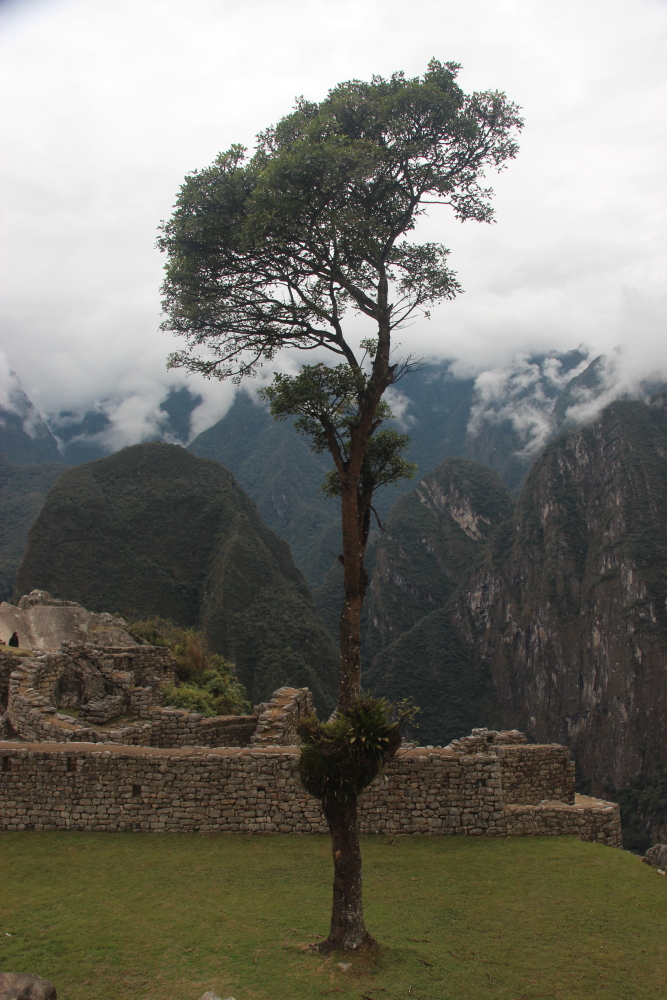
Machu Picchu
* an ongoing series of quotations – mostly from artists, to artists – that offers wisdom, inspiration, and advice for the sometimes lonely road we are on.
… the anthropologist Ellen Disanayake… in Homo Aestheticus, argues that art and aesthetic interest belong with rituals and festivals – offshoots of the human need to ‘make special,’ to extract objects, events, and human relations from everyday uses and to make them a focus of collective attention. This ‘making special’ enhances group cohesion and also leads people to treat those things which really matter for the survival of community – be it marriage or weapons, funerals, or offices – as things of public note, with an aura that protects them from careless disregard and emotional erosion. The deeply engrained need to ‘make special’ is explained by the advantage that it has conferred on human communities, holding them together in times of threat, and furthering their reproductive confidence in times of peaceful flourishing.
Beauty: A Very Short Introduction, by Roger Scruton
Comments are welcome!
Q: What historical art movement do you most identify with?

Barbara’s studio
A: I’d have to say that I identify most with surrealism, although my work does not exactly fit into any particular art historical movement. When I was first finding my way as an artist, I read everything I could find about surrealism in art and in literature. This research still res0nates deeply and is a tremendous influence on my studio practice. Elements of surrealism DO fit my work. Here’s an excerpt from Wikipedia:
Surrealism is a cultural movement that began in the early 20s and is best known for its visual artworks and writings. The aim was to “resolve the previously contradictory conditions of dream and reality.” Artists painted unnerving, illogical scenes with photographic precision, created strange creatures from everyday objects and developed painting techniques that allowed the unconscious to express itself.
Surrealist works feature the element of surprise, unexpected juxtapositions and non sequitur; however, many Surrealist artists and writers regard their work as an expression of the philosophical movement first and foremost, with the works being an artifact. Leader Andre Breton was explicit in his assertion that Surrealism was, above all, a revolutionary movement.
I hope to expand on this in a future post.
Comments are welcome!
Q: Would you say there is a unifying quality to all of the work you have produced in the last thirty years?
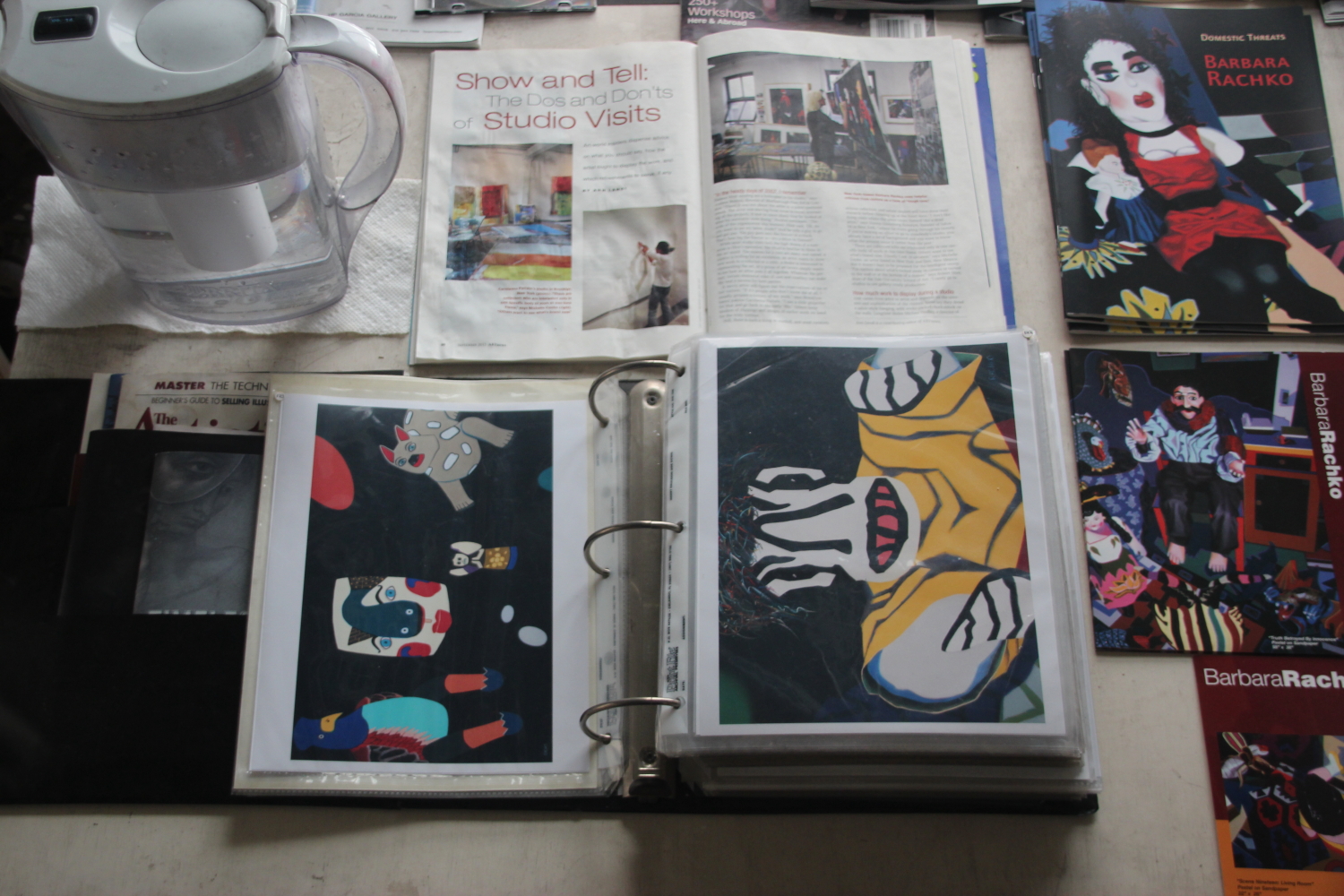
Barbara’s portfolio book
A: Yes, I can think of several. Whether making pastel paintings or printing photographs in the darkroom, I have always been concerned with quality and craftsmanship and never pronounce a work finished until it is the best thing I can make.
Although I started out as a maker of photorealist portraits in pastel, for twenty-odd years I have worked with Mexican folk art as my primary subject matter, treating these objects very differently in three separate series: “Black Paintings,” “Domestic Threats,” and “Gods and Monsters.” The first two are pastel-on-sandpaper paintings while the last is comprised of chromogenic photographs (c-prints). A few years ago I also started making “Teleidoscopes” using an iPad app to photograph my Mexican and Guatemalan folk art collection. This last one is just for fun; I do not offer them for sale.
Soft pastel is my first love and the two series of pastel paintings are my best-known work. My technique for using pastel continues to evolve in intriguing ways. I doubt I can ever learn all there is to know not only about color, but also about this medium. Pastel is endlessly fascinating, which is why I have never wanted to switch to anything else.
Comments are welcome!
Pearls from artists* # 165
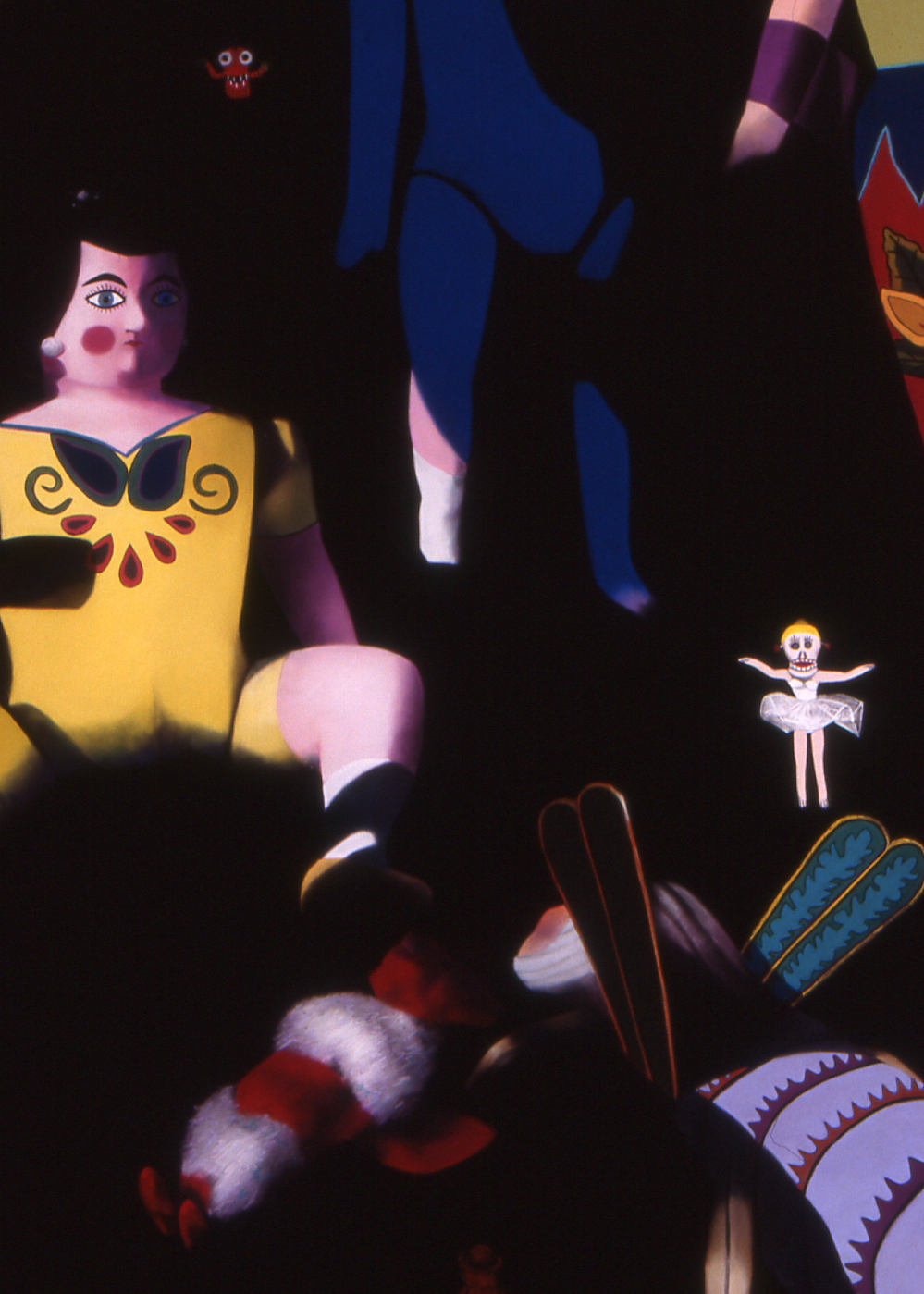
“The Space Between,” soft pastel on sandpaper, 58″ x 38″
* an ongoing series of quotations – mostly from artists, to artists – that offers wisdom, inspiration, and advice for the sometimes lonely road we are on.
When I have painted a fine picture I have not given expression to a thought! That is what they say. What fools people are! They would strip painting of all its advantages. A writer has to say almost everything in order to make himself understood, but in painting it is as if some mysterious bridge were set up between the spirit of the persons in the picture and the beholder. The beholder sees figures, the external appearance of nature, but inwardly he meditates; the true thinking that is common to all men. Some give substance to it in writing, but in so doing they lose the subtle essence. Hence, grosser minds are more easily moved by writers than by painters or musicians. The art of the painter is all the nearer to man’s heart because it seems to be more material. In painting, as in external nature, proper justice is done to what is finite and to what is infinite, in other words, to what the soul finds inwardly moving in objects that are known through the senses alone.
The Journal of Eugene Delacroix edited by Hubert Wellington
Comments are welcome!
Q: How do you decide how much realism and how much imagination to put into a pastel painting?
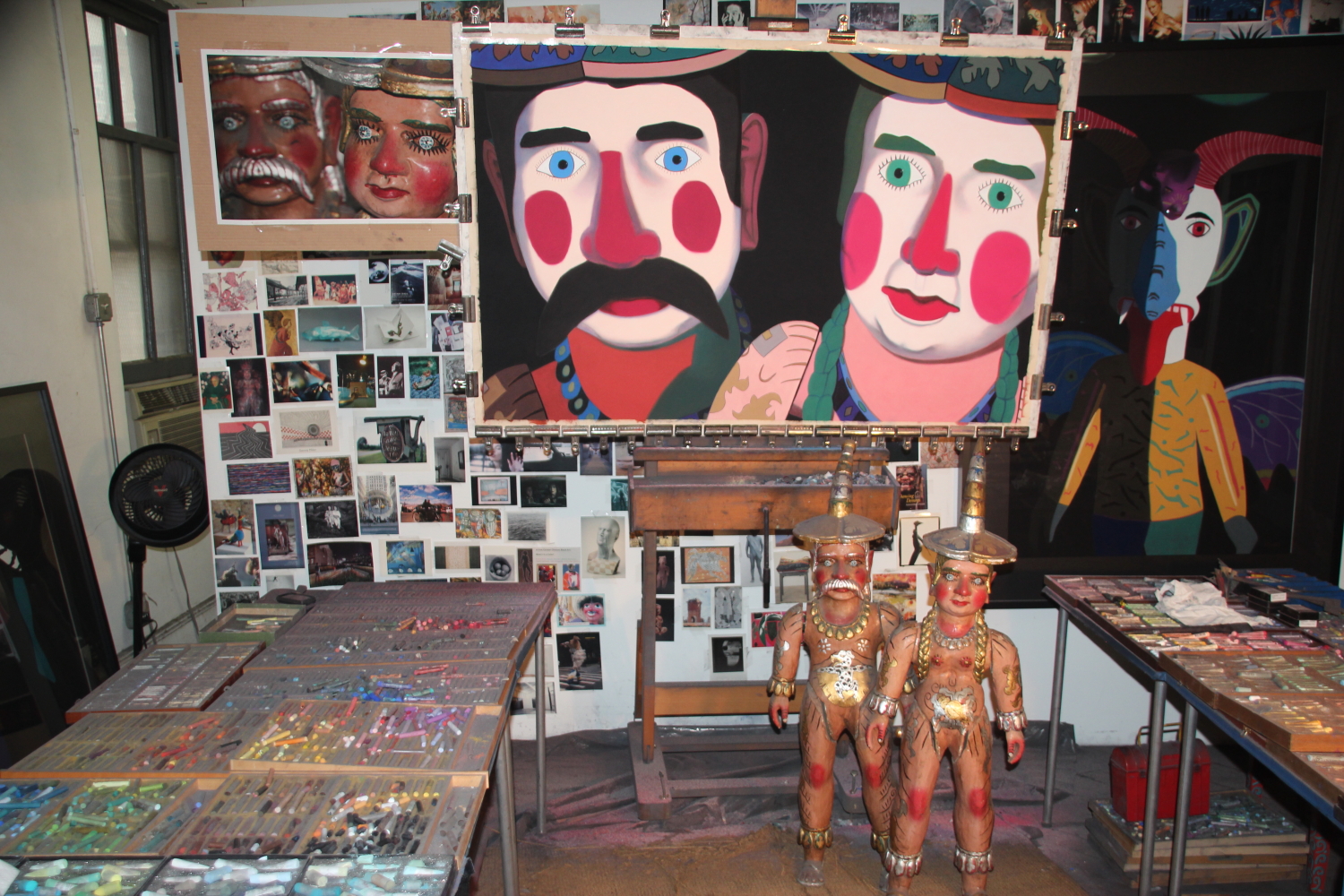
Models, reference photograph, and pastel painting in progress
A: I wouldn’t say “decide” is the right word because creating a painting is not strictly the result of conscious decisions. I think of my reference photograph, my preliminary sketch, and the actual folk art objects I depict as starting points. Over the months that it takes to make a pastel painting, the resulting interpretive development pushes the painting far beyond this source material. When all goes well, the original material disappears and characters that belong to the painting and nowhere else emerge.
It is a mysterious process that I am still struggling to understand. This is the best way I can describe what it feels like from the inside, as the maker.
Comments are welcome!
Q: Would you talk about your use of Mexican and Guatemalan folk art as a convenient way to study formal properties such as color, shape, pattern, composition, etc. in your pastel paintings?
Models, reference photograph, and pastel painting in progress
A: For me an interesting visual property of these objects is that they readily present themselves as a vehicle for exploring formal artistic properties, like color, pattern, shape, etc. especially compared to my earlier subject matter: hyper-realistic portraits and still-lifes. Intent as I was on creating verisimilitude in the earlier work, there was little room for experimentation.
Many Mexican and Guatemalan folk art objects are wildly painted and being a lover of color, their brilliant colors and patterns are what initially attracted me. As a painter I am free to use their actual appearance as my starting point. I photograph them out-of-focus and through colored gels in order to change their appearance and make them strange, enacting my own particular version of “rendering the familiar strange.” Admittedly these objects are not so familiar to begin with.
When I make a pastel painting I look at my reference photograph and I also look at the objects, positioning them within eye-shot of my easel. There is no need whatsoever to be faithful to their actual appearance so my imagination takes over. As I experiment with thousands of soft pastels, with shape, with pattern, with composition, and all the rest, I have one goal in mind – to create the best pastel-on-sandpaper painting I am capable of making.
Comments are welcome!


 barbararachkoscoloreddust.com