Blog Archives
Pearls from artists* # 680

“Sacrificial” (on the wall) and “Trickster” (on the floor)
*an ongoing series of quotations – mostly from artists, to artists – that offers wisdom, inspiration, and advice for the sometimes lonely road we are on.
What makes a work transcendent and powerful is a personal intensity, an ‘extra’ quality. Yet that intensity is exclusive to each artist: extra strangeness, subtlety, causticity, bravado, sensuality, rawness, grandiosity, succinctness, mystery, vulnerability, truth, etc. For an individual artist to infuse an object or an experience with their own ‘extra’ quality requires not only skill or ideas, but the profound benevolence of consistently delivering in spades.
It is this passion and genuine feeling, specific to each creator, that lives on in the art as a gift. It is wrapped up in the work, forever suspended in time. The artist says,
Here… everything I possessed in this moment is embodied in this object… All skills I have painstakingly learned, all of the knowledge I possess, the joy and pain I have felt and all the experiences I have lived. I spun these into the perfect, most sublime form, and packed it up, but for you to unwrap anytime you need sustenance. It will nourish, comfort, and surround you, because you have chosen it.
Each viewer selects which works of art speak to them… which embodied feelings, concepts, and knowledge they value. An empathic connection is forged through the art object or experience. What is love, but to say to someone, ‘you are truly seen and understood?’ Art offers this as well, by reaching out to puncture through the membrane of our emotional isolation, to articulate how we feel in the moments when we cannot find words. It tells the artist and viewer alike, ‘You are not alone. You are not alone in how your brain works. You are not alone in the pain you feel. You are not alone in what you notice or appreciate, or in how much love you have to give.’
Pour that love into an art object. It can handle all the devotion you pack into it, and more.
Kate Kretz in Art From Your Core: A Holistic Guide to Visual Voice
Comments are welcome!
Q: What would you be if you were not an artist?

The studio with pastel paintings in progress!
A: I honestly have no idea, but whatever it might be, there is a good chance that I’d be bored! In my younger days boredom was a strong motivator. I left the active duty Navy out of boredom. I couldn’t bear not being intellectually challenged (most of my jobs consisted of paper-pushing), not using my flying skills (at 27 I was a licensed commercial pilot and Boeing 727 flight engineer), and not developing my artistic talent. In what surely must be a first, by spending a lot of time and money training me for jobs I hated, the Navy turned me into a hard-working artist! And once I left the Navy there was no plan B. There was no time to waste. It was “full speed ahead.”
Art is a calling. You do not need to be told this if you are among those who are called. It’s all about “the work,” that all-consuming focus of an artist’s life. If a particular activity doesn’t make you a better artist, you avoid it. You work hard to nourish and protect your gifts. As artists we invent our own tasks, learn whatever we need in order to progress, and complete projects in our own time. It is life lived at its freest.
My art-making has led me to fascinating places: Mexico, Guatemala, Brazil, Chile, Easter island, Argentina, Uruguay, France, England, Italy, Bali, Java, India, Bhutan, and more; and to in-depth studies of intriguing subjects: drawing, color, composition, art and art history, the art business, film and film history, photography, mythology, literature, music, jazz history, and archaeology, particularly that of ancient Mesoamerica (the Olmec, Zapotec, Mixtec, Aztec, Maya, etc.). And this rich mixture continually grows! For anyone wanting to spend their time on earth learning and meeting new challenges, there is no better life than that of an artist.
I SO agree with this exchange that I read years ago between between Trisha Brown and Mikhail Baryshnikov in the New York Times. I wrote it on a piece of paper and taped it to my studio wall:
Trisha: How do you think we keep going? Are we obsessed?
Mikhail: We do it because there’s nothing better. I’m serious. Because there is nothing more exciting than that. Life is so boring, that’s why we are driven to the mystery of creation.
Comments are welcome.
Q: Does your work look different to you on days when you are sad, happy, etc.?

Barbara’s Studio
A: I am much more critical on days when I am sad so that the faults, imperfections, and things I wish I had done better stand out. Fortunately, all of my work is framed behind plexiglas so I can’t easily go back in to touch up perceived faults. I am reminded of the expression, “Always strive to improve, whenever possible. It is ALWAYS possible!” However, I’ve learned that re-working a painting is a bad idea. You are no longer deeply involved in making it and the zeitgeist has changed. The things you were concerned with are gone: some are forgotten, others are less urgent.
For most artists our work is autobiography. Art is personal. When I look at a completed pastel painting, I usually remember exactly what was happening in my life as I created it. Each piece is a snapshot – maybe a time capsule, if anyone could decode it – that reflects and records a particular moment. When I finally pronounce a piece finished and sign it, that’s it, THE END. It’s as good as I can make it at that point in time. I’ve incorporated everything I was thinking about, what I was reading, how I was feeling, what I valued, art exhibitions I visited, programs that I heard on the radio or watched on television, music that I listened to, what was going on in New York, in the country, and in the world.
It is still a mystery how this heady mix finds its way into the work. During the time that I spend on it, each particular painting teaches me everything it has to teach. A painting requires months of looking, reacting, correcting, searching, thinking, re-thinking, revising. Each choice is made for a reason and together these decisions dictate what the final piece looks like. On days when I’m sad I tend to forget that. On happier days I remember that the framed pastel paintings that you see have an inevitability to them. If all art is the result of one’s having gone through an experience to the end, as I believe it is, then the paintings could not, and should not, look any differently.
Comments are welcome.
Pearls from artists* # 608

*an ongoing series of quotations – mostly from artists, to artists – that offers wisdom, inspiration, and advice for the sometimes lonely road we are on.
There is in all of these forms of expression a unitive experience that is the essence of the creative mystery. The heart of improvisation is the free play of consciousness as it draws, writes, paints, and plays with the raw material emerging from the unconscious. Such play entails a certain degree of risk.
Stephen Nachmanovitch in Free Play: Improvisation in Life and Art
Comments are welcome!
Pearls from artists* # 579

New York, NY
*an ongoing series of quotations – mostly from artists, to artists – that offers wisdom, inspiration, and advice for the sometimes lonely road we are on.
An empirical fact about our lives is that we do not and cannot know what will happen a day or a moment in advance. The unexpected awaits us at every turn and every breath. The future is a vast perpetually regenerated mystery and the more we live and know, the greater the mystery. When we drop the blinders of our preconceptions, we are virtually propelled by every circumstance into the present time and the present mind: the moment, the whole moment, and nothing but the moment. This is a state of mind taught and strengthened by improvisation, a state of mind in which the here and now is not some trendy idea but a matter of life and death, upon which we can learn to reliably depend. We can depend on the world being a perpetual surprise in general motion and a perpetual invitation to create.
Stephen Nachmanovitch in Free Play: Improvisation in Life and Art
Comments are welcome!
Pearls from artists* # 488
*an ongoing series of quotations – mostly from artists, to artists – that offers wisdom, inspiration, and advice for the sometimes lonely road we are on.
To be astonished is to be caught unawares by the revelation of realities denied or repressed in the everyday. Astonishment has an intellectual as well as an emotional component – in it, the brain and the heart come together. Far from distracting us from the strange and the uncanny in life, the astonishment evoked by great artistic works puts them square in our sights. The work demands that we feel and think the mystery of our passage through this body, on this earth, in this universe. We realize afterward that the world is not what we thought it was: something hidden, impossible to communicate though clearly expressed in the work has risen into the light of awareness, and the share of the Real to which we are privy is proportionately expanded.
JF Martel in Reclaiming Art in the Age of Artifice: A Treatise, Critique, and Call to Action
Comments are welcome!
Pearls from artists* # 399
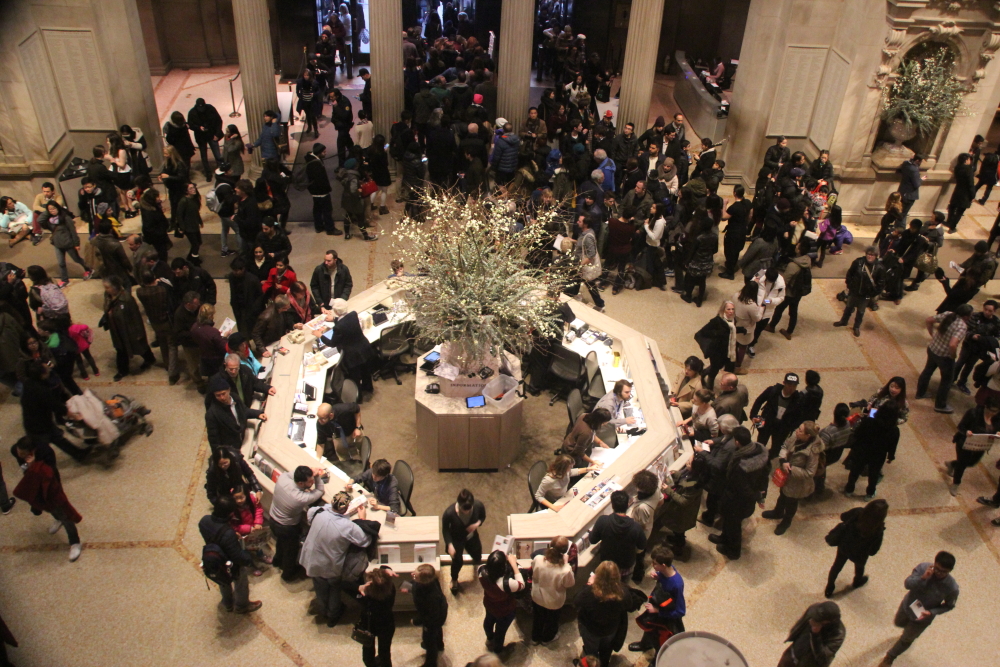
The Great Hall at the Met
* an ongoing series of quotations – mostly from artists, to artists – that offers wisdom, inspiration, and advice for the sometimes lonely road we are on.
Science is concerned with the general, the abstract, and the knowable. In contrast, art deals with the particular, the unknowable, the singular. This applies not just to the content of artistic works but also to the way this content is received. Even in the case of a film or concert attended by large numbers of people, the artistic experience remains fundamentally a solitary one. Each one of us lives the work alone. Whatever sense of togetherness accompanies the experience comes precisely from the fact that, faced with the singularity of the aesthetic moment, each percipient feels his aloneness before the radical mystery that enfolds us all. Wherever an act of creation is shared with others, then, there is individuation – not just for the author of the work but for the audience too. The singularity of art awakens us to our own singularity, and through it to the singularity in the Other. I have argued that artifice unifies by imposing an univocal image that replicates itself identically in each spectator. True art tears the spectator out of the mass of sameness, calling forth from the numberless crowd a new people and a new communion.
J.F. Martel in Reclaiming Art in the Age of Artifice: A Treatise, Critique, and Call to Action
Comments are welcome!
Q: Can you tell us about the different series of work you have created and what they embody?
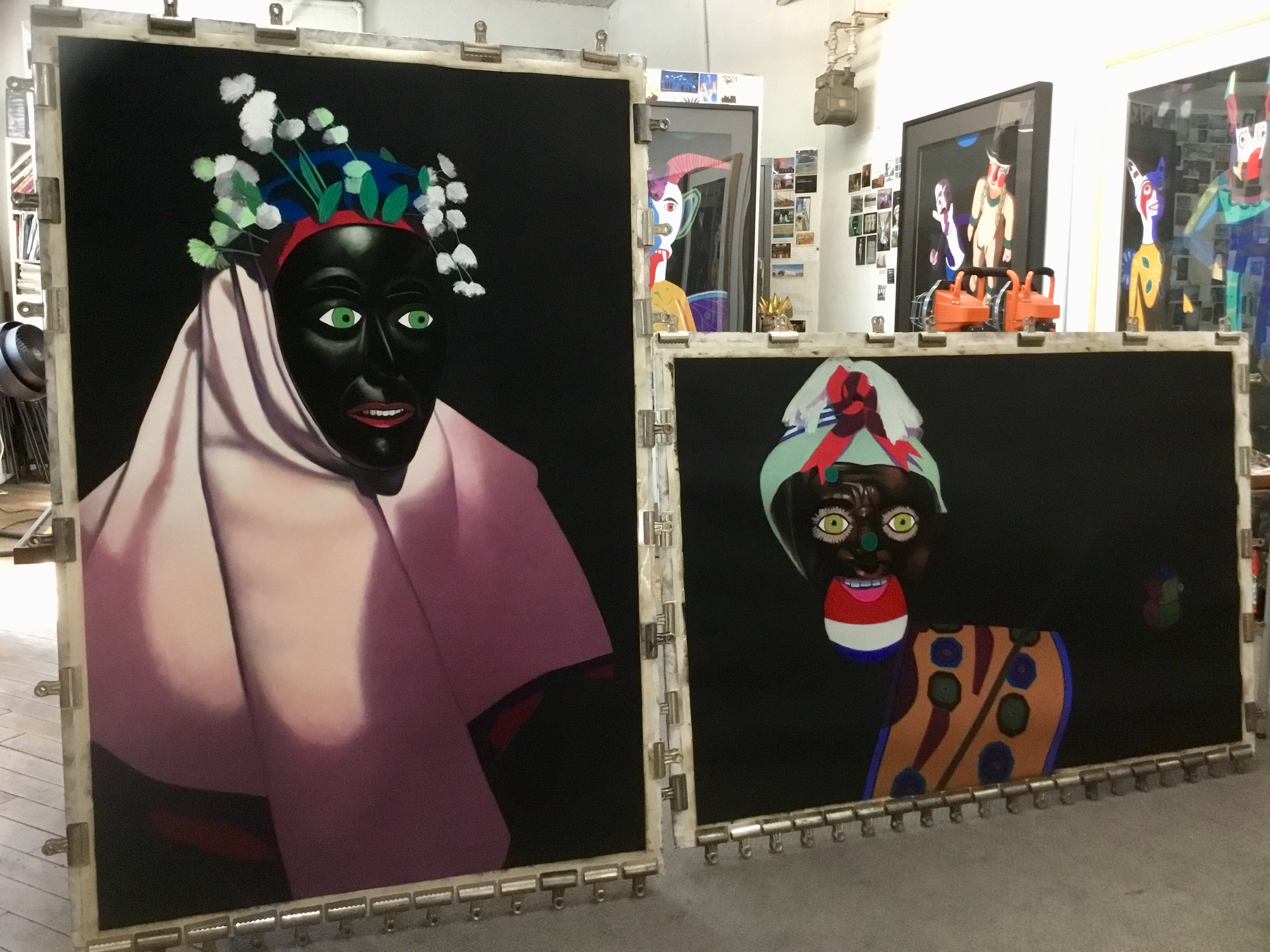
Barbara’s studio with work in progress
A: The Black Paintings series of pastel-on-sandpaper paintings grew directly from an earlier series, Domestic Threats. While both use cultural objects as surrogates for human beings acting in mysterious, highly-charged narratives, in the Black Paintings I replaced all background details of my actual setup (furniture, rugs, etc.) with lush black pastel. In this work the ‘actors’ are front and center.
While traveling in Bolivia two years ago, I visited a mask exhibition at the National Museum of Ethnography and Folklore in La Paz. The masks were presented against black walls, spot-lit, and looked eerily like 3D versions of my Black Paintings. I immediately knew I had stumbled upon a gift. So far I have completed nine pastel paintings in the Bolivianos series. One is awaiting finishing touches, one is in progress now, and I am planning the next one.
All of my pastel paintings are an example of a style called “contemporary conceptual realism” in which things are not quite as innocent as they seem. In this sense each painting is a kind of Trojan horse. There is plenty of backstory to my images, although I usually prefer not to over-explain them. Some mystery must always remain in art.
The world I depict is that of the imagination and this realm owes little debt to the natural world. I recently gave an art talk where I was reminded how fascinating it is to learn how others respond to my work. As New York art critic Gerrit Henry once remarked, “What we bring to a Rachko… we get back, bountifully.”
Comments are welcome!
Pearls from artists* # 356
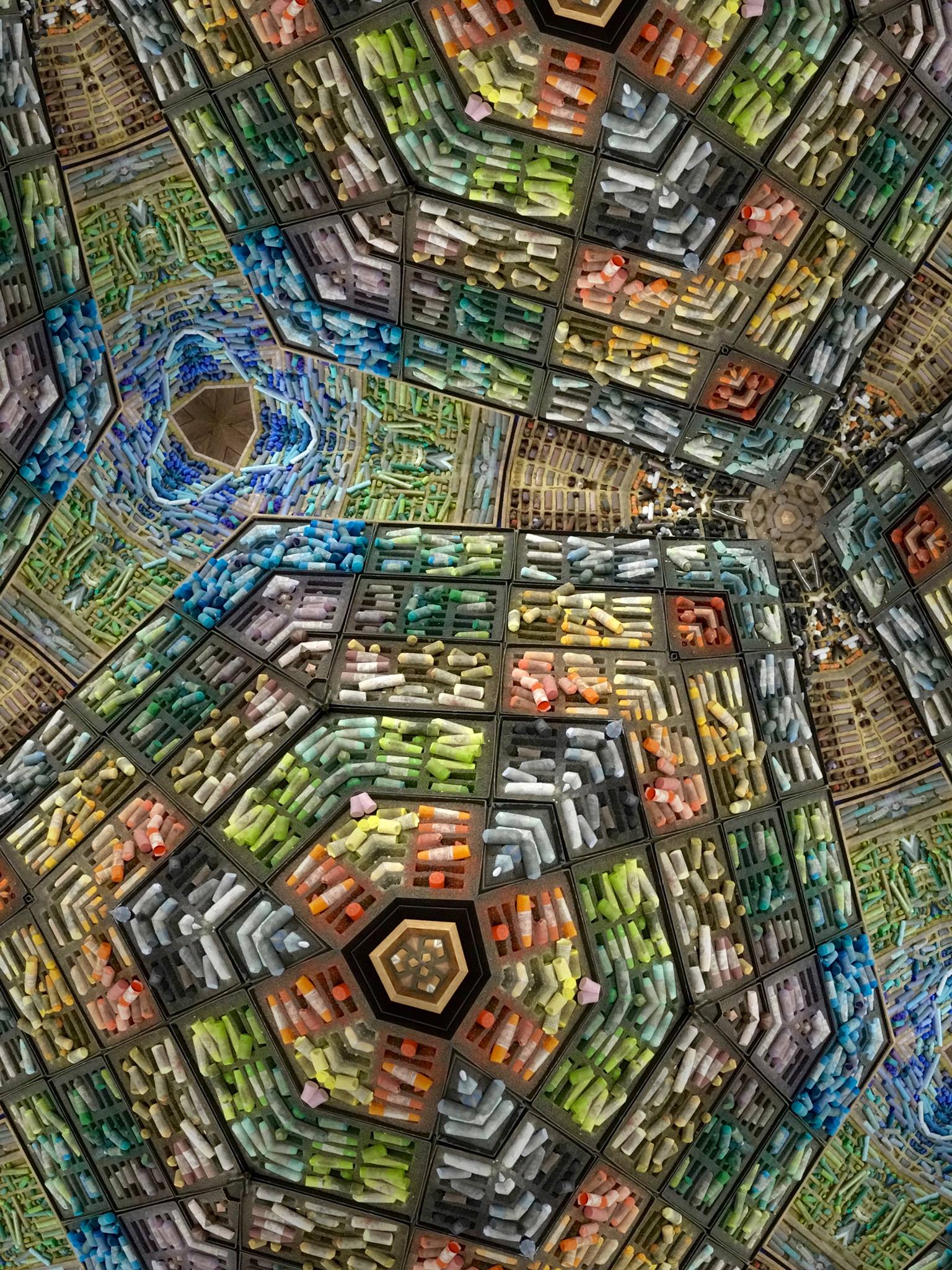
Some of Barbara’s pastels
*an ongoing series of quotations – mostly from artists, to artists – that offers wisdom, inspiration, and advice for the sometimes lonely road we are on.
Science is concerned with the general, the abstract, and the knowable. In contrast, art deals with the particular, the unknowable, the singular. This applies not just to the content of artistic works but also to the way this content is received. Even in the case of a film or concert attended by large numbers of people, the artistic experience remains a fundamentally solitary one. Each one of us lives the work from the work alone. Whatever sense of togetherness accompanies the experience comes precisely from the fact that, faced with the singularity of the aesthetic moment, each percipient feels his aloneness before the radical mystery that enfolds us all. Wherever an act of creation is shared with others, then, there is individuation – not just for the author of the work but for the audience too. The singularity of art awakens us to our own singularity, and through it to the singularity in the Other. I have argued that artifice unifies by imposing a univocal image that replicates itself indefinitely in each spectator. True art tears the spectral out of the mass of sameness, calling forth from the numberless crowd a new people and a new communion.
Reclaiming Art in the Age of Artifice: A treatise, Critique, and Call to Action
Comments are welcome!
Pearls from artists* # 306

New York, NY
* an ongoing series of quotations – mostly from artists, to artists – that offers wisdom, inspiration, and advice for the sometimes lonely road we are on.
It is the responsibility of artists to pay attention to the world, pleasant or otherwise, and to help us live respectfully in it.
Artists do this by keeping their curiosity and moral sense alive, and by sharing with us their gift for metaphor. Often this means finding similarities between observable fact and inner experience – between birds in a vacant lot, say, and an intuition worthy of Genesis.
More than anything else, beauty is what distinguishes art. Beauty is never less than mystery, but it has within it a promise.
In this way, art encourages us to gratitude and engagement, and is of both personal and civic consequence.
Robert Adams in Art Can Help
Comments are welcome!


 barbararachkoscoloreddust.com