Blog Archives
Pearls from artists* # 436
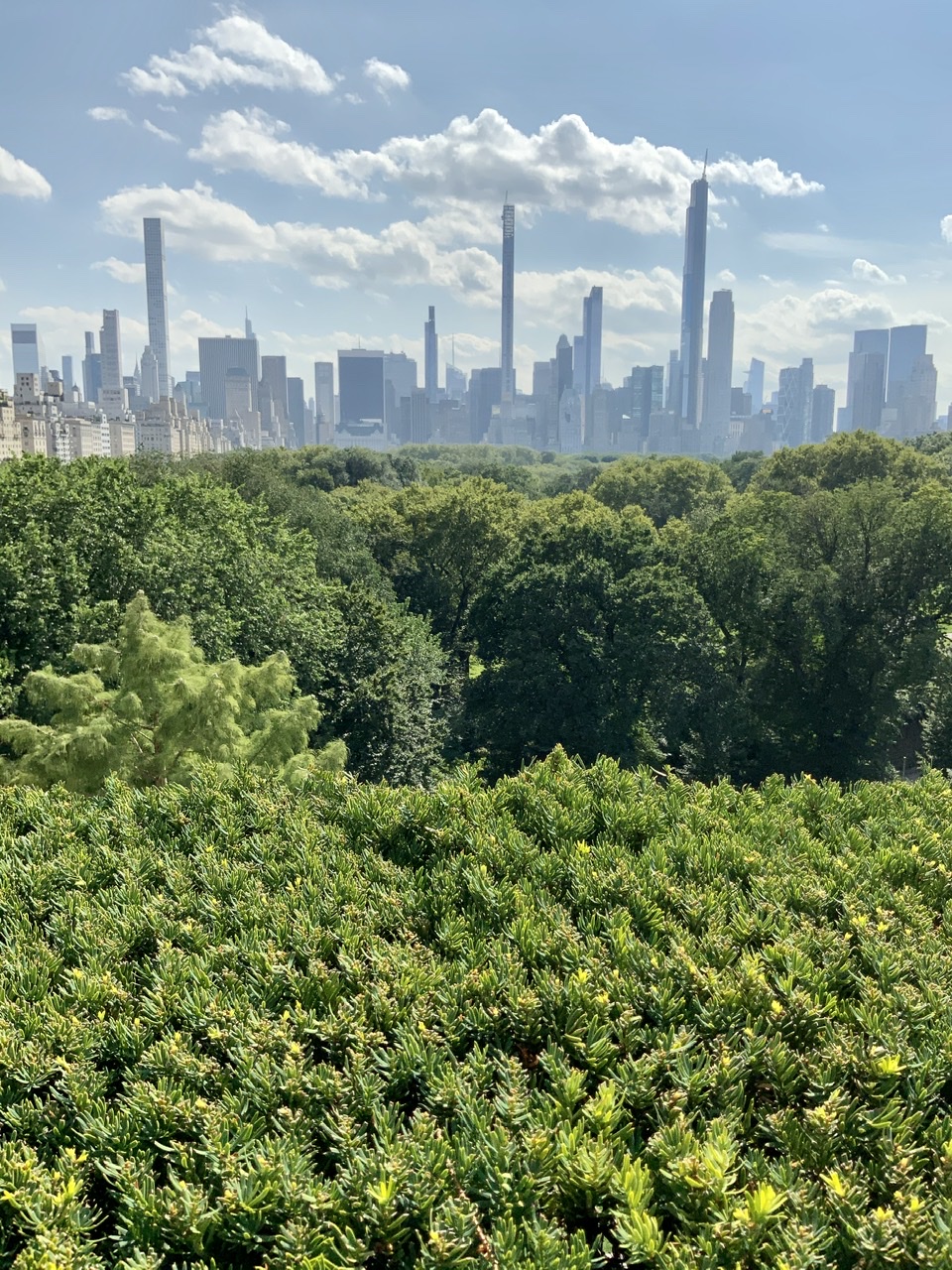
View from the roof of the Metropolitan Museum of Art, New York
*an ongoing series of quotations – mostly from artists, to artists – that offers wisdom, inspiration, and advice for the sometimes lonely road we are on.
Cassirer’s partial definition of art as symbolic language has dominated art studios in our [20th] century. A new history of culture anchored upon the work of art as a symbolic expression thus came into being. By these means art has been made to connect with the rest of history.
But the price has been high, for while studies of meaning received all our attention, another definition of art, as a system of formal relationships, thereby suffered neglect. This other definition matters more than meaning. In the same sense speech matters more than writing, because speech preceded writing, and because writing is but a special case of speech.
The other definition of art as form remains unfashionable, although every thinking person will accept it as a truism that no meaning can be conveyed without form. Every meaning requires a support, or a vehicle, or a holder. These are the bearers of meaning, and without them no meaning would cross from me to you, or from you to me, or indeed from any part of nature to any other part.
… The structural forms can be sensed independent of meaning. We know from linguistics in particular that the structural elements undergo more or less regular evolutions in time without relation to meaning, as when certain phonetic shifts in the history of cognate languages can be explained only by a hypothesis of regular change. Thus phoneme a occurring in an early stage of language, becomes phoneme b at a later stage, independently of meaning, and only under the rules governing the phonetic structure of the language. The regularity of these changes is such that the phonetic changes can be used to measure durations between recorded but undated examples of speech.
Similar regularities probably govern the formal infrastructure of every art. Whenever symbolic clusters appear, however, we see interferences that may disrupt the regular evolution of the formal system. An interference from visual images is present in almost all art. Even architecture, which is commonly thought to lack figural intention, is guided from one utterance to the next by the images of the admired buildings of the past, both far and near in time.
George Kubler in The Shape of Time: Remarks on the History of Things
Comments are welcome!
Pearls from artists* # 425

Gladstone, NJ
*an ongoing series of quotations – mostly from artists, to artists – that offers wisdom, inspiration, and advice for the sometimes lonely road we are on.
And yet books were faithful companions for Vincent, an important source of sustenance during his times of melancholy: he periodically re-read his favourites, finding new meaning in the text and illustrations each time. Van Gogh read in at least two ways: first “breathlessly,’ and then ‘by careful exploration.’ But we could add a third and a fourth way: thirdly as an artist, and fourthly from the perspective of the writer he perhaps knew himself to be. To Vincent, reading books meant above all to ‘seek in them the artist who made them,’ as he wrote to his sister Willemien. He sought to open an internal dialogue with other writers as artists, and meditated on their words, stopping to consider and reconsider a phrase to make it resonate within him He did this in more than one language – internalizing words, ruminating, bending them to his will, and finally assigning them to a fate of his choosing, over the years. Remarkably several Prefaces by French Naturalist novelists such as Zola, De Goncourts or Maupassant (today considered genuine manifestos) were among the pages that truly challenged and engaged his mind. In them he found the freedom that he was seeking in painting – the ‘confirmation’ of his own ideas, inspiration and encouragement. The work of the illustrators of his favorite books and magazines equally attracted him and had a lingering effect on him, on which he paused to reflect repeatedly, extracting inspiration indirectly.
Mariella Guzzoni in Vincent’s Books: Van Gogh and the Writers Who Inspired Him
Comments are welcome!
Pearls from artists* # 389

Henri Roche pastels: nine trays (four at the top, five on the bottom).
* an ongoing series of quotations – mostly from artists, to artists – that offers wisdom, inspiration, and advice for the sometimes lonely road we are on.
Color vision must be universal. The human eye and brain work the same way for nearly all people as a property of their being human – determining that we all see blue. But the color lexicon, meaning not merely the particular words but also the specific chromatic space they are said to mark, clearly has been shaped by the particularities of culture. Since the spectrum of visible colors is a seamless continuum, where one color is thought to stop and another begun is arbitrary. The lexical discrimination of particular segments is conventional rather than natural. Physiology determines what we see; culture determines how we name, describe, and understand it. The sensation of color is physical; the perception of color is cultural.
David Scott Kastan in On Color
Comments are welcome
Q: Why do you make art?

“Why Do I Make Art” by Ursula von Rydingsvard
A: Last spring I viewed Ursula von Rydingsvard’s exhibition at the National Museum of Women in the Arts. One thing that stayed with me is her wall text, “Why Do I Make Art by Ursula von Rydingsvard” in which she listed a few dozen benefits that art-making has brought to her life.
I want to share some of my own personal reasons here, in no particular order. My list keeps changing, but these are true at least for today.
1. Because I love the entire years-long creative process – from foreign travel whereby I discover new source material, to deciding what I will make, to the months spent in the studio realizing my ideas, to packing up my newest pastel painting and bringing it to my Virginia framer’s shop, to seeing the framed piece hanging on a collector’s wall, to staying in touch with collectors over the years and learning how their relationship to the work changes.
2. Because I love walking into my studio in the morning and seeing all of that color! No matter what mood I am in, my spirit is immediately uplifted.
3. Because my studio is my favorite place to be… in the entire world. I’d say that it is my most precious creation. It’s taken more than twenty-two years to get it this way. I hope I never have to move!
4. Because I get to listen to my favorite music all day or to Public Radio stations.
5. Because when I am working in the studio, if I want, I can tune out the world and all of it’s urgent problems. The same goes for whatever personal problems I am experiencing.
6. Because I am devoted to my medium. How I use pastel continually evolves. It’s exciting to keep learning about its properties and to see what new techniques will develop.
7. Because I have been given certain gifts and abilities and that entails a sacred obligation to USE them. I could not live with myself were I to do otherwise.
8. Because art-making gives meaning and purpose to my life. I never wake up in the morning wondering, how should I spend the day? I have important work to do and a place to do it. I know this is how I am supposed to be spending my time on earth.
9. Because I have an enviable commute. To get to my studio it’s a thirty-minute walk, often on the High Line early in the morning before throngs of tourists have arrived.
10. Because life as an artist is never easy. It’s a continual challenge to keep forging ahead, but the effort is also never boring.
11. Because each day in the studio is different from all the rest.
12. Because I love the physicality of it. I stand all day. I’m always moving and staying fit.
13. Because I have always been a thinker more than a talker. I enjoy and crave solitude. I am often reminded of the expression, “She who travels the farthest, travels alone.” In my work I travel anywhere.
14. Because spending so much solitary time helps me understand what I think and feel and to reflect on the twists and turns of my unexpected and fascinating life.
15. Because I learn about the world. I read and do research that gets incorporated into the work.
16. Because I get to make all the rules. I set the challenges and the goals, then decide what is succeeding and what isn’t. It is working life at its most free.
17. Because I enjoy figuring things out for myself instead of being told what to do or how to think.
18. Because despite enormous obstacles, I am still able to do it. Art-making has been the focus of my life for thirty-three years – I was a late bloomer – and I intend to continue as long as possible.
19. Because I have been through tremendous tragedy and deserve to spend the rest of my life doing exactly what I love. The art world has not caught up yet, but so be it. This is my passion and my life’s work and nothing will change that.
20. Because thanks to the internet and via social media, my work can be seen in places I have never been to and probably will never go.
21. Because I would like to be remembered. The idea of leaving art behind for future generations to appreciate and enjoy is appealing.
Comments are welcome!
Q: Would you speak about the meaning of your work and the different materials you use?
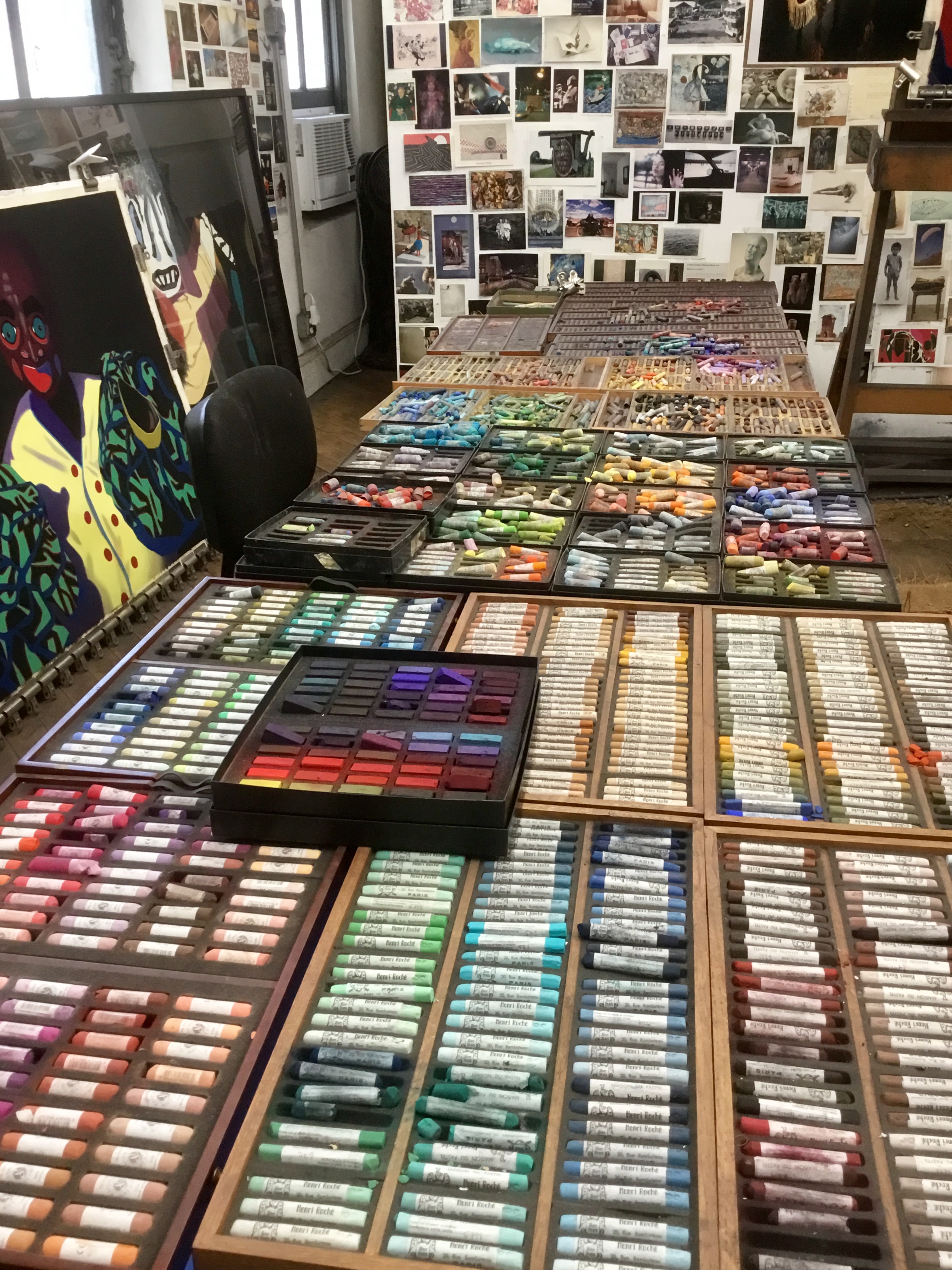
About half of Barbara’s pastels
A: It is as difficult to explain the meaning of my art as it is to interpret the meaning of life! I am invested in and concerned with process: foreign travel, prodigious reading, devotion to craft, months of slow meticulous work in the studio trying to create an exciting work of art that has never been seen before, etc. I love making pastel paintings! Many years ago I challenged myself to push the limits of what soft pastel can achieve. I am still doing so.
I leave it to others – viewers, arts writers, critics, art historians – to study my creative journey and talk about meanings. I believe an artist is inspired to create and viewers ponder the creation. I would not presume to tell anyone how to react to my work.
For many years I have been devoted to promoting soft pastel as a fine art medium. There are excellent reasons it has been around for five hundred years! It is the most permanent of media. There’s no liquid binder to cause oxidizing or cracking over time, as happens with oil paint. Pastel colors are intense because they are close to being pure pigment. Pastel allows direct application (no brushes) with no drying time and no color changes.
I use UArt acid-free sandpaper. This is not sandpaper from a hardware store. It is made for artists who work in pastel and allows me to build up layers of pigment without using a fixative. My process – slowly applying and layering pastels, blending and mixing new colors directly on the paper, making countless adjustments, searching for the best and/or most vivid colors – continually evolves. Each pastel painting takes months to create.
Comments are welcome!
Pearls from artists* # 328

Barbara in her studio, Photo: Izzy Nova
*an ongoing series of quotations – mostly from artists, to artists – that offers wisdom, inspiration, and advice for the sometimes lonely road we are on.
An artist’s words are always to be taken cautiously… The artist who discusses the so-called meaning of his work is usually describing a literary side-issue. The core of his original impulse is to be found, if at all, in the work itself. Just the same, the artist must say what he feels…
I want to explain why I did the piece, I don’t see why artists should say anything because the work is supposed to speak for itself. So whatever the artist says about it is like an apology, it is not necessary.
I never talk literally; you have to use analogy and interpretation and leaps of all kinds…
I am suspicious of words. They do not interest me, they do not satisfy me. I suffer from the ways in which words wear themselves out. I distrust the Lacans and Bossuets because they gargle with their own words. I am a very concrete woman. The forms are everything…
With words you can say anything. You can lie as long as the day, but you cannot lie in the recreation of experience…
Louise Bourgeois: Destruction of the Father, Reconstruction of the Father: Writings and interview 1923-1997, edited and with texts by Marie-Laure Bernadac and Hans-Ulrich Obrist
Comments are welcome!
Pearls from artists* # 321

Museum of Ethnography and Folklore, La Paz, Bolivia
*an ongoing series of quotations – mostly from artists, to artists – that offers wisdom, inspiration, and advice for the sometimes lonely road we are on.
This is Bolivia, a country rich in cultural expressions. Here many great civilizations have flourished, all of which, fundamentally, are bound to the soil from which both fruits and gods emerged.
As part of the expression of these cultures, masks are not mere accessories to conceal the face or represent a character for an artistic performance. Neither are they simply for diversion.
Their roles as objects of art and diversion make sense only as part of a ceremonial act. Then, masks can be understood as the remembrance of history and myth, the externalization of collective life. They are seen within the context of a religious or social ceremony whose meaning is embedded in the past as well as present of a people.
These collective acts, without being set apart from daily life, are special celebrations where many distinct elements must be taken into account: music, dance, costume, mask, food, drink, theatrical representation, work, history…
Masked Dances of the Altiplano, by Manuel Vargas in Masks of the Bolivian Andes, Photographs: Peter McFarren, Sixto Choque, Editorial Quipos and BancoMercantil
Comments are welcome!
Pearls from Artists* # 313

Barbara and Tomas in Panajachel, Guatemala
*an ongoing series of quotations – mostly from artists, to artists – that offers wisdom, inspiration, and advice for the sometimes lonely road we are on.
Proclaiming that the object in Surrealism was fundamental, [Andre] Breton suggests a radical transition in surrealist creation, one that liberated the poet-artist from all constraints in the making of the artistic object. Breton’s text calls for a “revolution of the object,” suggesting that in the placing of an object into a new context, and thus attributing it with a new meaning – also called a “detournement” – which takes precedence. Drawing in his interpretation of Hegelian subject-object relations, Breton describes the “object” as a work of art that relies on a philosophical procedure, affirming the surrealist process as one that is realized in the experience of apprehending the object through a dialectical method. Citing the work of Marcel Duchamp and Max Ernst, Breton explains that an object may become a product of surrealist creation through the simple “manipulation” of it. Here ”manipulation“ is defined as a procedure which reveals the object in its original and new state at the same time. If taking an object out of its original context and placing it in a new space creates the potential for a creative act, then this text seems to validate the surrealist practice of collecting. As the collector acquired objects and unites them in a gallery or a home, they assume new significance contingent upon their physical juxtaposition to other objects.
Moon Dancers: Yup’ik Masks and the Surrealists, edited by Jennifer Field, Introduction by Christina Rudofsky
Comments are welcome!
Pearls from artists* # 296
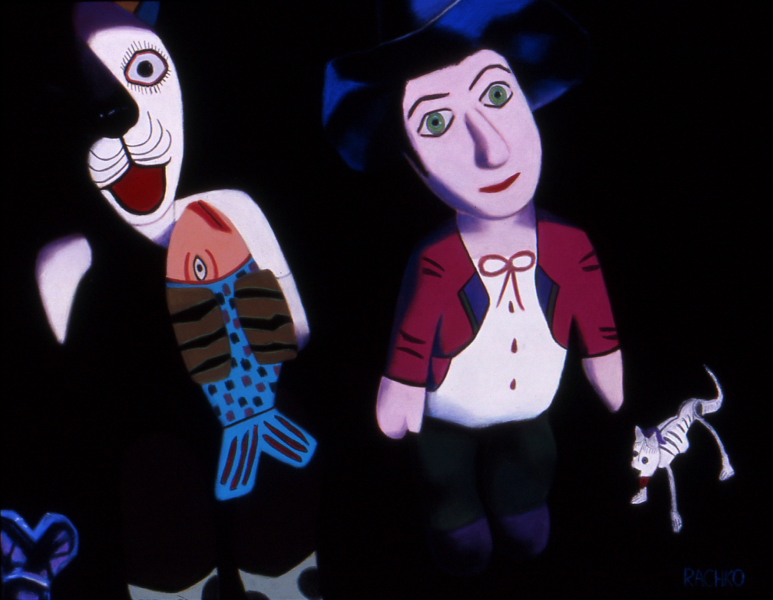
“Offering,” soft pastel on sandpaper, 20″ x 26″
* an ongoing series of quotations – mostly from artists, to artists – that offers wisdom, inspiration, and advice for the sometimes lonely road we are on.
Meaning in art isn’t the same as meaning in science. The meaning of the second law of thermodynamics, so long as the words are understood, isn’t changed by who reads it,or when, or where. The meaning of Huckleberry Finn is.
Writing is a risky business. No guarantees. You have to take the chance. I’m happy to take it. I love taking it. So my stuff gets misread, misunderstood, misinterpreted – so what? If it’s the real stuff, it will survive almost any abuse other than being ignored, disappeared, not read.
Ursula K. Le Guin in No Time to Spare: Thinking About What Matters
Comments are welcome!
Pearls from artists* # 274

Barbara’s studio
* an ongoing series of quotations – mostly from artists, to artists – that offers wisdom, inspiration, and advice for the sometimes lonely road we are on.
“Beauty is never enough,” he said. “Meaning is more important. If something catches people’s eyes enough to make them move around it, they will build a story around it. And that will not just be about beauty.”
Eric Charles-Donatien in Feathered Glory: In a studio in Paris, an old craft is given new life by Burkhard Bilger in The New Yorker, Sept. 25, 2017
Comments are welcome!


 barbararachkoscoloreddust.com