Blog Archives
Q: Would you speak more about being represented by Brewster Gallery in the late 1990s?

A: In 1996 I landed my first major New York gallery, Brewster Gallery. I was still living in Virginia and Mia Kim, the director, had accepted my work on the basis of unsolicited slides mailed to the gallery in July. The first time she saw my pastel paintings in person was when I delivered them for a solo exhibition in October.
Brewster represented Latin American masters such as Frida Kahlo, Francisco Zuniga, Diego Rivera, Francisco Toledo, and Rufino Tamayo. Mia Kim, the director, said that she sometimes had to defend her decision to represent me. Mia’s fabulous response was, “Barbara has the SOUL of a Latina!” My work at that time was heavily influenced by Mexican culture. Mia immediately understood what I was doing in my work. How thrilled and honored I was to be represented by a gallery where my fellow sole non-Latina was Leonora Carrington! Leonora came to my opening.
Those were wonderful days!
Comments are welcome!
Pearls from artists* # 640

*an ongoing series of quotations – mostly from artists, to artists – that offers wisdom, inspiration, and advice for the sometimes lonely road we are on.
When an artist changes and develops over the years, as is natural to any creative person, such change is met by howls of protest from the marketers. Sometimes an artist (or teacher, scientist, or spiritual guru) starts with something extraordinary, becomes a star, and then their gift is either frozen or perverted.
The growing and risky edge of creative work is devalued, treated as a frill or extracurricular activity decorating the routine of ordinary life. There are few mechanisms available for the artist to construct a self-sustaining way of living and working. “One gathers,” says Virginia Woolf,
“from the enormous modern literature of confession and self-analysis that to write a book of genius is almost always a feat of prodigious difficulty. Everything is against the likelihood that it will come from the writer’s mind whole and entire. Generally, material circumstances are against it. Dogs will bark; people will interrupt; money must be made; health will break down. Further, accentuating all these difficulties and making them harder to bear is the world’s notorious indifference. It does not ask people to write poems and novels and histories; it does not need them. It does not care whether Flaubert finds the right word or whether Carlyle scrupulously verifies this or that fact. Naturally, it will not pay for what it does not want. And so the writer, Keats, Flaubert, Carlyle, suffers, especially in the creative years of youth, every form of distraction and discouragement. A curse, a cry of agony, rises from those books of analysis and confession. “Mighty poems in their misery dead” – that is the burden of their song. If anything comes through in spite of all this, it is a miracle, and probably no book is born entire and uncrippled as it was conceived.”
Stephen Nachmanovitch in Free Play: Improvisation in Art and Life
Comments are welcome!
Pearls from artists* # 638

Barbara’s Studio
*an ongoing series of quotations – mostly from artists, to artists – that offers wisdom, inspiration, and advice for the sometimes lonely road we are on.
I was in the presence of a woman [Grace Hartigan] who had sacrificed everything, including her only child, to be what she was: an artist. The rewards had been few, beyond a life well-lived (not materially, but spiritually) and the recognition in her waning years that she had been honest about who she was and what she needed. A rare accomplishment for a woman of any generation, it was particularly so of hers, when servitude to family was the only goal toward which a “healthy” woman was to aspire. Grace was living proof that, on the contrary, a life dreamed could be a life lived. All it took was courage, commitment, and humor. I remember both of us laughing a lot that afternoon. Though the subject was serious, the stories Grace told were fantastic and the woman who recounted them was as wild as the twenty-six-year-old who had abandoned everything in 1948 to paint, though she wasn’t even sure how.
Mary Gabriel in Ninth Street Women
Comments are welcome!
Pearls from artists* # 635

Dinard, Brittany, France
*an ongoing series of quotations – mostly from artists, to artists – that offers wisdom, inspiration, and advice for the sometimes lonely road we are on.
The body of writing takes a thousand different forms,
and there is no right way to measure.
Changing, changing at the flick of a hand, its various
forms are difficult to capture.
Words and phrases compete with one another, but the
mind is still master.
Caught between the unborn and the living, the writer
struggles to maintain both depth and surface.
He may depart from the square, he may overstep the
circle, searching for the one true form of his reality.
He would fill the eyes of his readers with splendor, he
would sharpen the mind’s values.
The one whose language is muddled cannot do it;
only when mind is clear can language be noble.
Lu Chi quoted in Free Play: Improvisation in Art and Life by Stephen Nachmanovitch
Comments are welcome!
Q: Are there any artists you admire? (Question from “Cultured Focus” Magazine)

“Henri Matisse: Forms in Freedom,” The National Arts Center, Tokyo, Japan
A: Among historical painters, I adore Henri Matisse and André Derain, for their striking compositions and bold use of colors. Among living photographers, I am most fascinated by the Pictures Generation, namely, Cindy Sherman, Laurie Simmons, Sandy Skoglund, and Gregory Crewdson. I am drawn to these photographers, I think, because my earliest pastel painting series involved staged photography.
Comments are welcome!
Q: Are there any artists whose work you particularly admire? (Question from “Cultured Focus Magazine”)

Henri Matisse: Forms in Freedom at the National Art Center Tokyo
A: Among historical painters, I adore Henri Matisse and André Derain, for their striking compositions and bold use of colors. Among living photographers, I am most fascinated by the Pictures Generation, namely, Cindy Sherman, Laurie Simmons, Sandy Skoglund, and Gregory Crewdson. I am drawn to these photographers, I think, because my earliest pastel painting series involved staged photography.
Comments are welcome!
Pearls from artists* # 611
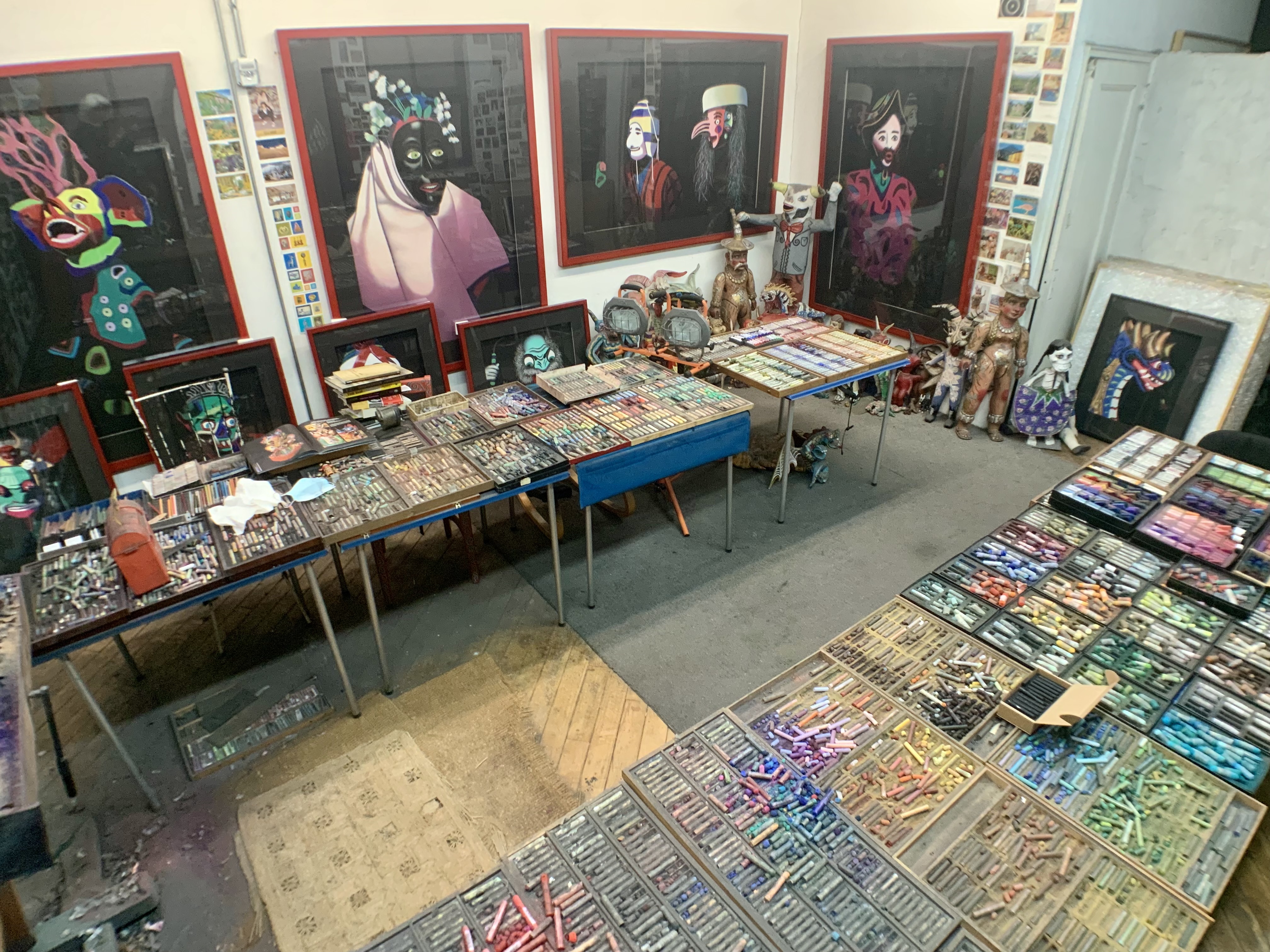
Barbara’s Studio
*an ongoing series of quotations – mostly from artists, to artists – that offers wisdom, inspiration, and advice for the sometimes lonely road we are on.
This common participation in the Trinity of Line, Form, and Color has founded a promiscuous fellowship which, while promoting the respect for skill, promotes to a far greater degree the misunderstanding of art. For skill in itself is but a sleight of hand. In a work of art one does not measure its extent but counts himself happiest when he is unaware of its existence in the contemplation of the result. Among those who decorate our banks and hotels you will find many who can imitate the manner of any master, living or dead, far better than the master could imitate himself, but they have no more knowledge of his soul than they have knowledge of their own. We will know how little skill avails, how ineffective are its artifices in filling the lack of true artistic motivation. His “less is more,” is Robert Browning’s famous evaluation of this problem in comparing the imperfections of Raphael’s art to the impecability of Del Sarto’s, “I should rather say that it will be more difficult to improve the mind of the master who makes such mistakes than to repair the work he has spoilt,” Leonardo wrote. Neither Giotto nor Goya exhibited half the skill of Coreggio or Sargent, either in the complexity of their undertaking or the apparent virtuosity of execution. The artist must have the particular skill to achieve his particular ends. If he has more, we are fortunate not to know it, for the exhibition of excess would only mar his art. You may be sure that the artist whose method is muddled betrays less his technical inadequacy than the incoherence of his own intentions.
Mark Rothko in The Artist’s Reality: Philosophies of Art
Comments are welcome!
Pearls from artists* # 574

Barbara’s Studio
*an ongoing series of quotations – mostly from artists, to artists – that offers wisdom, inspiration, and advice for the sometimes lonely road we are on.
A creative life is risky business. To follow your own course, not patterned on parents, peers, or institutions, involves a delicate balance of tradition and personal freedom, a delicate balance of sticking to your guns and remaining open to change. While on some dimensions living a normal life, you are nevertheless a pioneer, breaking away from the molds and models that inhibit the heart’s desire, creating life as it goes. Being, acting, creating in the moment without props and supports, without security, can be supreme play, and it can also be frightening, the very opposite of play. Stepping into the unknown can lead to delight, poetry, invention, humor, lifetime friendships, self-realization, and occasionally a great creative breakthrough. Stepping into the unknown can also lead to failure, disappointment, rejection, sickness, or death.
Stephen Nachmanovitch in Free Play: Improvisation in Life and Art
Comments are welcome!
Pearls from artists* #571
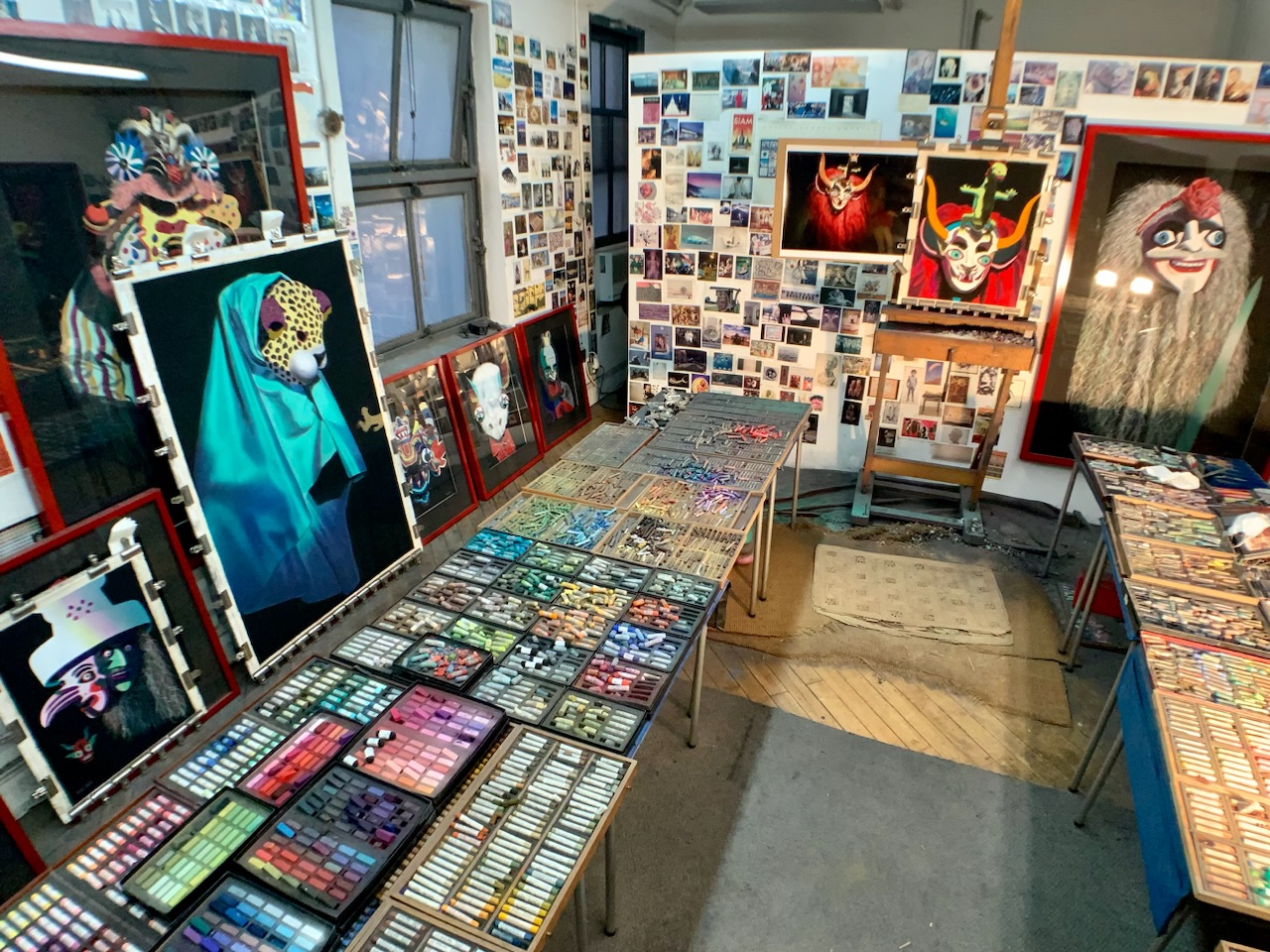
The Studio
*an ongoing series of quotations – mostly from artists, to artists – that offers wisdom, inspiration, and advice for the sometimes lonely road we are on.
To put it simply, but accurately, artists are often lost to the world because of their obsessions with their art. They may be just as lost as they prepare to work or incubate a new idea as in those feverish days when they make their final cuts on a film or race toward a publishing deadline. They may obsess about artistic questions and feel bursts of creative energy day or night, alone or in the company of others, in the middle of the work week or on vacation in the Bahamas.
Lost in time and space, the artist may feel more connected to Picasso, Emily Dickinson, Ingmar Bergman, Gertrude Stein, Handel, or Tennessee Williams than to the people in his immediate world. The living past holds extraordinary meaning for him. He travels elsewhere, removing his spirit and attention from the present. He may reside, as he works on his novel, in the childhood of a character, walking the garden paths and living the household dramas there. He may come upon a Rembrandt drawing and find himself wrenched, not to any particular place or time, but just elsewhere, as he experiences the greatness of his traditions, measures himself anew, and dreams again of his future.
Eric Maisel in A Life in the Arts: Practical Guidance and Inspiration for Creative and Performing Artists
Comments are welcome!
Pearls from artists* # 555

Studio view showing some tools of the trade
*an ongoing series of quotations – mostly from artists, to artists – that offers wisdom, inspiration, and advice for the sometimes lonely road we are on.
Rembrandt and Shakespeare, Tolstoy and Gauguin, possessed, I believe, powerful hearts, not powerful wills. They loved the range of material they used, the work’s possibilities excited them; the field’s complexities fired their imaginations. The caring suggested the tasks; the tasks suggested the schedules. They learned their fields and then loved them. They worked, respectfully, out of their love and knowledge, and they produced complex bodies of work that endure. Then, and only then, the world maybe flapped at them
some sort of hat, which, if they were still living, they ignored as well as they could, to keep at their tasks.
Annie Dillard in The Abundance, quoted in The Marginalian by Maria Popova, November 23, 2022
Comments are welcome!



