Blog Archives
Pearls from artists* # 177
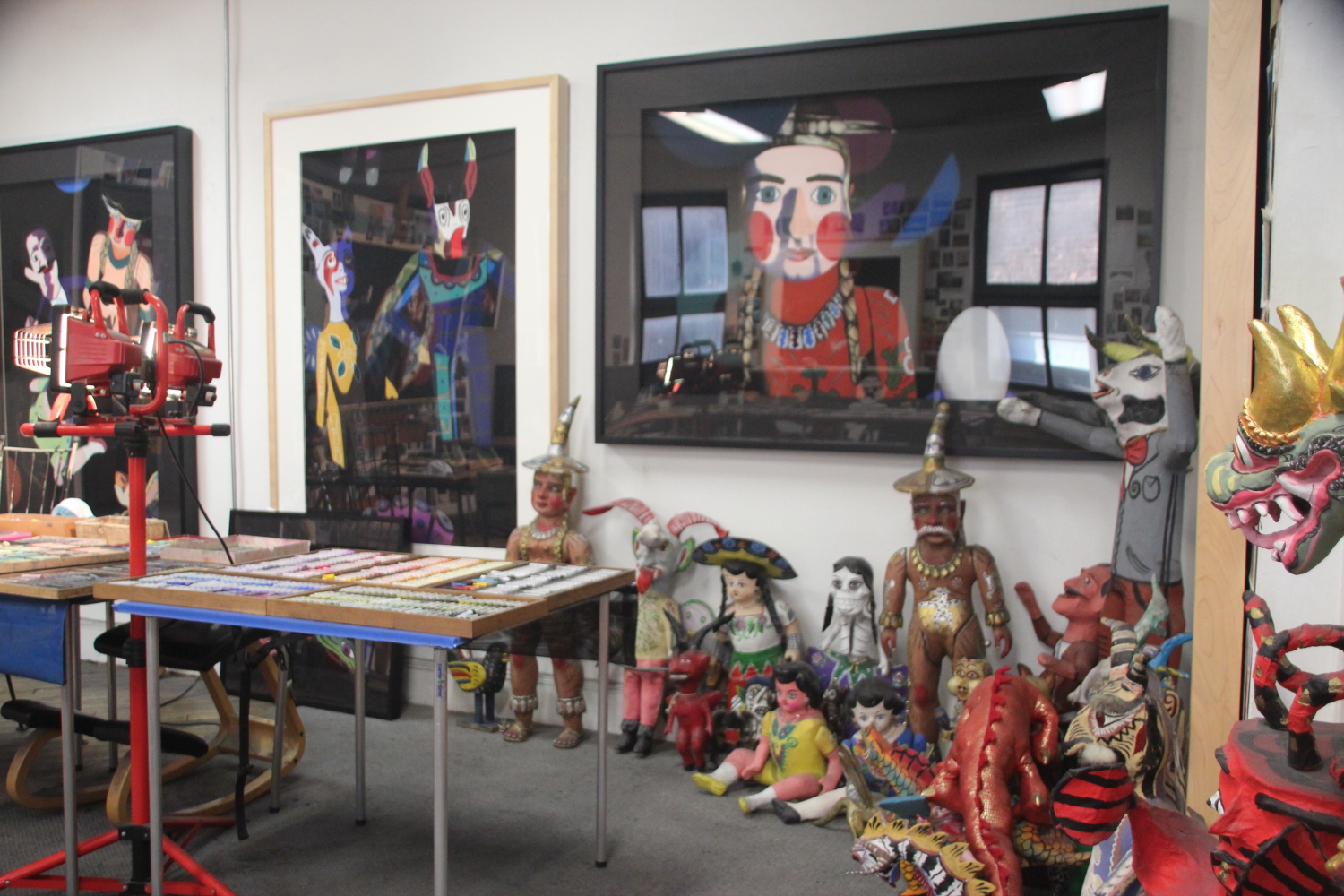
Barbara’s studio
* an ongoing series of quotations – mostly from artists, to artists – that offers wisdom, inspiration, and advice for the sometimes lonely road we are on.
Everyone but a lunatic has a reason for what he does. Yes, in that sense I am a determinist. But I believe, with Kant, that the mind is self-determined. That is, I believe intensely in the creative freedom of the mind. That is indeed absolutely essential to man’s security in a chaotic world of change. He is faced all the time with unique complex problems. To sum them up for action is an act of creative imagination. He fits the different elements together in a coherent whole and invents a rational act to deal with it. He requires to be free, he requires his independence and solitude of mind, he requires his freedom of mind and imagination. Free will is another matter – it is a term, or rather a contradiction in terms, which leads to continual trouble. The will is never free – it is always attached to an object, a purpose. It is simply the engine in the car – it can’t steer. It is the mind, the reason, the imagination that steers.
Joyce Carey in The Paris Review Interviews: Writers at work 1st Series, edited and with an introduction by Malcolm Cowley
Comments are welcome!
Pearls from artists* # 154
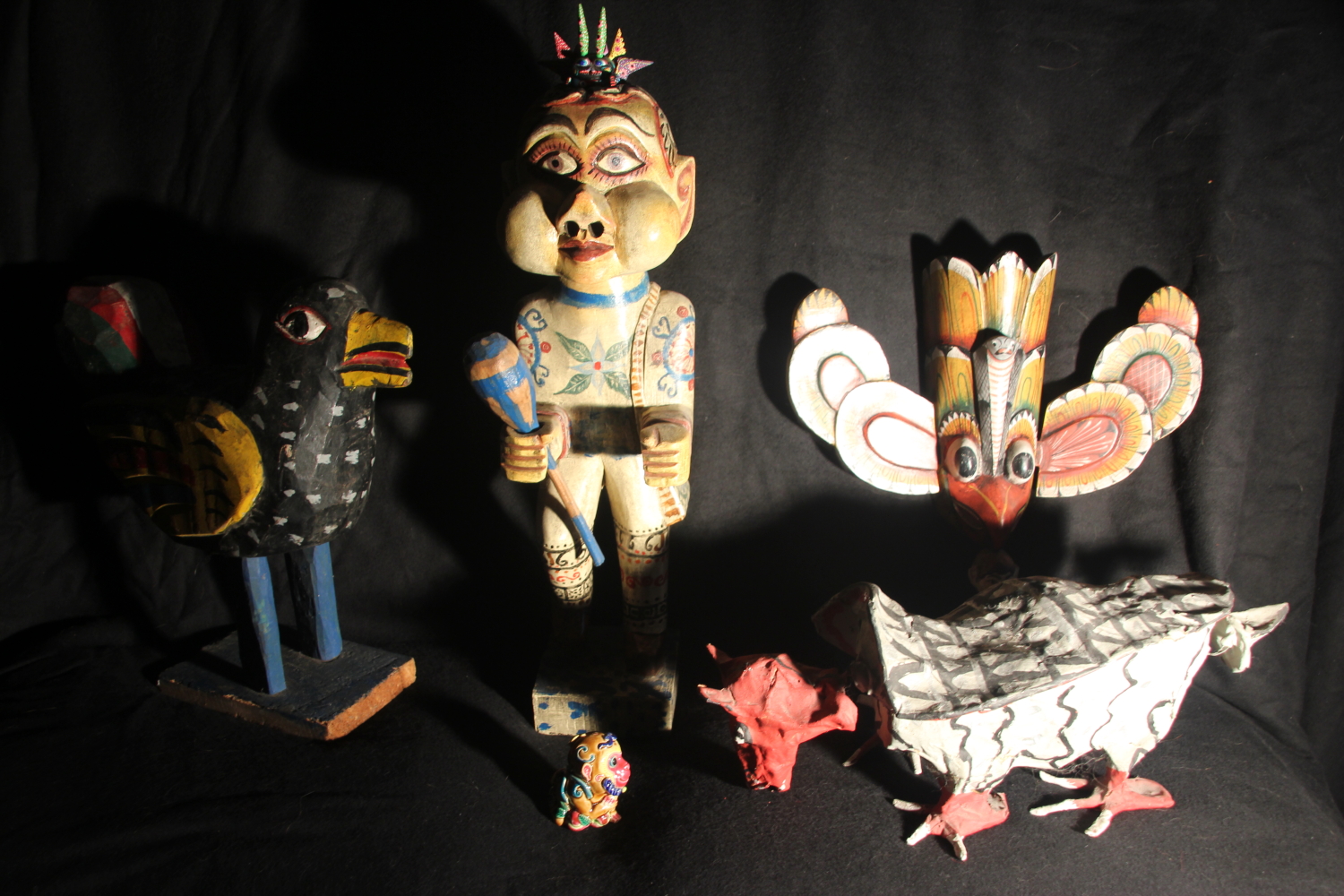
Idea for a painting
* an ongoing series of quotations – mostly from artists, to artists – that offers wisdom, inspiration, and advice for the sometimes lonely road we are on.
Often the public forms an idea of inspiration that is quite false, almost a religious notion. Alas! I do not believe that inspiration falls from heaven. I think it rather the result of a profound indolence and of our incapacity to put to work certain forces in ourselves. These unknown forces work deep within us, with the aid of the elements of daily life, its scenes and passions, and, they burden us and oblige us to conquer the kind of somnolence in which we indulge ourselves like invalids who try to prolong dream and dread resuming contact with reality, in short when the work that makes itself in us and in spite of us demands to be born, we can believe that this work comes to us from beyond and is offered by the gods. The artist is more slumberous in order that he shall not work. By a thousand ruses, he prevents his nocturnal work from seeing the light of day.
For it is at the moment that consciousness must take a precedence and that it becomes necessary to find the means which permit the unformed work to take form, to render it visible to all. To write, to conquer ink and paper, accumulate letters and paragraphs, divide them with periods and commas, is a different matter than carrying the dream of a play or of a book.
Jean Cocteau: The Process of Inspiration in The Creative Process, edited by Brewster Ghiselin
Comments are welcome!
Pearls from artists* # 152

“Between,” soft pastel on sandpaper, 20″ x 26″
* an ongoing series of quotations – mostly from artists, to artists – that offers wisdom, inspiration, and advice for the sometimes lonely road we are on.
The first picture I took of a black man was easy.
That’s the way it sometimes goes for me: I start on a new series of pictures and right away, in some kind of perverse bait-and-switch, I get a good one. This freak of a good picture inevitably inspires a cocky confidence, making me think this new project will be a stroll in the park. But, then, after sometimes two or three more good ones, the next dozen are duds, and that cavalier stroll becomes an uphill slog. It isn’t long before I have to take a breather, having reached the first significant plateau of doubt and lightweight despair. The voice of that despair suggests seducingly to me that I should give up, that I’m a phony, that I’ve made all the good pictures I’m ever going to, and I have nothing more worth saying.
That voice is easy to believe, and, as photographer and essayist (and my early mentor) Ted Orland has noted, it leaves me with only two choices: I can resume the slog and take more pictures, thereby risking further failure and despair, or I can guarantee failure and despair by not making more pictures. It’s essentially a decision between uncertainty and certainty and, curiously, uncertainty is the comforting choice.
Sally Mann in Hold Still: A Memoir with Photographs
Comments are welcome!
Pearls from artists # 146
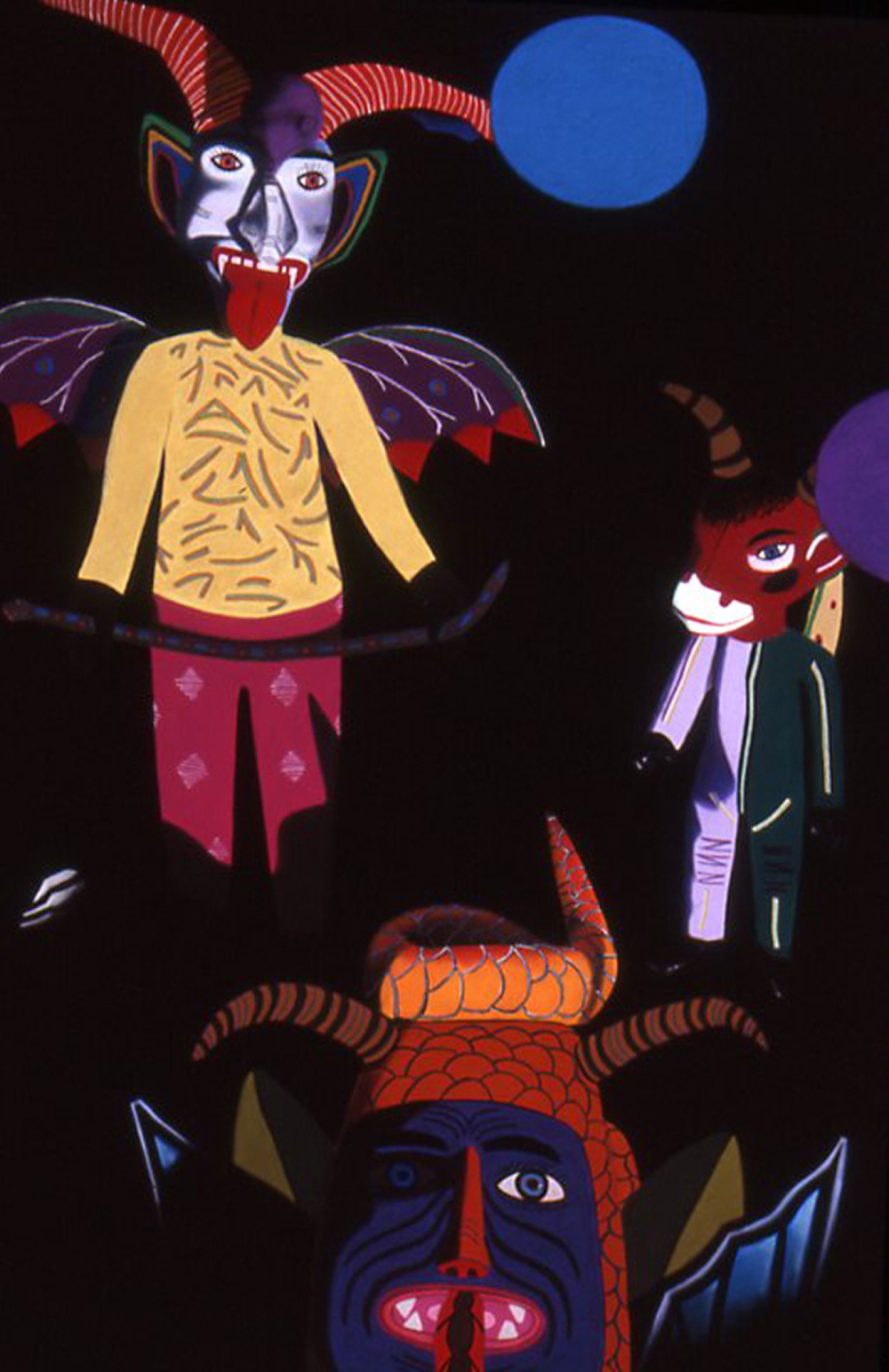
“The Sovereign,” soft pastel on sandpaper, 58″ x 38″
* an ongoing series of quotations – mostly from artists, to artists – that offers wisdom, inspiration, and advice for the sometimes lonely road we are on.
I try to remember that painting at its best is a form of communication, that it is constantly reaching out to find response from an ideal and sympathetic audience. This I know is not accomplished by pictorial rhetoric nor by the manipulation of seductive paint surfaces. Nor is a good picture concocted out of theatrical props, beautiful subjects, or memories of other paintings. All these might astound but they will never communicate the emotional content or exaltation of life, which I believe an artist, by definition, has to accept as his task.
Julian Levi: Before Paris and After in The Creative Process, edited by Brewster Ghiselin
Comments are welcome!
Q: Last week you spoke about what happens before you begin a pastel painting. Would you talk about how you actually make the work?
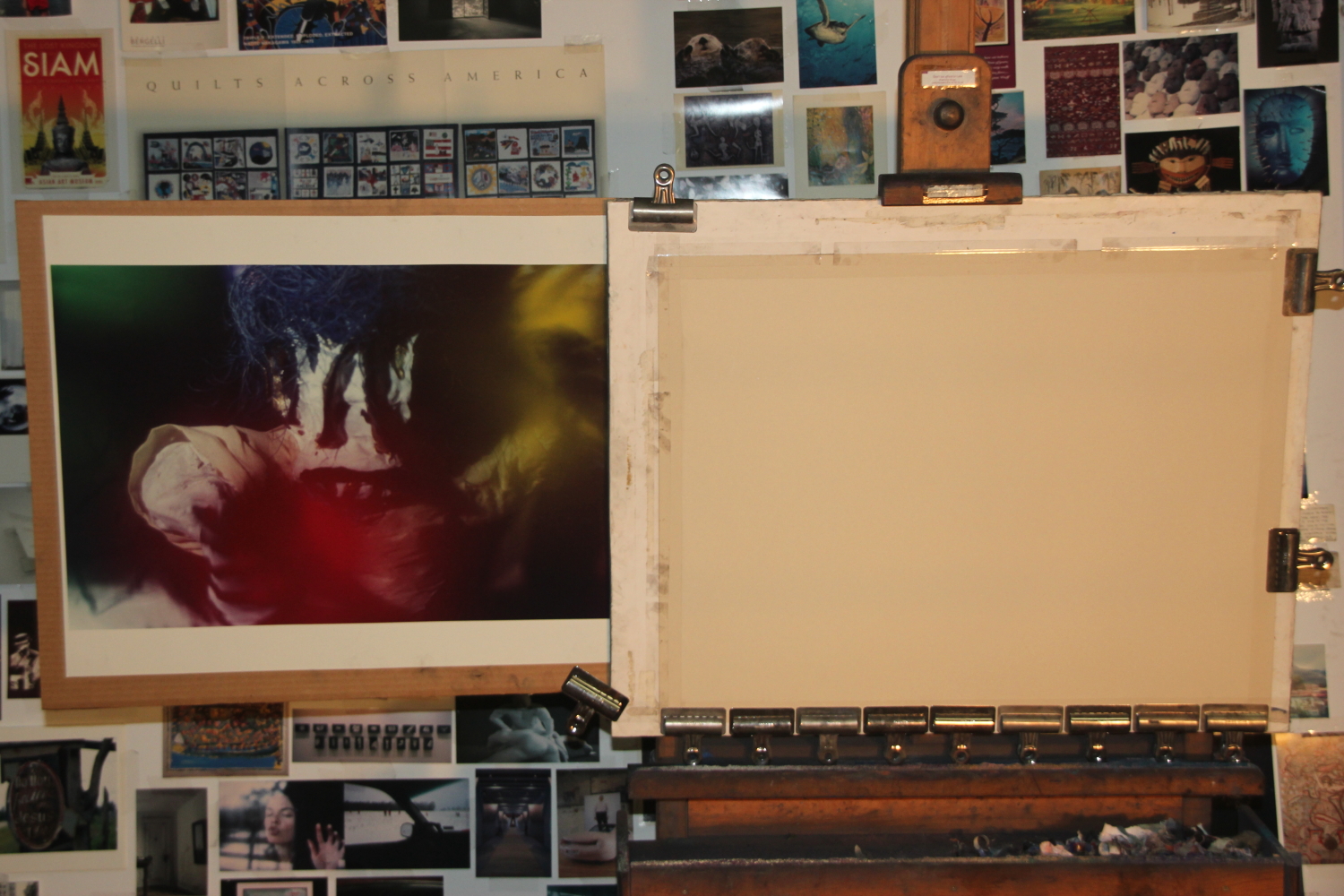
Beginning a new pastel painting
A: I work on each pastel-on-sandpaper painting for approximately three months. I try to be in my studio 7 to 8 hours a day, five days a week.
I make thousands of creative decisions as I apply and layer soft pastels (I have thousands to choose from), blend them with my fingers, and mix new colors directly on the sandpaper. A finished piece consists of up to 30 layers of soft pastel.
My self-invented technique accounts for the vivid, intense color that often leads viewers of my originals to look very closely and ask, “What medium is this?” I believe I am pushing soft pastel to its limits, using it in ways that no other artist has done before.
Comments are welcome!
Q: You took classes at The Art League School in Alexandria, VA in the late eighties studying intensely with Lisa Semerad and Diane Tesler. How have these experiences impacted on the way you currently produce your artworks? By the way, I sometimes wonder if a certain kind of formal training in artistic disciplines could even stifle a young artist’s creativity. What do you think?
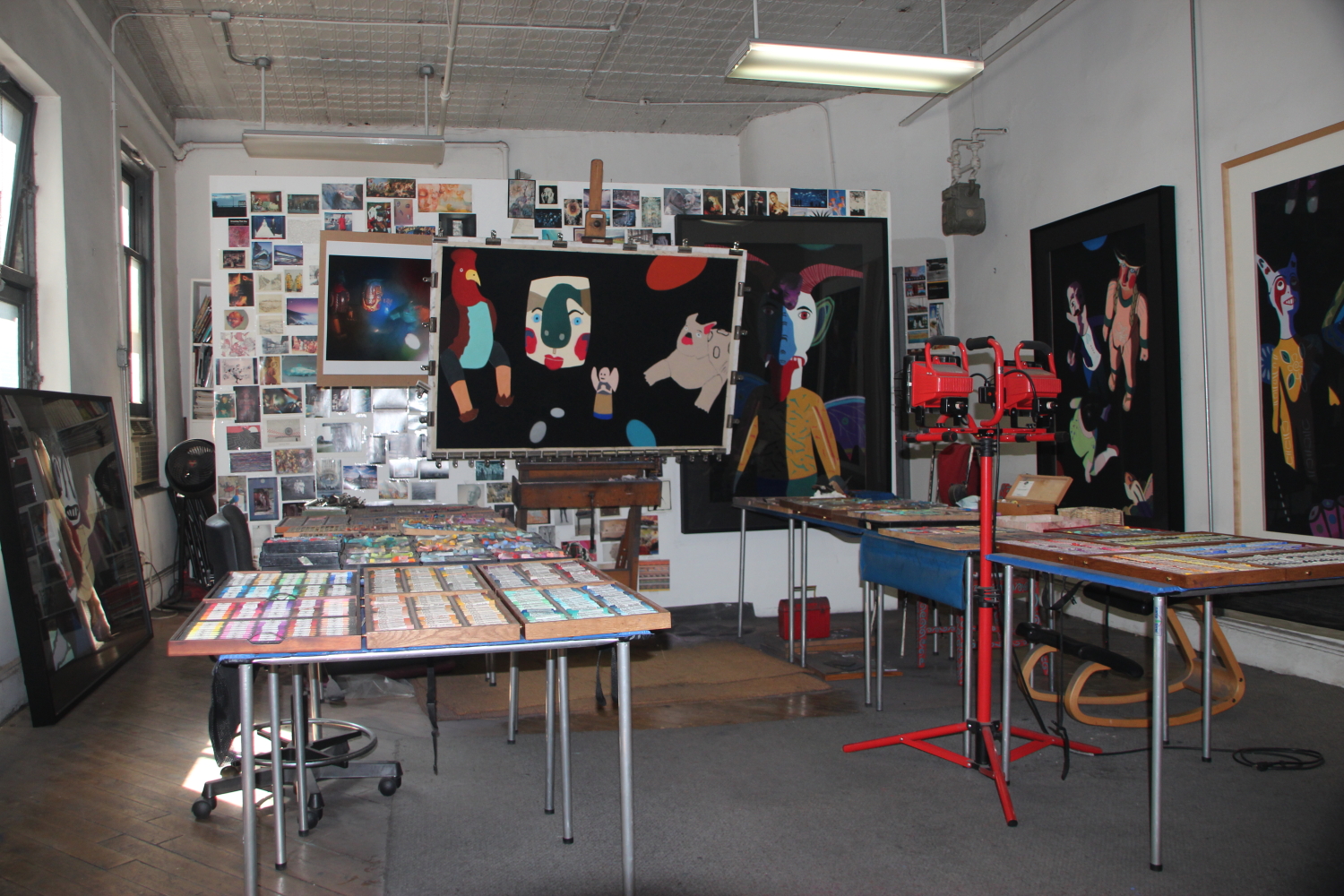
Barbara’s studio
A: From studying with Lisa and Diane I gained an excellent technical foundation and developed my ability to draw and depict just about anything in soft pastel. They were both extremely effective teachers and I worked hard in their classes. I probably got my work ethic from them. Without Diane and Lisa I doubt I would have gained the necessary skills nor the confidence to move to New York to pursue my art career.
Needless to say, I believe developing excellent technical skills is paramount. Artists can, and should, go ahead and break the rules later, but they won’t be able to make strong work, expressing what they want, without a firm foundation. Once you have the skills, you can focus on the things that really make your work come alive and speak to an appreciative audience.
Comments are welcome!
Pearls from artists* # 107

“The Ancestors,” soft pastel on sandpaper, 38″ x 58″
* an ongoing series of quotations – mostly from artists, to artists – that offers wisdom, inspiration, and advice for the sometimes lonely road we are on.
If the proper goal of art is, as I now believe, Beauty, the Beauty that concerns me is that of Form. Beauty is, in my view, a synonym of the coherence and structure underlying life (not for nothing does Aristotle list plot first in his enumeration of the components of tragedy, a genre of literature that, at least in its classical form, affirms order in life). Beauty is the overriding demonstration of pattern that one observes, for example, in the plays of Sophocles and Shakespeare, the fiction of Joyce, the films of Ozu, the paintings of Cezanne and Matisse and Hopper, and the photographs of Timothy O’Sullivan, Alfred Stieglitz, Edward Weston, and Dorothea Lange.
Why is Form beautiful? Because, I think, it helps us meet our worst fear, the suspicion that life may be chaos and that therefore our suffering is without meaning. James Dickey was right when he asked rhetorically, “What is heaven anyway, but the power of dwelling among objects and actions of consequence.” “Objects of consequence” cannot be created by man alone, nor can “actions of consequence’ happen in a void; they can only be found within a framework that is larger than we are, an encompassing totality invulnerable to our worst behavior and most corrosive anxieties.
… How, more specifically, does art reveal Beauty, or Form? Like philosophy it abstracts. Art simplifies. It is never exactly equal to life. In the visual arts, this careful sorting out in favor of order is called composition, and most artists know its primacy.
Beauty in Photography by Robert Adams
Comments are welcome!
Q: How long does it take you to complete a pastel-on-sandpaper painting?
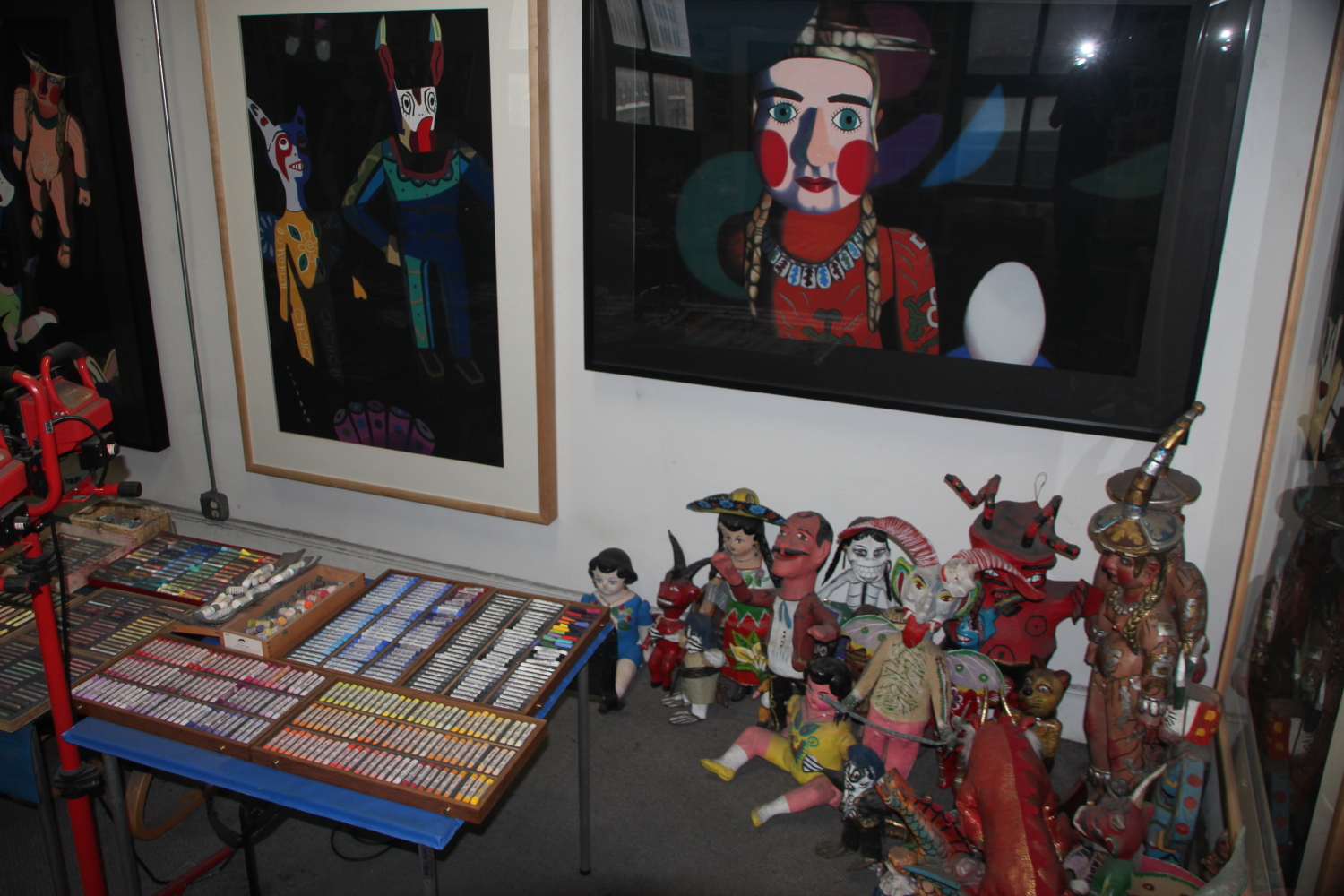
Barbara’s studio
A: Mine is a slow and labor-intensive process. First, there is foreign travel to find the cultural objects – masks, carved wooden animals, paper mâché figures, and toys – that are my subject matter. If they are heavy I ship them home.
Next comes planning exactly how to photograph them, lighting and setting everything up, and shooting a roll of 220 film with my Mamiya 6 camera. I still like to use an analog camera for my fine art work, although I am rethinking this. I have the film developed, decide which image to use, and order a 20” x 24” reference photograph from Manhattan Photo on West 20th Street.
Then I am ready to start. I work on each pastel-on-sandpaper painting for approximately three months. I am in my studio 7 to 8 hours a day, five days a week. During that time I make thousands of creative decisions as I apply and layer soft pastels (I have 8 tables-worth to choose from!), blend them with my fingers, and mix new colors directly on the sandpaper. A finished piece consists of up to 30 layers of soft pastel. My self-invented technique accounts for the vivid, intense color that often leads viewers of my originals to look very closely and ask, “What medium is this?” I believe I am pushing soft pastel to its limits, using it in ways that no other artist has done.
Comments are welcome!
Pearls from artists* # 95
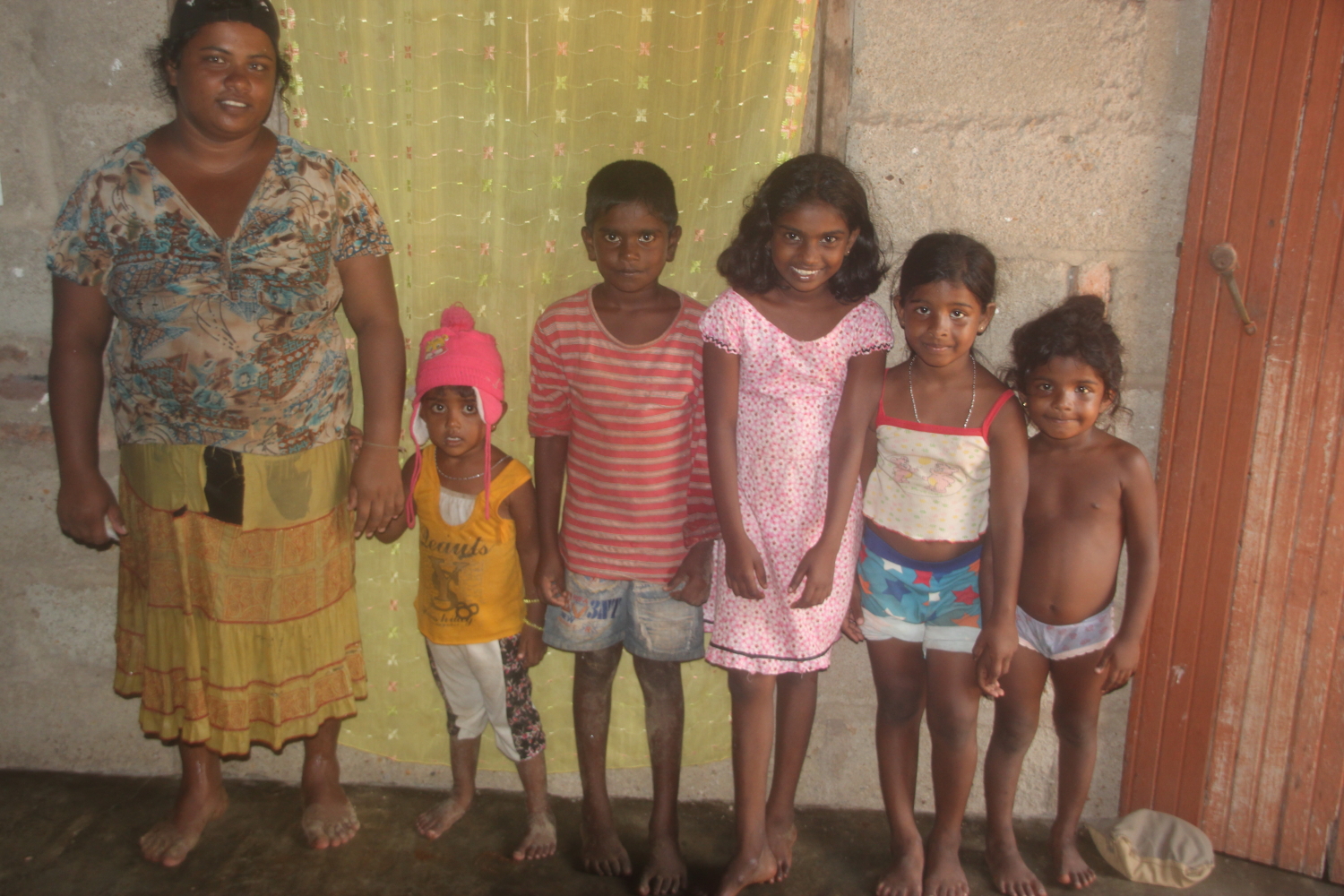
Negombo, Sri Lanka
* an ongoing series of quotations – mostly from artists, to artists – that offers wisdom, inspiration, and advice for the sometimes lonely road we are on.
Not enough people believe in the cracks in the universe that you have to wiggle into to get anything new established. There are cracks – places that are not filled in that need to be filled in, so the edifice doesn’t crumble. And if you believe in the arts passionately, they fit into those cracks, because without those connective tissues of understanding all we are are people who go to war every so often.
Zelda Fichandler in Conversations with Anne: Twenty-four Interviews
Comments are welcome!
Q: How would you define art?

Barbara’s studio
A: At its core all art is communication. I personally believe that without the component of communication, there is no art. The expression of human creative skill and imagination becomes art when it is appreciated for its beauty, complexity, emotional power, evocativeness, etc. A sympathetic and understanding audience is essential.
Why might artists fail to communicate? Perhaps they haven’t mastered their medium sufficiently to elicit a reaction from the viewer. Perhaps the viewer lacks the necessary artistic, cultural, or intellectual background to understand and appreciate what the artist is communicating. Maybe the viewer is distracted or preoccupied and not looking or thinking deeply enough. There are many reasons.
Comments are welcome!


 barbararachkoscoloreddust.com