Blog Archives
Q: How do you think your recent trip to Bolivia will affect your work?
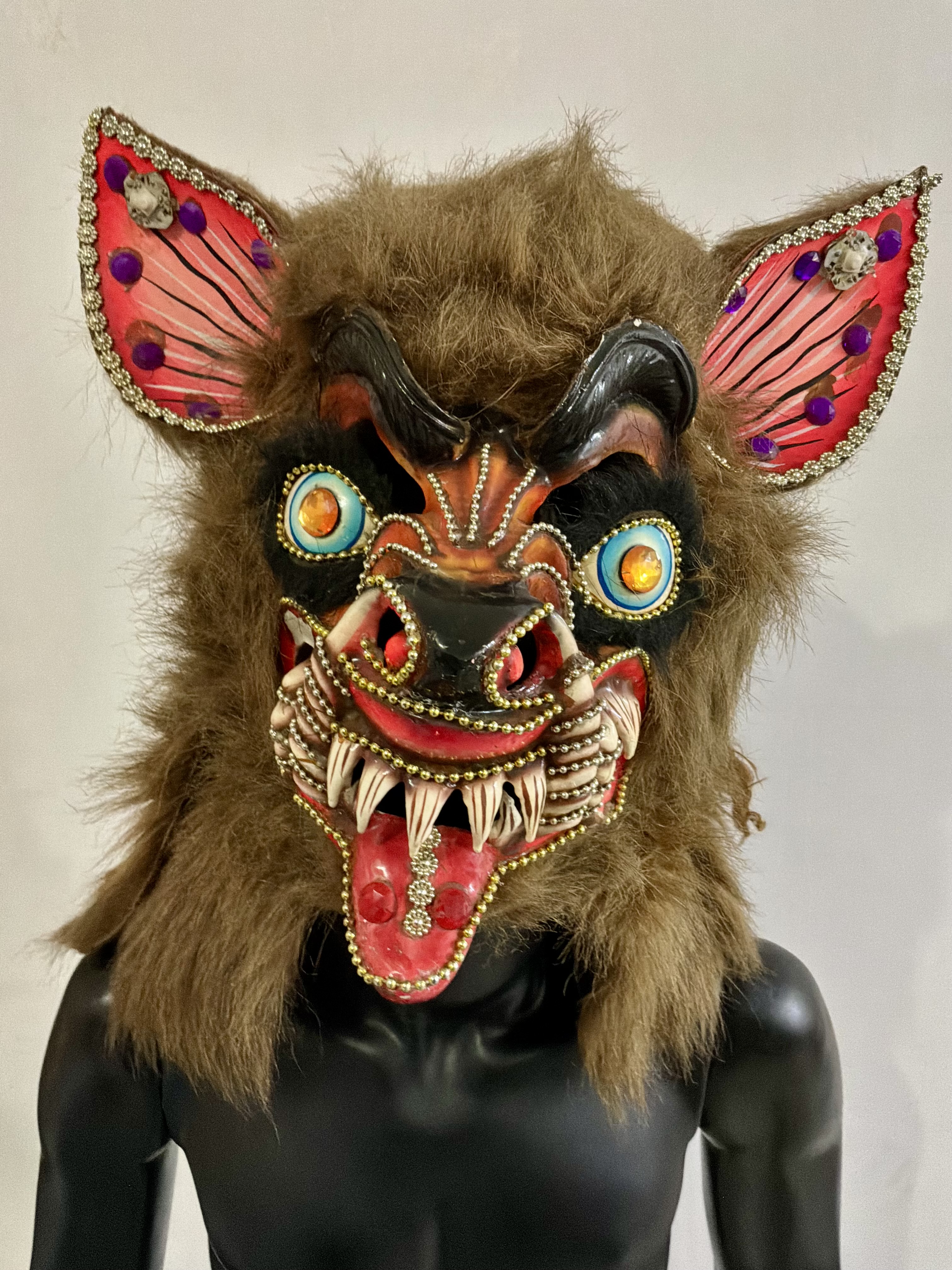
Reference photo from my trip to Bolivia
A: I have been back in the United States for one month and I know from past trips that there is always a long gestation period as I reflect on colorful new experiences, new sights, sounds, etc. My three and a half-weeks in Bolivia were non-stop, intense, and just full of so many high points. Bolivia is a fascinating country with profound cultural riches, and exceptionally warm and welcoming people. I experienced new friendships and events that were way beyond anything I could have imagined. In short, there’s a lot to process!
In the immediate aftermath, back in the studio I am deliberately selecting more vibrant colors and bumping up the contrast and drama in the painting on my easel (“Gatecrasher”) as I attempt to reflect some of what I saw and experienced in Oruro during Carnaval. I have begun to plan a pastel painting based on the mask pictured above, which I photographed in La Paz. We shall see what new work is created over the coming months and years. For now, it’s exciting to be reenergized and to have new subject matter with which to work. And, at this early date, I can barely conceive what our new Bolivia documentary will be like!
Comments are welcome!
Pearls from artists* # 677

Barbara’s Studio
*an ongoing series of quotations – mostly from artists, to artists – that offers wisdom, inspiration, and advice for the sometimes lonely road we are on.
… in Japan, in the native Shinto religion of the land, where the rites are extremely stately, musical, and imposing, no attempt has been made to reduce their “affect images” to words. They have been left to speak for themselves – as rites, as works of art – through the eyes to the listening heart. And that, I would say, is what we, in our own religious rites, had best be doing, too. Ask an artist what his picture “means,” and you will not soon ask such a question again. Significant images render insights beyond speech, beyond the kinds of meaning speech defines. And if they do not speak to you, that is because you are not ready for them, and words will only serve to make you think you have understood, thus cutting you off altogether. You don’t ask what a dance means, you enjoy it. You don’t ask what the world means, you enjoy it. You don’t ask what you mean, you enjoy yourself; or at least, so you do when you are up to snuff.
Joseph Campbell in Myths to Live By
Comments are welcome!
Pearls from artists* # 625

*an ongoing series of quotations – mostly from artists, to artists – that offers wisdom, inspiration, and advice for the sometimes lonely road we are on.
The artist not equipped with the necessary arrogance will be repeatedly sidetracked or subverted by the agendas of others. He will lack a sufficient sense of purpose, will frequently stall and block, and will bring a nagging passivity to his art career. His resolve to do great art may remain a potent idea only, a kind of unexplained force in his body. He is likely to accomplish much less than he otherwise might, support others rather than find support for himself, attempt the small rather than the large, and rebound less well from rejection.
The self-centered artist, on the other hand, is challenged to remember that he is neither god nor Superman, but a human being with human limitations. He hasn’t the time to turn every idea into a book, the ability to top each work with a greater one, the energy to toil ceaselessly at his art, nor the right to trample others as he pursues his goals. If he mistakes or oversteps these limits he will put himself in harm’s way and may find himself struck down by his own obsessional energy, by burnout, by depression, by self-abuse, or by the angry complaints of those whose rights he has cavalierly trampled.
Eric Maisel in A Life in the Arts: Practical Guidance and Inspiration for Creative and Performing Artists
Comments are welcome!
Pearls from artists* # 575

Barbara’s Studio
*an ongoing series of quotations – mostly from artists, to artists – that offers wisdom, inspiration, and advice for the sometimes lonely road we are on.
Creativity is a harmony of opposite tensions… As we ride through the flux of our own creative processes, we hold onto both poles. If we let go of play, our work becomes ponderous and stiff. If we let go of the sacred, our work loses its connection to the ground on which we live.
Knowledge of the creative process cannot substitute for creativity, but it can save us from giving up on creativity when the challenges seem too intimidating and free play seems blocked. If we know that our inevitable setbacks and frustrations are phases of the natural cycle of creative processes, if we know that our obstacles can become our ornaments, we can persevere and bring our desires to fruition. Such perseverance can be a real test, but there are ways through, there are guideposts. And the struggle, which is guaranteed to take a lifetime, is worth it. It is a struggle that generates incredible pleasure and joy. Every attempt we make is imperfect; yet each one of these imperfect attempts is an occasion for a delight unlike anything else on earth.
The creative path is a spiritual path. The adventure is about us, about the deep self, the composer in all of us, about originality, meaning not that which is all new, but that which is fully and originally ourselves.
Stephen Nachmanovitch in Free Play: Improvisation in Life and Art
Comments are welcome!
Pearls from artists* # 501

* an ongoing series of quotations – mostly from artists, to artists – that offers wisdom, inspiration, and advice for the sometimes lonely road we are on.
When I talk about “creative living” here, please understand that I am not necessarily talking about pursuing a life that is professionally or exclusively devoted to the arts. I’m not saying that you must become a poet who lives on a mountaintop in Greece, or that you must perform at Carnegie Hall, or that you must win the Palme d’Or at the Cannes Film Festival. (Though if you want to attempt any of these feats, have at it. I love to watch people swing for the bleachers.) No, when I refer to “creative living,” I am speaking more broadly. I’m talking about living a life that is driven more strongly by curiosity than by fear.
... A creative life is an amplified life. It’s a bigger life, a happier life, an expanded life, and a hell of a lot more interesting life. Living in this manner – continually and stubbornly bringing forth the jewels that are hidden within you – is a fine art, in and of itself.
Elizabeth Gilbert in Big Magic: Creative Living Beyond Fear
Comments are welcome!

Pearls from artists* # 482

*an ongoing series of quotations – mostly from artists, to artists – that offers wisdom, inspiration, and advice for the sometimes lonely road we are on.
Devils’ heads with daring and disturbing eyes, twisted horns, abundant grey hair and hooked noses hang on the blue walls of Antonio Viscarra’s house. Long benches covered with old, multi-colored cushions in Bolivian motifs surround the concrete floor of the small room. Several dozen of these hanging faces, which seem to watch in silence from the darkness, are ready to be used in festivals and traditional dances.
The maskmaker or “maestro” as he is called, lives [deceased now] in the area of Avenida Buenos Aires, far from the political and administrative center of the city of La Paz, but rather at the very center of the other La Paz (Chuquiago in the Aymara language) where many peasant immigrants have settled, and which for that reason, is the center of the city’s popular culture.
Viscarra is the oldest creator of masks in La Paz, and his work has helped to conserve, and at the same time to rejuvenate, the tradition of using masks in Bolivian dances. If economic progress and alienation have contributed to the excessive adornment of new masks with glass and other foreign materials, Viscarra, in an attempt to recover the distinctive, original forms, has gone back to the 100-year-old molds used by his grandfather. His work has been exhibited in Europe, in the United States and in South America, Most important, however, is that Viscarra is transmitting his knowledge to his children, ensuring that this form of authentic Bolivian culture will never die.
…Viscarra inherited the old mask molds from his grandfather and was told to take good care of them because some day he might need them. After keeping them carefully put away for 50 years, the maestro used them again for an exhibition of masks prepared in 1984, slowly recreating the original masks, beautiful in their simplicity, in their delicate craftsmanship and in their cultural value. In this way, the masks which emerged from the old molds are regaining their past prestige and importance.
Antonio Viscarra, The mask Maker by Wendy McFarren in Masks of the Bolivian Andes, Editorial Quipus and Banco Mercantil
Comments are welcome!
Pearls from artists* # 475

*an ongoing series of quotations – mostly from artists, to artists – that offers wisdom, inspiration, and advice for the sometimes lonely road we are on.
In order to warm the artist’s heart, it’s necessary to assert that he is doing good work. Random or wrong-headed praise won’t do the trick, but will only exacerbate the artist’s feeling that he is unseen and misunderstood.
Even wrong-headed praise is the exception rather than the rule in the artist’s search for recognition. More often than not your recognition will consist of criticism, not praise. You may be criticized for not attempting work you have no desire to attempt, for pandering to mass taste, for working too exotically or too narrowly… You may be attacked in a mixed review that purports to praise you. In short, you may be criticized for everything and anything under the sun.
Can you escape this criticism as you struggle for recognition? No. The journalist Elbert Hubbard said, “To escape criticism, do nothing, say nothing, be nothing.” … you can’t escape criticism, you can’t tame your critics.
Eric Maisel in A Life in the Arts: Practical Guidance and Inspiration for Creative and performing Artists
Comments are welcome!
Pearls from artists* # 441
*an ongoing series of quotations – mostly from artists, to artists – that offers wisdom, inspiration, and advice for the sometimes lonely road we are on.
The most perennially popular category of art is the cheerful, pleasant, and pretty kind: meadows in spring, the shade of trees on hot summer days, pastoral landscapes, smiling children. This can be deeply troubling to people of taste and intelligence.
… The worries about prettiness are twofold. First, pretty pictures are alleged to feed sentimentality. Sentimentality is a symptom of insufficient engagement with complexity, by which one really means problems. The pretty picture seems to suggest that in order to make life nice, one merely has to brighten up the apartment with a depiction of some flowers. If we were to ask the picture what is wrong with the world, it might be taken as saying ‘You don’t have enough Japanese water gardens’ – a response that appears to ignore all the more urgent problems that confront humanity (primarily economic, but also moral, political, and sexual). The very innocence and simplicity of the picture seems to mitigate against any attempt to improve life as a whole. Secondly, there is the related fear that prettiness will numb us and leave us insufficiently critical and alert to the injustices surrounding us.
Alain de Botton and John Armstrong in Art as Therapy
Comments are welcome!
Pearls from artists* # 408

“No Cure for Insomnia,” pastel on sandpaper, 58″ x 38″ image, 70” x 50” framed
* an ongoing series of quotations – mostly from artists, to artists – that offers wisdom, inspiration, and advice for the sometimes lonely road we are on.
Classics have nothing to do with aesthetic sophistication. They use the aesthetic as a springboard to something else. The creation of a classic will often require the artist to deviate from prevailing standards in order to push the ordinary vision through. If there is one prerequisite for producing a classic, it is the willingness to follow the vision wherever it leads, even if it demands a breach of convention, technique, or popular taste. (It may not even be a question of if or when, for how can one produce a truly singular work without reinventing the medium to some extent?) We often hear that the master artist is “in love” with her material: that the sculptor loves the marble, the dancer loves the body, the musician loves his instrument. For the maker of classics, however, the medium always seems to be an obstacle; love is never without a tinge of spite. William S. Burroughs was so contemptuous of language that he took to describing it as a disease. He conceived his work as an attempt to confront language in hopes to cure the mind of the “word virus.” Indeed, if the goal of art is to take us beyond the ordinary preoccupations to reach the heart of the Real, it would seem essential that there be a fight, a struggle to wrest from the medium something to which Consensus dictates it is not naturally inclined.
J.F. Martel in Reclaiming Art in the Age of Artifice: A Treatise, Critique, and Call to Action
Comments are welcome!


 barbararachkoscoloreddust.com