Author Archives: barbararachkoscoloreddust
Q: How do you get such fine detail with soft pastel? Do they make pencil-size pastels? (Question from Lucia Sommer via Facebook)

A: After 37 years as a pastel artist, I have learned all sorts of techniques and can do whatever I want with it. I used regular Rembrandt white pastels for the sweater in “Sam and Bobo,” above.
There are several brands of pastel pencils that are made especially for drawing fine details. Sam’s face, hair, and hands are mostly pastel pencil. (Now I probably would not use pastel pencils as much. These days I only use them to draw lines and sign my name).
Another technique for making fine lines is to break a pastel stick and work with an edge.
Years ago I used to sharpen my pastels into a point with a small handheld sharpener (I still have one that allows me to change the blades). Sometimes I rub a pastel stick against a sandpaper pad until I get a somewhat sharp point. The problem with both of these methods is they waste so much pastel and pastels are not cheap! For example, my favorite French brand is nearly $20 per stick. I would never think of sharpening those!
Comments are welcome!
Pearls from artists* # 575

Barbara’s Studio
*an ongoing series of quotations – mostly from artists, to artists – that offers wisdom, inspiration, and advice for the sometimes lonely road we are on.
Creativity is a harmony of opposite tensions… As we ride through the flux of our own creative processes, we hold onto both poles. If we let go of play, our work becomes ponderous and stiff. If we let go of the sacred, our work loses its connection to the ground on which we live.
Knowledge of the creative process cannot substitute for creativity, but it can save us from giving up on creativity when the challenges seem too intimidating and free play seems blocked. If we know that our inevitable setbacks and frustrations are phases of the natural cycle of creative processes, if we know that our obstacles can become our ornaments, we can persevere and bring our desires to fruition. Such perseverance can be a real test, but there are ways through, there are guideposts. And the struggle, which is guaranteed to take a lifetime, is worth it. It is a struggle that generates incredible pleasure and joy. Every attempt we make is imperfect; yet each one of these imperfect attempts is an occasion for a delight unlike anything else on earth.
The creative path is a spiritual path. The adventure is about us, about the deep self, the composer in all of us, about originality, meaning not that which is all new, but that which is fully and originally ourselves.
Stephen Nachmanovitch in Free Play: Improvisation in Life and Art
Comments are welcome!
Q: Do you ever erase the color? Can you do that with pastel? (Question from Hollis Hildebrand-Mills via Facebook)
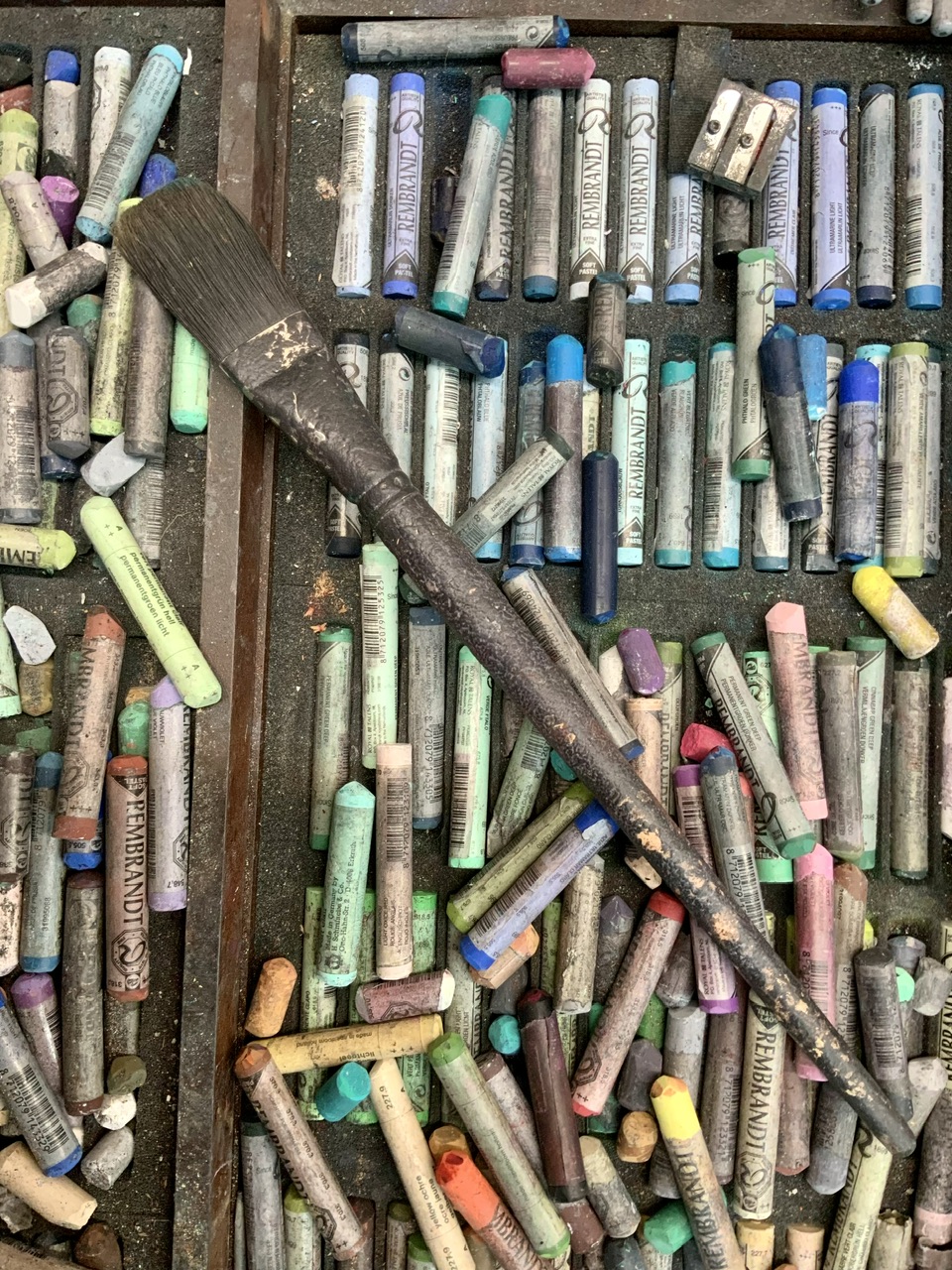
My “eraser”
A: Yes, sort of. I take a bristle brush and wipe it off. I do this only occasionally, when the sandpaper’s tooth is filled up and the paper will no longer accept more pastel. So I brush off what’s there and then I can start over.
Comments are welcome!
Pearls from artists* # 574

Barbara’s Studio
*an ongoing series of quotations – mostly from artists, to artists – that offers wisdom, inspiration, and advice for the sometimes lonely road we are on.
A creative life is risky business. To follow your own course, not patterned on parents, peers, or institutions, involves a delicate balance of tradition and personal freedom, a delicate balance of sticking to your guns and remaining open to change. While on some dimensions living a normal life, you are nevertheless a pioneer, breaking away from the molds and models that inhibit the heart’s desire, creating life as it goes. Being, acting, creating in the moment without props and supports, without security, can be supreme play, and it can also be frightening, the very opposite of play. Stepping into the unknown can lead to delight, poetry, invention, humor, lifetime friendships, self-realization, and occasionally a great creative breakthrough. Stepping into the unknown can also lead to failure, disappointment, rejection, sickness, or death.
Stephen Nachmanovitch in Free Play: Improvisation in Life and Art
Comments are welcome!
Travel photo of the month*
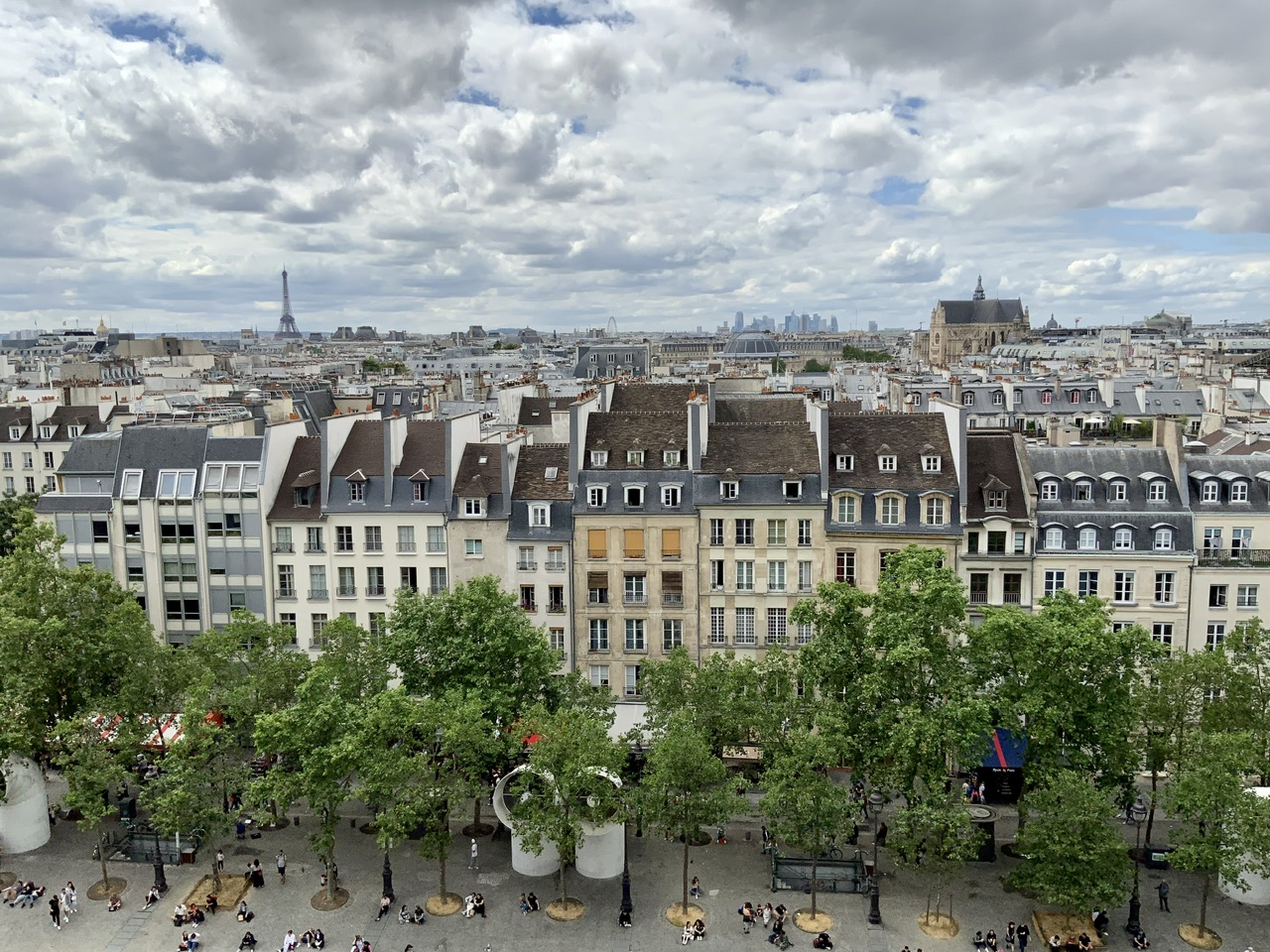
*favorite travel photos that have not yet appeared in this blog
Comments are welcome!
Pearls from artists* # 573

In the studio
*an ongoing series of quotations – mostly from artists, to artists – that offers wisdom, inspiration, and advice for the sometimes lonely road we are on.
The literature on creativity is full of tales of breakthrough experiences. These moments come when you let go of some impediment or fear, and boom – in whooshes the muse. You feel clarity, power, freedom, as something unforeseen jumps out at you. The literature of Zen… abounds with accounts of kensho and satori – moments of illumination and moments of total change of heart. There come points in your life when you simply kick the door open. But there is no ultimate breakthrough; what we find in the development of a creative life is an open-ended series of provisional breakthroughs. In this journey there is no endpoint because it is the journey into the soul.
Stephen Nachmanovitch in Free Play: Improvisation in Life and Art
Comments are welcome!
Q: What’s on the easel today?
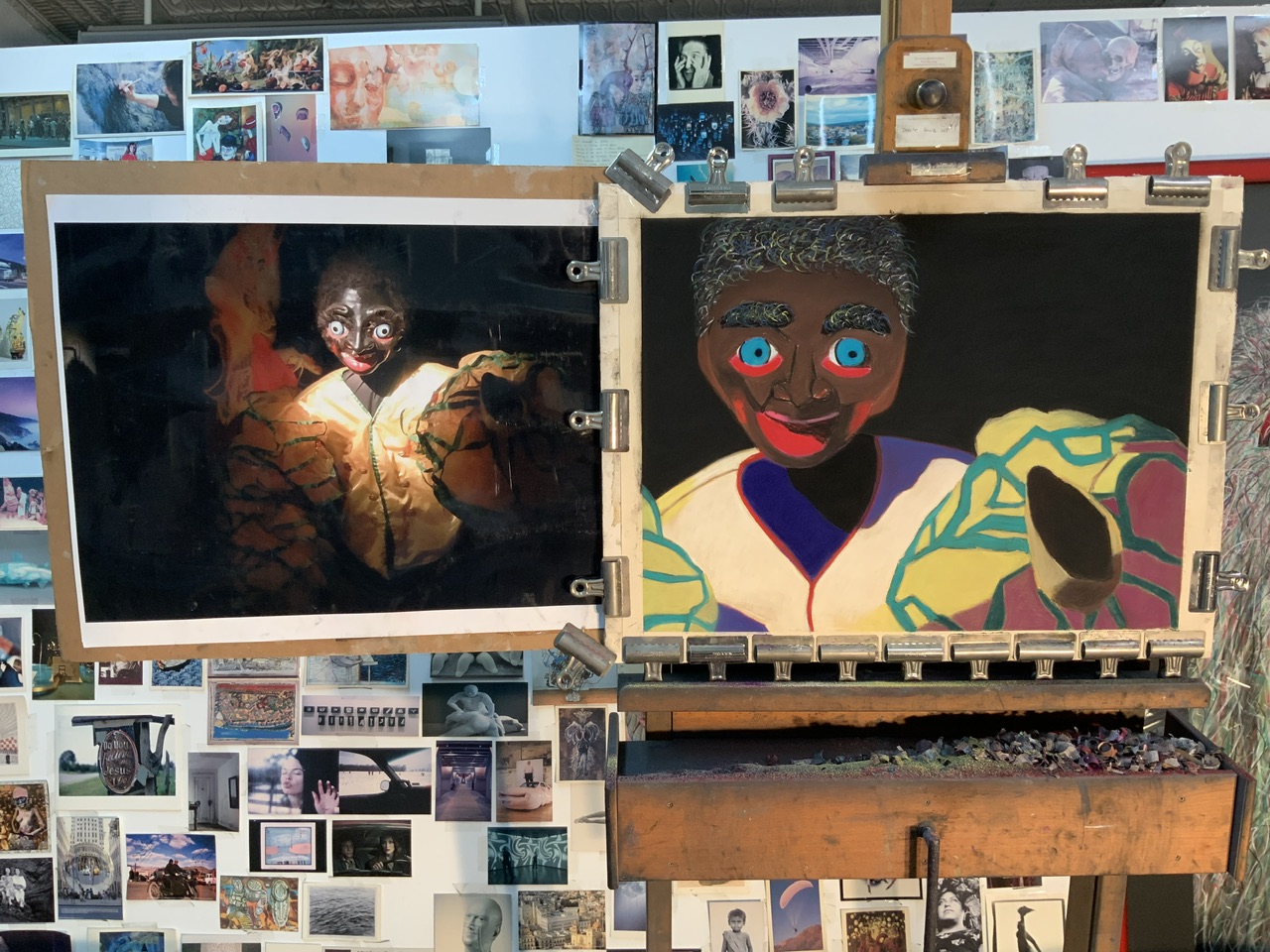
Work in progress
A: I started working on “Narcissist,” 20”x 26”, a few days ago.
Comments are welcome!
Pearls from artists* # 572

*an ongoing series of quotations – mostly from artists, to artists – that offers wisdom, inspiration, and advice for the sometimes lonely road we are on.
The use of color to paint the Chinchorro mummies is interesting. According to anthropologist Victor Turner (1970), colors are experiences of social relationships. The use of particular colors in prehistory, then, has meaning even if today we cannot comprehend these meanings. Turner said that white, red, and black are the earliest colors produced by humans and they “provide a kind of primordial classification of reality” (Turner, 1970:90). This color trilogy is associated with reproduction, life, and death. Obviously, in the case of Chinchorros, black and red colors predominated. Black is equated with darkness, like the night, invisible yet present. Black is what is hidden, it is a mystical transition (Turner, 1970:109, 89-73). Black represents death, but not the end of a cycle, not an annihilating, rather a change of status and existence (Turner, 1970:71-72). Red on the other hand is equal to membership, change, blood, and social place (Turner, 1970:90). Red can be associated with life, here and in the afterworld.
The use of colors as symbols is rather universal, but the meaning of each color varies from culture to culture. In western societies black may be worn to symbolize mourning, but on other occasions it signifies relevance. The Yahgan Indians in South America used body painting with intricate patterns of black, white, and red to show their sadness and grief when someone died (Gusinde, 1937). Black was the color to symbolize mourning among the Incas (Montez, 1929:222; Zuidema, 1992:23).
Bernardo T. Arrizabalaga in Beyond Death: The Chinchorro Mummies of Ancient Chile
Comments are welcome!
Q: You make it look effortless when we know it is not. Would you explain how you started your blog 11 years ago? (Question from Colette C. McBratney via Facebook)
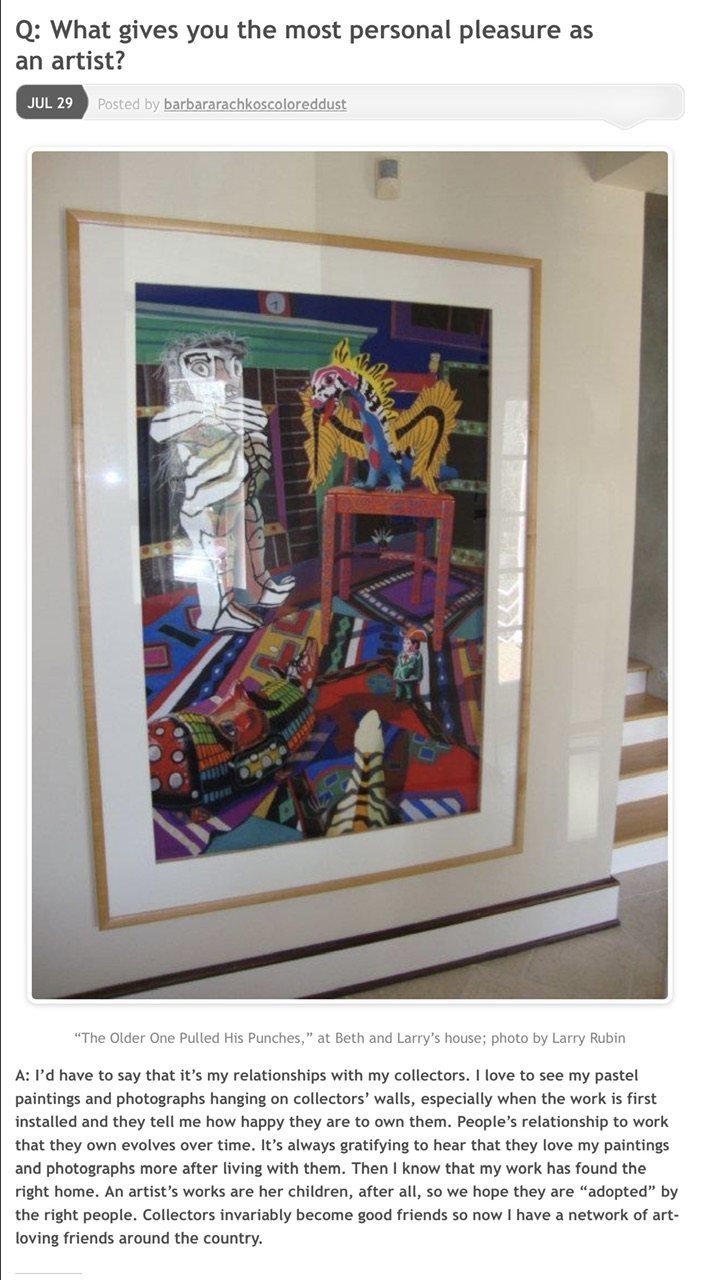
An Early Blog Post, Above
A: My blog turned 11 on July 15th. To learn how to set up, publish, and maintain a blog, I took a class at the International Center of Photography in New York. It was called “The Daily Blog” and that’s where I learned how to work with WordPress.
I decided to use a question and answer format because I had a backlog of material from interviews I had done over the years. During the class, which lasted five weeks, I published blog posts every day. Once the class ended, I cut back to a more manageable schedule of publishing posts twice a week.
Writing about my work quickly became an important part of my creative process. As most people probably know, I am very persistent so these days I just make sure to keep going!
Comments are welcome!
Pearls from artists* #571
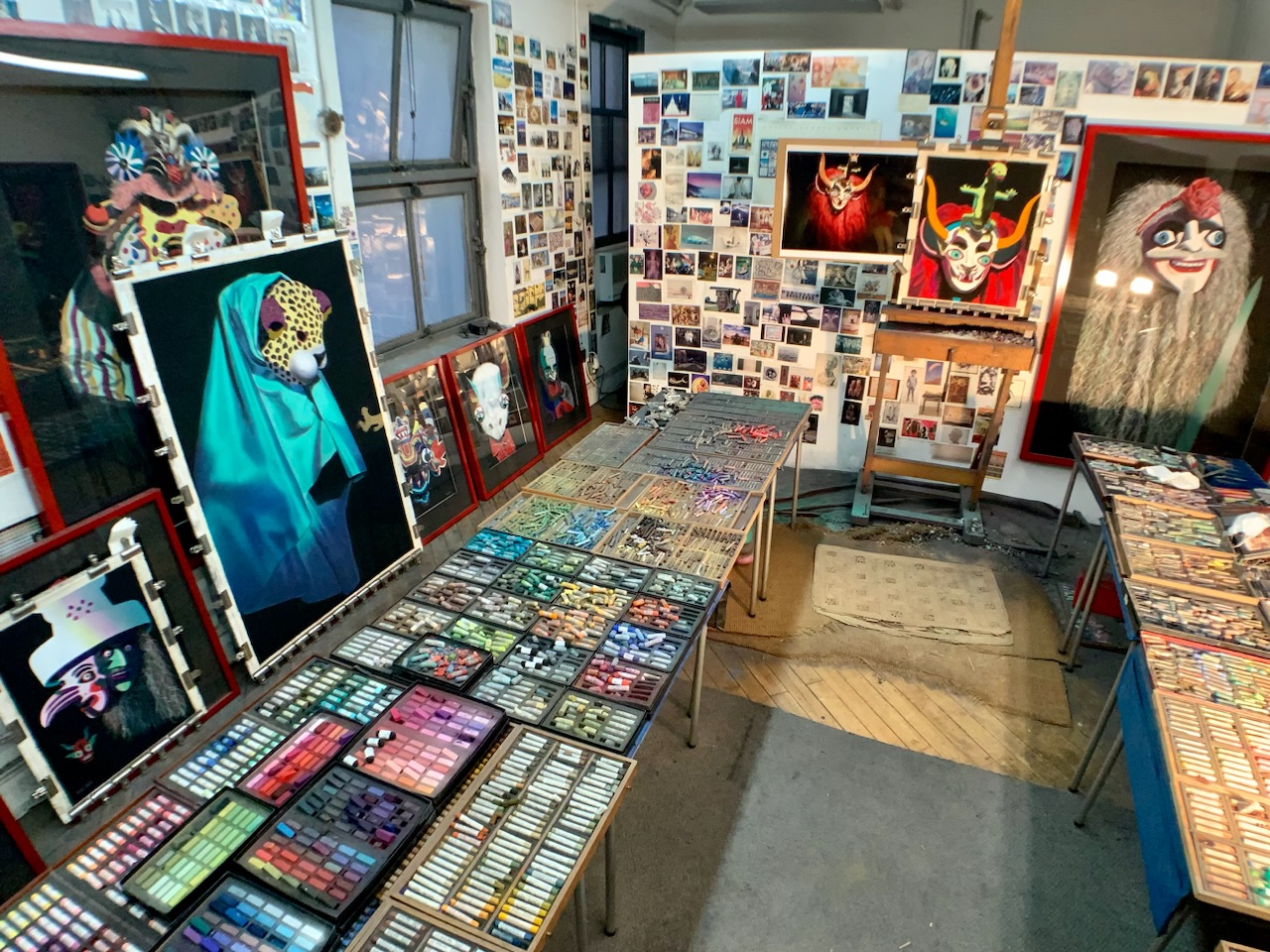
The Studio
*an ongoing series of quotations – mostly from artists, to artists – that offers wisdom, inspiration, and advice for the sometimes lonely road we are on.
To put it simply, but accurately, artists are often lost to the world because of their obsessions with their art. They may be just as lost as they prepare to work or incubate a new idea as in those feverish days when they make their final cuts on a film or race toward a publishing deadline. They may obsess about artistic questions and feel bursts of creative energy day or night, alone or in the company of others, in the middle of the work week or on vacation in the Bahamas.
Lost in time and space, the artist may feel more connected to Picasso, Emily Dickinson, Ingmar Bergman, Gertrude Stein, Handel, or Tennessee Williams than to the people in his immediate world. The living past holds extraordinary meaning for him. He travels elsewhere, removing his spirit and attention from the present. He may reside, as he works on his novel, in the childhood of a character, walking the garden paths and living the household dramas there. He may come upon a Rembrandt drawing and find himself wrenched, not to any particular place or time, but just elsewhere, as he experiences the greatness of his traditions, measures himself anew, and dreams again of his future.
Eric Maisel in A Life in the Arts: Practical Guidance and Inspiration for Creative and Performing Artists
Comments are welcome!


 barbararachkoscoloreddust.com