Blog Archives
Q: You started the Bolivianos series in 2017. It has been 8 years since you created The Champ. This endeavor of focussing on a series for almost a decade’s timeline shows that you embody stability as against many artists who tend to hop on to the next inspiration they find. How has discipline, stability, focus and punctuality defined your works apart from being inspired by Bolivian culture for the series Bolivianos? (Question from Vedica Art Studios and Gallery)
A: My first series, Domestic Threats, lasted fifteen years, and my second, Black Paintings, lasted ten. Stability and related qualities are likely natural parts of my personality, reinforced by my previous professional life. My prior careers as a Navy Commander, commercial pilot, and Boeing-727 Flight Engineer undoubtedly helped develop discipline, stability, focus, and punctuality. Details matter deeply to me; as a Naval Officer for twenty-one years, “attention to detail” was paramount. From my earliest days as an artist, I have been meticulous and dedicated to inventing new techniques and refining the craft of soft pastel.
I dislike wasting precious time. As a goal-oriented person, I continually strive to accomplish as much as possible. These qualities were influenced by my Navy career and further deepened by the tragic loss of my husband onboard the plane that crashed into the Pentagon on 9/11. I understand firsthand that life can change in an instant. Whenever I finish one task, I immediately look around and ask, “OK, what’s next?” I devote my studio time to pushing myself and pastel to new technical heights. There’s always more to accomplish as an artist!
Comments are welcome!
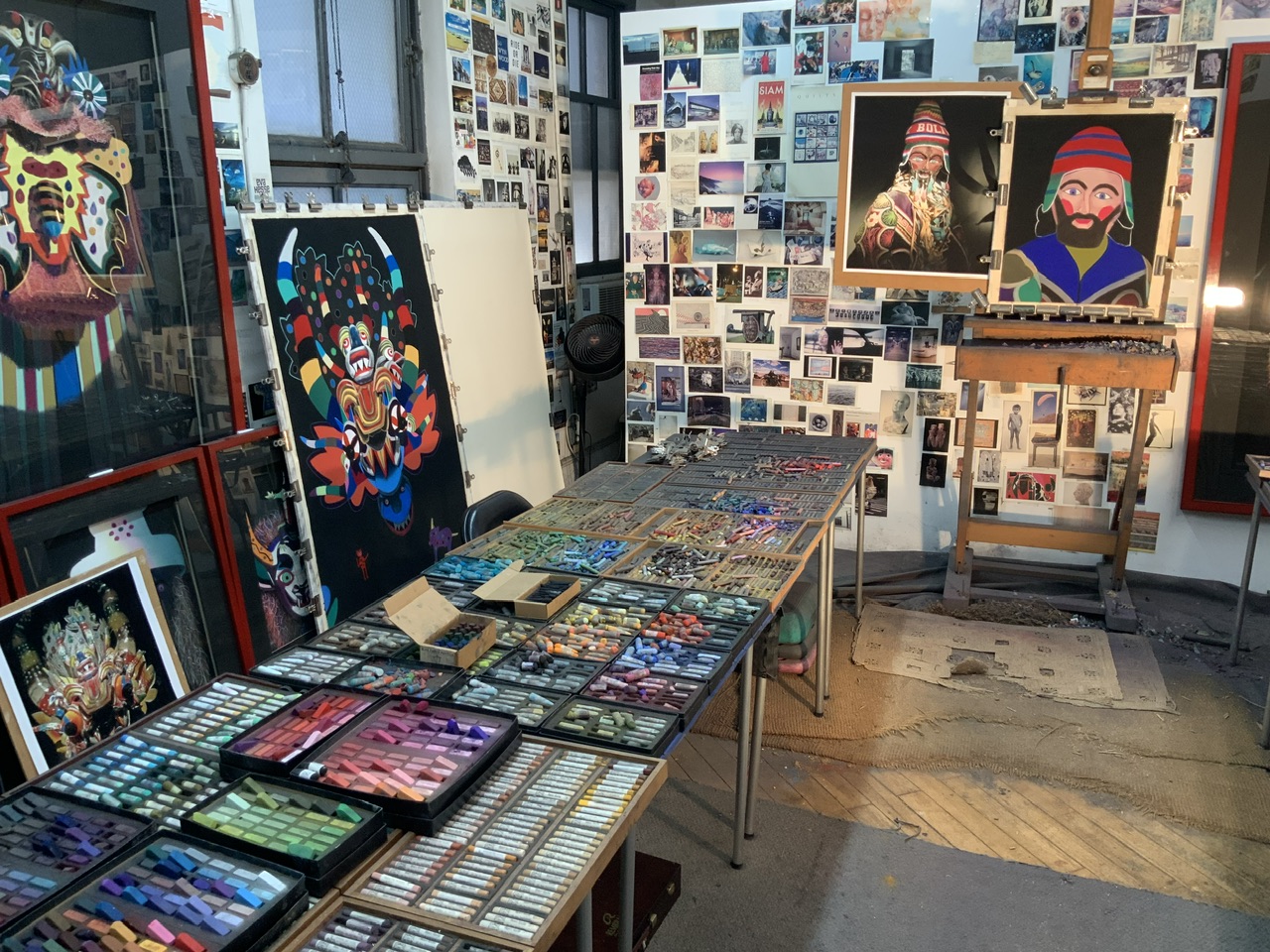
Q: Why do you have so many pastels?

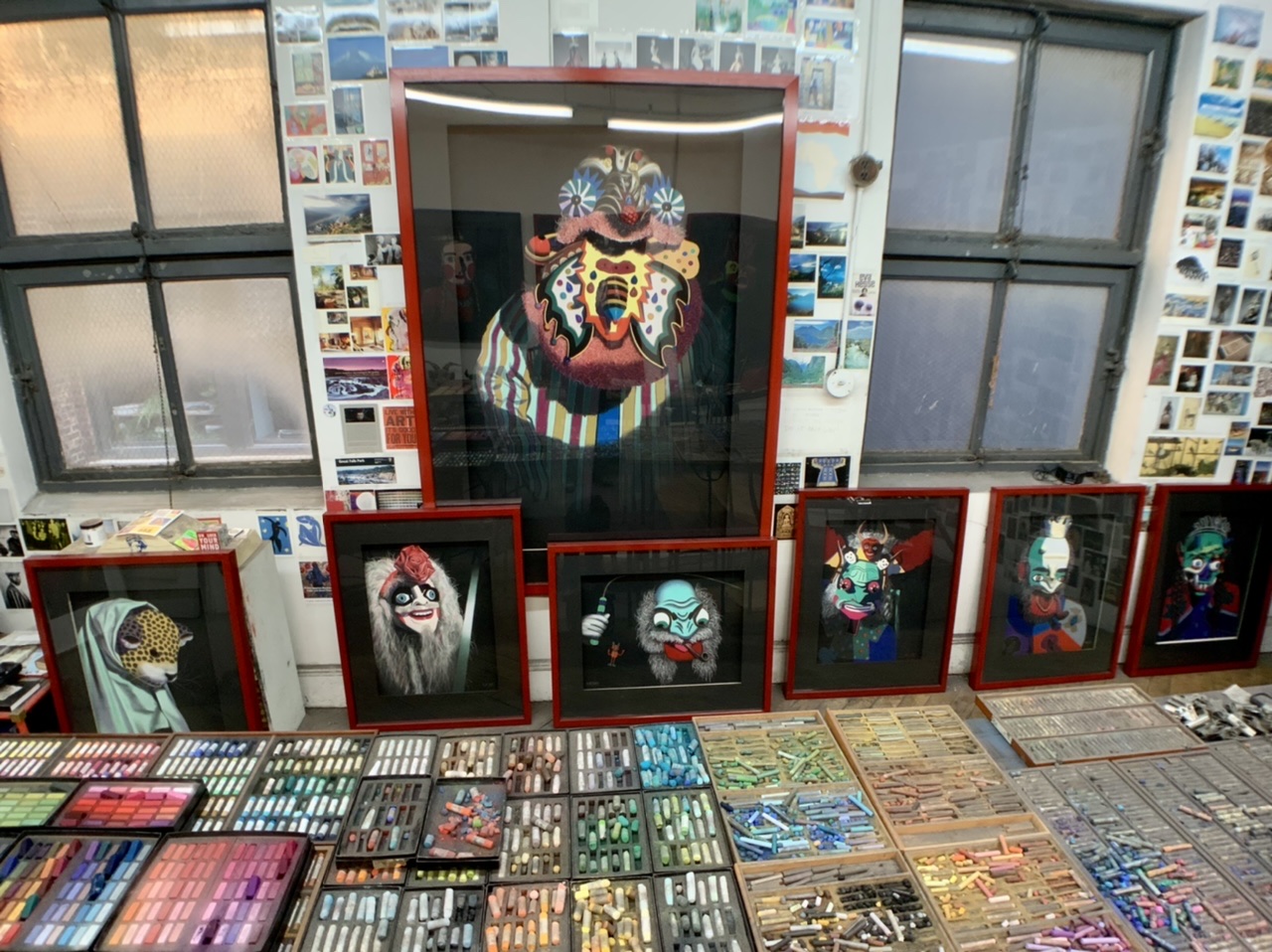
Barbara’s Studio
A: Our eyes can see infinitely more colors than the relative few that are made into pastels. When I layer pigments onto the sandpaper substrate, I mix new colors directly on the paper. The short answer is, I need lots of pastels so that I can make new colors.
I have been working exclusively with soft pastel for 40 years. Whenever I feel myself getting into a rut in how I select and use my colors, I look around for new materials to try. Fortunately, new brands of soft pastels are continually coming onto the market. There are pastels that are handmade by artists – I love discovering these – and new colors manufactured by well-known pastel companies. Some sticks of soft pastel are oily, some are buttery, some more powdery, some crumble easily, some are more durable. Each one feels distinct in my hand.
Furthermore, they each have unique mixing properties. It’s an under-appreciated science that I stumbled upon (or maybe I invented it, I’m not sure since I cannot know how other pastel painters work). In this respect soft pastel is very different from other paint media. Oil painters, for example, need only a few tubes of paint to make any color in the world. I don’t go in much for studying color theory as a formal discipline. If you want to really understand and learn how to use color, try soft pastel and spend 10,000+ hours (the amount of time Malcolm Gladwell says, in his book, “Outliers,” that it takes to master a skill) figuring it all out for yourself!
Comments are welcome.
Q: All art media involve some level of toxicity. Do you use an air filter? How do you protect yourself against the harmful effects of working with soft pastel?

A: No, but I wear a surgical mask when I work, to prevent breathing the pastel dust. Also, before I begin, I apply a barrier cream, called Artgard, to my hands to prevent pigment being absorbed into my skin through any tiny cuts I may have.
My easel is tilted forward, allowing pastel dust to fall onto the easel and floor. I take care that my head is always higher than my hand as I work, so the dust is below my mouth and nose. I am well aware of the toxicity of pastel and believe I take the proper precautions. After nearly forty years working with soft pastel, so far I’ve managed to stay healthy.
Comments are welcome.
Q: What kind of reactions do you get from spectators at your exhibitions? (Question from “Cultured Focus Magazine”)

A group exhibition in New Jersey
A: Reactions to my work run the gamut – from dopey comments like, “I’m scared!” to “How in the world is such beauty and profundity possible to achieve using only soft pastel on a piece of sandpaper!”
I’m sure most artists can say the same. We can only hope that our work finds its way to an audience that has the eyes, heart, and mind to understand, to appreciate on a deep level the decades of devotion, sacrifice, and hard work that go into creating works of art.
Comments are welcome!
Q: How do you get such fine detail with soft pastel? Do they make pencil-size pastels? (Question from Lucia Sommer via Facebook)

A: After 37 years as a pastel artist, I have learned all sorts of techniques and can do whatever I want with it. I used regular Rembrandt white pastels for the sweater in “Sam and Bobo,” above.
There are several brands of pastel pencils that are made especially for drawing fine details. Sam’s face, hair, and hands are mostly pastel pencil. (Now I probably would not use pastel pencils as much. These days I only use them to draw lines and sign my name).
Another technique for making fine lines is to break a pastel stick and work with an edge.
Years ago I used to sharpen my pastels into a point with a small handheld sharpener (I still have one that allows me to change the blades). Sometimes I rub a pastel stick against a sandpaper pad until I get a somewhat sharp point. The problem with both of these methods is they waste so much pastel and pastels are not cheap! For example, my favorite French brand is nearly $20 per stick. I would never think of sharpening those!
Comments are welcome!
Q: Many of the world’s cultures have a mask tradition. Is there something special about Bolivian masks that first attracted you to them?

Bolivian Carnival Mask
A: My subject matter emerges directly from my travels. I visited Bolivia in 2017. What I especially liked then – and now – about Bolivian Carnival masks, is that they include additional textures – feathers, fur, costume jewelry, sequins, fabric, etc. that add to their physical presence. Masks from most of the other countries I’ve visited tend to be made of wood and/or paper mache and nothing else. In my view such masks are not as dramatic nor do they offer much expressive potential. They feel dead. They lack a certain “soulfulness.”
Furthermore, textures are challenging to render in soft pastel. For more than three decades I have been striving to improve my pastel techniques. By now I have a vast repertoire from which to select. As was true in my earlier series, with “Bolivianos” an important personal goal is to keep adding to the repertoire.
It takes months to create a pastel painting, which means I need masks that will hold my attention every day over the course of three or four months. I never want to be bored in the studio. If I am bored while making the work, those feelings will be directly transferred and I will make a boring pastel painting, something I hope never to do! The masks need to have a really strong ‘presence.’ Then as I slowly make a pastel painting, one that is exciting to work on from start to finish, I can transform my subject into something surprising and powerful that has never existed before!
Comments are welcome!
Q: Can you explain how you choose colors? (Question from Maria Cox via Instagram)

A: I am wild about color! As I work to create a pastel painting, I apply a color, back up from my easel to see how it interacts with and affects the rest of the painting, and then I make revisions. This process necessitates countless color changes and hundreds of hours during months of work. I apply pastel using a meticulous layering process. Were you to x-ray one of them, the earlier, discarded versions of a pastel painting would be visible. All the while I carefully fine-tune and refine how the colors and shapes interact with each other.
The goal is to make an exciting painting that no one, especially me as the maker, has ever seen before. I have no desire to repeat myself, to make art that resembles work by any other artist, or to be forced into a niche.
I try to select intense, vibrant colors that are exciting to look at, that work well in relationship to each other, and that will grab the viewer. Sometimes I deliberately choose colors for their symbolic meanings. For example, I selected a dark purple for the alternating triangles (the ones with the pink dots above) in “Overlord” because purple denotes royalty.
I have been working with soft pastel for 37 years so I have a fairly intricate science of color at my disposal. No doubt, many unconscious factors are at play, too. More on that in future posts.
Comments are welcome!
Q: Contemporary art has become very diverse and multidisciplinary in the last few decades. Do you welcome this trend? Is this trend part of your art practice? (Question from artamour)
A: By definition trends in art come and go and I don’t see how any self-respecting artist can or should pay much attention to them. I continue to do my own thing, refining my soft pastel techniques, following wherever my interests, inspiration, and subject matter lead, all the while striving to become a better artist.
Comments are welcome!
Q: When did you start using the sandpaper technique and why (Question from “Arte Realizzata”)

A: In the late 1980s when I was studying at the Art League School in Alexandria, VA, I enrolled in a three-day pastel workshop with Albert Handel, an artist known for his southwest landscapes in pastel and oil paint. I had just begun working with soft pastel and was experimenting with paper. Handel suggested I try Ersta fine sandpaper. I did and nearly three decades later, I’ve never used anything else.
This paper is acid-free and accepts dry media, mainly pastel and charcoal. It allows me to build up layer upon layer of pigment and blend, without having to use a fixative. The tooth of the paper almost never gets filled up so it continues to hold pastel. (On the rare occasion when the tooth DOES fill up, which sometimes happens with problem areas that are difficult to resolve, I take a bristle paintbrush, dust off the unwanted pigment, and start again). My entire technique – slowly applying soft pastel, blending and creating new colors directly on the paper, making countless corrections and adjustments, rendering minute details, looking for the best and/or most vivid colors – evolved in conjunction with this paper.
I used to say that if Ersta ever went out of business and stopped making sandpaper, my artist days would be over. Thankfully, when that DID happen, UArt began making a very similar paper. I buy it in two sizes – 22″ x 28″ sheets and 56″ wide by 10-yard-long rolls. The newer version of the rolled paper is actually better than the old, because when I unroll it, it lays flat immediately. With Ersta I would lay the paper out on the floor for weeks before the curl would give way and it was flat enough to work on.
Comments are welcome!


 barbararachkoscoloreddust.com
Q: What kind of reactions do you get from spectators at your exhibitions? (Question from “Cultured Focus Magazine”)
Jan 18
Posted by barbararachkoscoloreddust
A: Reactions to my work run the gamut – from dopey comments like, “I’m scared!” to “How in the world is it possible to achieve such beauty and profundity using only soft pastel on a piece of sandpaper!” I’m sure most artists can say the same. We can only hope that our work finds its way to an audience that has the eyes, heart, and mind to understand, to appreciate on a deep level the decades of devotion, sacrifice, and hard work that go into creating works of art.
Comments are welcome!
Share this:
Posted in 2025, 2025, Exhibitions, New York, NY
Comments Off on Q: What kind of reactions do you get from spectators at your exhibitions? (Question from “Cultured Focus Magazine”)
Tags: achieve, appreciate, artists, audience, “Worlds Unseen & Seen”, ”Cultured Focus Magazine”, beauty, comments, creating, decades, devotion, Exhibitions, hard work, New York, possible, profundity, question, reactions, sacrifice, sandpaper, scared, soft pastel, spectators, understand, using, Westbeth Gallery, works of art