Blog Archives
Pearls from artists* # 672

Barbara’s Studio
*an ongoing series of quotations – mostly from artists, to artists – that offers wisdom, inspiration, and advice for the sometimes lonely road we are on.
Beware of first impressions; try to have more presence of mind.
You should not be deceived by the eager promises of your best friends, by offers of help from influential people, or by the interest which men of talent seem to take in you, into thinking that there is anything real in what they say – real in the way of results, I mean. Many people are full of good intentions when they speak, but their eagerness subsides appreciably when it comes to action, like blusterers, or people who make angry scenes […]. And you, yourself, try to be more cautious in the way you welcome people, and above all, avoid these ridiculous attentions; they’re only offered on the impulse of the moment.
Cultivate a well-ordered mind, it’s your only road to happiness; and to reach it, be orderly in everything, even in the smallest details.
The Journal of Eugène Delacroix, edited by Hubert Wellington
Comments are welcome!
Q: Can you elaborate on the title of your very first series, “Domestic Threats”?

A: All of the paintings in this series are set in places where I reside or used to live, either a Virginia house or New York apartments, i.e., domestic environments. Each painting typically contains a conflict of some sort, at least one figure who is being menaced or threatened by a group of figures. So I named the series “Domestic Threats.”
Depending on what is going on in the country at a particular moment in time, however, people have seen political associations in my work. When my husband, Bryan, was killed on 9/11, many people thought the title, “Domestic Threats,” was prescient. They have ascribed all kinds of domestic terrorism associations to it, but that is not really what I had in mind. For a time some thought I was hinting at scenes of domestic violence, but that also is not what I had intended. “Domestic Threats” seems to be fraught with associations that I never considered, but it’s an apt title for this body of work.
Comments are welcome!
Pearls from artists* # 519
*an ongoing series of quotations – mostly from artists, to artists – that offers wisdom, inspiration, and advice for the sometimes lonely road we are on.
Because the arts are the products of a process that stands apart from so much of our social, economic, and political life, they move us and excite us unlike anything else in our lives. When we rush to label them – as radical, conservative, liberal, gay,straight, feminist, Black, or white – we may describe a part of what they are, but we’ve failed to account for their freestanding value. And without that the arts are nothing. The artist in the act of creation – working through particular words, sounds, colors, shapes, and their infinite combinations – almost inevitably risks irrelevance. But the decision to reject doing in favor of making, which some have described as a retreat into self-absorption and narcissism, is in fact an act of courage. Artists reenter the world by sending the work that they’ve made back into the world, where it lives on – independent, inviolable – in what Auden called ”the valley of its making.” That is a place apart – paradoxically, triumphantly apart.
Jed Perl in Authority and Freedom: A Defense of the Arts
Comments are welcome!
Pearls from artists* # 484

*an ongoing series of quotations – mostly from artists, to artists – that offers wisdom, inspiration, and advice for the sometimes lonely road we are on.
[Walter] Murch: We hope we become better editors with experience! Yet you have to have an intuition about the craft to begin with: for me, it begins with, Where is the audience looking? What are they thinking? As much as possible, you try to be the audience. At the point of transition from one shot to another, you have to be pretty sure where the audience’s eye is looking, where the focus of attention is. That will either make the cut work or not.
[Michael] Ondaatje: So before you make the cut, if you feel the audience is looking towards point X, then you cut to another angle where the focus of attention is somewhere around that point X.
The Conversation: Walter Murch and the Art of Editing Film by Michael Ondaatje
This passage in Ondaatje’s book resonates because I work similarly to refine and construct each pastel painting. My goal is to move the viewer’s eye around in an engaging and interesting way. This part of my process is subtle so I suspect that most of my audience neither appreciates nor even suspects that I have done it.
Comments are welcome!
Pearls from artists* # 483

*an ongoing series of quotations – mostly from artists, to artists – that offers wisdom, inspiration, and advice for the sometimes lonely road we are on.
The editor has a unique relationship with the actors. I never try to go on to the set to see the actors out of costume or out of character – and also just not to see the set. I only want to see what there is on screen. Ultimately, that’s all the audience is ever going to see. Everyone else working on the film at that stage is party to everything going on around the filmed scene: how cold it was when that scene was shot; who was mad at whom; who is in love with whom; how quickly something was done; what was standing just to the left of the frame. An editor particularly has to be careful that those things don’t exert a hidden influence on the way the film is constructed, can (and should in my view) remain ignorant of all that stuff – in order to find value where others might not see value, and on the other hand, to diminish the value of certain things that other people see as too important. It’s one o the crucial functions of the editor. To take, as far as it is possible, the view of the audience, who is seeing the film without any knowledge of all the things that went into its construction.
On Editing Actors, by Walter Murch in The Conversations: Walter Murch and the Art of Editing Film, by Michael Ondaatje
Comments are welcome!
Pearls from artists* # 434
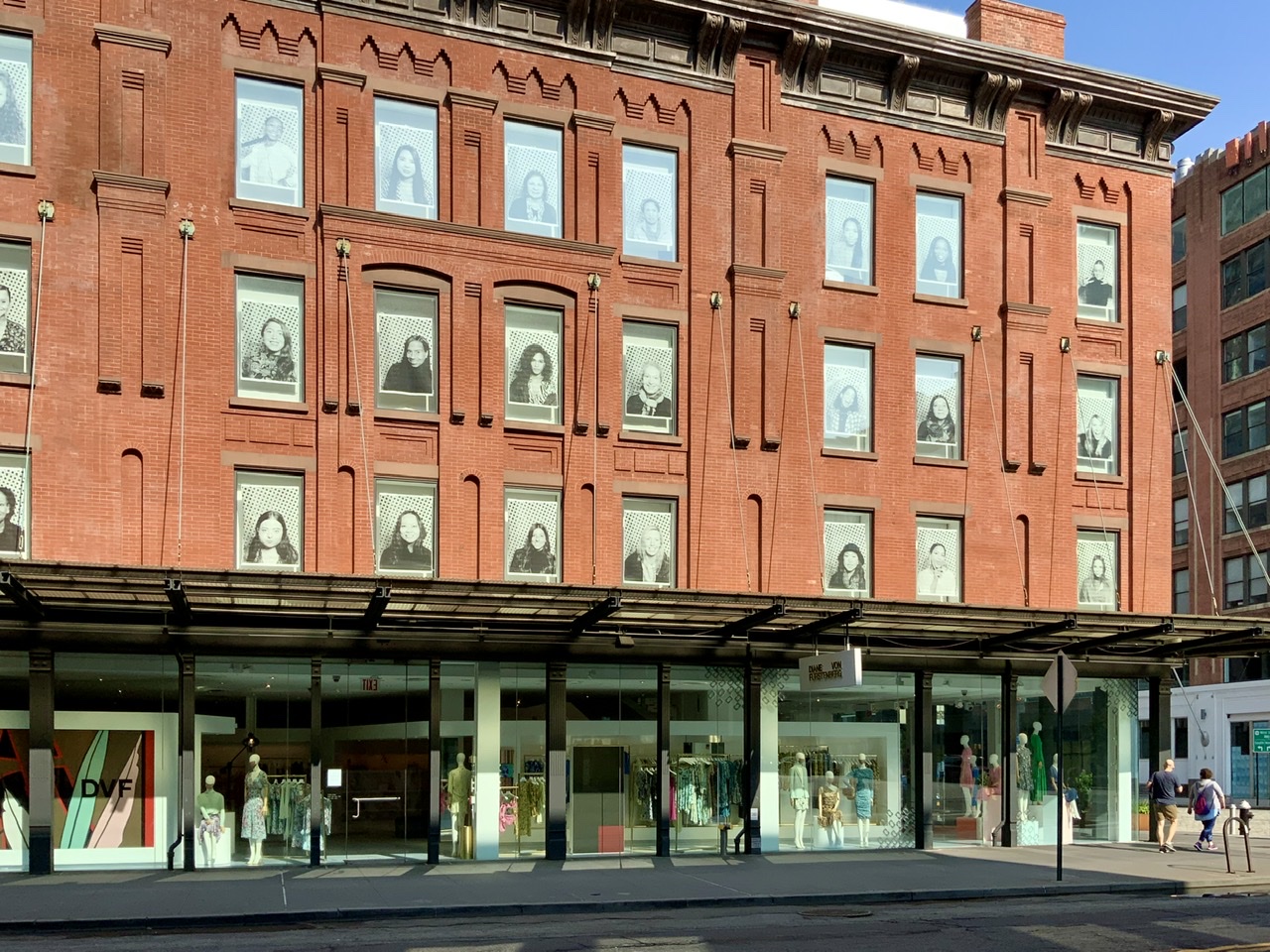
West Village, NYC
*an ongoing series of quotations – mostly from artists, to artists – that offers wisdom, inspiration, and advice for the sometimes lonely road we are on.
What do we carry forward? My family lived in New Jersey near Manhattan until I was ten, and although I have enjoyed spending my adult life as a photographer in the American West, when we left New Jersey for Wisconsin in 1947 I was homesick.
The only palliative I recall, beyond my parents’ sympathy was the accidental discovery in a magazine of pictures by a person of whom I had never heard but of scenes I recognized. The artist was Edward Hopper and one of the pictures was of a woman sitting in a sunny window in Brooklyn, a scene like that in the apartment of a woman who had cared for my sister and me. Other views resembled those I recalled from the train to Hoboken. There was also a picture inside a second-floor restaurant, one strikingly like the restaurant where my mother and I occasionally had lunch in New York.
The pictures were a comfort but of course none could permanently transport me home. In the months that followed, however, they began to give me something lasting, a realization of the poignancy of light. With it, all pictures were interesting.
Robert Adams in Art Can Help
Q: What historical art movement do you most identify with?

Barbara’s studio
A: I’d have to say that I identify most with surrealism, although my work does not exactly fit into any particular art historical movement. When I was first finding my way as an artist, I read everything I could find about surrealism in art and in literature. This research still res0nates deeply and is a tremendous influence on my studio practice. Elements of surrealism DO fit my work. Here’s an excerpt from Wikipedia:
Surrealism is a cultural movement that began in the early 20s and is best known for its visual artworks and writings. The aim was to “resolve the previously contradictory conditions of dream and reality.” Artists painted unnerving, illogical scenes with photographic precision, created strange creatures from everyday objects and developed painting techniques that allowed the unconscious to express itself.
Surrealist works feature the element of surprise, unexpected juxtapositions and non sequitur; however, many Surrealist artists and writers regard their work as an expression of the philosophical movement first and foremost, with the works being an artifact. Leader Andre Breton was explicit in his assertion that Surrealism was, above all, a revolutionary movement.
I hope to expand on this in a future post.
Comments are welcome!
Pearls from artists* # 154
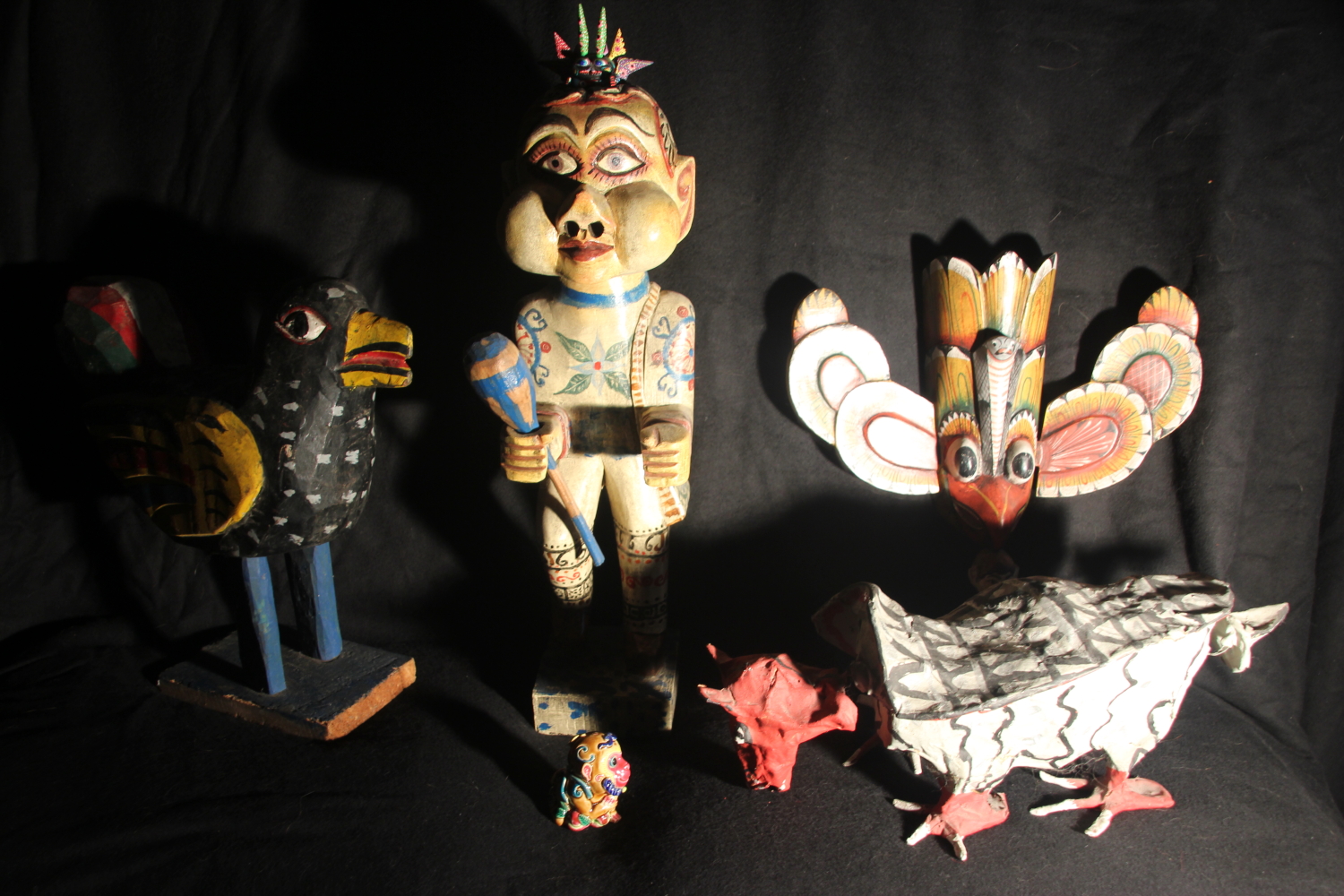
Idea for a painting
* an ongoing series of quotations – mostly from artists, to artists – that offers wisdom, inspiration, and advice for the sometimes lonely road we are on.
Often the public forms an idea of inspiration that is quite false, almost a religious notion. Alas! I do not believe that inspiration falls from heaven. I think it rather the result of a profound indolence and of our incapacity to put to work certain forces in ourselves. These unknown forces work deep within us, with the aid of the elements of daily life, its scenes and passions, and, they burden us and oblige us to conquer the kind of somnolence in which we indulge ourselves like invalids who try to prolong dream and dread resuming contact with reality, in short when the work that makes itself in us and in spite of us demands to be born, we can believe that this work comes to us from beyond and is offered by the gods. The artist is more slumberous in order that he shall not work. By a thousand ruses, he prevents his nocturnal work from seeing the light of day.
For it is at the moment that consciousness must take a precedence and that it becomes necessary to find the means which permit the unformed work to take form, to render it visible to all. To write, to conquer ink and paper, accumulate letters and paragraphs, divide them with periods and commas, is a different matter than carrying the dream of a play or of a book.
Jean Cocteau: The Process of Inspiration in The Creative Process, edited by Brewster Ghiselin
Comments are welcome!
Q: Why do you call the small paintings in your “Domestic Threats” series, “Scenes?”
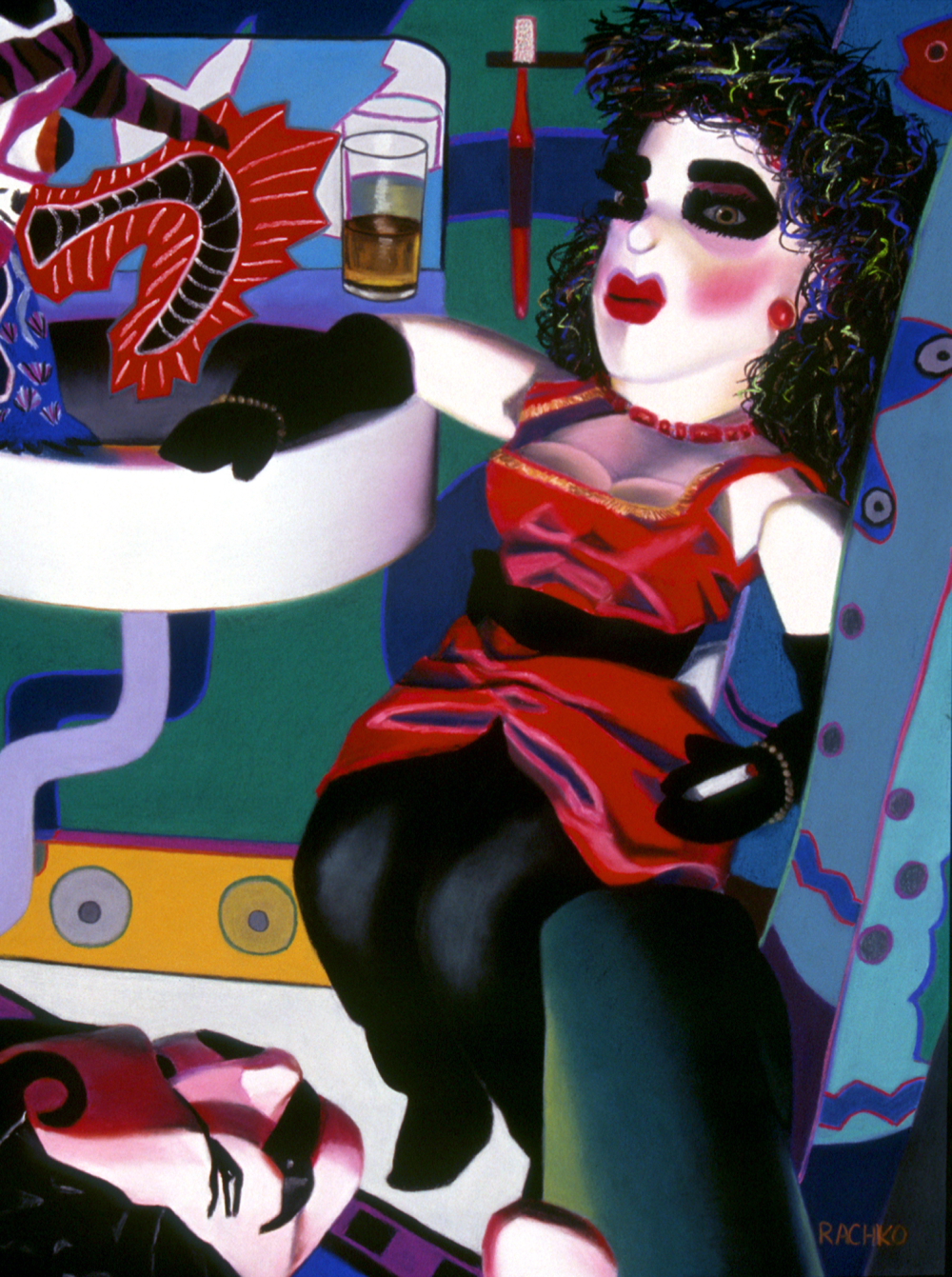
“Scene Thirteen: Bathroom,” 26″ x 20″, soft pastel on sandpaper
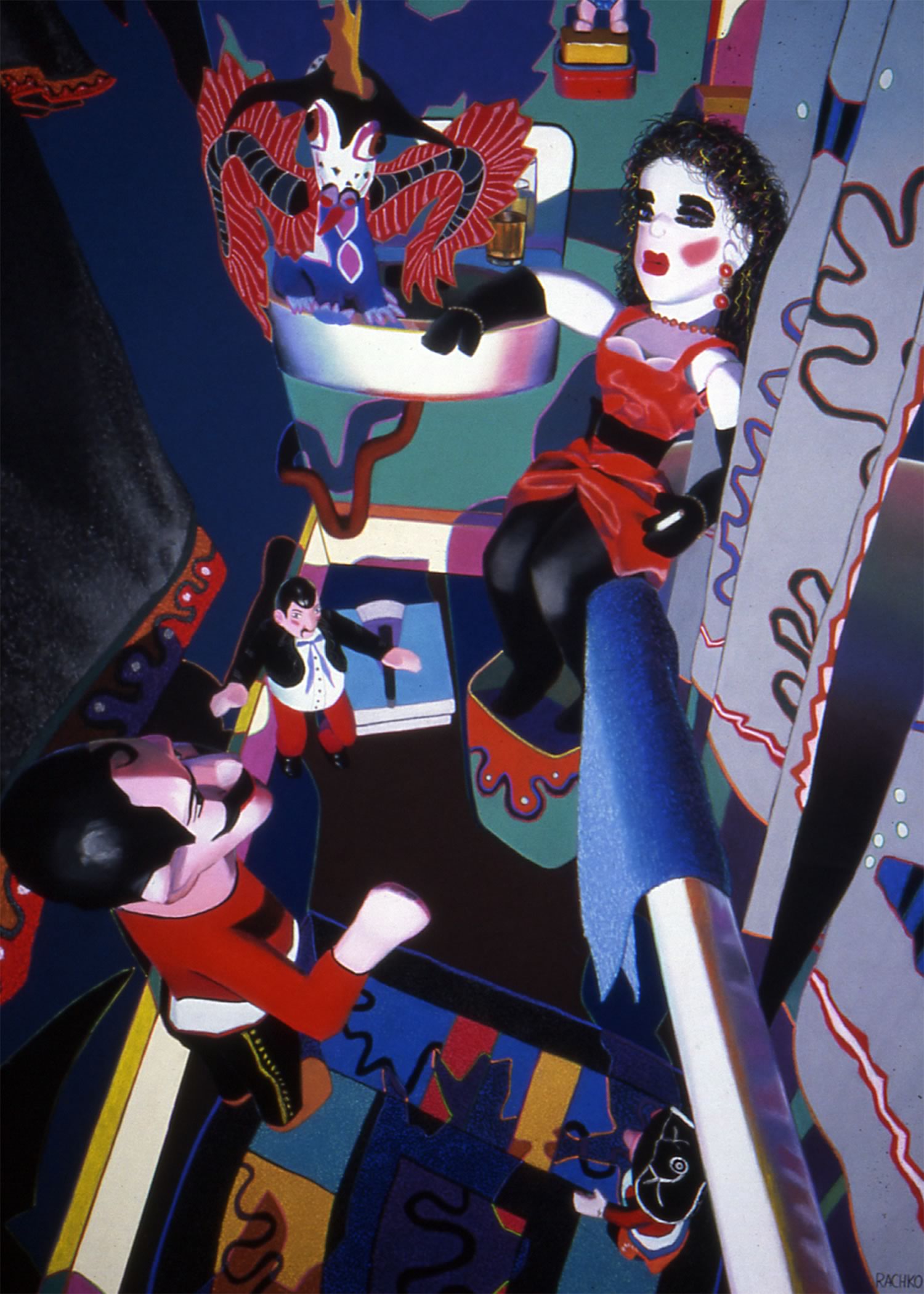
“He Urged Her to Abdicate,” 58″ x 38,” soft pastel on sandpaper
A: At first I didn’t know what to call them. I was looking for a word that meant “a piece of some larger whole.” Initially the word “shard” – a fragment of pottery – came to mind. However, that didn’t capture the meaning I was seeking, since my paintings have little to do with pottery.
My large “Domestic Threats” paintings are theatrical. There is substantial labor and much thought involved in their creation, so I often think of myself as a director and each image as a play.
Small “Domestic Threats” paintings are made from a portion of a photograph that I use as reference for a larger painting. For example, “Scene Thirteen: Bathroom” (above, top) is a small version of “He Urged Her to Abdicate” (above, bottom).
A “portion” of a play is a “Scene” so that’s what I finally named them. Additionally, I numbered the paintings in order of their creation and added the room where each takes place.
Comments are welcome!


 barbararachkoscoloreddust.com
Pearls from artists* # 529
Oct 19
Posted by barbararachkoscoloreddust
* an ongoing series of quotations – mostly from artists to artists – that offers wisdom, inspiration, and advice for the sometimes lonely road we are on.
All sorts of novelists, composers, choreographers, poets, and painters find themselves engaged in the challenges of authority and freedom that are the lifeblood of the arts. Art is a way of life – and not only or even essentially for geniuses. An artistic community – to whatever degree it may be joined by social, economic, or other concerns – is fundamentally united by the imperatives of a vocation as they are shaped in a particular time. Genius doesn’t emerge ex nihilo. And it doesn’t have a unique relationship with authority and freedom. Whatever truth there is to Walter Benjamin’s comment, apropos of Proust’s novel, that certain masterpieces begin or end a genre, it’s usually true that every masterpiece reaffirms the fundamental character of a form. For every epochal achievement that we may see as an assertion of unexpected degrees of freedom (Beethoven’s final quartets or Shakespeare’s last plays), there are others that reaffirm the pressure of tradition (an example is Raphael’s neoclassical designs for tapestries representing scenes from the lives of Saint Peter and Saint Paul). For every creative spirit, the great as well as the merely good, there is a sense in which the wager is the same.
Jed Perl in Authority and Freedom: A Defense of the Arts
Comments are welcome!
Share this:
Posted in 2022, An Artist's Life, Art in general, Art Works in Progress, Inspiration, Pearls from Artists, Quotes
Comments Off on Pearls from artists* # 529
Tags: achievement, apropos, artistic, assertion, authority, Beethoven, certain, challenges, character, choreographers, comment, community, composers, concerns, creative, degree, degrees, designs, economic, emerge, engaged, epochal, essentially, every, ex nihilo, example, freedom, fundamental, fundamentally, genius, geniuses, Jed Perl, joined, lifeblood, masterpiece, masterpieces, merely, neoclassical, novelists, painters, particular, presence, pressure, Proust, quartets, Raphael, reaffirm, relationship, Saint Paul, Saint Peter, scenes, Shakespeare, shaped, social, spirit, tapestries, the arts, themselves, tradition, unexpected, unique, united, usually, vocation, Walter Benjamin, whatever, work in progress