Blog Archives
Pearls from artists* # 692

*an ongoing series of quotations – mostly from artists, to artists – that offers wisdom, inspiration, and advice for the sometimes lonely road we are on.
Claiming space, money, and time to do our work requires fortitude. We need to say ‘no’ to projects and people fighting for our attention. We just follow our work through changes, even when it is comfortable, or in other people’s interests, for our work to stay the same. If we want to expand our careers, we get rejected… a lot. But artists are like sharks; we must keep moving to survive, creating authentic, original work as we outgrow it to evolve as human beings.
Kate Kretz in Art From Your Core: A Holistic Guide to Visual Voice
Comments are welcome!
Pearls from artists* # 680

“Sacrificial” (on the wall) and “Trickster” (on the floor)
*an ongoing series of quotations – mostly from artists, to artists – that offers wisdom, inspiration, and advice for the sometimes lonely road we are on.
What makes a work transcendent and powerful is a personal intensity, an ‘extra’ quality. Yet that intensity is exclusive to each artist: extra strangeness, subtlety, causticity, bravado, sensuality, rawness, grandiosity, succinctness, mystery, vulnerability, truth, etc. For an individual artist to infuse an object or an experience with their own ‘extra’ quality requires not only skill or ideas, but the profound benevolence of consistently delivering in spades.
It is this passion and genuine feeling, specific to each creator, that lives on in the art as a gift. It is wrapped up in the work, forever suspended in time. The artist says,
Here… everything I possessed in this moment is embodied in this object… All skills I have painstakingly learned, all of the knowledge I possess, the joy and pain I have felt and all the experiences I have lived. I spun these into the perfect, most sublime form, and packed it up, but for you to unwrap anytime you need sustenance. It will nourish, comfort, and surround you, because you have chosen it.
Each viewer selects which works of art speak to them… which embodied feelings, concepts, and knowledge they value. An empathic connection is forged through the art object or experience. What is love, but to say to someone, ‘you are truly seen and understood?’ Art offers this as well, by reaching out to puncture through the membrane of our emotional isolation, to articulate how we feel in the moments when we cannot find words. It tells the artist and viewer alike, ‘You are not alone. You are not alone in how your brain works. You are not alone in the pain you feel. You are not alone in what you notice or appreciate, or in how much love you have to give.’
Pour that love into an art object. It can handle all the devotion you pack into it, and more.
Kate Kretz in Art From Your Core: A Holistic Guide to Visual Voice
Comments are welcome!
Pearls from artists* # 651

*an ongoing series of quotations – mostly from artists, to artists – that offers wisdom, inspiration, and advice for the sometimes lonely road we are on.
We are engaged in a mission that can be perplexing to those around us. We are playing a long game that no one else can see. Every time we walk into the studio, it is a mini act of defiance against all of those who believe we are wasting our time. If you do not shore up and internalize this right to make art until it becomes a part of you, outside forces will repeatedly rise up to challenge it, creating conflict. Understand deep in your being that making art is a vital part of who you are, to be your own strongest advocate. Be greedy for the time and space your work requires to be actualized.
Kate Kretz in Art From Your Core: A Holistic Guide to Visual Voice
Comments are welcome!
Pearls from artists* # 631

With “Maestro,” soft pastel on sandpaper, 35” x 28.5” framed
*an ongoing series of quotations – mostly from artists, to artists – that offers wisdom, inspiration, and advice for the sometimes lonely road we are on.
Selling your art is harder than creating it. Every artist dreams of being able to sell his/her art and make a considerable profit from it and/or build a business based on art. This would give artists the opportunity to make art full-time. However, the process is neither easy nor quick. It requires determination, discipline, and consistency. The idea of becoming a successful artist overnight almost doesn’t exist. All the artists who seem to be “overnight successes” put in a lot of hard work for years.
Dr. Bianca Turner in The Business of Art: A Guide for Visual Artists to Become Successful Entrepreneurs
Comments are welcome!
Pearls from artists* # 628

Beginning
*an ongoing series of quotations – mostly from artists, to artists – that offers wisdom, inspiration, and advice for the sometimes lonely road we are on.
We have nothing to go by, but still, we must begin. It requires chutzpah – the Yiddish word for that ineffable combination of courage and hubris – to put down one word, then another, perhaps even accumulate a couple of flimsy pages, so few that they don’t even firm the smallest of piles, and call it the beginning of a novel. Or memoir. Or story. Or anything, really rather than a couple of flimsy pages.
When I’m between books, I feel as if I will never have another story to tell. The last book has wiped me out, has taken everything from me, everything I understand and feel and know and remember, and … that’s it. There’s nothing left. A low-level depression sets in. The world hides its gifts from me. It has taken me years to realize that this feeling, the one of the well being empty, is as it should be. It means I’ve spent everything. And so I must begin again.
I wait.
I try to be patient. I remember Colette, who wrote that her most essential art was “not that of writing, but the domestic task of knowing how to wait, to conceal, to save up crumbs, to reglue, regild, change the worst into the not-so-bad, how to lose and recover in the same moment that frivolous thing, a taste for life.” Colette’s words, along with those of a few others, have migrated from one of my notebooks to another for over twenty years now. It’s wisdom I need to remember – wisdom that is easy to forget.
Dani Shapiro in Still Writing: The Perils and Pleasures of a Creative Life
Comments are welcome!
Pearls from artists* # 565

*an ongoing series of quotations – mostly from artists, to artists – that offers wisdom, inspiration, and advice for the sometimes lonely road we are on.
Jung and Freud both observed that much of what ails us today is a product of being cut off from our inner life. Healing that division requires us to speak the language of symbol, and that necessitates a kind of thinking which is not easy for many of us. This kind of approach is particularly challenging in our culture, which has a bias in favor of the too bright, daylight awareness of the conscious mind, and privileges literal thinking and mechanistic ways of understanding the world.
Gary Bobroff in Carl Jung: Knowledge in a Nutshell
Comments are welcome!
Pearls from artists* #561

*an ongoing series of quotations – mostly from artists, to artists – that offers wisdom, inspiration, and advice for the sometimes lonely road we are on.
The most powerful symbols draw profound reactions from us. The symbolic images in great art attract and fascinate us; they stir our souls and move us beyond what can be easily expressed; ‘their pregnant language cries out to us that they mean more than they say.’
The unconscious produces symbols as part of a natural process within us. These images emerge out of the context of our lived experience… Jung saw the meaning-making process as one that not only requires attendance to the real context of our lives and history, but also involves profound inner listening. It asks us to use our rational capacities, but also our feeling and imaginal ones.
Symbolic images redirect our psychic energy, bringing together conscious and unconscious material and producing the lessening of conflict. In this way, they activate a transcendent function within the psyche. We experience this as the discovery of personal meaning and healing. This transformation is not the result of formulaic operations, but rather is a dynamic process that requires our authentic and vulnerable participation. The process challenges the whole of who we are and requires deep moral effort. That the unconscious would produce moving, powerful compensatory symbols inside us at all points to a fact that our culture may not have fully grasped – that there is a force working within us which is always driving us towards healing growth and greater consciousness… Despite our suffering, the psyche is always ultimately seeking both a healthy homeostatic balance and our ever-unfolding growth and unique development.
Gary Bobroff in Carl Jung: Knowledge in a Nutshell
Comments are welcome!
Pearls from artists* # 523
*an ongoing series of quotations – mostly from artists, to artists – that offers wisdom, inspiration, and advice for the sometimes lonely road we are on.
How strange the human mind is! When I first began, I think I should have been willing to work at it from the top of a church steeple, whereas now, even to think of finishing requires a real effort. And all this, simply because I have been away from it for so long. It is the same with my picture and with everything else I do. There is always a thick crust to be broken before I can give my whole heart to anything; a stubborn piece of ground, as it were, that resists the attack of plough and hoe. But with a little perseverance the hardness suddenly gives and it becomes so rich in fruit and flowers that I am quite unable to gather them all.
The Journal of Eugene Delacroix edited by Hubert Wellington
Comments are welcome!
Pearls from artists* # 436
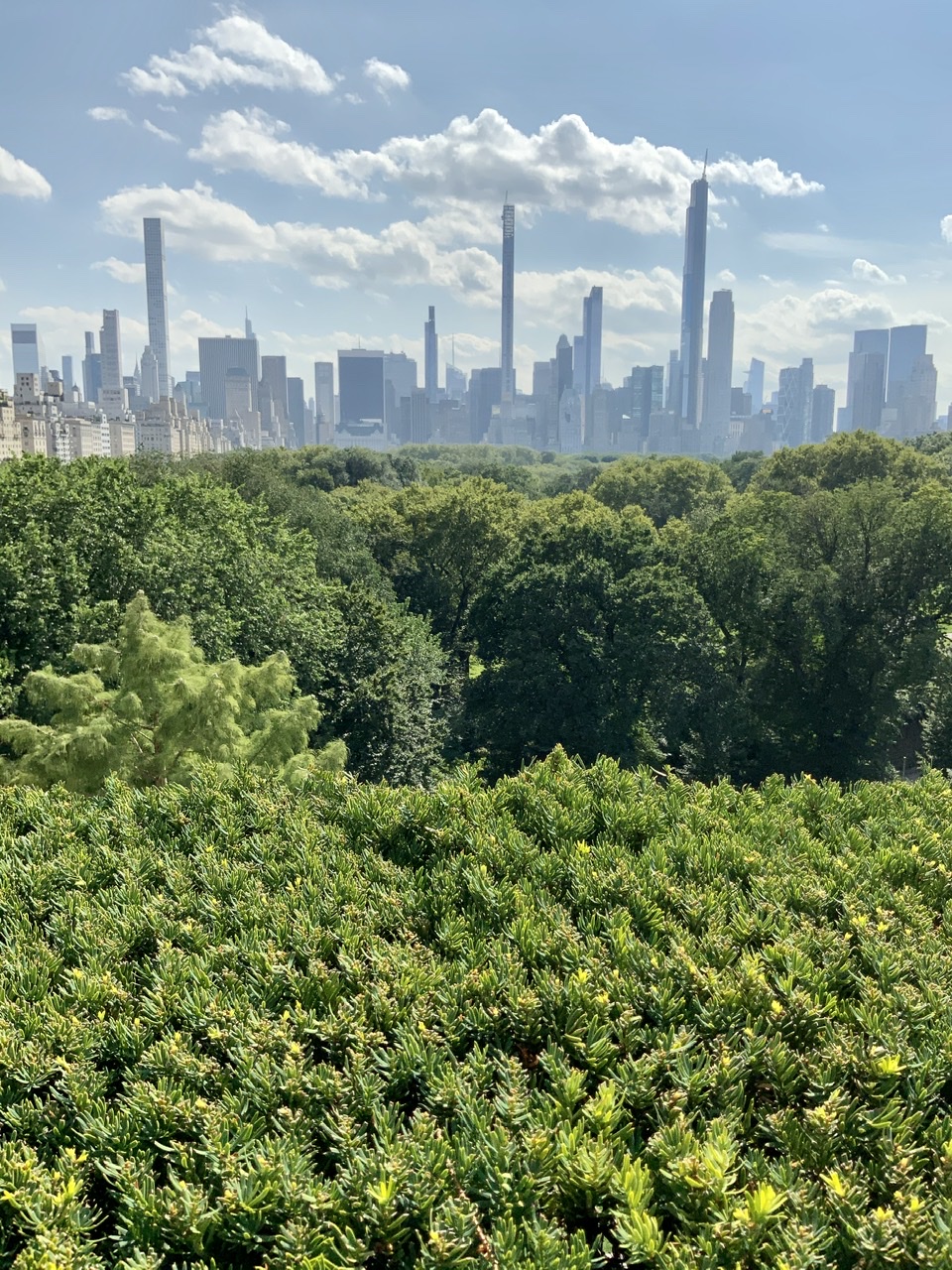
View from the roof of the Metropolitan Museum of Art, New York
*an ongoing series of quotations – mostly from artists, to artists – that offers wisdom, inspiration, and advice for the sometimes lonely road we are on.
Cassirer’s partial definition of art as symbolic language has dominated art studios in our [20th] century. A new history of culture anchored upon the work of art as a symbolic expression thus came into being. By these means art has been made to connect with the rest of history.
But the price has been high, for while studies of meaning received all our attention, another definition of art, as a system of formal relationships, thereby suffered neglect. This other definition matters more than meaning. In the same sense speech matters more than writing, because speech preceded writing, and because writing is but a special case of speech.
The other definition of art as form remains unfashionable, although every thinking person will accept it as a truism that no meaning can be conveyed without form. Every meaning requires a support, or a vehicle, or a holder. These are the bearers of meaning, and without them no meaning would cross from me to you, or from you to me, or indeed from any part of nature to any other part.
… The structural forms can be sensed independent of meaning. We know from linguistics in particular that the structural elements undergo more or less regular evolutions in time without relation to meaning, as when certain phonetic shifts in the history of cognate languages can be explained only by a hypothesis of regular change. Thus phoneme a occurring in an early stage of language, becomes phoneme b at a later stage, independently of meaning, and only under the rules governing the phonetic structure of the language. The regularity of these changes is such that the phonetic changes can be used to measure durations between recorded but undated examples of speech.
Similar regularities probably govern the formal infrastructure of every art. Whenever symbolic clusters appear, however, we see interferences that may disrupt the regular evolution of the formal system. An interference from visual images is present in almost all art. Even architecture, which is commonly thought to lack figural intention, is guided from one utterance to the next by the images of the admired buildings of the past, both far and near in time.
George Kubler in The Shape of Time: Remarks on the History of Things
Comments are welcome!
Pearls from artists* # 397
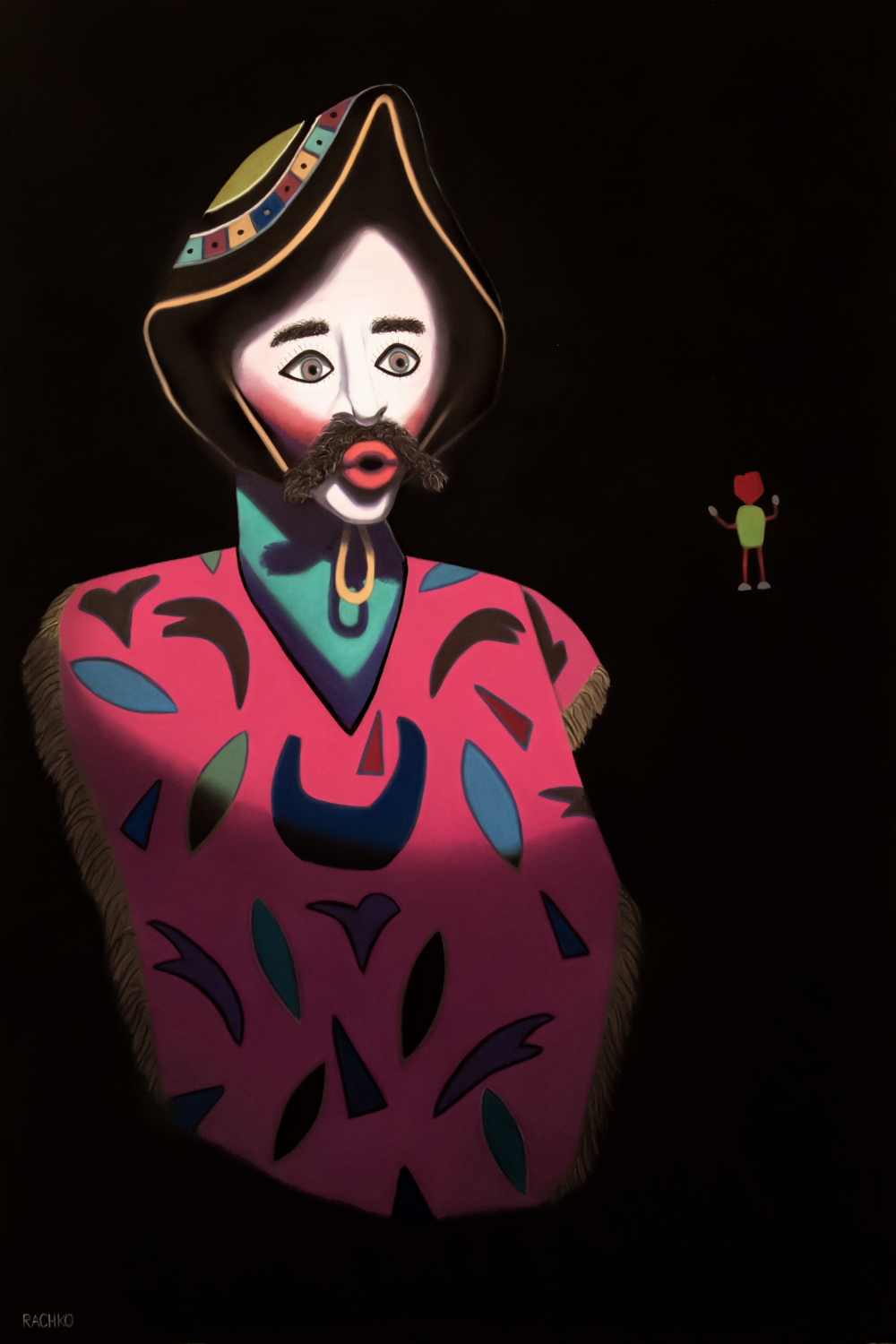
“Prophecy,” soft pastel on sandpaper, 58″ x 38″
* an ongoing series of quotations – mostly from artists, to artists – that offers wisdom, inspiration, and advice for the sometimes lonely road we are on.
Our species requires a greater capacity to see into the Real, not just the outer universe of the senses but also the inner cosmos of the psyche, the normally invisible dimensions. Near the end of his life, Jung said to an English journalist, “The only real danger that exists is man himself… His psyche should be studied because we are the origin of all coming evil.” It is a beautiful statement until the word studied comes up, at which point we are reminded that Jung at bottom was a rationalist: he refused to see that while psychology could talk brilliantly about the soul, it could never descend into its depths. For this we need imagination, madness, prophecy – art. We must understand that creative expression is not a pastime or distraction, but a psychonautic science in its own right. Allowed to operate in freedom, it can illuminate the darkness beyond our field of vision.
J.F. Martel in Reclaiming Art in the Age of Artifice: A Treatise, Critique, and Call to Action
Comments are welcome!


 barbararachkoscoloreddust.com