Blog Archives
Q: How many studios have you had since you’ve been a professional artist?

Barbara’s studio
A: I am on my third, and probably last, studio. I say ‘probably’ because I love my space and have no desire to move. Plus, it would be a tremendous amount of work to relocate, considering that I have been in my West 29th Street studio since 1997.
My very first studio, in the late 1980s, was the spare bedroom of my house in Alexandria, Virginia. I set up a studio there while I was on active duty in the Navy. When I resigned my commission, I was required to give the President an entire year’s advance notice. Towards the end of that year I remember calling in sick so I could stay home and make art.
In the early 1990s I rented a studio on the third floor of the Torpedo Factory in Alexandria. For a while I enjoyed working there, but the constant interruptions – in an art center that is open to the public – became tiresome.
In 1997 I had the opportunity to move to New York. I desperately craved solitary hours to work in peace, without interruption, so at first I didn’t have a telephone. I still don’t have WiFi there because my studio is reserved strictly for creative work.
Moving from Virginia to New York in 1997 was relatively easy. My aunt, who planned to be in California to continue her Buddhist studies, offered me her rent-controlled sixth-floor walkup on West 13th Street. I looked at just one other studio before signing a sublease for my space at 208 West 29th Street. I had heard about the vacancy through a college friend of my husband, Bryan. Karen, the lease-holder, was relocating to northern California to work on “Star Wars” with George Lucas. After several years, she decided not to return to New York and I have been the lease-holder ever since.
Comments are welcome!
Q: What was the first painting you ever sold?
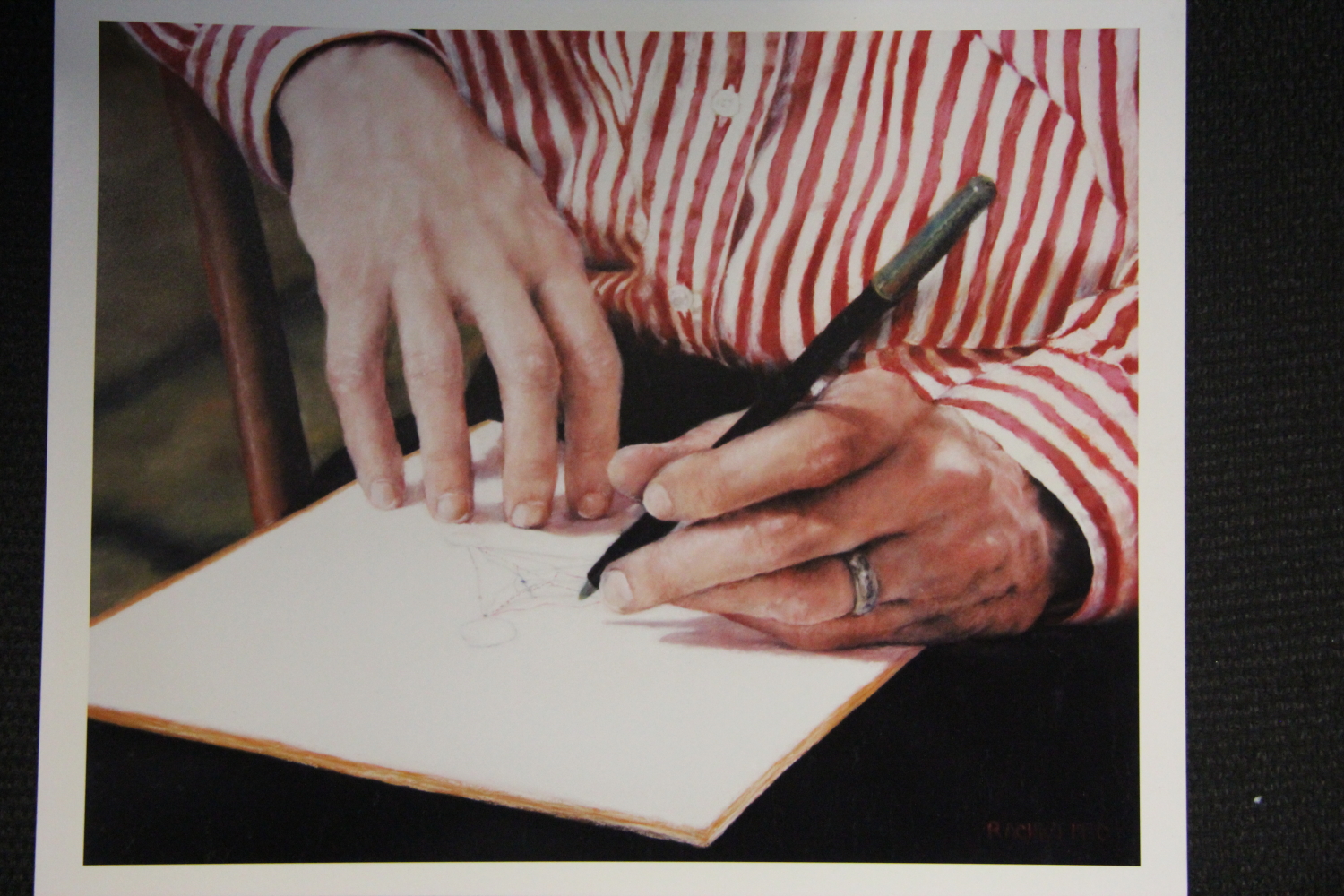
“Bryan’s Ph.D.”, 11″ x 13 1/2″, soft pastel on sandpaper
A: I believe my first sale was “Bryan’s Ph.D.” I made it in 1990 as one of several small paintings created to improve my skills at rendering human hands in pastel. I had recently left the Navy and was building a career as a portrait artist. Bryan, my late husband, was often my model for these studies, not only because it was convenient, but because he had such beautiful hands.
In 1990 Bryan was working on his Ph.D. in economics at the University of Maryland. In this painting he is drawing a diagram that illustrates a theoretical point about “international public goods,” the subject of his research. He was sitting in an old wooden rocking chair in our backyard in Alexandria, VA. I still own the chair and the house. I photographed his hands close-up and then created the painting. I don’t remember which of Bryan’s cameras I used, but it was one that took 35 mm film; perhaps his Nikon F-2. Somewhere I must still have the negative and the original reference photo.
“Bryan’s Ph.D.” is 11″ x 13 1/2″ and it sold for $500 at a monthly juried exhibition at The Art League in Alexandria. I have not seen it since 1990. (Above is a photograph of “Bryan’s Ph.D.” from my portfolio book).
Not long ago the owner contacted me, explaining that she had received the painting as a gift from her now ex-husband. She was selling it because it evoked bitter memories of her divorce. Her phone call was prompted by uncertainty about the painting’s value now. She had a likely buyer and needed to know what price to charge.
I was saddened because I have so many beautiful memories of this particular painting and of an idyllic time in my life with Bryan. He was on a leave of absence from the Pentagon to work on his dissertation, while I was finished with active duty. At last I was a full time artist, busily working in the spare bedroom that we had turned into my first studio.
My conversation with the owner was a reminder that once paintings are let out into the world, they take on associations that have nothing to do with the personal circumstances surrounding their creation. In short, what an artist creates solely out of love, stands a good chance of not being loved or appreciated by others. This is one reason to only sell my work to people I select personally. I ended the telephone conversation hoping that “Bryan’s Ph.D.” fares better in its new home.
Comments are welcome!
Q: Were there any other artists in your family?

“The Ancestors,” soft pastel on sandpaper, 58″ x 38,” 2013
A: Unfortunately, I have not been able to reconstruct my family tree further back than two generations. So as far as I can tell, I am the first artist of any sort, whether musician, actor, dancer, writer, etc. in my family.
Both sets of grandparents emigrated to the United States from Europe. On my mother’s side my Polish grandparents died by the time my mother was 16, years before I was born.
My paternal grandparents both lived into their 90s. My father’s mother spoke Czech, but since I did not, it was difficult to communicate. I never heard any stories about the family she left behind. My grandfather spoke English, but I don’t remember him ever talking about his childhood or telling stories about his former life. My most vivid memories of my grandfather are seeing him in the living room watching Westerns on an old-fashioned television.
Sometimes I am envious of artists who had parents, siblings, or extended family who were artists. How I would have loved to grow up with a family member who was an artist and a role model!
Comments are welcome!
Pearls from artists # 146
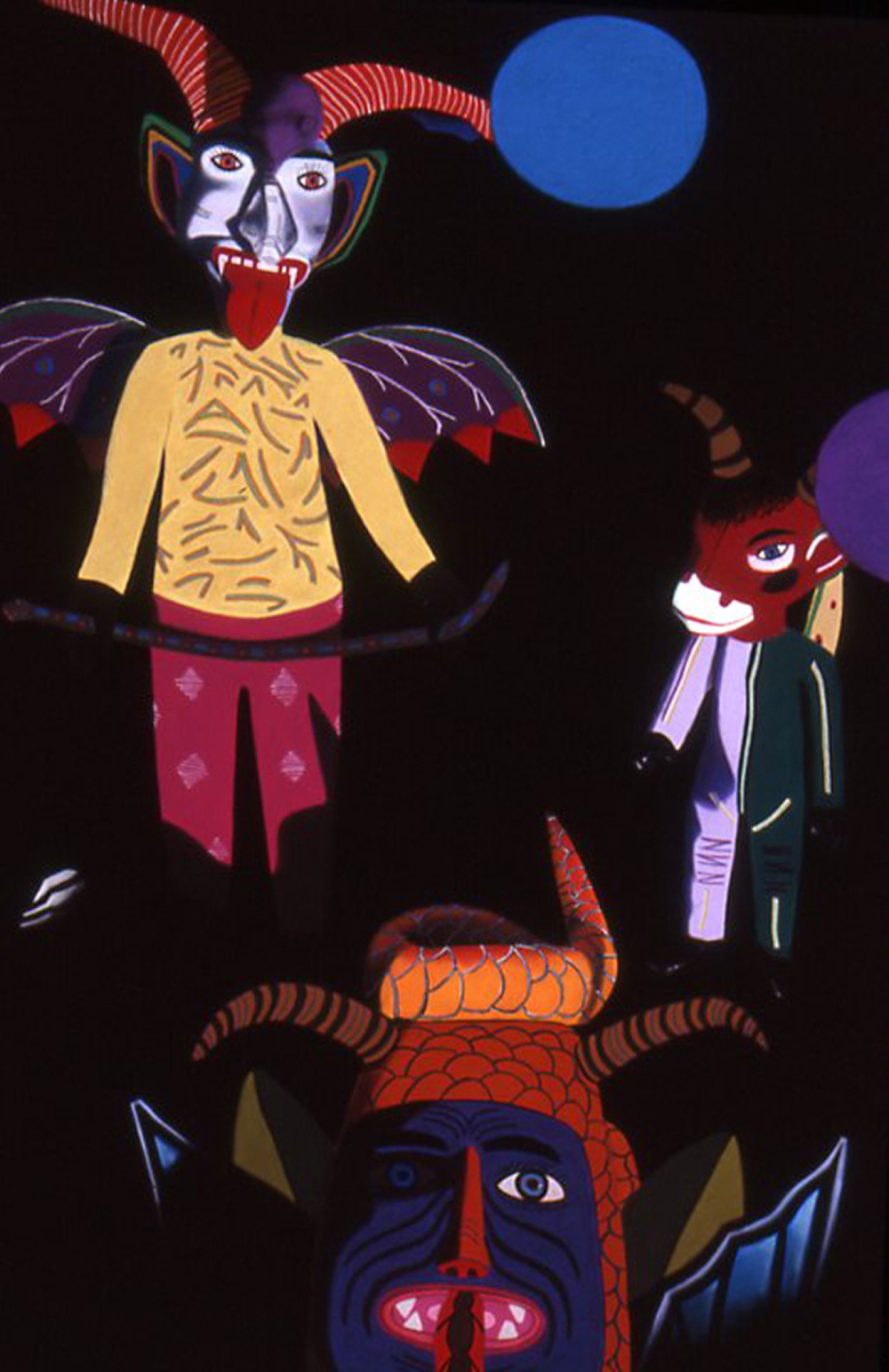
“The Sovereign,” soft pastel on sandpaper, 58″ x 38″
* an ongoing series of quotations – mostly from artists, to artists – that offers wisdom, inspiration, and advice for the sometimes lonely road we are on.
I try to remember that painting at its best is a form of communication, that it is constantly reaching out to find response from an ideal and sympathetic audience. This I know is not accomplished by pictorial rhetoric nor by the manipulation of seductive paint surfaces. Nor is a good picture concocted out of theatrical props, beautiful subjects, or memories of other paintings. All these might astound but they will never communicate the emotional content or exaltation of life, which I believe an artist, by definition, has to accept as his task.
Julian Levi: Before Paris and After in The Creative Process, edited by Brewster Ghiselin
Comments are welcome!
Pearls from artists* # 144
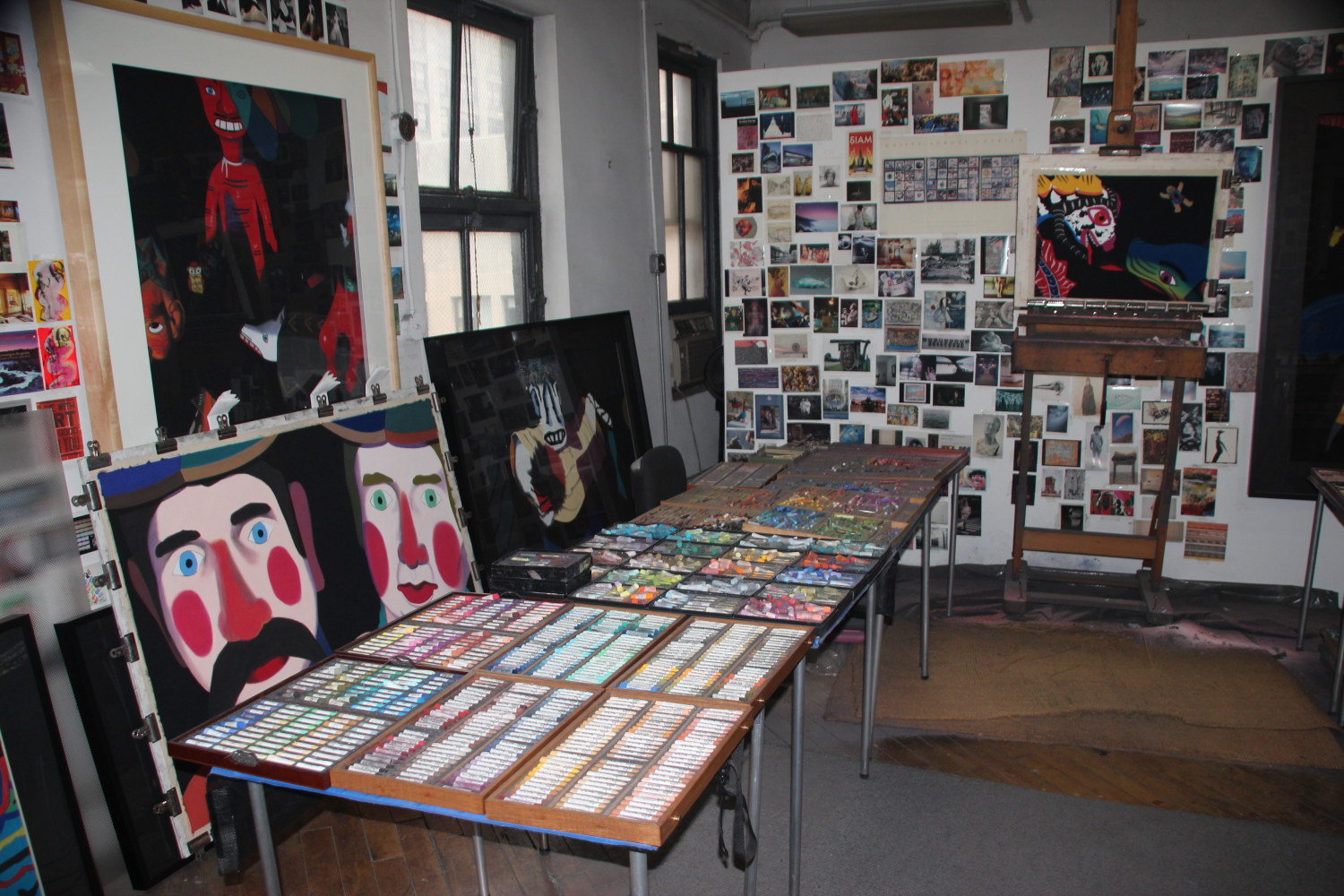
Barbara’s studio
* an ongoing series of quotations – mostly from artists, to artists – that offers wisdom, inspiration, and advice for the sometimes lonely road we are on.
Art and design are rule-based. This flies in the face of everything that most people have been taught before, namely, that art and design are about freedom. I remember reading a wonderful analogy about this concept many years ago in an out-of-print, early twentieth-century book on design. The author asked us to imagine a flying kite – the quintessential emblem of unrestricted, spontaneity, soaring in the wind. Keeping taught the line between you and the kite, however, is the source of that freedom. Here’s another way of putting it: “Creativity arises out of the tension between the rules and imagination.”
Leslie Hirst in The Art of Critical Making: Rhode Island School of Design on Creative Practice, Rosanne Somerson and Mara L. Hermano, editors
Comments are welcome!
Pearls from artists* # 135

Chalcatzingo (Mexico)
* an ongoing series of quotations – mostly from artists, to artists – that offers wisdom, inspiration, and advice for the sometimes lonely road we are on.
[Meredith Monk on beginning a new piece and whether it gets easier over time].
I always say that the fear is overwhelming at the beginning. It’s like jumping off a cliff. You have absolutely no idea what is going on. It is like being a detective. You try to follow every clue that comes up. Some of them are McGuffins, but I think that is what the process is. It starts out with fear, and I think that’s a good thing. If you know what you are doing already, what is the point in doing it? It is always like hanging out and tolerating pain and the fear of the unknown. Then usually what happens is that a little something will come up. If I am sitting at the piano – and I remember sitting at the piano and almost shaking at the beginning of this piece – one little phrase will come up. And then you get a little interested in that one little phrase. Or I say to myself, “Step by step.” Another thing I say to myself, “Remember playfulness, Meredith?”
What happens at a certain point is that the thing itself starts coming in and you realize that you are more interested than you are afraid. You are in this thing, whatever it is, and fear is useless at a certain point. But at the beginning, it is not bad. It is saying that you are risking. I think that taking the chance on risking is something that keeps you young. I’ll tell you, what you are saying about my skills – I don’t find it easier. It is just as hard as it ever was. I don’t think, “Now I have these skills.” I don’t think in those terms at all.
… When you are making something new, you aren’t going to be able to use the same technique that you used on something else. Maybe other people think it is easier as they go along. I think part of the challenge is not to rely on things that you know, and to keep on listening. It is really a process of listening to what something needs. What’s right for it.
Conversations with Meredith Monk by Bonnie Marranca
Comments are welcome!
Q: All artists go through periods when they wonder what it’s all for. What do you do during times like that?
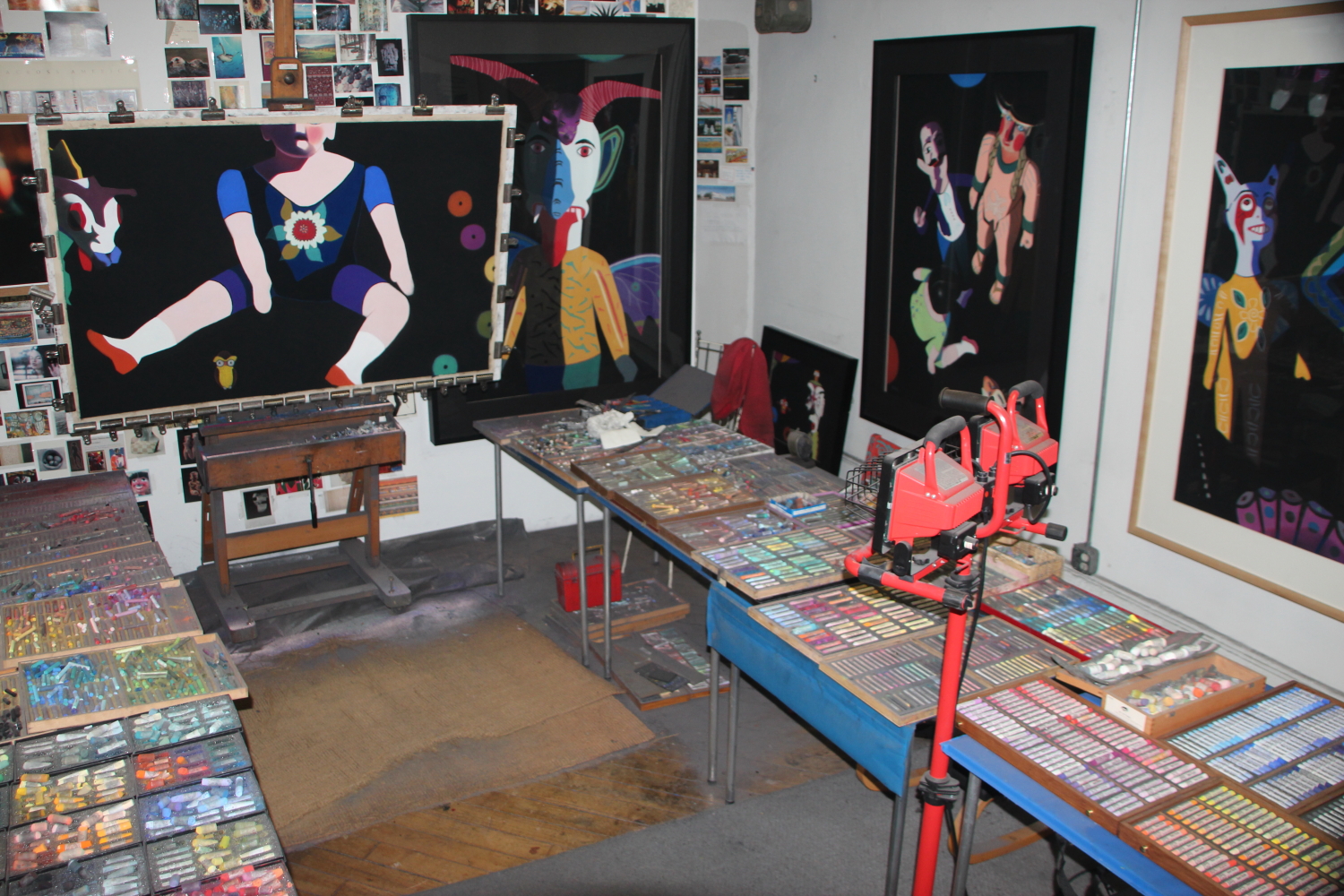
Barbara’s studio
A: Fortunately, that doesn’t happen very often. I love and enjoy all the varied facets involved in being an artist, even (usually) the business aspects, which are just another puzzle to be solved. I have vivid memories of being stuck in a job that I hated, one I couldn’t immediately leave because I was an officer in the US Navy. Life is so much better as a visual artist!
I appreciate the freedom that comes with being a self-employed artist. The words of Louise Bourgeois often come to mind: “It is a PRIVILEGE to be an artist.”
Still, with very valid reasons, no one ever said that an artist’s life is easy. It is difficult at every phase.
Books offer sustenance, especially ones written by artists who have endured all sorts of terrible hardships beyond anything artists today are likely to experience. I just pick up a favorite book. My Wednesday blog posts, “Pearls from artists,” give some idea of the sorts of inspiration I find. I read the wise words of a fellow artist, then I get back to work. As I quickly become intrigued with the problems at hand in a painting, all doubt usually dissolves.
I try to remember: Artists are extremely fortunate to be doing what we love and what we are meant to do with our short time on earth. What more could a person ask?
Comments are welcome!
Q: What’s on the easel today?

Work in progress
A: I am in the early stages – only 3 or 4 layers of pastel applied so far – on a large pastel painting with the working title, “He and She.” The figures are two favorites – a four-foot tall male and female couple, made of carved wood and silver and gold-leaf. I found them years ago at Galerie Eugenio in Mexico City.
These are the largest heads I have ever painted. As I work on this piece I remember one of my teachers saying, “Never paint a head larger than life-size.” Well, here’s to breaking rules.
For reference I am looking at a digital photograph shot with my Canon T3i. My usual practice is to make a c-print from a negative made with my Mamiya 6, but the photo clipped to my easel above is from a high resolution JPEG. Typically I set up a scene at home on a black cloth and photograph it, but my reference photo was taken in my studio without rearranging anything. In this painting I am breaking a few rules, while my creative process is perhaps evolving towards greater simplicity.
Comments are welcome!
Q: I have been always fascinated with the re-contexualizing power of Art and with the way some objects or even some concepts often gain a second life when they are “transduced” on a canvas or in a block of marble. So I would like to ask you if in your opinion, personal experience is an absolutely indespensable part of a creative process. Do you think that a creative process could be disconnected from direct experience?
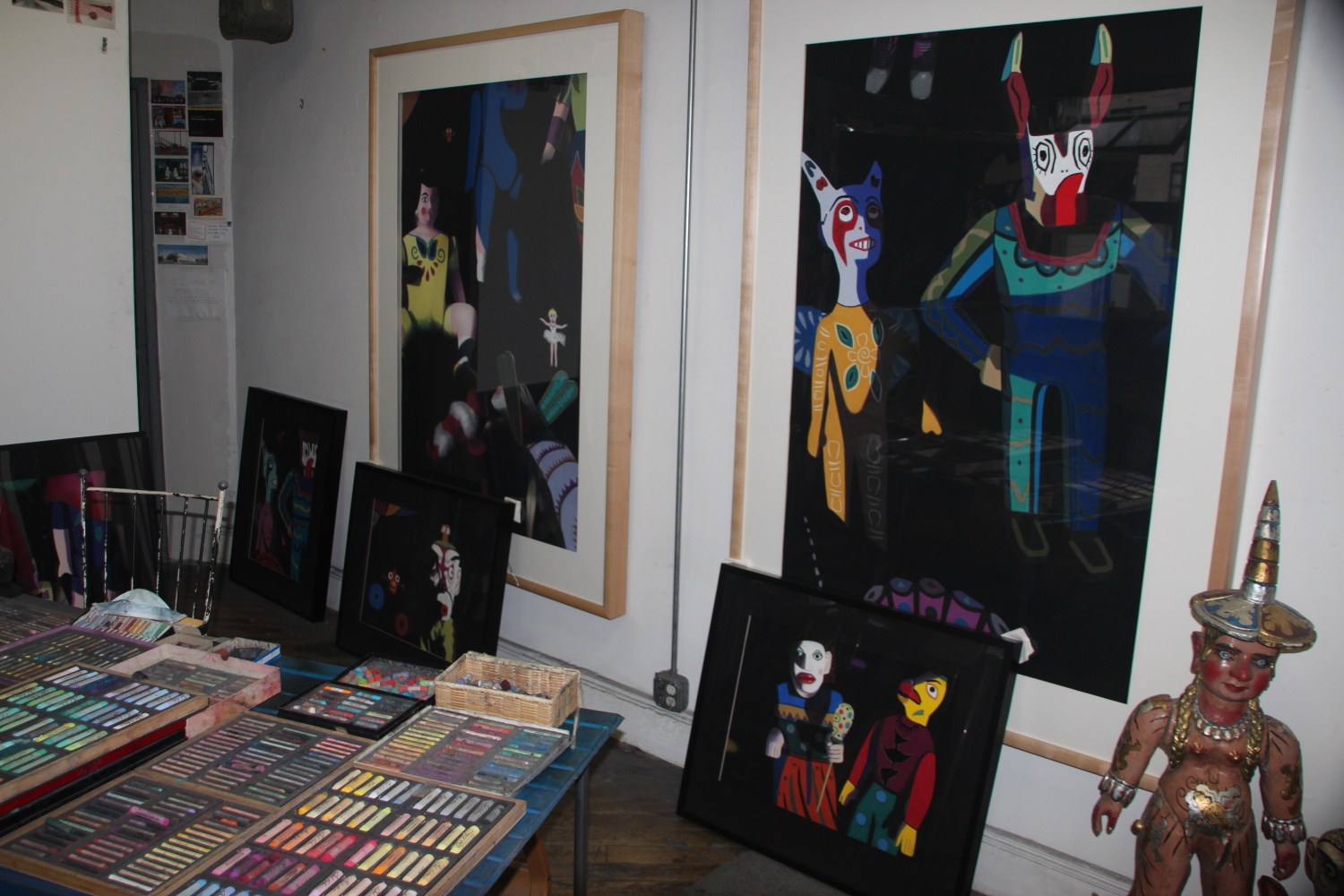
Barbara’s studio
A: Certainly personal experience is an indispensable and inseparable part of the creative process. For me art and life are one and I suspect that is true for most artists. When I look at each of my pastel paintings I can remember what was going on in my life at the time I made it. Each is a sort of veiled autobiography waiting to be decoded and in a way, each is also a time-capsule of the larger zeitgeist. It’s still a mystery how exactly this happens but all lived experience – what’s going on in the world, books I’m reading and thinking about, movies I’ve seen that have stayed with me, places I’ve visited, etc. – overtly and/or not so obviously, finds its way into the work.
Life experience also explains why the work I do now is different from my work even five years ago. In many ways I am not the same person.
The inseparableness of art and life is one reason that travel is so important to my creative process. Artists always seek new influences that will enrich and change our work. To be an artist, indeed to be alive, is to never stop learning and growing.
Comments are welcome!
Q: When you left the Navy you worked on commission as a portrait artist. Why don’t you accept commissions now?

Barbara’s studio
A: As I have often said, I left the active duty Navy in 1989, but stayed in the Reserves. The Reserves provided a small part-time income and the only requirement was that I work one weekend a month and two weeks each year. Plus, I could retire after 13 more years and receive a pension. (In 2003 I retired from the Navy Reserve as a Commander). The rest of the time I was free to pursue my studio practice.
For a short time I made a living making commissioned photo-realist portraits in soft pastel on sandpaper. However, after a year I became very restless. I remember thinking, “I did not leave a boring job just to make boring art!” I lost interest in doing commissions because what I wanted to accomplish personally as an artist did not coincide with what portrait clients wanted. I finished my final portrait commission in 1990 and never looked back.
To this day I remain reluctant to accept a commission of any kind. So I am completely free to paint whatever I want, which is the only way to evolve as a serious, deeply committed artist.
Comments are welcome!


 barbararachkoscoloreddust.com