Blog Archives
Q: Have you noticed any common characteristics among the people who collect your work?

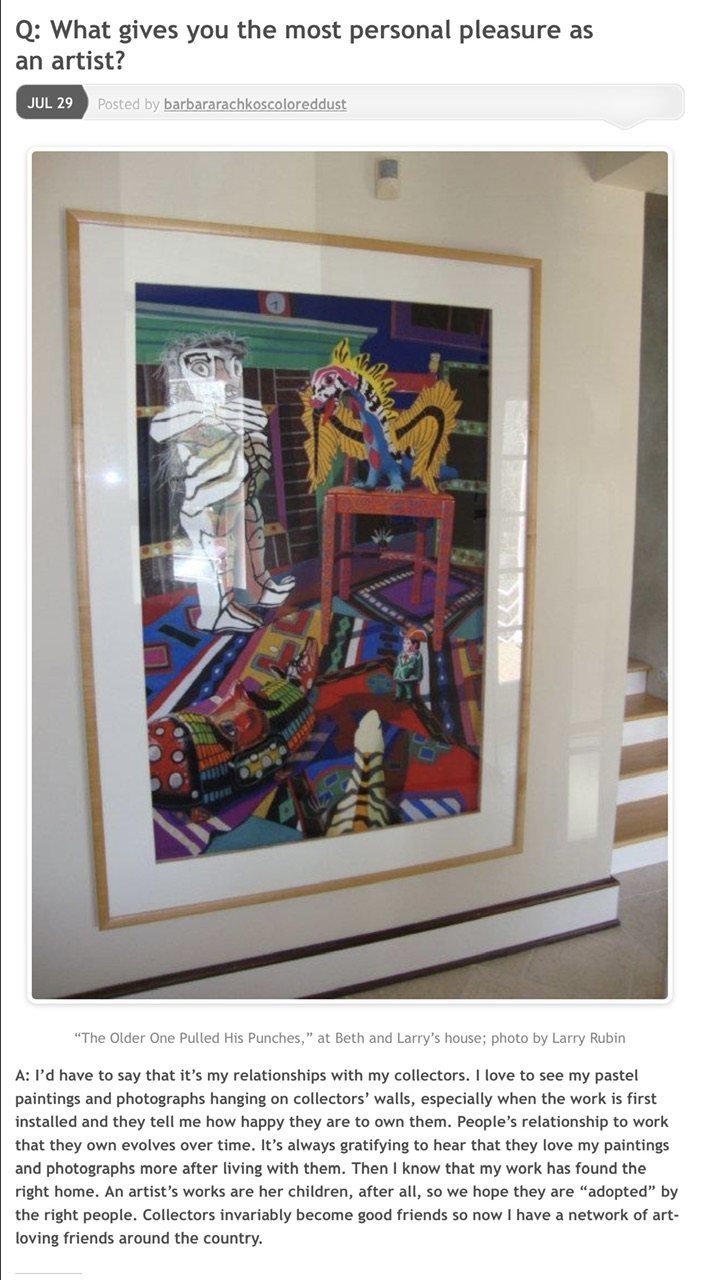
“Poseur,” soft pastel on sandpaper, 70” x 50” framed
A: Yes! They are fascinating people living lives devoted to nonstop learning, adventurous travel, and other proactive pursuits. Collectors of my work typically range in age from 40 to around 80. They are college graduates with advanced degrees. Sometimes they don’t have kids, which is why they have disposable income and time to pursue their interests in art and culture.
When I meet them (presuming my work was sold through a gallery or other third party), we usually have much to talk about – art, art history, photography, cinema, film history, dance, drama, music, travel, archaeology, Mexico, Central and South America, Bali – the list goes on and on. With so much in common, we quickly become good friends!
Comments are welcome!
Q: What’s on the easel today?

Work in progress
A: I am working on a small 26” x 20” pastel painting called, “Harbinger” that, for once, is coming together rather quickly.
Comments are welcome!
Q: When did you begin drawing and painting? (Question from “Cultured Focus Magazine”)

A: This is a long story because my path to becoming a professional artist has been unusually circuitous.
I grew up in a blue collar family in suburban New Jersey. My parents were both first-generation Americans and no one in my family had gone to college. I was a smart kid, who showed some artistic talent in kindergarten and earlier. At the age of 6, my sister, my cousin, and I enrolled in Saturday morning painting classes at the studio of a local artist. I continued the classes for about 8 years and became a fairly adept oil painter.
At the age of 15 my father decided that art was not a serious pursuit – he called it a hobby, not a profession – and abruptly stopped paying for my Saturday morning lessons. Unfortunately, there were no artists or suitable role models in my family. So with neither financial nor moral support to pursue art, I turned my attention to very different interests.
Cut to ten years later. When I was 25, I earned my private pilot’s license and spent the next two years amassing other flying licenses and ratings, culminating in a Boeing-727 flight engineer’s certificate.
At 29, I joined the Navy. By then I was an accomplished civilian pilot with thousands of flight hours so I expected to fly jets. However, in the early 1980s women were not allowed in combat. There were very few women Navy pilots and those few were restricted to training male pilots. There were no women pilots landing on aircraft carriers.
In the mid-1980s I was in my early 30s, a lieutenant on active duty in the Navy, working a soul-crushing job as a computer analyst on the midnight shift in a Pentagon basement. It was literally and figuratively the lowest point of my life. I was completely bored and miserable.
Remembering the joyful Saturdays of my youth when I had taken art classes with a local New Jersey painter, I enrolled in a drawing class at the Art League School in Alexandria, Virginia. Initially I wasn’t very good, but it was wonderful to be around other women and a world away from the mentality of the Pentagon. I was having fun again! I enrolled in more classes and became a very motivated full-time art student who worked nights at the Pentagon. As I studied and improved my skills, I quickly discovered my preferred medium – soft pastel on sandpaper.
Although I knew I had found my calling, for more than a year I agonized over whether or not to leave the financial security of a Navy paycheck. Finally I did make up my mind and resigned my commission, effective on September 30, 1989. With Bryan’s (my then boyfriend’s) support, I left the Navy to devote my time to making art.
I’m probably one of the few people who can name THE day I became a professional artist! That day was October 1, 1989. Fortunately, I have never needed another job. I remained in the Navy Reserve for the next 14 years, working primarily at the Pentagon for two days each month and two weeks each year. I commuted by train to Washington, DC after I moved to Manhattan in 1997. Finally on November 1, 2003, I officially retired as a Navy Commander.
Life as a self-employed professional artist is endlessly varied, fulfilling, and interesting. I have never regretted my decision to pursue art full-time.
Comments are welcome!
Q: Would you talk about your early art exhibitions? (Question from “Culture Focus Magazine”)

Review of my first exhibition at Brewster Arts, New York City!
A: Certainly! My very first group exhibition was in a juried show in the late 1980s at the Art League Gallery in Alexandria, VA. This was a gallery that offered monthly juried shows for members. I applied regularly, had work accepted many times, and frequently won first prize for my pastel paintings.
Early exhibitions at the Art League were followed by group and solo exhibitions at nonprofit and university spaces in Virginia, Washington, D.C., Maryland, North Carolina, Pennsylvania, Ohio, Rhode Island, Connecticut, Massachusetts, New Jersey, and New York; more or less up and down the mid-Atlantic states and the northeast, which were all places I could drive my truck to hand-deliver fragile pastel paintings.
My very first solo exhibition at a commercial gallery was at 479 Gallery in SoHo (New York City) in July 1996. In 1995 I had submitted work to a juried group show and was awarded first prize, which was a solo exhibition at 479 the following year.
My exhibition with 479 Gallery was quickly followed by representation at a prestigious New York gallery, Brewster Arts Ltd., which specialized in Latin American masters such as Frida Kahlo, Leonora Carrington, Diego Rivera, Rufino Tamayo, and many others. I was awarded my first two-person exhibition there in October 1996 and got to meet fellow gallery artist Leonora Carrington when she came to the opening. I could hardly believe my good fortune at gaining representation at such a revered and elegant gallery!
Comments are welcome!
Q: Many artists can’t bear to face a blank canvas. How do you feel about starting a new piece?

Starting a 26” x 20”pastel painting!
A: That’s an interesting question because I happen to be re-reading The War of Art by Steven Pressfield and this morning I saw this:
You know, Hitler wanted to be an artist. At eighteen he took his inheritance, seven hundred kronen, and moved to Vienna to live and study. He applied to the Academy of Fine Arts and later to the school of architecture. Ever see one of his paintings? Neither have I. Resistance beat him. Call it overstatement but I’ll say it anyway: it was easier for Hitler to start World War II than it was for him to face a blank square of canvas.
I’ve never understood this fear of “the blank canvas” because I am always excited about beginning a new painting. When you think about it, artists can often say, “In the history of the planet no one has ever made what I am about to make!” Once again I am looking at something new on my easel, even if it is only a blank 26” x 20” piece of sandpaper clipped to a slightly larger piece of foam core.
Unlike artists who are paralyzed before “a blank canvas,” I am energized by the imagined possibilities of all that empty space! I spend three or four months on a pastel painting so this experience of looking at a blank piece of paper on my easel happens three or four times a year at most.
Excluding travel to remote places, which is essential to my work and endlessly fascinating, the first day I get to spend blocking in a new painting is the most exhilarating part of my whole creative process. It’s when I feel the freest! I select the pastel colors quickly, without thinking too much about them, first imagining them, then feeling, looking, and reacting intuitively, always correcting and trying to make the painting look better and better!
Comments are welcome!
Q: You make it look effortless when we know it is not. Would you explain how you started your blog 11 years ago? (Question from Colette C. McBratney via Facebook)
An Early Blog Post, Above
A: My blog turned 11 on July 15th. To learn how to set up, publish, and maintain a blog, I took a class at the International Center of Photography in New York. It was called “The Daily Blog” and that’s where I learned how to work with WordPress.
I decided to use a question and answer format because I had a backlog of material from interviews I had done over the years. During the class, which lasted five weeks, I published blog posts every day. Once the class ended, I cut back to a more manageable schedule of publishing posts twice a week.
Writing about my work quickly became an important part of my creative process. As most people probably know, I am very persistent so these days I just make sure to keep going!
Comments are welcome!
Pearls from artists* # 483

*an ongoing series of quotations – mostly from artists, to artists – that offers wisdom, inspiration, and advice for the sometimes lonely road we are on.
The editor has a unique relationship with the actors. I never try to go on to the set to see the actors out of costume or out of character – and also just not to see the set. I only want to see what there is on screen. Ultimately, that’s all the audience is ever going to see. Everyone else working on the film at that stage is party to everything going on around the filmed scene: how cold it was when that scene was shot; who was mad at whom; who is in love with whom; how quickly something was done; what was standing just to the left of the frame. An editor particularly has to be careful that those things don’t exert a hidden influence on the way the film is constructed, can (and should in my view) remain ignorant of all that stuff – in order to find value where others might not see value, and on the other hand, to diminish the value of certain things that other people see as too important. It’s one o the crucial functions of the editor. To take, as far as it is possible, the view of the audience, who is seeing the film without any knowledge of all the things that went into its construction.
On Editing Actors, by Walter Murch in The Conversations: Walter Murch and the Art of Editing Film, by Michael Ondaatje
Comments are welcome!
Q: Why do you make a preliminary drawing before you begin a pastel painting?

A: I make a preliminary charcoal drawing because that’s how I like to begin thinking about and planning a new pastel painting. I always make preliminary drawings the same size as the upcoming pastel painting. While I draw, I make decisions about the overall composition, decide where the major light and dark shapes will be, and envision the likely problem areas that lie ahead. These drawings are done quickly. I spend perhaps an hour on them.
Once the drawing is in my head I no longer need it. So I put it away and when it’s time to begin a subsequent pastel painting, I erase it. I wipe it out with a paper towel and make the next preliminary charcoal drawing directly on top. These are ephemeral tools, existing only for as long as I need them.
Comments are welcome!
Pearls from artists* # 365
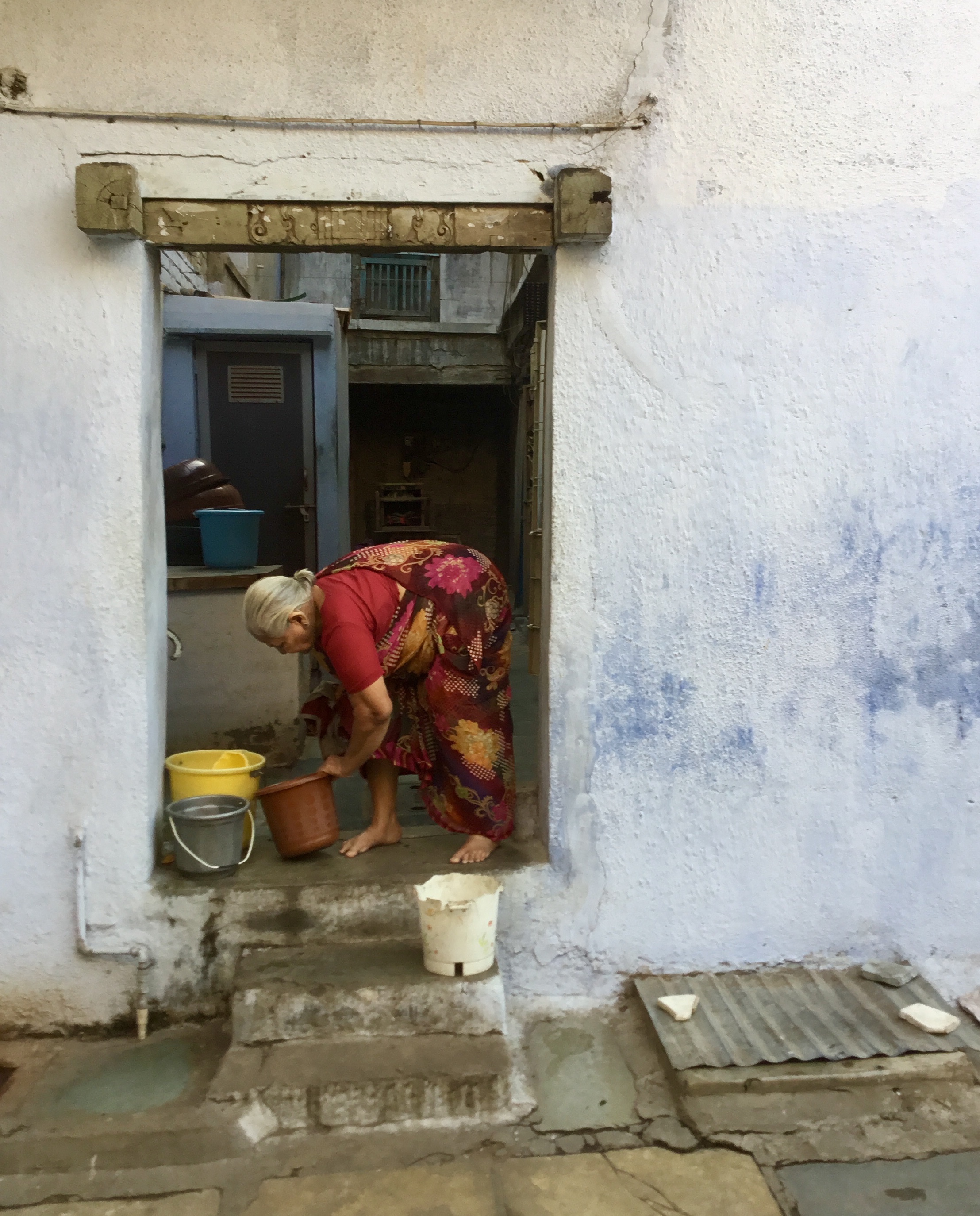
Ahmedabad, India
* an ongoing series of quotations – mostly from artists, to artists – that offers wisdom, inspiration, and advice for the sometimes lonely road we are on.
The important thing is the intersection between intuition and discipline, because you have to be alert and at the same time invisible. The eye has to be alert and capture very quickly everything you have inside you – I don’t know how to explain it. What the eye sees is the synthesis of what you are or what you’ve learned to do, this is the language of photography…
Graciela Iturbide in Eyes to Fly With: Portraits, Self-Portraits, and Other Photographs
Comments are welcome!
Pearls from artists* # 150

Tile worker, South India
* an ongoing series of quotations – mostly from artists, to artists – that offers wisdom, inspiration, and advice for the sometimes lonely road we are on.
You wait for your eye to sort of “turn on,” for the elements to fall into place and that ineffable rush to occur, a feeling of exultation when you look through that ground glass, counting ever so slowly, clenching teeth and whispering to Jessie to holdstillholdstillholdstill and just knowing that it will be good, that it is true. Like the one true sentence that Hemingway writes about in A Moveable Feast, that incubating purity and grace that happens, sometimes, when all the parts come together.
And these pictures have come quickly, in a rush… like some urgent bodily demand. They have been obvious, they have been right there to be taken, almost like celestial gifts.
Sally Mann in Hold Still: A Memoir with Photographs
Comments are welcome!


 barbararachkoscoloreddust.com