Blog Archives
Q: How do you think your recent trip to Bolivia will affect your work?
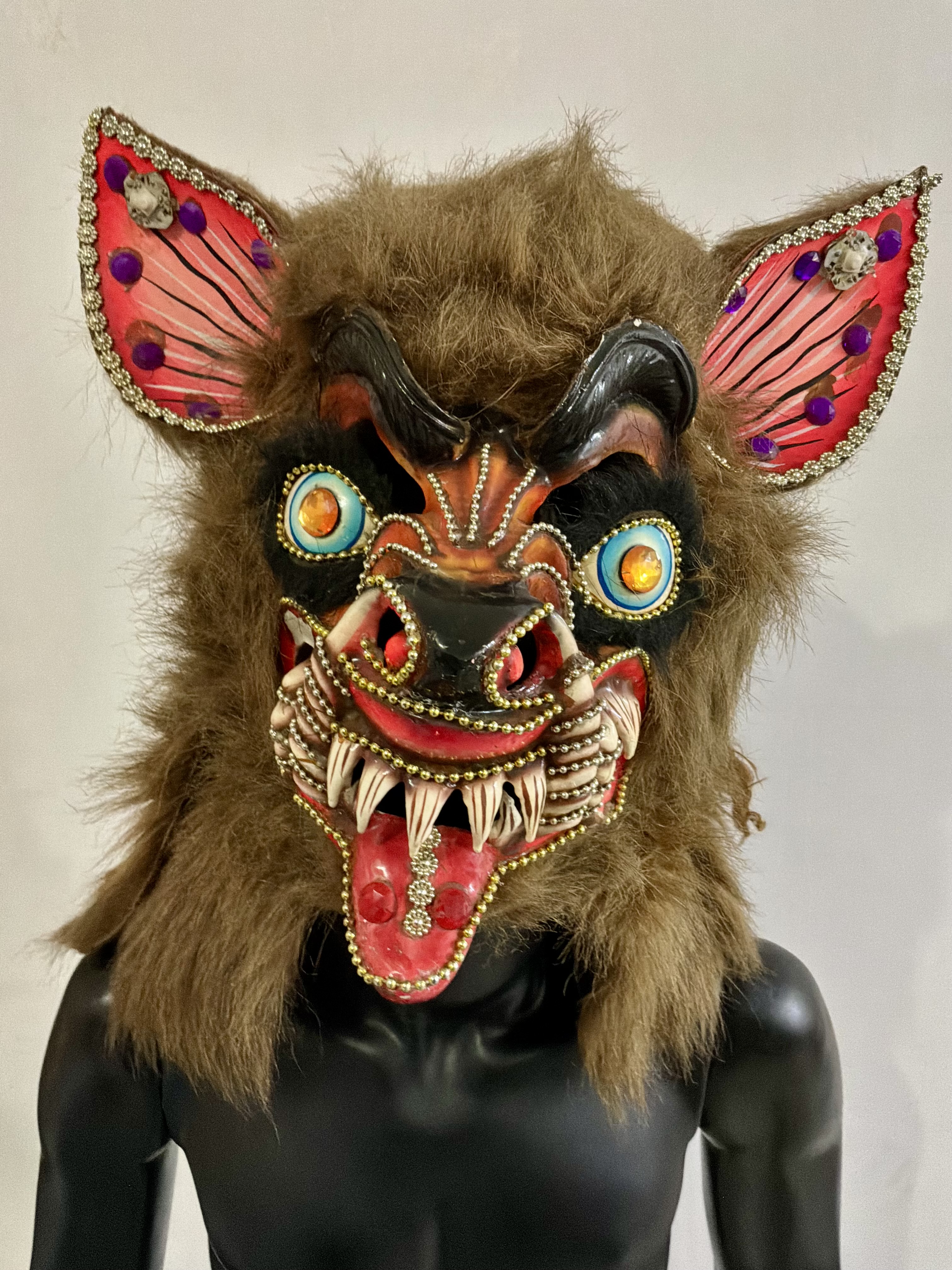
Reference photo from my trip to Bolivia
A: I have been back in the United States for one month and I know from past trips that there is always a long gestation period as I reflect on colorful new experiences, new sights, sounds, etc. My three and a half-weeks in Bolivia were non-stop, intense, and just full of so many high points. Bolivia is a fascinating country with profound cultural riches, and exceptionally warm and welcoming people. I experienced new friendships and events that were way beyond anything I could have imagined. In short, there’s a lot to process!
In the immediate aftermath, back in the studio I am deliberately selecting more vibrant colors and bumping up the contrast and drama in the painting on my easel (“Gatecrasher”) as I attempt to reflect some of what I saw and experienced in Oruro during Carnaval. I have begun to plan a pastel painting based on the mask pictured above, which I photographed in La Paz. We shall see what new work is created over the coming months and years. For now, it’s exciting to be reenergized and to have new subject matter with which to work. And, at this early date, I can barely conceive what our new Bolivia documentary will be like!
Comments are welcome!
Pearls from artists* # 680

“Sacrificial” (on the wall) and “Trickster” (on the floor)
*an ongoing series of quotations – mostly from artists, to artists – that offers wisdom, inspiration, and advice for the sometimes lonely road we are on.
What makes a work transcendent and powerful is a personal intensity, an ‘extra’ quality. Yet that intensity is exclusive to each artist: extra strangeness, subtlety, causticity, bravado, sensuality, rawness, grandiosity, succinctness, mystery, vulnerability, truth, etc. For an individual artist to infuse an object or an experience with their own ‘extra’ quality requires not only skill or ideas, but the profound benevolence of consistently delivering in spades.
It is this passion and genuine feeling, specific to each creator, that lives on in the art as a gift. It is wrapped up in the work, forever suspended in time. The artist says,
Here… everything I possessed in this moment is embodied in this object… All skills I have painstakingly learned, all of the knowledge I possess, the joy and pain I have felt and all the experiences I have lived. I spun these into the perfect, most sublime form, and packed it up, but for you to unwrap anytime you need sustenance. It will nourish, comfort, and surround you, because you have chosen it.
Each viewer selects which works of art speak to them… which embodied feelings, concepts, and knowledge they value. An empathic connection is forged through the art object or experience. What is love, but to say to someone, ‘you are truly seen and understood?’ Art offers this as well, by reaching out to puncture through the membrane of our emotional isolation, to articulate how we feel in the moments when we cannot find words. It tells the artist and viewer alike, ‘You are not alone. You are not alone in how your brain works. You are not alone in the pain you feel. You are not alone in what you notice or appreciate, or in how much love you have to give.’
Pour that love into an art object. It can handle all the devotion you pack into it, and more.
Kate Kretz in Art From Your Core: A Holistic Guide to Visual Voice
Comments are welcome!
Pearls from artists* # 650

Some of Barbara’s Mexican and Guatemalan folk art collection
*an ongoing series of quotations – mostly from artists, to artists – that offers wisdom, inspiration, and advice for the sometimes lonely road we are on.
Art objects are not just gifts for the viewer: they can hold profound, even mystical, revelations for the maker. When actualizing work that comes from your core, one of the greatest sources of pleasure is the recording of your art life journey, with the serendipitous connections, the seminal players, and meaningful symbols that return again and again. Art is an unconscious language that knows more about you than you know about yourself.
Kate Kretz in Art From Your Core: A Holistic Guide to Visual Voice
Comments are welcome!
Pearls from artists* # 641

In the Studio
*an ongoing series of quotations – mostly from artists, to artists – that offers wisdom, inspiration, and advice for the sometimes lonely road we are on.
Artistic voice is the most critical aspect of creative practice, yet it is rarely taught…
Some schools teach ‘ideation’ (conceptualizing a work or series), but that is very different from cultivating an essential core that is uniquely your own. Ideation is a Band-Aid to get you through your next few projects, while voice is a consistent, profound, and idiosyncratic wellspring that you own. It is born of your singular fascinations, obsessions, and life experiences, both weighty and mundane. If you make the effort to build and consistently replenish it, this well will deepen, yielding creative riches over the course of your entire life. Cultivating visual voice needs to be a cornerstone of art education, not an afterthought.
Kate Kretz in Art From Your Core: A Holistic Guide to Visual Voice
Comments are welcome!
Pearls from artists* # 590

Barbara’s Studio: when you fall in love with pastel!
*an ongoing series of quotations – mostly from artists, to artists – that offers wisdom, inspiration, and advice for the sometimes lonely road we are on.
We see again and again in the lives of special artists a profound youthful infatuation with their medium, with everything and anything connected with it – the good, the bad, the indifferent. If books have mesmerized them, they will read everything; if painting, they will frequent every gallery, running to every visiting show. They may have no idea that they are about to devote their life to that medium; they simply fell in love. The actor Len Cariou said:
“I didn’t have any thoughts about being an actor. I always was an actor. I’d go to films every Saturday. I had an insatiable appetite for films. You could see four films and a serial for half a buck. In 1959 when I read an ad in the local paper, ‘Young actors wanted for summer stock,’ all of a sudden I knew; there was a crunch in my head.”
… The artist is transported by his medium, is delighted and astonished. That his medium is able to speak to him in this way is almost a proof of the existence of god, or at least a special affirmation in the realm of the spirit.
Eric Maisel in A Life in the Arts: Practical Guidance and Inspiration for Creative and Performing Artists
Comments are welcome!
Pearls from artists* #561

*an ongoing series of quotations – mostly from artists, to artists – that offers wisdom, inspiration, and advice for the sometimes lonely road we are on.
The most powerful symbols draw profound reactions from us. The symbolic images in great art attract and fascinate us; they stir our souls and move us beyond what can be easily expressed; ‘their pregnant language cries out to us that they mean more than they say.’
The unconscious produces symbols as part of a natural process within us. These images emerge out of the context of our lived experience… Jung saw the meaning-making process as one that not only requires attendance to the real context of our lives and history, but also involves profound inner listening. It asks us to use our rational capacities, but also our feeling and imaginal ones.
Symbolic images redirect our psychic energy, bringing together conscious and unconscious material and producing the lessening of conflict. In this way, they activate a transcendent function within the psyche. We experience this as the discovery of personal meaning and healing. This transformation is not the result of formulaic operations, but rather is a dynamic process that requires our authentic and vulnerable participation. The process challenges the whole of who we are and requires deep moral effort. That the unconscious would produce moving, powerful compensatory symbols inside us at all points to a fact that our culture may not have fully grasped – that there is a force working within us which is always driving us towards healing growth and greater consciousness… Despite our suffering, the psyche is always ultimately seeking both a healthy homeostatic balance and our ever-unfolding growth and unique development.
Gary Bobroff in Carl Jung: Knowledge in a Nutshell
Comments are welcome!
Q; What was the spark that got you started? (Question from Barbara Smith via Facebook)

A: If I had to select one factor, I would say, profound unhappiness with my professional life. In 1986 I was a 33-year-old Navy Lieutenant working as a computer analyst at the Pentagon. I hated my job, was utterly miserable, and moreover, I was trapped because unlike many jobs, it’s not possible to resign a Naval commission with two weeks notice.
My bachelor’s degree had been in psychology. When I was in my 20s and before I joined the Navy, I had spent two years and my own money training to become a licensed commercial pilot and Boeing-727 Flight Engineer. I had planned to become an airline pilot, but due to bad timing (airlines were not hiring pilots when I was looking for a job), that did not come to pass.
So there I was with absolutely no interest, nor any training in computers, working for the Joint Chiefs of Staff, and completely bored. I knew I must have taken a wrong turn somewhere and resolved to make a significant change. Searching around, I discovered a local art school, the Art League School in Alexandria, VA, and began taking drawing classes.
One drawing class lead to more. Within a couple of years, due to being highly motivated to change my life, my technical skills rapidly improved. Even then, I believe, it was obvious to anyone who knew me that I had found my calling. I resigned my active duty Naval commission and have been a fulltime professional artist since October 1989. (Note: For fourteen more years I remained in the Naval Reserve working, mostly at the Pentagon, one weekend a month and two weeks each year, and retired as a Navy Commander in 2003).
Life as a self-employed professional artist is endlessly varied, fulfilling, and interesting. I have never once regretted my decision to pursue art fulltime!
Comments are welcome!
Pearls from artists* # 416

“Acolytes,” soft pastel on sandpaper, 38″ x 58″
* an ongoing series of quotations – mostly from artists, to artists – that offers wisdom, inspiration, and advice for the sometimes lonely road we are on.
The young man was experiencing that profound emotion which has stirred the hearts of all great artists when, in the prime of youth and their love of art, they approach a man of genius or stand in the presence of a masterpiece. There is a first bloom in all human feelings, the result of a noble enthusiasm which gradually fades till happiness is no more than a memory, glory a lie. Among such fragile sentiments, none so resembles love as the youthful passion of an artist first suffering that initial delicious torture which will be his destiny of glory and woe, a passion brimming with boldness and fear, vague hopes and inevitable frustrations. The youth who, short of cash but long of talent, fails to tremble upon first encountering a master, must always lack at least one heartstring, some sensitivity in his brushstroke, a certain poetic expressiveness. There may be concerned boasters prematurely convinced that the future is theirs, but only fools believe them. In this regard, the young stranger seemed to possess true merit, if talent is to be measured by that initial shyness and that indefinable humility which a man destined for glory is likely to lose in the exercise of his art, as a pretty woman loses hers in the stratagems of coquetry. The habit of triumph diminishes doubt, and humility may be a kind of doubt.
Honore Balzac in The Unknown Masterpiece
Comments are welcome!
Pearls from artists* # 377
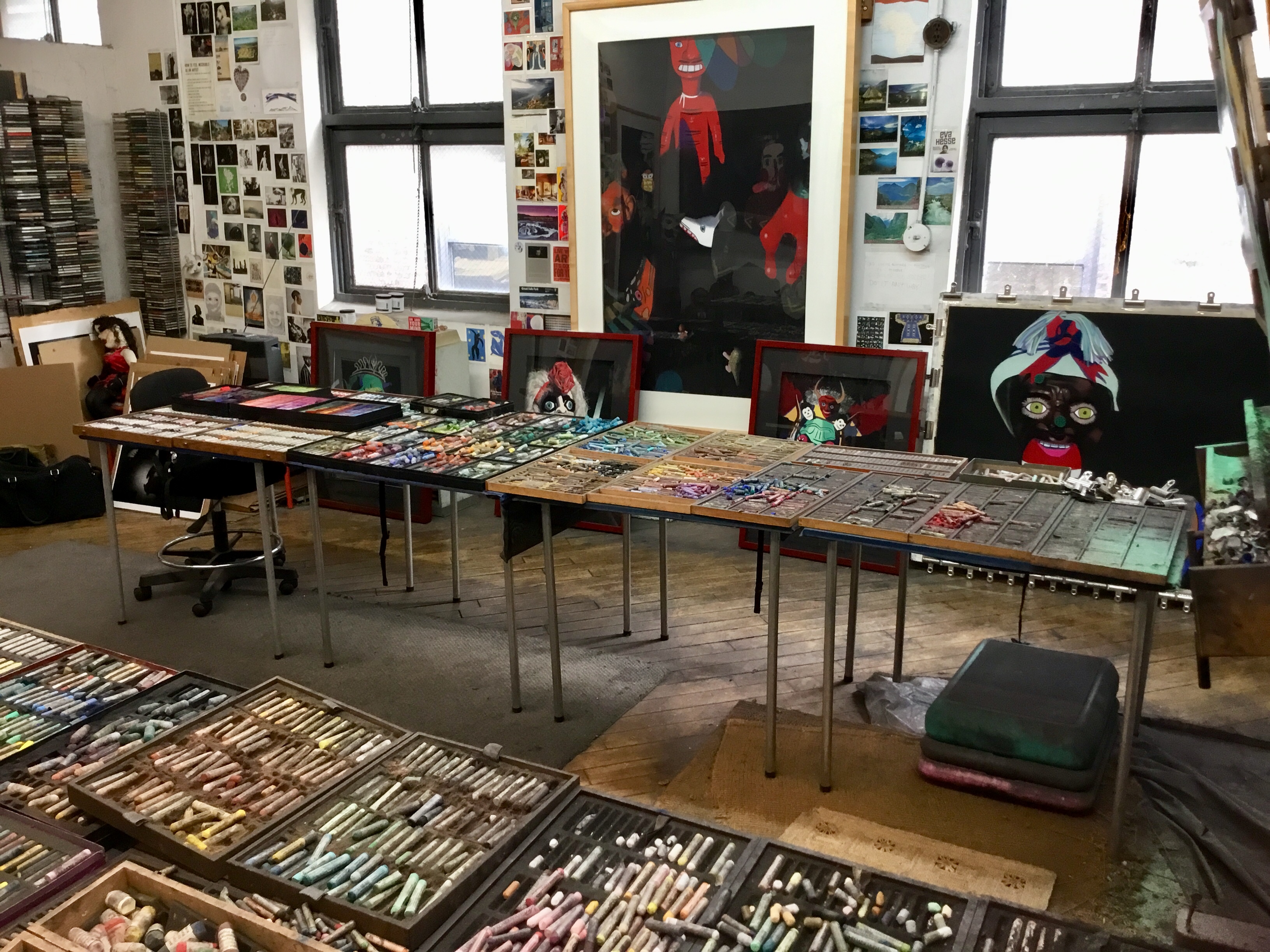
Barbara’s studio
* an ongoing series of quotations – mostly from artists, to artists – that offers wisdom, inspiration, and advice for the sometimes lonely road we are on.
Life for an artist, any artist, was difficult. There were few rewards other than the most important, which was satisfying one’s need to create. But in the art world of galleries, collections, and museums that the avant-garde artists in New York would inherit in the late 1940s, the difficulties experienced by the men who painted and sculpted would be nothing compared to those of the women. Society might mock the men’s work and disparage them for being “bums,” but at least they were awarded the dignity of ridicule. Women had to fight with every fiber of their being not to be completely ignored. In a treatise on men and women in America published at the start of the war, author Pearl S. Buck wrote,
The talented woman… must have, besides their talent, an unusual energy which drives them… to exercise their own powers. Like talented men, they are single-minded creatures, and they can’t sink into idleness nor fritter away life and time, nor endure discontent. They possess that rarest gift, integrity of purpose… Such women sacrifice, without knowing they do, what many other women hold dear – amusement, society, play of one kind or another – to choose solitude and profound thinking and feeling, and at last final expression.
“To what end?” another woman might ask. To the end, perhaps… of art – art which has lifted us out of mental and spiritual savagery.”
Mary Gabriel in Ninth Street Women
Comments are welcome!
Q: I especially enjoy your “Black Paintings” series. You mention being influenced by the story of how Miles Davis developed cool jazz, making this work uniquely American all around. How did you use jazz history in this series?

“Between,” soft pastel on sandpaper, 20″ x 26″
A: In 2007 I finished the Domestic Threats series and was blocked, certain that a strong body of work was behind me. But what would come next?
The idea for the Black Paintings began when I attended a jazz history course at Lincoln Center and learned how Miles Davis developed cool jazz from bebop. In bebop the notes were played hard and fast as musicians showcased their musical virtuosity. Cool jazz was a much more relaxed style with fewer notes being played. In other words, the music was pared down to its essentials. Similarly, the Black Paintings evolved from dense, intricate compositions into paintings that depicted only the essential elements. As the series evolved, what was left out became more important, resulting in more demands being placed on the viewer.
Eventually, after much reflection, I had an epiphany and my painful creative block ended. “Between,” with drastically simplified imagery, was the first in a new series called Black Paintings. I like to think this series includes work that is richer and more profound than the previous Domestic Threats.
Comments are welcome!


 barbararachkoscoloreddust.com