Blog Archives
Pearls from artists* # 562

“Shadow,” soft pastel on sandpaper, 26” x 20,” in progress
*an ongoing series of quotations – mostly from artists, to artists – that offers wisdom, inspiration, and advice for the sometimes lonely road we are on.
Jung observed that complexes could affect groups of people en masse. He saw that certain moments seemed to be expressions of a collective shadow, a bursting forth of a mass psychosis; the repressed side of a whole group coming alive; a tribal Mr. Hyde. He saw this madness first-hand in Germany in the 1930s and wrote about it. But every era carries some measure of collective shadow.
One could argue that no moment in time has seen more of the reality of human darkness than ours. Having witnessed the Holocaust and faced the threat of nuclear war in the twentieth century, and now facing the environmental impact of fossil fuels and plastics in the twenty-first century, we are undoubtedly aware of more of humanity’s potential for destruction than any of our ancestors ever were. Such a view does not come from a moralizing stance. Our era has made forced witnesses of us all.
The shadow is about where we put the Devil – where do we allow darkness to be housed? Racism and bigotry offer the relief of foisting our group’s shadow onto another whom we view as lesser. Doing so enables us not to look at or feel our shadow, and not see our own worst selves. But this collective shadow of our modern culture is also bigger and wider than group-to-group projections. There are culture-wide or civilization expressions of the collective shadow.
Jung saw the widespread loss of connection to the inner life and to a lived spirituality as one of the primary illnesses of our time. He observed that people were no longer animated by the traditional religions… For Jung, this meant that we’ve lost the old way but not yet found the new, and are sitting in a spiritual vacuum.
Into that vacuum, without our awareness, has slipped our fascination with human technology. Observe people closely today and you’ll notice that we have an almost magical faith in our devices. People see their computers and phones as all-knowing and expect them to function perfectly all the time, and view pharmaceuticals as magic cure-alls. Where we used to put God, we now have put technology. Where spirit was, we have unconsciously placed human genius.
Gary Bobroff in Carl Jung: Knowledge in a Nutshell
Comments are welcome!
Pearls from artists* # 450

*an ongoing series of quotations – mostly from artists, to artists – that offers wisdom, inspiration, and advice for the sometimes lonely road we are on.
All the journeys that have transpired in my life have been animated by interest. Something or someone has stopped me in my tracks. Interest, that thing that cannot really be faked, is an invitation to adventure. It has always been disorienting to do but I have to act on these interests. Somehow I know that in order to keep on working as an artist, I have to keep on changing. And this means that when interest is piqued, I must follow or die. And I know that I will have to hang on tight for the ride. These rides have changed me irrevocably.
The primary tool in a creative process is interest. To be true to one’s interest, to pursue it successfully, one’s body is the best barometer. The heart races. The pulse soars. Interest can be your guide. It always points you in the right direction. It defines the quality, energy and content of your work. You cannot feign or fake interest or choose to be interested in something because it is prescribed. It is never prescribed. It is discovered. When you sense this quickening you must act immediately. You must follow that interest and hold tight.
… If the interest is genuine and large enough and if it is pursued with tenacity and generosity, the boomerang effect is resounding. Interest returns volley to affect your life and inevitably alter it. You must be available and attentive to the doors that open unexpectedly. You cannot wait. The doors close fast. It will change your life. It will give you adventures you never expected. You must be true to it and it will be true to you.
Anne Bogart in A Director Prepares: Seven Essays on Art and Theatre
Comments are welcome!
Q: Would you say there is a unifying quality to all of the work you have produced in the last thirty years?
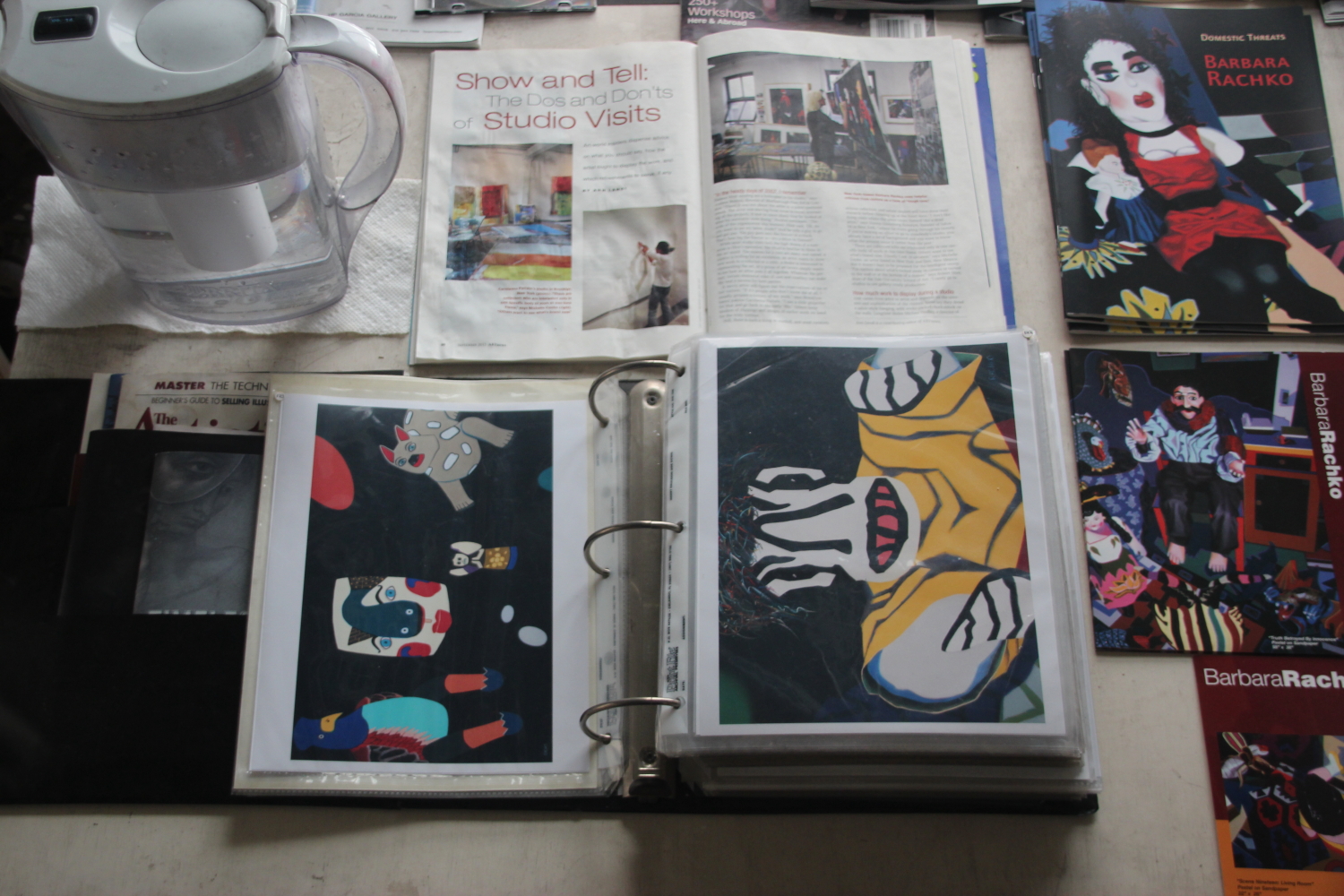
Barbara’s portfolio book
A: Yes, I can think of several. Whether making pastel paintings or printing photographs in the darkroom, I have always been concerned with quality and craftsmanship and never pronounce a work finished until it is the best thing I can make.
Although I started out as a maker of photorealist portraits in pastel, for twenty-odd years I have worked with Mexican folk art as my primary subject matter, treating these objects very differently in three separate series: “Black Paintings,” “Domestic Threats,” and “Gods and Monsters.” The first two are pastel-on-sandpaper paintings while the last is comprised of chromogenic photographs (c-prints). A few years ago I also started making “Teleidoscopes” using an iPad app to photograph my Mexican and Guatemalan folk art collection. This last one is just for fun; I do not offer them for sale.
Soft pastel is my first love and the two series of pastel paintings are my best-known work. My technique for using pastel continues to evolve in intriguing ways. I doubt I can ever learn all there is to know not only about color, but also about this medium. Pastel is endlessly fascinating, which is why I have never wanted to switch to anything else.
Comments are welcome!
Q: What does your creative process look like when you are ready to begin a new painting?

Preliminary sketch
A: My working methods have changed dramatically over the years with my current process being a much-simplified version of how I used to work. In other words as I pared down my imagery in the “Black Paintings,” my process quite naturally pared down, too.
One constant is that I have always worked in series with each pastel painting leading quite logically to the next. Another is that I always have set up a scene, lit and photographed it, and worked with a 20″ x 24″ photograph as the primary reference material. In the “Domestic Threats” series I shot with a 4″ x 5″ view camera. Nowadays the first step is to decide which photo I want to make into a painting (currently I have a backlog of images to choose from) and to order a 19 1/2″ x 19 1/2″ image (my Mamiya 6 shoots square images and uses film) printed on 20″ x 24″ paper. I get the print made at Manhattan Photo on West 20th Street in New York. Typically I have in mind the next two or three paintings that I want to create.
Once I have the reference photograph in hand, I make a preliminary tonal charcoal sketch on a piece of white drawing paper. The sketch helps me think about how to proceed and points out potential problem areas ahead. For example, in the photograph above I had originally thought about creating a vertical painting, but changed to horizontal format after discovering spatial problems in my sketch.
Also, I decided to make a small painting now because it has been two years since I last worked in a smaller (than my usual 38″ x 58″) size. I am re-using the photograph on which “Epiphany” is based. Using a photograph a second time lets me see how my working methods have evolved over time.
Comments are welcome!
Pearls from artists* # 73
Sri Lanka
* an ongoing series of quotations – mostly from artists, to artists – that offers wisdom, inspiration, and advice for the sometimes lonely road we are on.
The primary tool in a creative process is interest. To be true to one’s interest, to pursue it successfully, one’s body is the best barometer. The heart races. The pulse soars. Interest can be your guide. It always points you in the right direction. It defines the quality, energy, and content of your work. You cannot feign or fake interest or choose to be interested in something because it is prescribed. It is never prescribed. It is discovered. When you sense this quickening you must act immediately. You must follow that interest and hold on tight.
Anne Bogart in A Director Prepares: Seven Essays on Art and Theater
Comments are welcome!
Q: Why do you create?
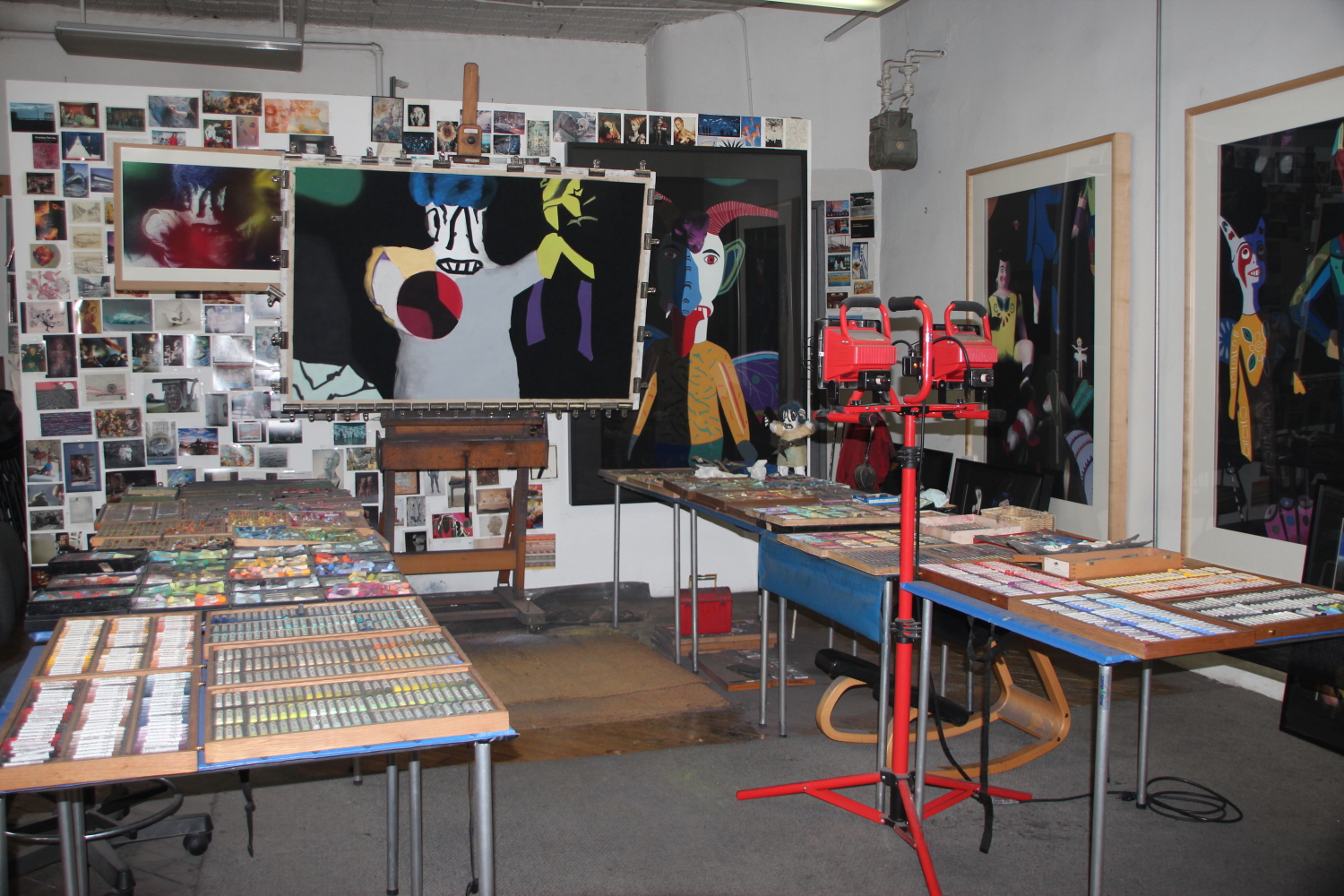
West 29th Street studio
A: There are many answers to that question and my responses vary according to how things are going in the studio. Just now these three are most compelling:
~ to create bold and vibrant pastel paintings and photographs that have never existed before
~ to continue to push my primary medium – soft pastel on sandpaper – as far as I can and to use it in more innovative ways
~ to create opportunities for artistic dialogue with people who understand and value the work to which I am devoting my life
The last has always been the toughest. I sometimes think of myself as Sisyphus because expanding the audience for my art is an ongoing uphill battle. Many artist friends tell me they feel the same way about building their audience. It’s one of the most difficult tasks that we have to do as artists.
Comments are welcome!
Q: What is it about soft pastel that you find so intriguing that you use it as your primary fine art medium?

Some of Barbara’s pastels
A: For starters it’s the medium that I fell in love with many years ago. I recently read this article online, “What is Pastel?” by Mike Mahon, and will quote it because it neatly sums up what I love about working with pastel.
Pastel is the most permanent of all media when applied to conservation ground and properly framed. Pastel has no liquid binder that may cause it to oxidize with the passage of time as oftentimes happens with other media.
In this instance, Pastel does not refer to pale colors, as the word is commonly used in cosmetic and fashion terminology. The pure, powdered pigment is ground into a paste with a minimum amount of gum binder, rolled into sticks and dried. The infinite variety of colors in the Pastel palette range from soft and subtle to hard and brilliant.
An artwork is created by stroking the stick of dry pigment across an abrasive ground, embedding the color in the “tooth” of the ground. If the ground is completely covered with Pastel, the work is considered a Pastel painting; whereas, leaving much of the ground exposed produces a Pastel sketch. Techniques vary with individual artists. The Pastel medium is favored by many artists because it allows a spontaneous approach. There is no drying time, therefore, no change in color occurs after drying as it does in other media.
Did you know that a particle of Pastel pigment seen under a microscope looks like a diamond with many facets? It does! Therefore, Pastel paintings reflect light like a prism. No other medium has the same power of color or stability.
Historically, Pastel can be traced back to the 16th century. Its invention is attributed to the German painter, Johann Thiele. A Venetian woman, Rosalba Camera, was the first to make consistent use of Pastel. Chardin did portraits with an open stroke, while La Tour preferred the blended finish. Thereafter, a galaxy of famous artists—Watteau, Copley, Delacroix, Millet, Manet, Renoir, Toulouse Lautrec, Vuillard, Bonnard, Glackens, Whistler, Hassam, William Merritt Chase—used Pastel for a finished work rather than for preliminary sketches.
Pastels from the 16th century exist today, as fresh as the day they were painted. Edgar Degas was the most prolific user of Pastel and its champion. His protégé, Mary Cassat, introduced Pastel to her friends in Philadelphia and Washington, and thus to the United States. In the Spring of 1983, Sotheby Parke Bernet sold at auction, two Degas Pastels for more than $3,000,000 each! Both Pastels were painted about 1880.
Note: Do not confuse Pastel with “colored chalk.” Chalk is a porous, limestone substance impregnated with dyes, whereas, Pastel is pure pigment—the same as is used in other permanent painting media.
Today, Pastel paintings have the stature of oil and watercolor as a major fine art medium. Many of our most renowned, living artists have distinguished themselves in Pastel and have enriched the art world with this beautiful medium.
So knowing all this, I often wonder, why don’t more artists use pastel? Is it because framing is a big issue? Works on paper need to be framed and pastel paintings have unique problems (see my April 27, 2013 blog post). Second only to the cost of maintaining a studio in New York City, frames are my single largest business expense. Sometimes I am grateful that pastel is a very slow medium. I typically finish 4 or 5 paintings in a year, which means I only have to pay for 4 or 5 frames!
Comments are welcome!
Pearls from artists* # 32
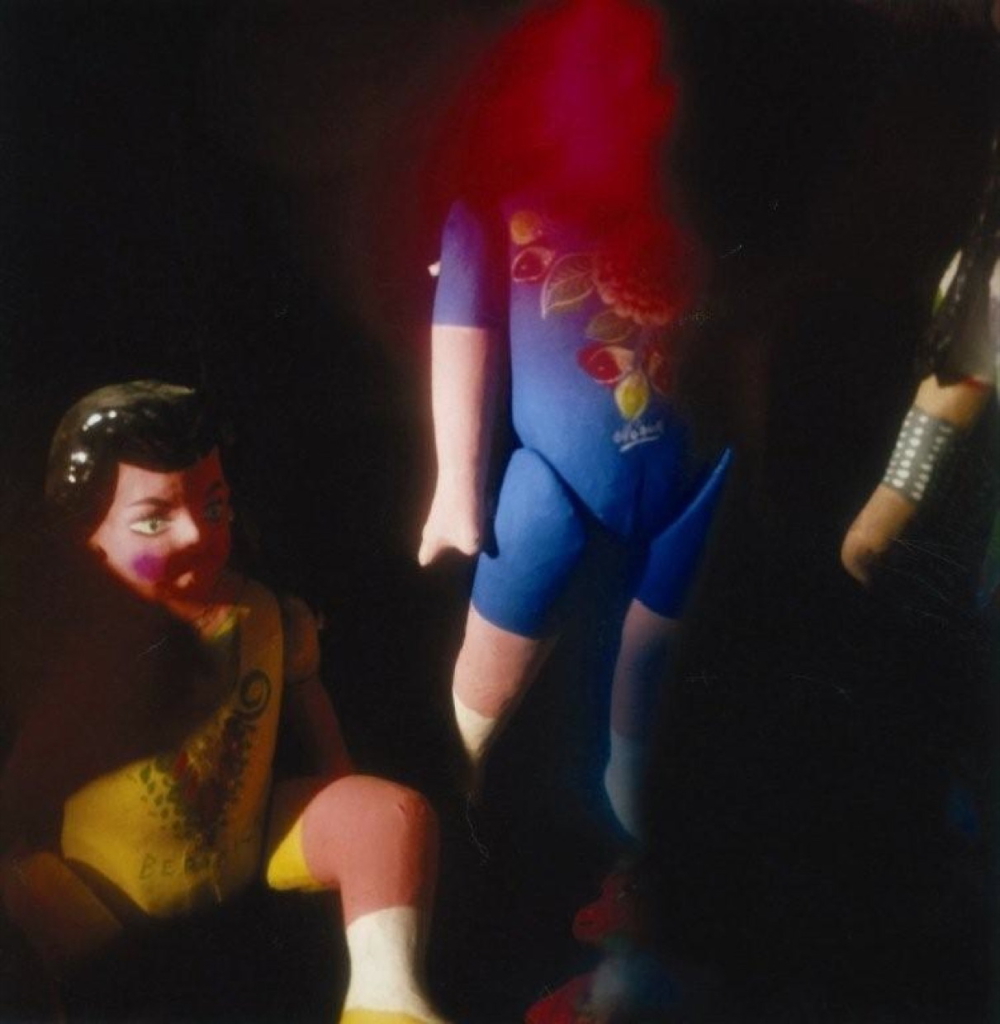
Untitled, 24″ x 24″ chromogenic print, edition of 5
* an ongoing series of quotations – mostly from artists, to artists – that offers wisdom, inspiration, and advice for the sometimes lonely road we are on.
We most certainly need to test ourselves against the most extreme possibilities, just as we are probably obligated not to express, share, and impart the most extreme possibility before it has entered the work of art. As something unique that no other person would and should understand, as one’s personal madness, so to speak, it has to enter into the work to attain its validity and to reveal there an internal law, like primary patterns that become visible only in the transparency of artistic creation. There exist nonetheless two freedoms to express oneself that seem to me the ultimate possibilities: one in the presence of the created object, and the other within one’s actual daily life where one can show another person what one has become through work, and where one may in this way mutually support and help and (here understood humbly) admire one another. In either case, however, it is necessary to show results, and it is neither lack of confidence nor lack of intimacy nor a gesture of exclusion if on does not reveal the tools of one’s personal becoming that are marked by so many confusing and tortuous traits, which are valid only for one’s own use.
Ulrich Baer, editor, The Wisdom of Rilke
Comments are welcome!


 barbararachkoscoloreddust.com