Blog Archives
Q: Do you have a daily artistic practice?

Studio entrance
A: In one way or another I suppose I do. Of course, I don’t go to the studio six days a week like I used to, but I generally work five days, about seven to eight hours per day. When I am not actually in the studio working at my easel, I try to make use of my time in ways that, hopefully, will make me a better artist. I am usually reading, studying, looking at art, talking to friends who are artists, thinking about my creative practice, etc. Art and everything related to it are naturally the focus of my life.
Comments are welcome!
Q: What’s on the easel today?

Work in progress
A: I am in the early stages – only 3 or 4 layers of pastel applied so far – on a large pastel painting with the working title, “He and She.” The figures are two favorites – a four-foot tall male and female couple, made of carved wood and silver and gold-leaf. I found them years ago at Galerie Eugenio in Mexico City.
These are the largest heads I have ever painted. As I work on this piece I remember one of my teachers saying, “Never paint a head larger than life-size.” Well, here’s to breaking rules.
For reference I am looking at a digital photograph shot with my Canon T3i. My usual practice is to make a c-print from a negative made with my Mamiya 6, but the photo clipped to my easel above is from a high resolution JPEG. Typically I set up a scene at home on a black cloth and photograph it, but my reference photo was taken in my studio without rearranging anything. In this painting I am breaking a few rules, while my creative process is perhaps evolving towards greater simplicity.
Comments are welcome!
Pearls from artists* # 120
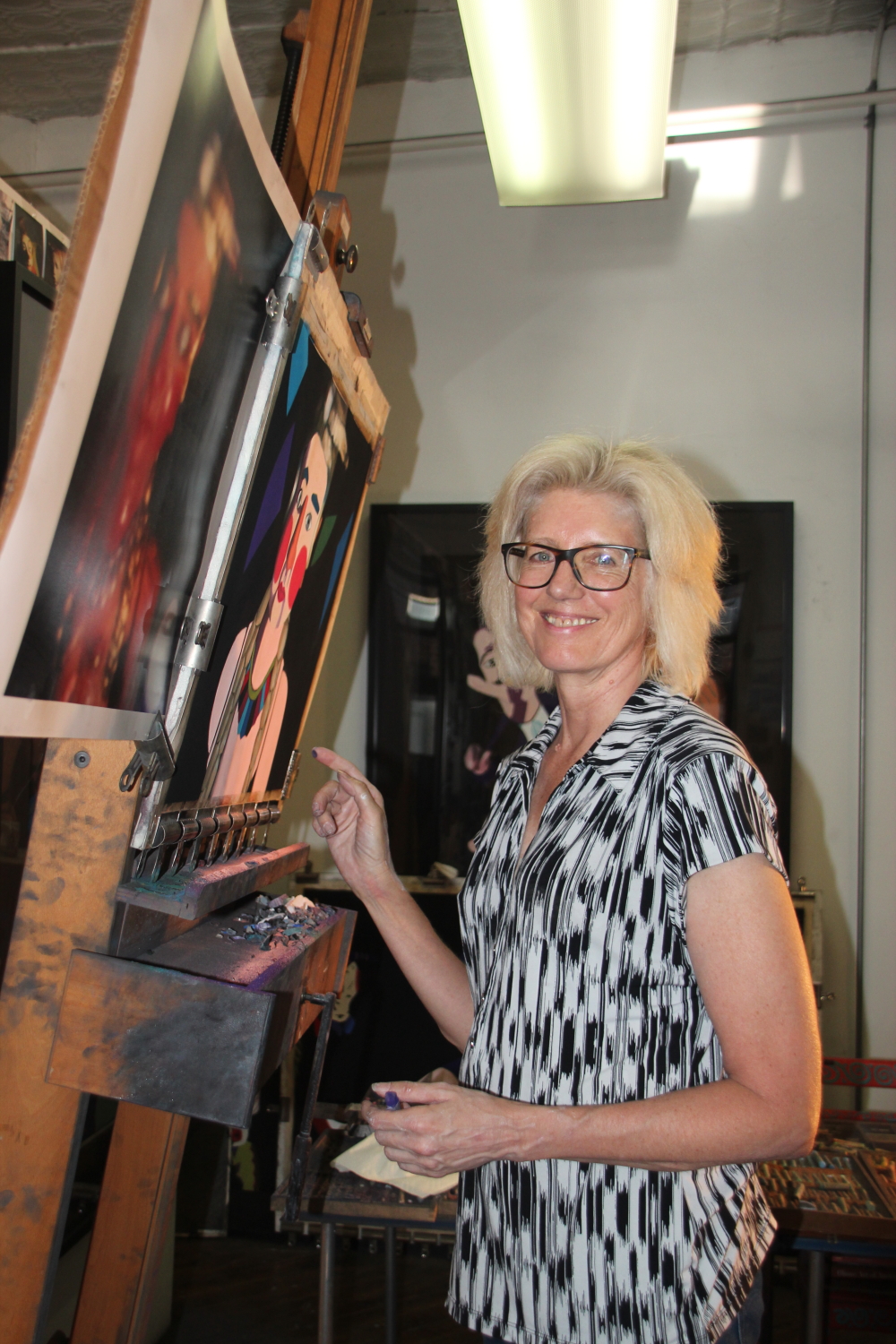
In the studio, Photo: Britta Konau
* an ongoing series of quotations – mostly from artists, to artists – that offers wisdom, inspiration, and advice for the sometimes lonely road we are on.
In solitude artists can experiment, make a mess, sustain notes for the joy of it, imagine themselves on any stage in any play. In the studio or practice room, they are not on display and need not wear their public face. They can be their silent selves, their worst selves. If there is unfreedom on the stage or in the gallery, there is freedom in the studio. As the visual artist Allen Kaprow put it, “Artists’ studios do not look like galleries, and when an artist’s studio does, everyone is suspicious.” Galleries are for show; studios are where messes are made and where the real work happens.
Eric Maisel in A Life in the Arts
Comments are welcome!
Pearls from artists* # 117
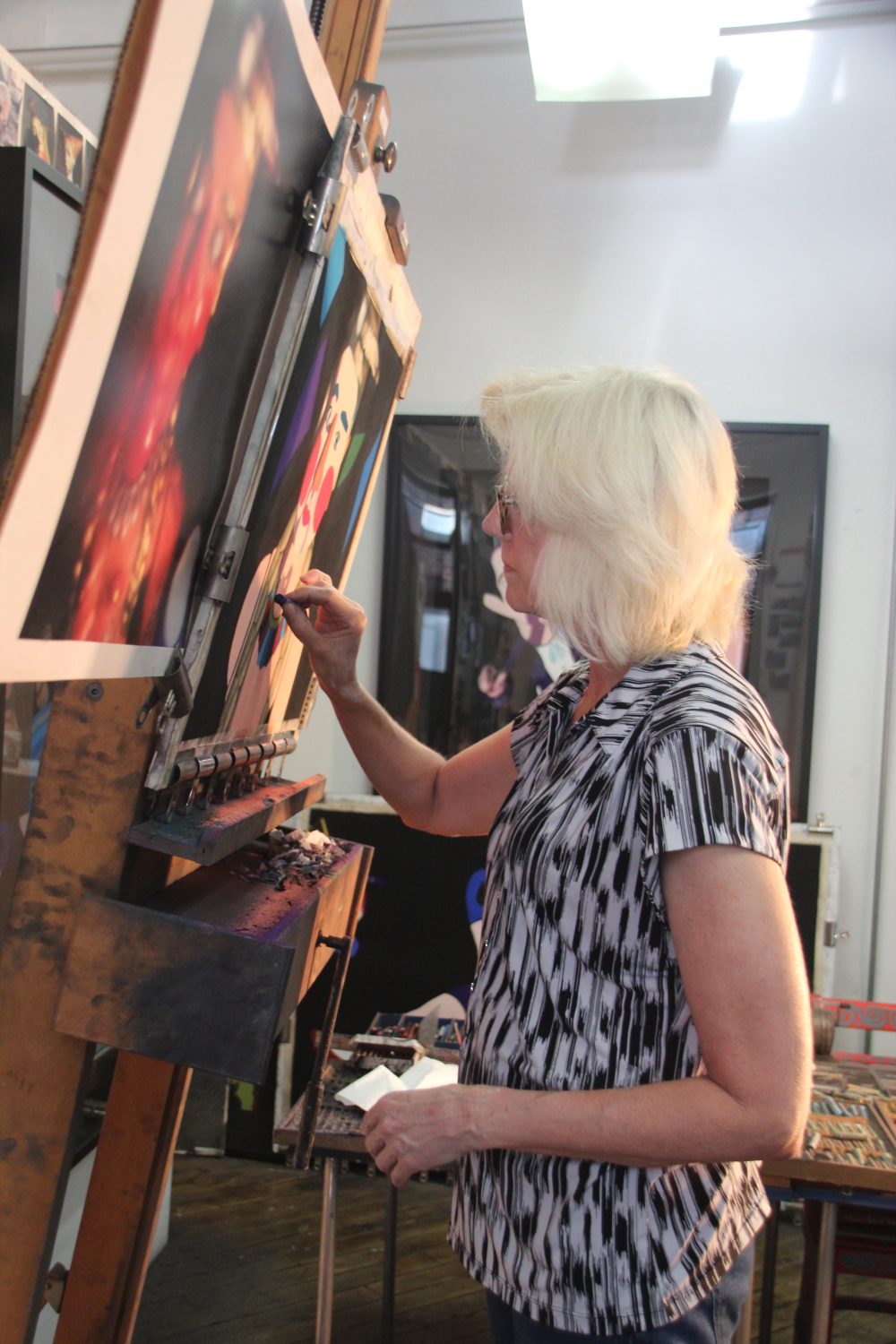
At work on a pastel painting
* an ongoing series of quotations – mostly from artists, to artists – that offers wisdom, inspiration, and advice for the sometimes lonely road we are on.
Rote practice is not deep practice. Deep practice is slow, demanding, and uncomfortable. To practice deeply is to live deliberately in a space that is uncomfortable but with the encouraging sense that progress can happen. Deep practice is not rushed. Constant critical feedback is essential. Over time the effort alters neural pathways and increases skill.
Anne Bogart in What’s the Story: Essays about art, theater, and storytelling
Comments are welcome!
Q: Can you talk a little bit about your process? What happens before you even begin a pastel painting?

Barbara in Bali (far right)
A: My process is extremely slow and labor-intensive.
First, there is foreign travel – often to Mexico, Guatemala or someplace in Asia – to find the cultural objects – masks, carved wooden animals, paper mâché figures, and toys – that are my subject matter. I search the local markets, bazaars, and mask shops for these folk art objects. I look for things that are old, that look like they have a history, and were probably used in religious festivals of some kind. Typically, they are colorful, one-of-a- kind objects that have lots of inherent personality. How they enter my life and how I get them back to my New York studio is an important part of my art-making practice.
My working methods have changed dramatically over the nearly thirty years that I have been an artist. My current process is a much simplified version of how I used to work. As I pared down my imagery in the current series, “Black Paintings,” my creative process quite naturally pared down, too.
One constant is that I have always worked in series with each pastel painting leading quite naturally to the next. Another is that I always set up a scene, plan exactly how to light and photograph it, and work with a 20″ x 24″ photograph as the primary reference material.
In the setups I look for eye-catching compositions and interesting colors, patterns, and shadows. Sometimes I make up a story about the interaction that is occurring between the “actors,” as I call them.
In the “Domestic Threats” series I photographed the scene with a 4″ x 5″ Toyo Omega view camera. In my “Gods and Monsters” series I shot rolls of 220 film using a Mamiya 6. I still like to use an old analog camera for fine art work, although I have been rethinking this practice.
Nowadays the first step is to decide which photo I want to make into a painting (currently I have a backlog of photographs to choose from) and to order a 19 1/2″ x 19 1/2″ image (my Mamiya 6 shoots square images) printed on 20″ x 24″ paper. They recently closed, but I used to have the prints made at Manhattan Photo on West 20th Street in New York. Now I go to Duggal. Typically I have in mind the next two or three paintings that I want to create.
Once I have the reference photograph in hand, I make a preliminary tonal charcoal sketch on a piece of white drawing paper. The sketch helps me think about how to proceed and points out potential problem areas ahead.
Only then am I ready to start actually making the painting.
Comments are welcome!
Pearls from artists* # 106

Road delay, Arizona
* an ongoing series of quotations – mostly from artists, to artists – that offers wisdom, inspiration, and advice for the sometimes lonely road we are on.
Yet even I, who track the hours closely, understand that one pleasure of art-making is its resolute inefficiency. It resists the sweep of the second hand; it is opposite to my daily muster of punch lists, telephone calls, day job requirements, family life, and errands. The necessary thought may come today or next week. Yet it’s not the same as leisure. The struggle toward the next thought is rigorous, held within an isometric tension. The poet Richard Wilbur writes about laundry drying on the line, “moving and staying like white water.” Moving and staying. Such water, familiar to anyone who has watched a brook rush over rocks, captures the way a creative practice insists you bear time. You must hold still and wait, and yet you must push forward.
Janna Malamud Smith in An Absorbing Errand: How Artists and Craftsmen Make Their Way to Mastery
Comments are welcome!
Pearls from artists* # 105

“Blind Faith,” 38″ x 58″, soft pastel on sandpaper
* an ongoing series of quotations – mostly from artists, to artists – that offers wisdom, inspiration, and advice for the sometimes lonely road we are on.
Serendipitously, I read two memoirs in close proximity, Julia Child’s account of her life in France and how she learned to be a first-rate cook, and Renee Fleming’s story of becoming a world-class opera diva. While there were many differences between the women and the skills they set out to master, I was struck in both books by how extraordinarily hard each one worked in private for years and years before going public, certainly before becoming famous, and how each managed shame. Both women loved what they did and thus brought to bear a similar, and I suspect key, willingness to stay with their efforts through eons of study, practice, and improvement. Both had the ability to hear criticism and to make corrections repeatedly without becoming terminally discouraged; to bear the anxiety of their efforts; neither was too proud to learn and keep learning. This willingness to be taught and corrected, without feeling ashamed, sometimes over and over again, is a huge asset when you are seeking to do something very well. And one way shame impedes people is by making them take criticism too personally – as about them rather than about what they’re trying to learn.
Janna Malamud Smith in An Absorbing Errand: How Artists and Craftsmen Make Their Way to Mastery
Comments are welcome!
Q: Please describe your artistic self in six words.

Alli’s backyard
A: Talking about myself I would say, “Seeker of color, light, and beauty;” on my creative journey, “Driven to communicate eloquently with less;” and concerning my artistic practice as a whole, “Excellence, authenticity, and integrity above everything.”
Comments are welcome!
Pearls from artists* # 12

Grand Falls, AZ
* an ongoing series of quotations – mostly from artists, to artists – that offers wisdom, inspiration, and advice for the sometimes lonely road we are on.
People who set their sails into art tend to work very hard. They train themselves in school; they practice and they read and they think and they talk. But for most of them there seems to be a more or less conscious cutoff point. It can be a point in time: “I will work until I am twenty-one (twenty-five, thirty, or forty).” Or a point in effort: “I will work three hours a day (or eight or ten).” Or a point in pleasure: “I will work unless…” and here the “enemies of promise” harry the result. These are personal decisions, more or less of individual will. They depend on the scale of values according to which artists organize their lives. Artists have a modicum of control. Their development is open-ended. As the pressure of their work demands more and more of them. they can stretch to meet it. They can be open to themselves, and as brave as they can be to see who they are, what their work is teaching them. This is never easy. Every step forward is a clearing through a thicket of reluctance and habit and natural indolence. And all the while they are at the mercy of events. They may have a crippling accident, or may find themselves yanked into a lifelong responsibility such as the necessity to support themselves and their families. Or a war may wipe out the cultural context on which they depend. Even the most fortunate have to adjust the demands of a personal obsession to the demands of daily life.
Anne Truitt, Daybook: The Journal of an Artist
Comments are welcome.


 barbararachkoscoloreddust.com
New eBook!
Jan 18
Posted by barbararachkoscoloreddust
Cover
I am pleased to announce that my first eBook, FROM PILOT TO PAINTER, is available now on Amazon!
It is based on my blog and is part memoir, including my personal loss on 9/11, insights into my creative practice, and intimate reflections on what it’s like to be an artist living in New York City now.
The eBook includes new material not found on the blog: 25+ reproductions of my vibrant pastel-on-sandpaper paintings, a Foreword by Ann Landi (who writes for ARTnews and The Wall Street Journal), and more.
Thank you for your support!
http://www.amazon.com/From-Pilot-Painter-Interview-Barbara-ebook/dp/B00HNVR200/ref=sr_1_1?ie=UTF8&qid=1389292390&sr=8-1&keywords=barbara+rachko
Note: If you do not own a Kindle, you can download a free Kindle app.
Here is the one for MACs:
http://www.amazon.com/gp/feature.html?docId=1000464931
Here is a link for the rest:
Kindle Cloud Reader – Read instantly in your browser
Smartphones – iPhone & iPod touch, Android, Windows Phone, BlackBerry
Computers – Mac, Windows 8, Windows 7, XP & Vista
Tablets – iPad, Android Tablet, Windows 8
http://www.amazon.com/gp/feature.html/ref=sv_kstore_3?ie=UTF8&docId=1000493771
Comments are welcome!
Share this:
Posted in 2014, An Artist's Life, Art in general, Art Works in Progress, Black Paintings, Creative Process, Domestic Threats, Gods and Monsters, Guatemala, Inspiration, Mexico, New York, NY, Painting in General, Pastel Painting, Photography, Quotes, Studio, Travel, Working methods
4 Comments
Tags: "From Pilot to Painter", "The Wall Street Journal", 9/11, Amazon, Ann Landi, announce, app, artist, ARTnews, available, blog, comments, cover, creative, easy, ebook, foreword, instructions, interview, intimate, Kindle, loss, material, memoir, New York City, paintings, pastel-on-sandpaper, personal, pleased, practice, reflections, reproductions, support, vibrant