Blog Archives
Q: What art project(s) are you working on currently? What is your inspiration or motivation for this? (Question from artamour)

A: While traveling in Bolivia in 2017, I visited a mask exhibition at the National Museum of Ethnography and Folklore in La Paz. The masks were presented against black walls, spot-lit, and looked eerily like 3D versions of my Black Paintings, the series I was working on at the time. I immediately knew I had stumbled upon a gift. To date I have completed seventeen pastel paintings in the Bolivianos series. One awaits finishing touches, another is in progress, and I am planning the next two, one large and one small pastel painting.
The following text is from my “Bolivianos” artist’s statement.
“My long-standing fascination with traditional masks took a leap forward in the spring of 2017 when I visited the National Museum of Ethnography and Folklore in La Paz, Bolivia. One particular exhibition on view, with more than fifty festival masks, was completely spell-binding.
The masks were old and had been crafted in Oruro, a former tin-mining center about 140 miles south of La Paz on the cold Altiplano (elevation 12,000’). Depicting important figures from Bolivian folklore traditions, the masks were created for use in Carnival celebrations that happen each year in late February or early March.
Carnival in Oruro revolves around three great dances. The dance of “The Incas” records the conquest and death of Atahualpa, the Inca emperor when the Spanish arrived in 1532. “The Morenada” dance was once assumed to represent black slaves who worked in the mines, but the truth is more complicated (and uncertain) since only mitayo Indians were permitted to do this work. The dance of “The Diablada” depicts Saint Michael fighting against Lucifer and the seven deadly sins. The latter were originally disguised in seven different masks derived from medieval Christian symbols and mostly devoid of pre-Columbian elements (except for totemic animals that became attached to Christianity after the Conquest). Typically, in these dances the cock represents Pride, the dog Envy, the pig Greed, the female devil Lust, etc.
The exhibition in La Paz was stunning and dramatic. Each mask was meticulously installed against a dark black wall and strategically spotlighted so that it became alive. The whole effect was uncanny. The masks looked like 3D versions of my “Black Paintings,” a pastel paintings series I have been creating for ten years. This experience was a gift… I could hardly believe my good fortune!
Knowing I was looking at the birth of a new series – I said as much to my companions as I remained behind while they explored other parts of the museum – I spent considerable time composing photographs. Consequently, I have enough reference material to create new pastel paintings in the studio for several years. The series, entitled “Bolivianos,” is arguably my strongest and most striking work to date.”
Comments are welcome!
Q: How do you work and approach your subject? (Question from “Arts Illustrated”)
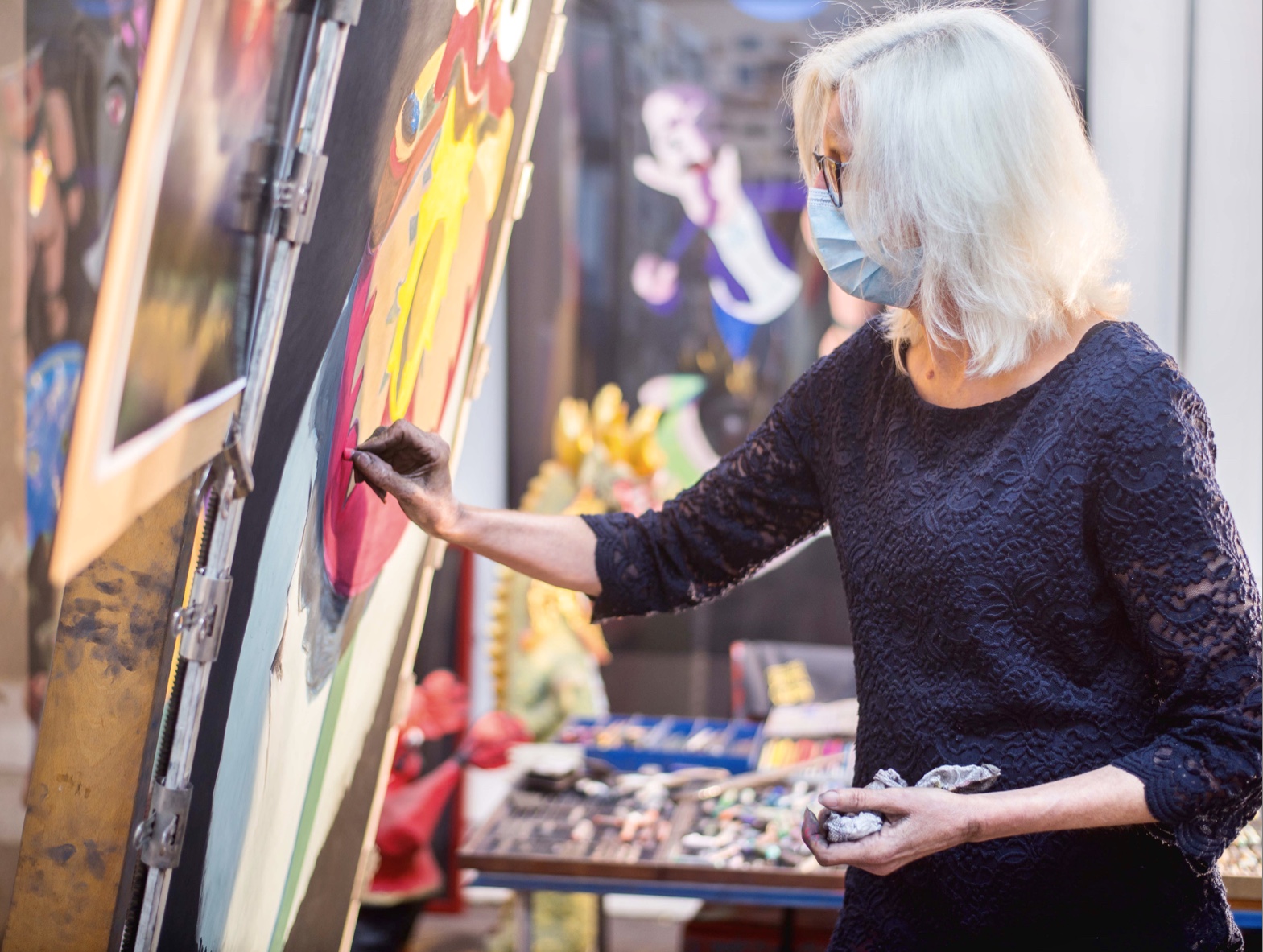
A: Undoubtedly, I could not make my work without UART sandpaper since my entire pastel technique evolved around it. I use 400 0r 500 grit. My favorite thing about it is its ‘tooth’ (i.e. texture or roughness).
Over the many months I spend creating a pastel painting, I build layer upon layer of soft pastel. Because the paper I use is relatively “toothy,” it accepts all of the pastel the painting needs. And as many people know, I own and use thousands of soft pastels!
Many layers of soft pastel and several months of studio time go into creating each painting. My self-invented technique is analogous to the glazing techniques used by the Old Masters, who slowly built up layers of thin oil paint to achieve a high degree of finish. Colors were not only mixed physically, but optically.
Similarly, I gradually build up layers of soft pastel, as many as thirty, to create a pastel painting. After applying a color, I blend it with my fingers and push it into the sandpaper’s tooth. It mixes with the color beneath to create a new color, continually adding richness, saturation, and intensity to the piece. By the time a pastel painting is finished, the colors are bold, vibrant, and exciting.
From the beginning in the 1980s I used photographs as reference material and my late husband, Bryan, would shoot 4” x 5” negatives of my elaborate setups with his Toyo-Omega view camera. In those days I rarely picked up a camera except when we were traveling. After Bryan was killed on 9/11, I inherited his extensive camera collection – old Nikons, Leicas, Graphlex cameras, etc. – and I wanted to learn how to use them. In 2002 I enrolled in a series of photography courses (about 10 over 4 years) at the International Center of Photography in New York. I learned how to use all of Bryan’s cameras and how to make my own big color prints in the darkroom.
Along the way I discovered that the sense of composition, form, and color I developed over many years as a painter translated well into photography. The camera was just another medium with which to express my ideas. Astonishingly, in 2009 I had my first solo photography exhibition in New York.
It’s wonderful to be both a painter and a photographer. Pastel painting will always be my first love, but photography lets me explore ideas much faster than I ever could as a painter. Paintings take months of work. To me, photographs – from the initial impulse to hanging a framed print on the wall – are instant gratification.
For several years I have been using my iPad Pro to capture thousands of travel photographs. Most recently, I visited Gujarat and Rajasthan in India. I have never been inclined to use a sketchbook so composing photos on my iPad keeps my eye sharp while I’m halfway around the world, far from my studio practice.
My blog, “Barbara Rachko’s Colored Dust,” continues to be a crucial part of my overall art practice. Blogging twice a week forces me to think deeply about my work and to explain it clearly to others. The process has helped me develop a better understanding about why I make art and, I like to think, has helped me to become a better writer.
Comments are welcome!
Travel photo of the month*
*Favorite travel photos that have not yet appeared in this blog
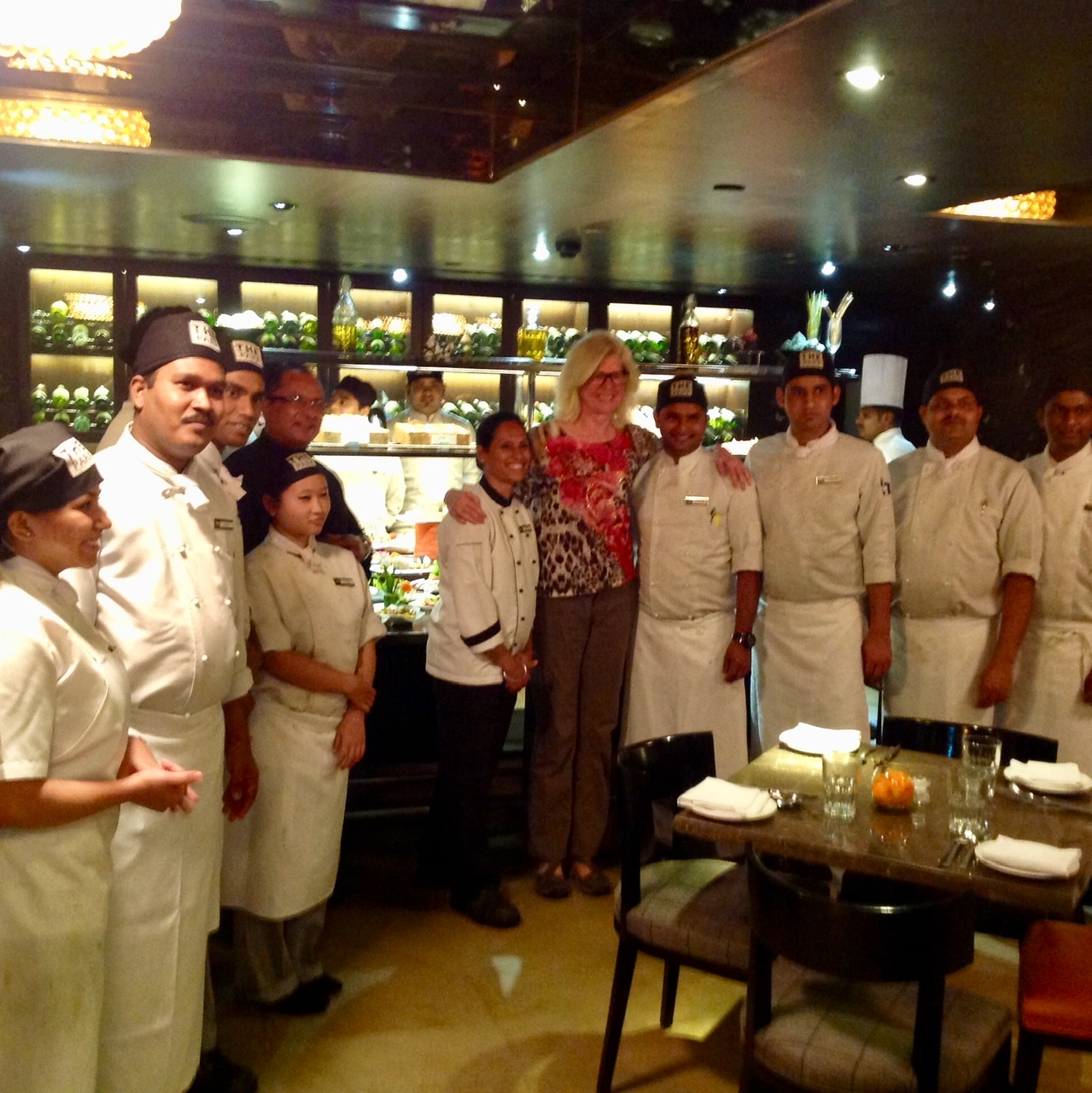
It was New Year’s Eve and I had just arrived in Bangalore from New York (jet lagged, although it doesn’t show here). Too tired to explore the neighborhood, I opted to dine at the hotel restaurant. I seemed to be the only Westerner there and I stood out. Soon the staff began treating me like a celebrity, requesting to take photographs, individually and in groups. Finally, I thought to ask for a photo of my own!
Comments are welcome!
Pearls from artists* # 438
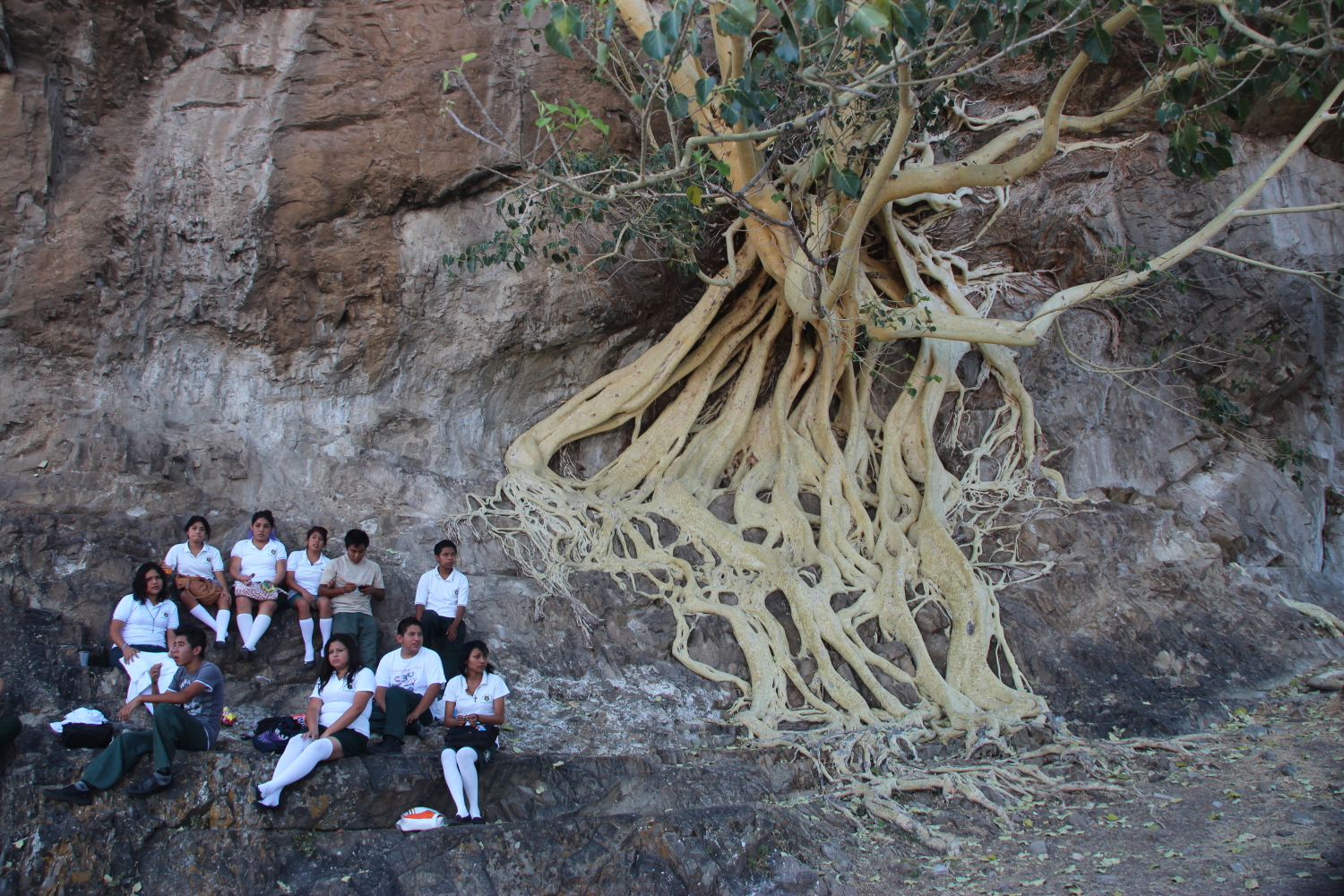
Chalcatzingo, Mexico
* an ongoing series of quotations – mostly from artists, to artists – that offers wisdom, inspiration, and advice for the sometimes lonely road we are on.
Although {Manuel} Alvarez Bravo and Cartier-Bresson were both important mentors for Iturbide, her photographs, as she confirms, are not connected to Surrealism in any way. Henri Cartier-Bresson’s publication Carnets du Mexique (Mexican Notebooks) was an important influence, as it presented a visual representation of Mexico that resonated with her. (Cartier-Bresson also worked mainly in Juchitan, where Iturbide has spent a great deal of time). However, Iturbide developed a way of working quite different from Cartier-Bresson’s. What distinguishes the two artists’ photographs lies in the notion of the fleeting instant, or, as Cartier-Bresson called it, “the decisive moment.” Iturbide refers to Cartier-Bresson’s interest in the “sharp eye” and capturing an instant in time, and describes her own intentions when photographing: “More than in time, I’m interested in the artistic form of the symbol.” Further, Iturbide’s photographs are taken with an understanding of the people, rituals, and symbols of the communities she captures, which makes them stand apart from Cartier-Bresson’s fleeting moments of Mexico. Her work is informed by her deep connection and empathy for her subjects.
Kristen Gresh in Graciela Iturbide’s Mexico
Comments are welcome!
Q: How many days a week do you work on your art?

At work
A: My life is devoted to art and to art-making. Working in pastel is slow and labor-intensive – in a good year I make four or five pastel paintings – so maintaining good work habits is imperative. As a fulltime professional artist, I strive to keep regular studio hours. I work five days a week, roughly seven hours a day.
However, running the business side of things is an every day activity: marketing, interviews, applying for exhibitions, making photographs, documenting my professional activities, sending JPEGs, responding to inquiries, etc. There is always something to do!
Comments are welcome!
Travel photo of the month*
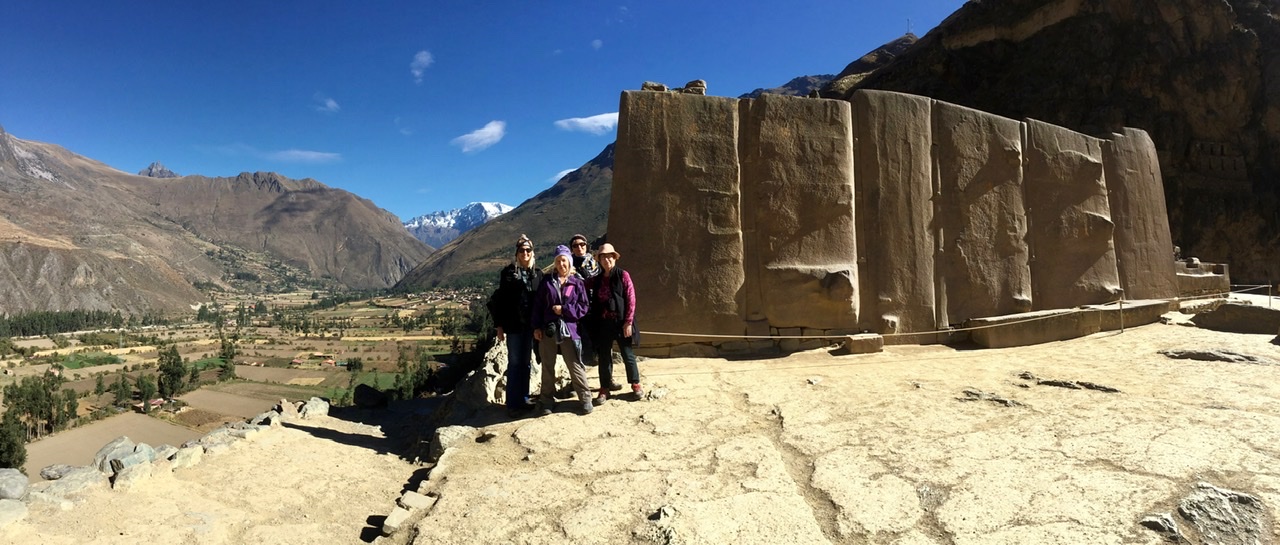
Ollantaytambo in Peru‘s Sacred Valley
* Favorite travel photos that have not yet appeared in this blog
Because reminiscing while looking through old photographs is one of the few ‘travel’ options open to Americans now… sigh!
Comments are welcome!
Q: What do you do when you are feeling undervalued and/or misunderstood as a visual artist?

On a favorite walk
A: After more than three decades as a professional artist, I wish I could say this rarely happens, but that’s not the case. People say dumb things to artists all the time and I’m no exception. Often I tune it out, remembering the title of a terrific book by Hugh MacLeod called, “Ignore Everybody and 39 Other Keys to Creativity.” Come to think of it, it’s time for a re-read of Hugh’s wise book.
But ignoring people is not always possible. So I might take a break from the studio, go for a long walk along the Hudson River, compose photographs, think about what’s bothering me, and try to refocus and remember all the positive things that art-making has brought to my life. I always feel better after this simple ritual.
Here’s another helpful quote that I read recently and try to remember:
‘’An artist cannot fail; it is a success to be one.” – Charles Cooley
I wonder, what do you do?
Comments are welcome!
Q: You are a multi-talented woman! Tell us about your book, “From Pilot to Painter,” and how writing, for you, compares to painting and photography. Which do you prefer?
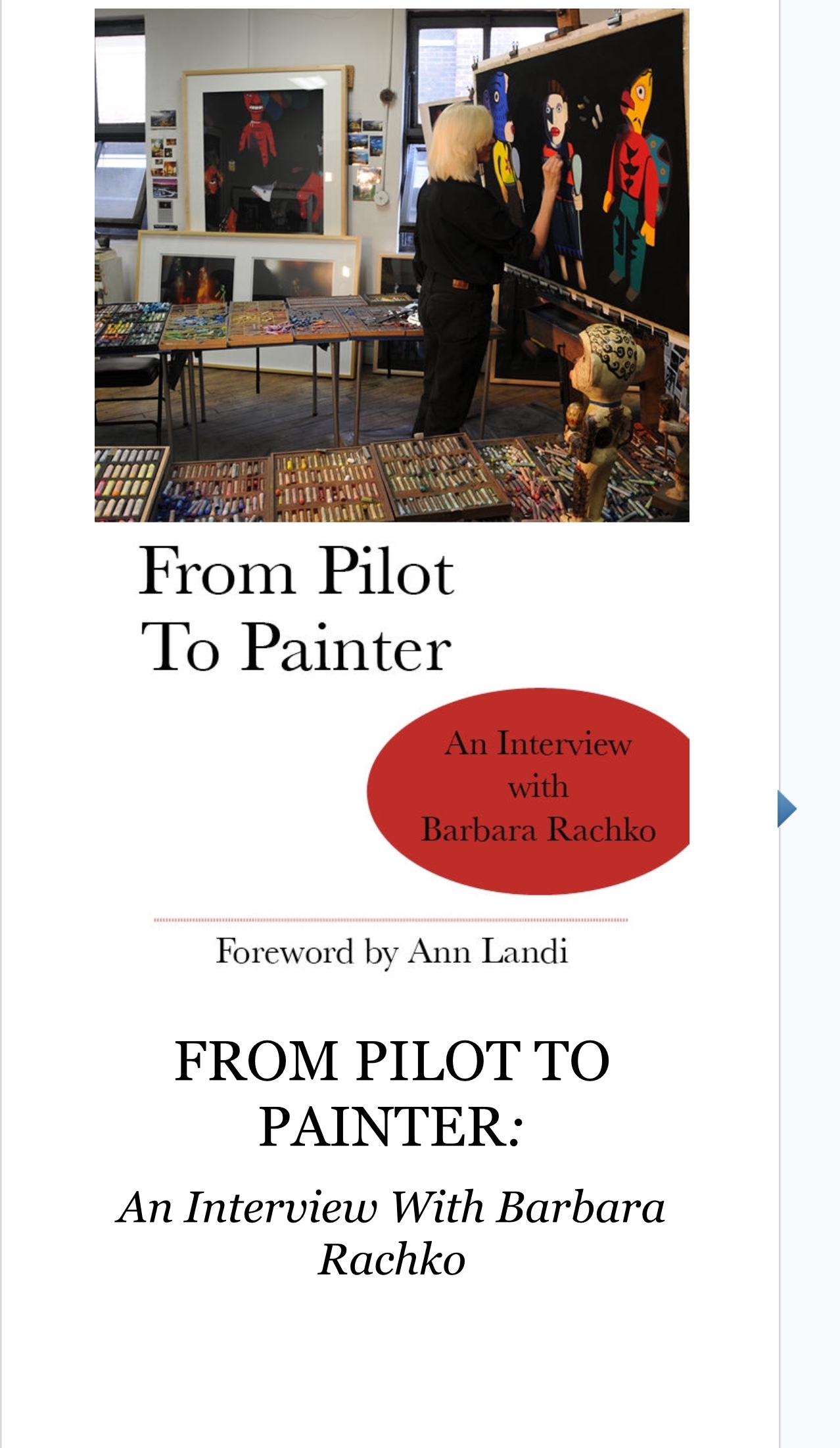
“From Pilot to Painter”
A: I am pleased that my eBook FROM PILOT TO PAINTER is available on Amazon and iTunes. It is based on my blog and is part memoir, including my personal loss on 9/11, insights into my creative practice, and intimate reflections on what it’s like to be an artist living in New York City now. The eBook includes new material not found on the blog, plus 25+ reproductions of my vibrant pastel-on-sandpaper paintings, a Foreword by Ann Landi (who writes for ARTnews and The Wall Street Journal), and more.
“Barbara Rachko’s Colored Dust” (the title of my blog) continues to be a crucial part of my overall art practice. Blogging twice a week forces me to think deeply about my work and to explain it clearly to others. The process has helped me develop a better understanding about why I make art and has encouraged me to become a better writer.
From the beginning in the 1980s I used photographs as reference material and Bryan would shoot 4” x 5” negatives of my elaborate setups with his Toyo-Omega view camera. In those days I rarely picked up a camera except when we were traveling. After Bryan was killed on 9/11, I inherited his extensive camera collection – old Nikons, Leicas, Graphlex cameras, etc. – and I wanted to learn how to use them. In 2002 I enrolled in a series of photography courses (about 10 over 4 years) at the International Center of Photography in New York. I learned how to use all of Bryan’s cameras and how to make my own big color prints in the darkroom. Along the way I discovered that the sense of composition, form, and color I developed over many years as a painter translated well into photography. The camera was just another medium with which to express my ideas. Astonishingly, in 2009 I had my first solo photography exhibition in New York.
It’s wonderful to be both a painter and a photographer. Pastel painting will always be my first love, but photography lets me explore ideas much faster than I ever could as a painter. Paintings take months of work. To me, photographs – from the initial impulse to hanging a framed print on the wall – are instant gratification.
For two years I have been using my iPad Pro to capture thousands of travel photographs. Most recently, I visited Gujarat and Rajasthan in India. I have never been inclined to use a sketchbook so composing photos on my iPad keeps my eye sharp while I’m halfway around the world, far from my studio practice.
Comments are welcome!
Travel photo of the month*
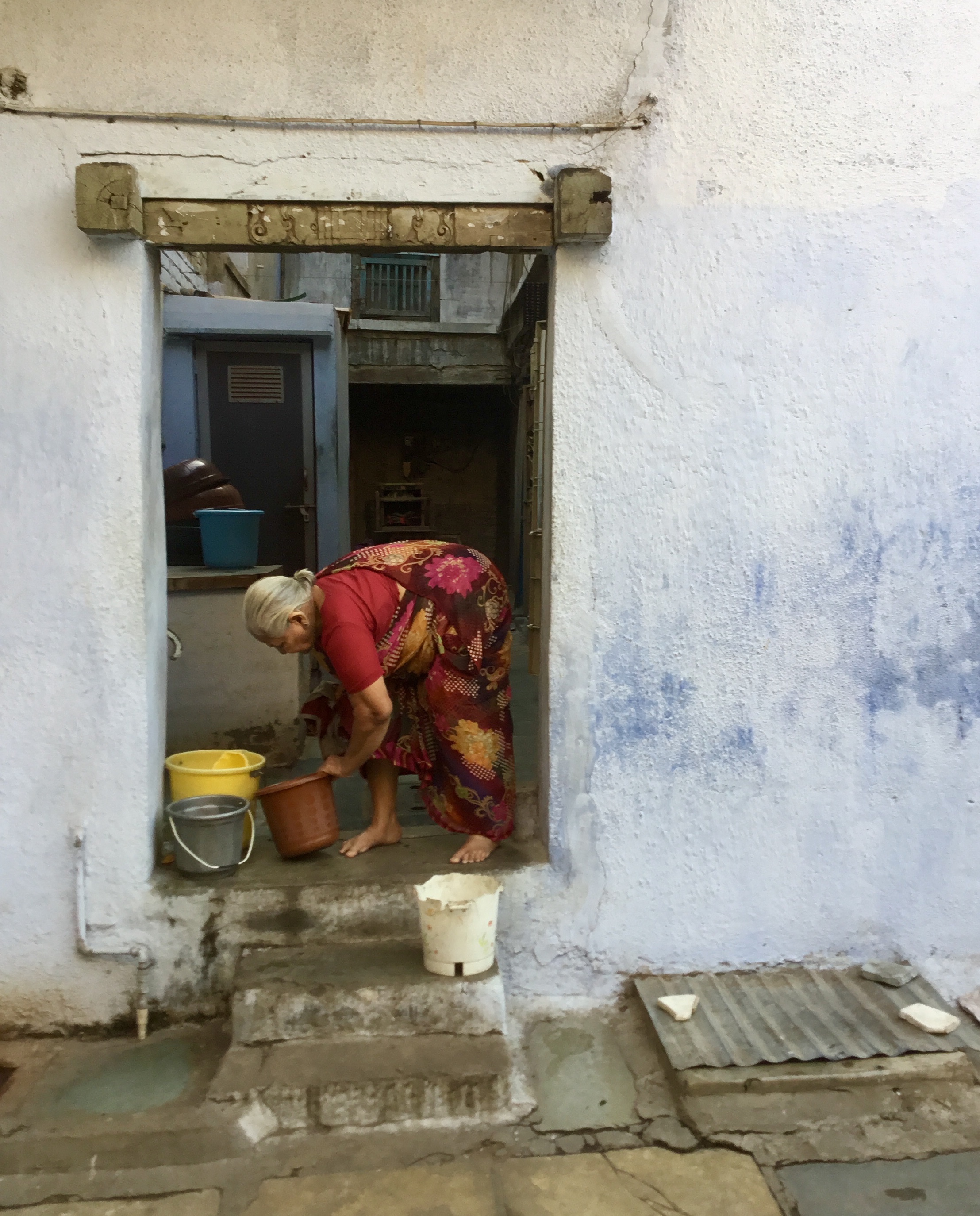
Ahmedabad, India
*Favorite travel photographs that have not yet appeared in this blog
Comments are welcome!
Q: Do you plan your work in advance or is it improvisation?
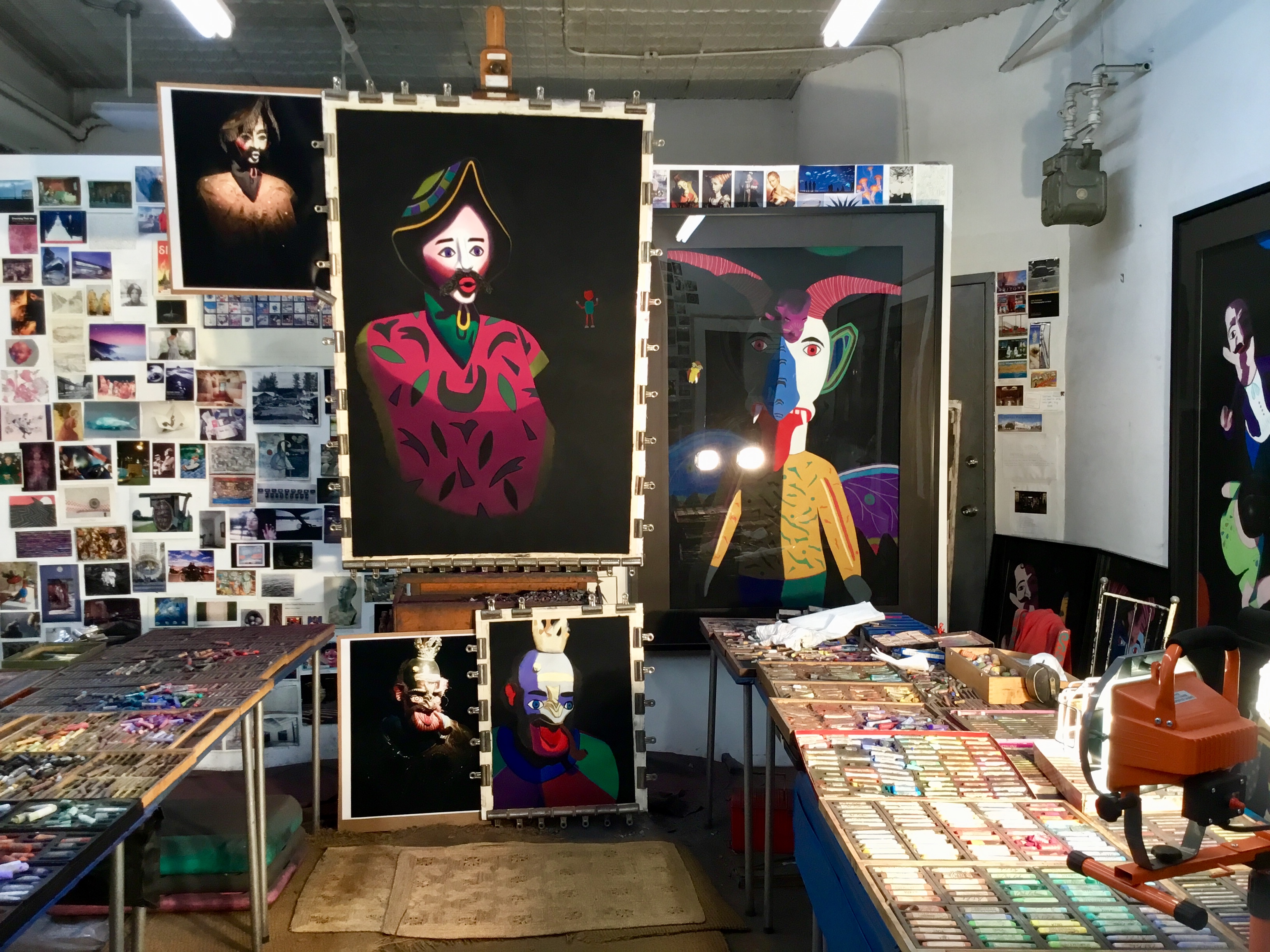
Barbara’s studio
A: My process is somewhere in between those two. I work from my own set-up or on-site photographs and make a preliminary sketch in charcoal before I start a pastel painting. Thousands of decisions about composition, color, etc. occur as I go along.
Although it starts out somewhat planned, I have no idea what a pastel painting will look like when it’s finished. Each piece takes about three months, not counting foreign travel, research, and a gestation period of several months to determine what the next pastel painting will even be.
Comments are welcome!


 barbararachkoscoloreddust.com