Blog Archives
Q: What’s the most unusual place you have exhibited your art? Was it worth it?
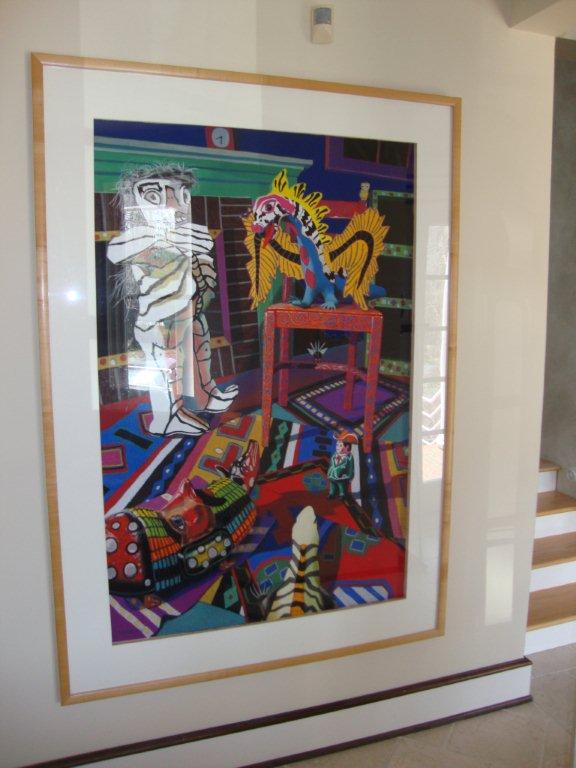
A: In 2004 I exhibited in a group show that was hosted as a fund raiser for Breast Cancer Awareness Month. Artists who had had breast cancer were invited to present our work. The show was titled, “Art of Survival,” and was held in a breast surgeon’s office in West Long Branch, NJ. I had absolutely no expectations of selling anything and reluctantly participated, thinking, “More people are likely to see my work in this show than would see it in my studio during the same period.” Who could have foreseen it, but I sold a $15,000 painting to the surgeon who had organized the exhibition!
Sadly, several years later, the curator of the exhibition informed me that Beth, the breast cancer surgeon, had died from the same disease.
Comments are welcome!
Pearls from artists* # 679
*an ongoing series of quotations – mostly from artists, to artists – that offers wisdom, inspiration, and advice for the sometimes lonely road we are on.
PC: In your painting, you’ve always kept this speed of movement. One senses that you work something out slowly, deep down, that it’s hard work, but there’s always something fresh about its expression
HM: That’s because I revise my notion several times over. People often add or superimpose completing things without changing their plan, whereas I rework my plan every time. I always start again, working from the previous state. I try to work in a contemplative state, which is very difficult: contemplation is inaction and I act in contemplation.
In all the studies I’ve made from my own ideas, there’s never been a faux pas because I’ve always unconsciously had a feeling for the goal; I’ve made my way toward it the way one heads north, following the compass. What I’ve done, I’ve done by instinct, always with my sights on a goal I still hope to reach today. I’ve completed my apprenticeship now. All I ask is four or five years to realize the goal.
PC: Delacroix said that too. Great artists never look back.
HM: Delacroix also said – ten years after he’d left the place – “I’m just beginning to see Morocco.” He needed the perspective. Rodin said to an artist, “You need to stand back a long way for sculpture.” To which the student replied, “Master, my studio is only ten meters wide.”
Chatting With Henri Matisse: The Lost 1941 Interview, Henri Matisse with Pierre Courthion, edited by Serge Guilbaut
Comments are welcome!
Q: What’s on the easel today?

Work in progress
A: I’m in the early stages of a new 58” x 38” “Bolivianos” pastel-on-sandpaper painting.
Comments are welcome!
Q: How do you decide when a pastel painting is finished?

“Magisterial,” soft pastel on sandpaper, 58” x 38” in progress
A: During the months that it takes to create a pastel painting, I search for arresting colors that work well together. The goal is to make a painting that I have never seen before and that leads the viewer’s eyes around in interesting ways. To do this I build up and blend together as many as 25 to 30 layers of pigment. I am able to complete some areas, like the background, fairly easily – maybe with just six or seven layers of black Rembrandt pastel. The more realistic parts of a pastel painting take many more applications. In general, details always take plenty of time to refine and perfect.
No matter how many pastel layers I apply, however, I never use fixatives. It is difficult to see this in reproductions of my work, but some of the finished surfaces achieve a texture akin to velvet. My technique involves blending each layer with my fingers, pushing the pastel deep into the tooth of the sandpaper, and mixing new colors directly on the paper. Fortunately, the sandpaper holds plenty of pigment so I am able to include lots of details.
Before I pronounce a pastel painting finished, I let it sit against a wall in my studio for a few days so I can look at it later with fresh eyes. I consider a piece done when it is as good as I can make it, when adding or subtracting something would diminish what is there. Always, I try to push myself and my materials to their limits, using them in new and unexpected ways.
Comments are welcome.
Q: Do you ever use other people’s photographs as reference material for your paintings?

Some Reference Photos
A: For a number of reasons, I never use anyone else’s photographs as reference material. It seems wrong on many levels. Besides the fact that it is theft of intellectual property, it would mean I did not have the all-important experience of finding and making the photograph. Each reference photograph is the beginning of an idea for a future pastel painting. How each photograph even comes to exist – the travel and adventure behind it and the memories and stories that result – is an essential first step in my months- and even years-long creative process.
Comments are welcome!
Q: What’s on the easel today?

Planning my next painting
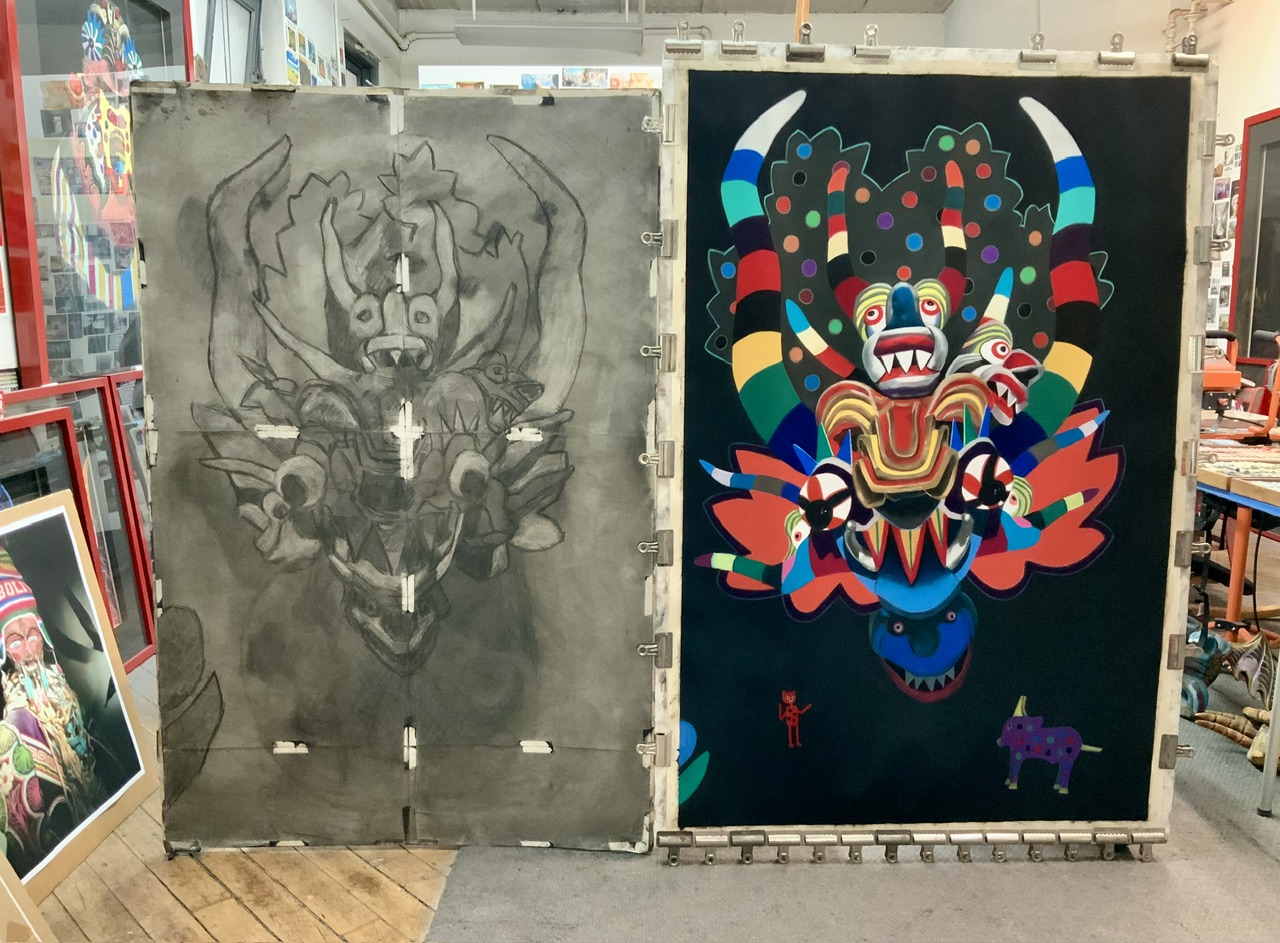
A: In preparation for my next large “Bolivianos” painting, I made this preliminary charcoal drawing.
Comments are welcome!
Pearls from artists* # 647

Barbara’s Studio
*an ongoing series of quotations – mostly from artists, to artists – that offers wisdom, inspiration, and advice for the sometimes lonely road we are on.
My life is a collage, with time cutting and rearranging the materials and laying them down, overlapping and contrasting, sometimes with the fresh shock of a surrealist painting. I wonder if traditional perspective is a necessary discipline for the art student, for over the years my life has taken on its own pattern and formed its own rules, adapting events and chronology in the sifting process of memory. As a mature artist, I can take liberties with perspective. We are not made of straight lines. As Picabia said: ‘Our heads are round so that thoughts can change direction.’
Eileen Agar in A Look at My Life
Comments are welcome!
Q: Does your work look different to you on days when you are sad, happy, etc.?

Barbara’s Studio
A: I am much more critical on days when I am sad so that the faults, imperfections, and things I wish I had done better stand out. Fortunately, all of my work is framed behind plexiglas so I can’t easily go back in to touch up perceived faults. I am reminded of the expression, “Always strive to improve, whenever possible. It is ALWAYS possible!” However, I’ve learned that re-working a painting is a bad idea. You are no longer deeply involved in making it and the zeitgeist has changed. The things you were concerned with are gone: some are forgotten, others are less urgent.
For most artists our work is autobiography. Art is personal. When I look at a completed pastel painting, I usually remember exactly what was happening in my life as I created it. Each piece is a snapshot – maybe a time capsule, if anyone could decode it – that reflects and records a particular moment. When I finally pronounce a piece finished and sign it, that’s it, THE END. It’s as good as I can make it at that point in time. I’ve incorporated everything I was thinking about, what I was reading, how I was feeling, what I valued, art exhibitions I visited, programs that I heard on the radio or watched on television, music that I listened to, what was going on in New York, in the country, and in the world.
It is still a mystery how this heady mix finds its way into the work. During the time that I spend on it, each particular painting teaches me everything it has to teach. A painting requires months of looking, reacting, correcting, searching, thinking, re-thinking, revising. Each choice is made for a reason and together these decisions dictate what the final piece looks like. On days when I’m sad I tend to forget that. On happier days I remember that the framed pastel paintings that you see have an inevitability to them. If all art is the result of one’s having gone through an experience to the end, as I believe it is, then the paintings could not, and should not, look any differently.
Comments are welcome.
Q: Why do you have so many pastels?

Barbara’s Studio
A: Our eyes can see infinitely more colors than the relative few that are made into pastels. When I layer pigments onto the sandpaper substrate, I mix new colors directly on the painting. This has the result of making many of my colors unrepeatable. The short answer is, I need lots of pastels so that I can mix new colors.
I have been working exclusively with soft pastel for nearly 40 years. Each pastel stick has unique mixing properties that depend on what was used as a binder to hold the dry pigment together. Some soft pastels are oily, some are buttery, some are powdery, some crumble easily, some are harder. Each one feels slightly different when I apply it to the sandpaper.
Soft pastel is distinct among paint media. Oil painters need only a few tubes of paint to make any number of colors, but pastels are not easily combined to form new colors. I learned how to mix colors by experimenting. In the process I developed a personal and unique science of color-mixing and blending. This is one of the factors that makes my work so recognizable and sets it apart from that of other pastel painters.
Comments are welcome.
Q: What’s on the easel today?

Charcoal Drawing
A: This is a preliminary charcoal drawing to help plan my next small “Bolivianos” painting.
Comments are welcome!


 barbararachkoscoloreddust.com