Blog Archives
Q: What do you see when you look back at your early efforts?
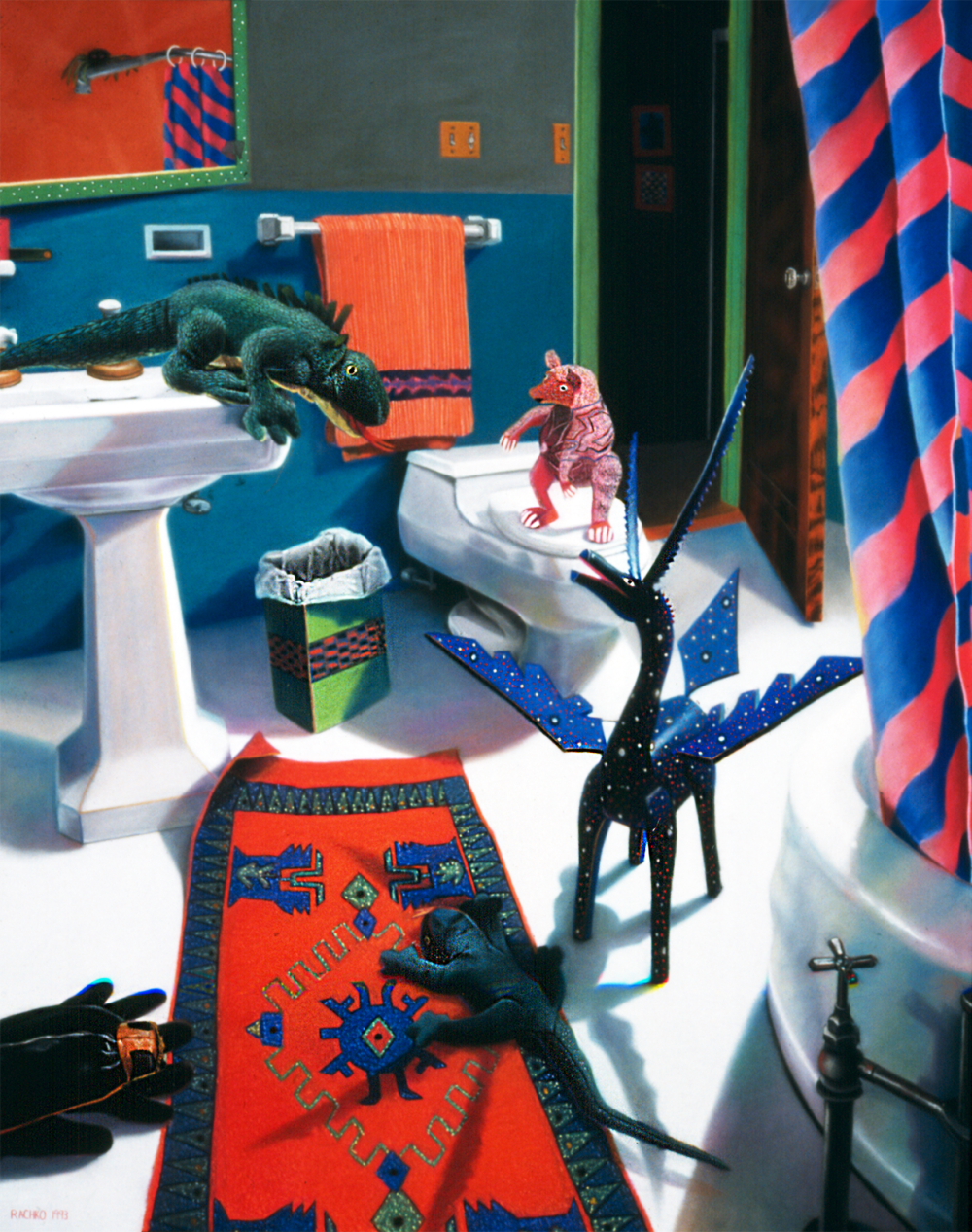
“Myth Meets Dream,” soft pastel on sandpaper, 47″ x 38,” 1993
A: I see continuity in subject matter and in medium, surely. For thirty-three years I have been inspired by foreign travel and research. In addition, I remain devoted to pushing the limits of what soft pastel can do and to promoting its merits as a fine art medium.
Here and there I see details I would render differently now; not exactly mistakes, but things that maybe could be done better. Fortunately, I think, all of my work is framed behind glass or plexiglas, making it extremely difficult to attempt revisions.
Perhaps most important of all, I see the long personal road that has advanced my work to its present state. Each gain has been hard-fought.
Comments are welcome!
Pearls from artists* # 337
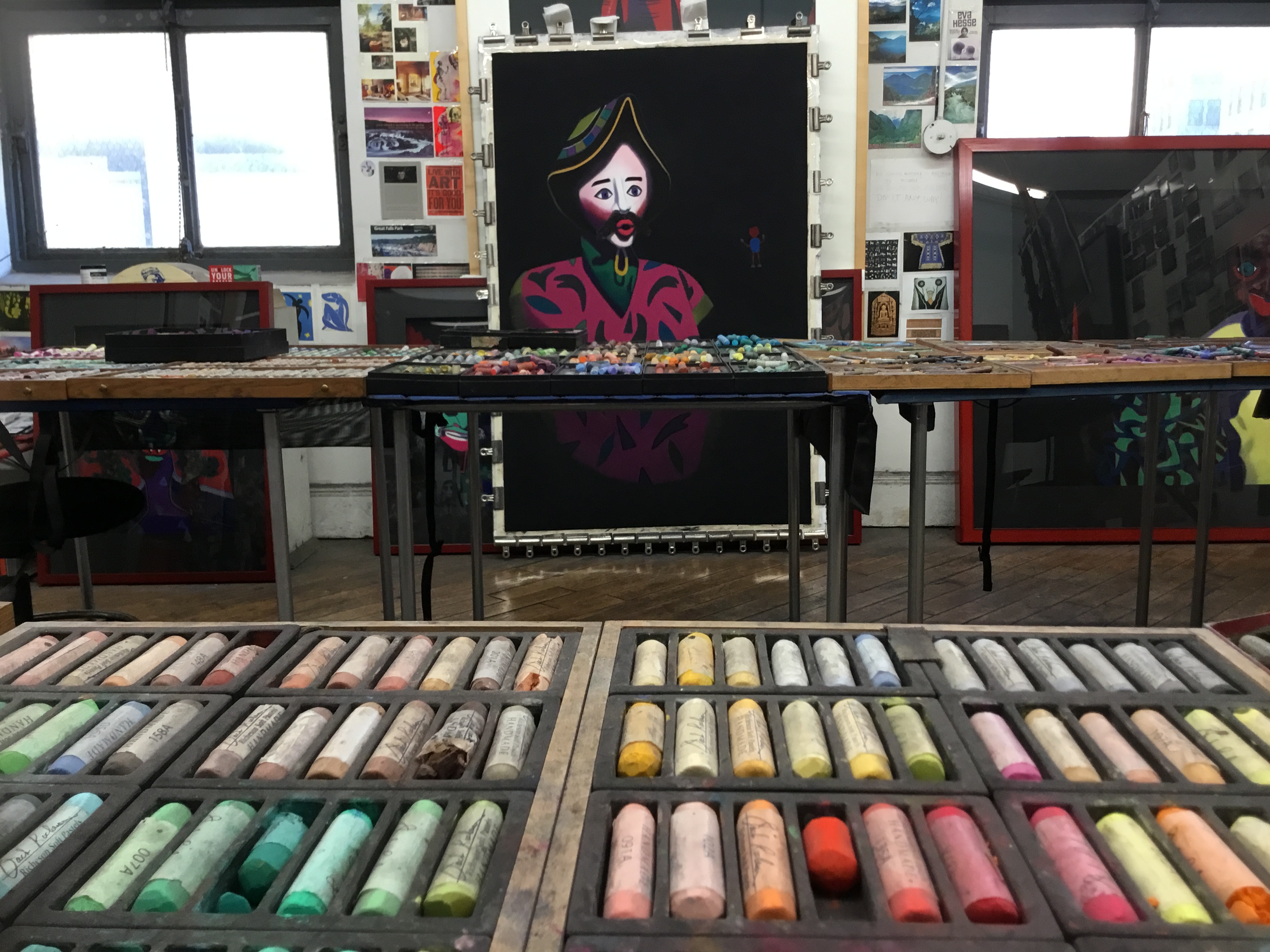
Barbara’s studio
*an ongoing series of quotations – mostly from artists, to artists – that offers wisdom, inspiration, and advice for the sometimes lonely road we are on.
I think society did a great disservice to artists when we started saying they were geniuses, instead of saying they had geniuses. That happened around the Renaissance, with the rise of a more rational and human-centered view of life. The gods and the mysteries fell away, and suddenly we put all credit and blame for creativity on the artists themselves – making the all-too-fragile humans completely responsible for the vagaries of inspiration.
In the process, we also venerated art and artists beyond their appropriate stations. The distinction of “being a genius” (and the rewards and status often associated with it) elevated creators into something like a priestly cast – and perhaps even into minor deities – which I think is a bit too much pressure for mere mortals, no matter how talented. That’s when artists start to really crack, driven mad and broken in half by the weight and weirdness of their gifts.
Elizabeth Gilbert in Big Magic: Creative Living Beyond Fear
Comments are welcome!
Q: Would you speak about the meaning of your work and the different materials you use?
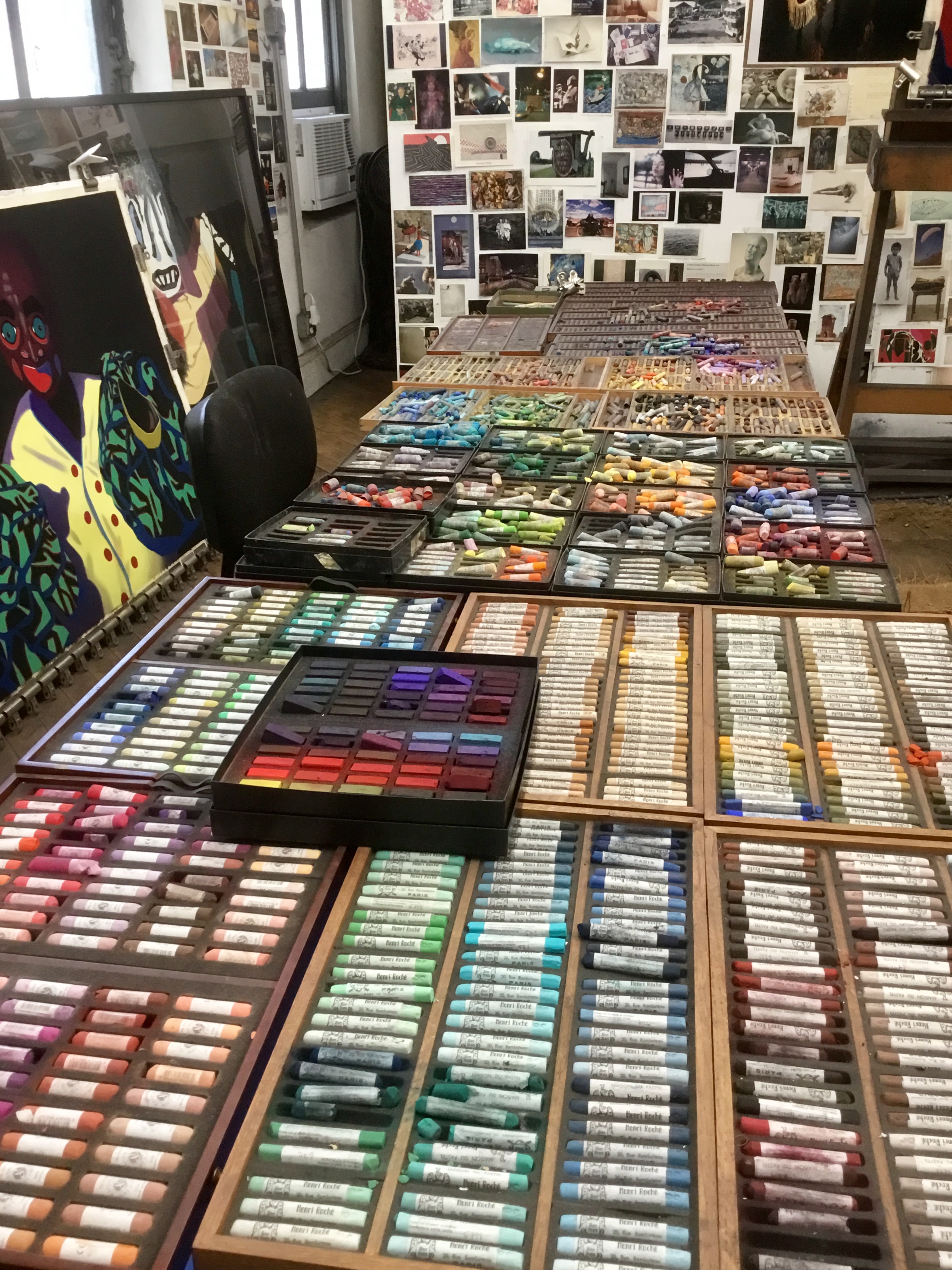
About half of Barbara’s pastels
A: It is as difficult to explain the meaning of my art as it is to interpret the meaning of life! I am invested in and concerned with process: foreign travel, prodigious reading, devotion to craft, months of slow meticulous work in the studio trying to create an exciting work of art that has never been seen before, etc. I love making pastel paintings! Many years ago I challenged myself to push the limits of what soft pastel can achieve. I am still doing so.
I leave it to others – viewers, arts writers, critics, art historians – to study my creative journey and talk about meanings. I believe an artist is inspired to create and viewers ponder the creation. I would not presume to tell anyone how to react to my work.
For many years I have been devoted to promoting soft pastel as a fine art medium. There are excellent reasons it has been around for five hundred years! It is the most permanent of media. There’s no liquid binder to cause oxidizing or cracking over time, as happens with oil paint. Pastel colors are intense because they are close to being pure pigment. Pastel allows direct application (no brushes) with no drying time and no color changes.
I use UArt acid-free sandpaper. This is not sandpaper from a hardware store. It is made for artists who work in pastel and allows me to build up layers of pigment without using a fixative. My process – slowly applying and layering pastels, blending and mixing new colors directly on the paper, making countless adjustments, searching for the best and/or most vivid colors – continually evolves. Each pastel painting takes months to create.
Comments are welcome!
Q: How do you deal with the loneliness of working in a studio?
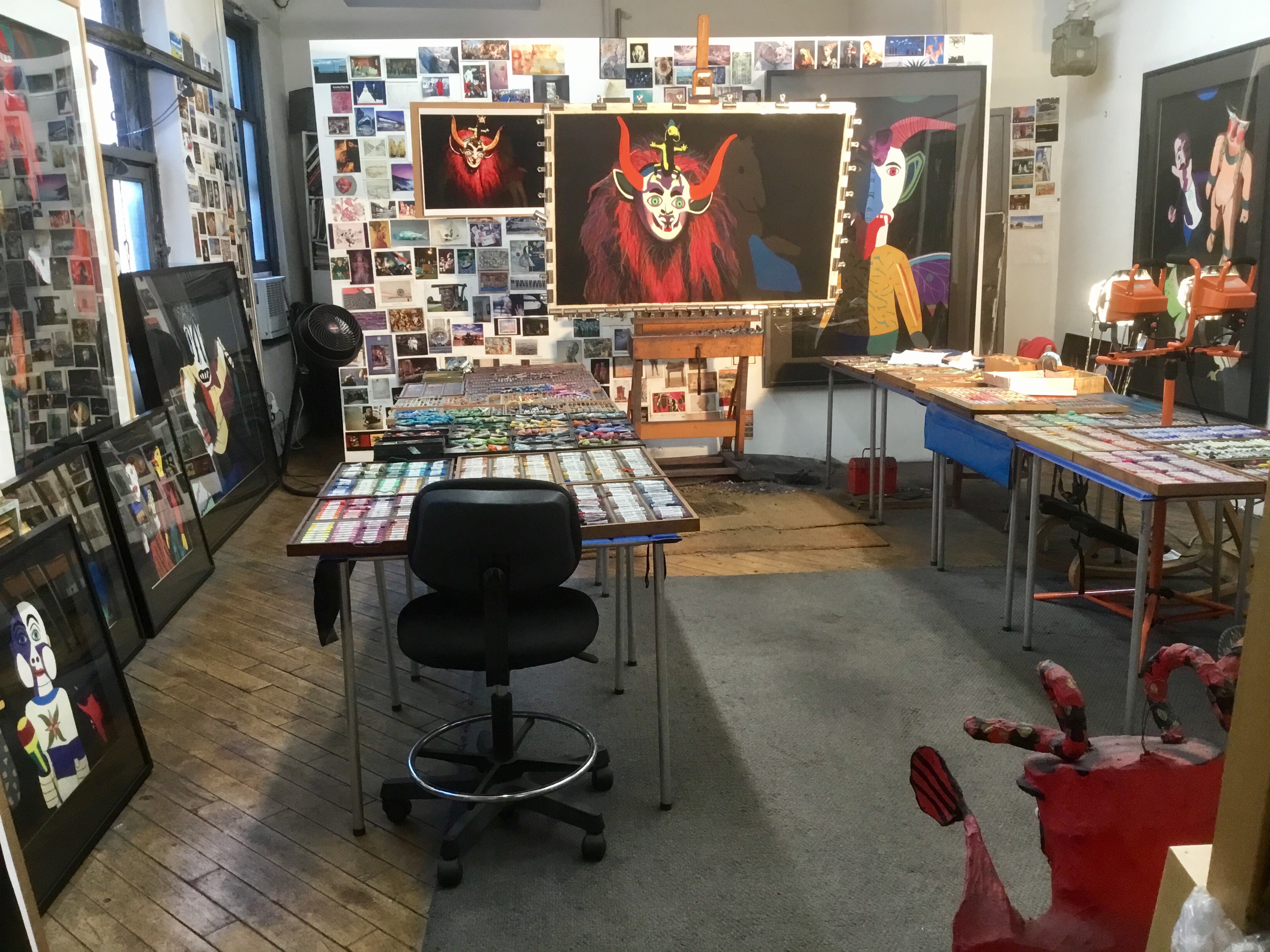
Barbara’s studio
A: I never feel lonely when I’m working. I love being in my studio and even after thirty years, still find the whole process of making a pastel painting completely engaging.
Painting is the one activity that not only uses all of my mental and physical abilities, but challenges me to push further. I am at my best in the studio.
Because there is always more to learn and process into the work, creating art is endlessly fascinating! Most artists probably feel the same way. It’s one of the reasons we persist.
Comments are welcome!
Pearls from artists* # 212
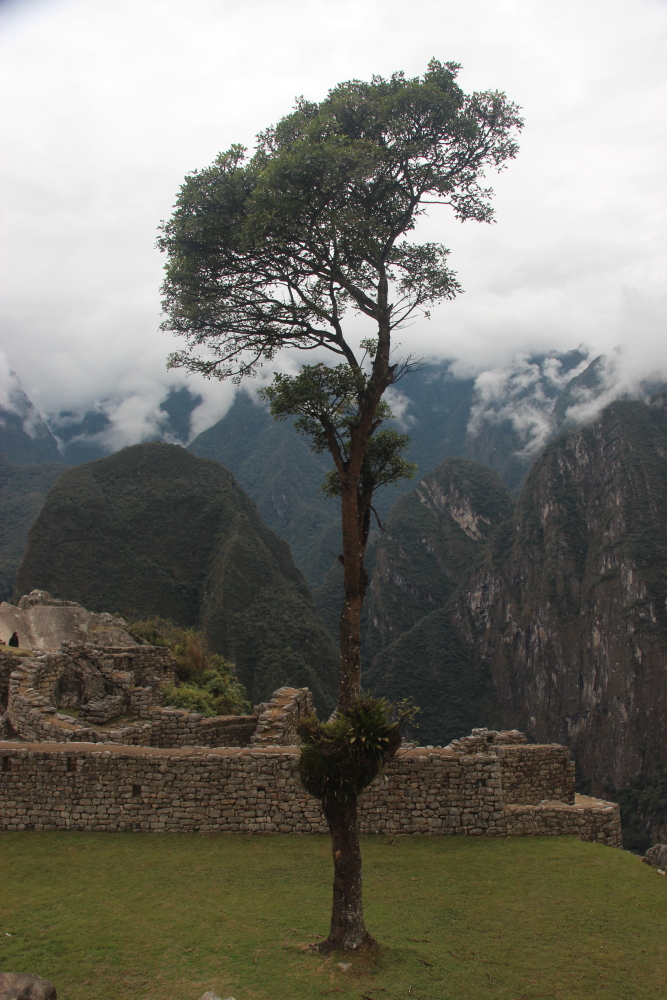
Machu Picchu
* an ongoing series of quotations – mostly from artists, to artists – that offers wisdom, inspiration, and advice for the sometimes lonely road we are on.
… the anthropologist Ellen Disanayake… in Homo Aestheticus, argues that art and aesthetic interest belong with rituals and festivals – offshoots of the human need to ‘make special,’ to extract objects, events, and human relations from everyday uses and to make them a focus of collective attention. This ‘making special’ enhances group cohesion and also leads people to treat those things which really matter for the survival of community – be it marriage or weapons, funerals, or offices – as things of public note, with an aura that protects them from careless disregard and emotional erosion. The deeply engrained need to ‘make special’ is explained by the advantage that it has conferred on human communities, holding them together in times of threat, and furthering their reproductive confidence in times of peaceful flourishing.
Beauty: A Very Short Introduction, by Roger Scruton
Comments are welcome!
Q: Do you have a mentor?
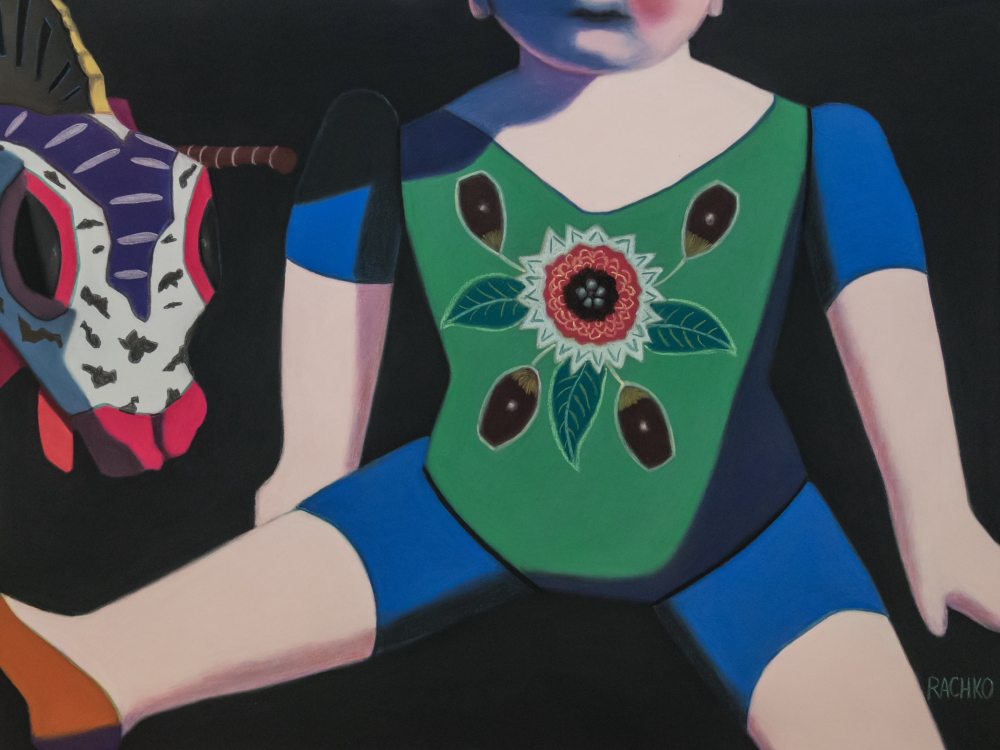
“Alone Together,” soft pastel on sandpaper, 20″ x 26″
A: No, but I often wish I did. How wonderful it would be to consult someone who’s been there, a productive and successful artist who could provide advice on all the concerns, especially the problems and dangers, inherent in a professional artist’s life.
But I have been at this for thirty years and found no such person! I think it’s because each artist’s career is highly unique as we chart are own individual paths. Unlike most professions, there are no firm rules or straight forward career milestones for making your way as an artist.
Besides the countless hours spent in the studio, I have always worked diligently to understand the art business. Certainly getting work seen, exhibited, reviewed, sold, etc. is as important as making it in the first place. It’s all part of being a professional artist.
Early on I developed the habit of relying on my own best judgment, both in creating the work and in getting it seen and collected. Certainly I have made plenty of mistakes. As a result though, I know a tremendous amount about the art business. And I enjoy sharing what I know in the hopes of steering other artists away from making similar missteps.
Comments are welcome!
Q: Is there a pastel painting that you are most proud of?

“She Embraced It and Grew Stronger,” soft pastel on sandpaper, 58″ x 38,” 2003
A: Without a doubt I am most proud of “She Embraced It and Grew Stronger.”
After Bryan was killed on 9/11, making art again seemed an impossibility. When he was alive I would spend weeks setting up and lighting the tableau I wanted to paint. Then Bryan would shoot two negatives using his Toyo-Omega 4 x 5 view camera. I would select one and order a 20″ x 24″ reference photo to be printed by a local photography lab.
“She Embraced It…” is the first large pastel painting that I created without using a photograph taken by Bryan. This painting proved that I had learned to use his 4 x 5 view camera to shoot the reference photographs that were (and still are) integral to my process. My life’s work could continue!
Certainly the title is autobiographical. ‘She’ in “She Embraced It and Grew Stronger” is me and ‘It’ means continuing on without Bryan and living life for both of us.
Comments are welcome!
Q: What’s on the easel today?
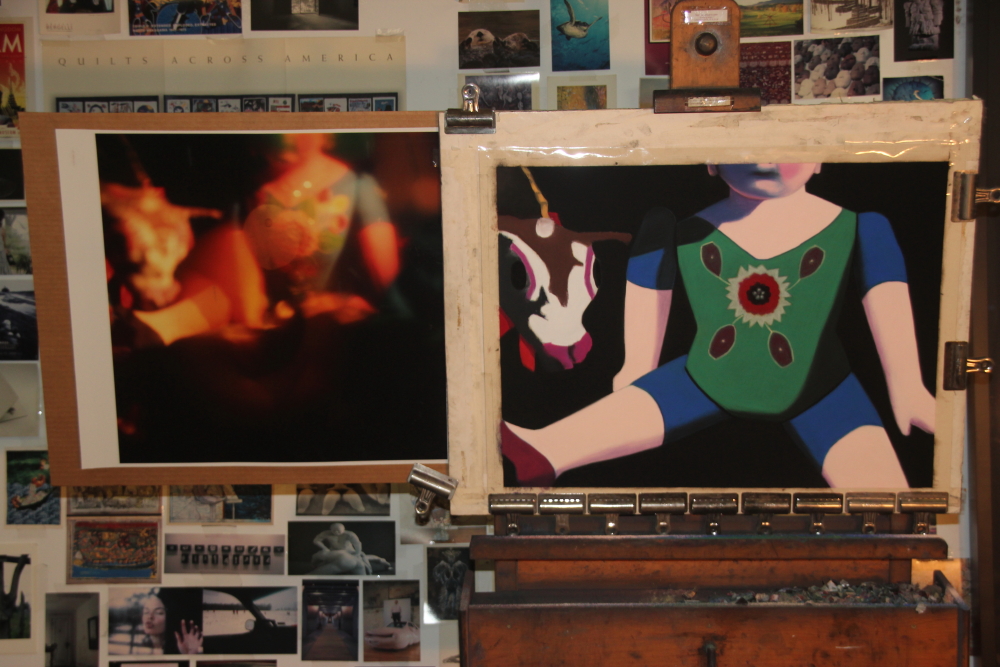
Work in progress
A: I am at work on a small (20″ x 26″) pastel-on-sandpaper painting tentatively called, “Duo.” My previous painting, “Charade,” was a breakthrough of sorts; at least I hope so, because it was such an ordeal to complete!
That’s why I am giving myself a break and making a relatively simple piece now. It’s a way of resting and also of re-filling the well.
Recently something happened that broke my heart: I had to put my beloved cat to sleep. When I look at this image I am reminded of Kit Kat, who was always by my side. He and I were another “Duo” alluded to in the title of this painting.
Comments are welcome!
Q: How important are the titles of your pastel paintings?
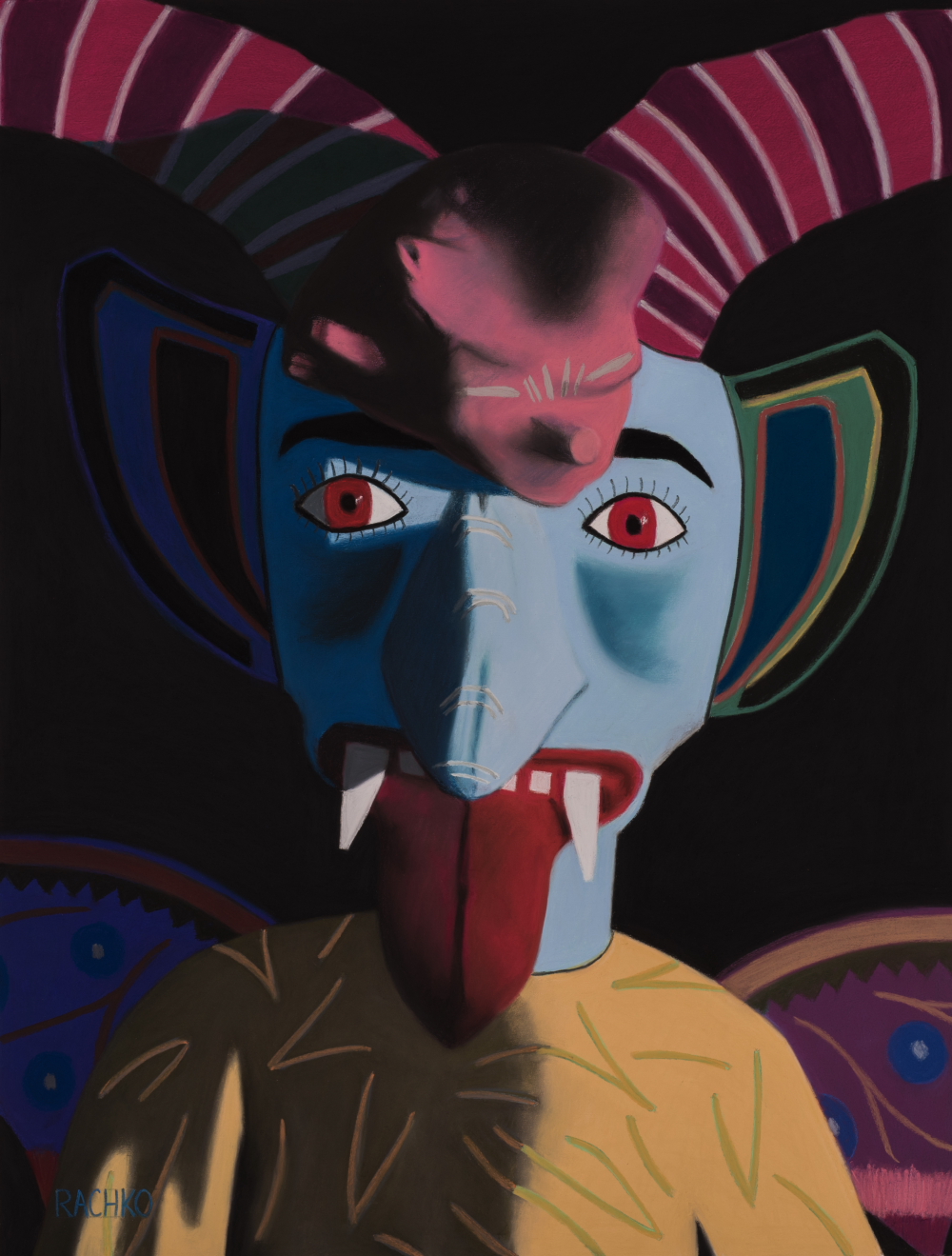
“Provocateur,” soft pastel on sandpaper, 26″ x 20″
A: I’d say they are important. Titles serve mainly as “a way in” for viewers, giving some clues about my thought processes while I am making a painting. Usually titles emerge only after I have been working on a painting for weeks or months. For me they are very much like mementos after a very interesting journey.
Comments are welcome!
Q: Would you say there is a unifying quality to all of the work you have produced in the last thirty years?
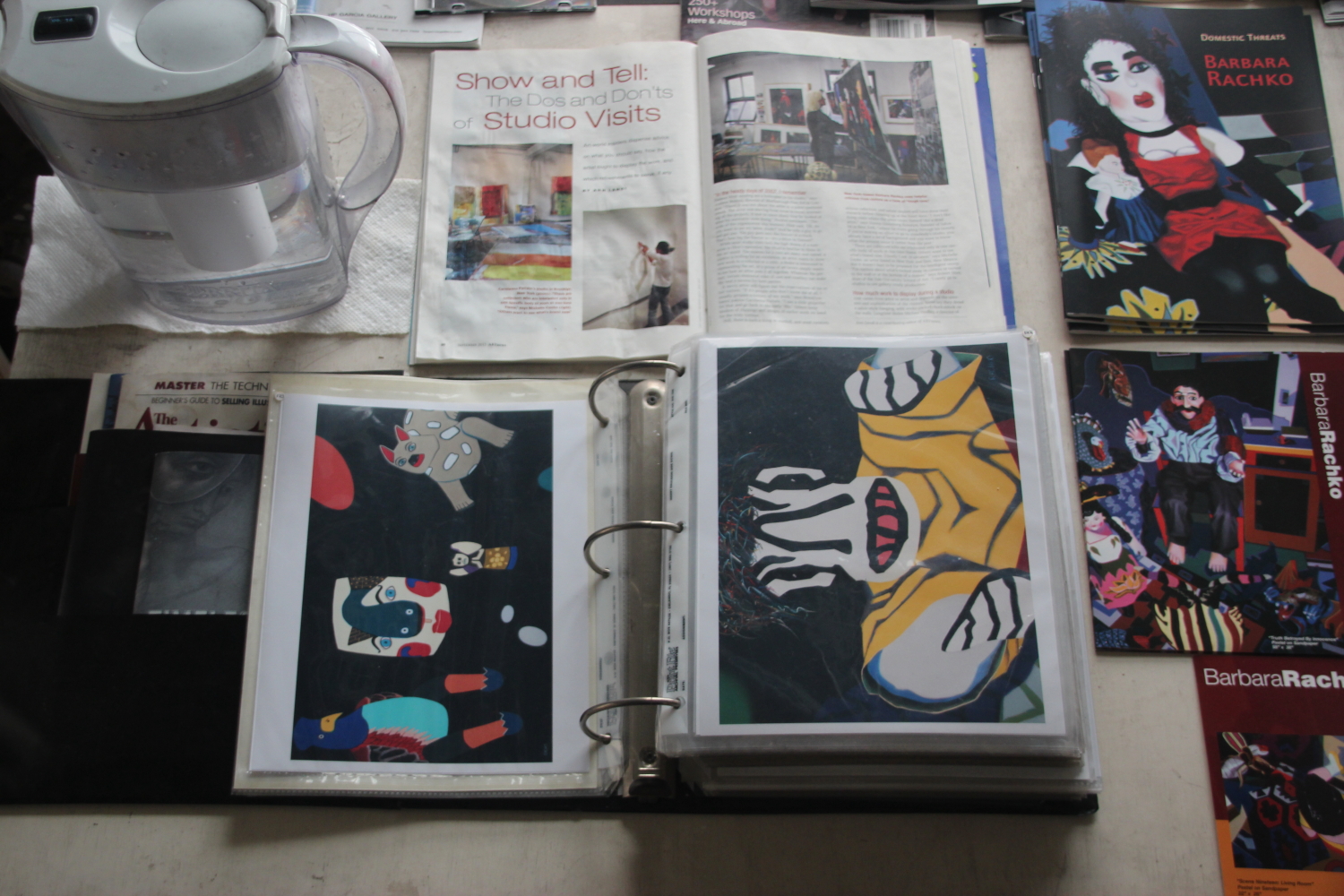
Barbara’s portfolio book
A: Yes, I can think of several. Whether making pastel paintings or printing photographs in the darkroom, I have always been concerned with quality and craftsmanship and never pronounce a work finished until it is the best thing I can make.
Although I started out as a maker of photorealist portraits in pastel, for twenty-odd years I have worked with Mexican folk art as my primary subject matter, treating these objects very differently in three separate series: “Black Paintings,” “Domestic Threats,” and “Gods and Monsters.” The first two are pastel-on-sandpaper paintings while the last is comprised of chromogenic photographs (c-prints). A few years ago I also started making “Teleidoscopes” using an iPad app to photograph my Mexican and Guatemalan folk art collection. This last one is just for fun; I do not offer them for sale.
Soft pastel is my first love and the two series of pastel paintings are my best-known work. My technique for using pastel continues to evolve in intriguing ways. I doubt I can ever learn all there is to know not only about color, but also about this medium. Pastel is endlessly fascinating, which is why I have never wanted to switch to anything else.
Comments are welcome!


 barbararachkoscoloreddust.com