Blog Archives
Pearls from artists* # 692

*an ongoing series of quotations – mostly from artists, to artists – that offers wisdom, inspiration, and advice for the sometimes lonely road we are on.
Claiming space, money, and time to do our work requires fortitude. We need to say ‘no’ to projects and people fighting for our attention. We just follow our work through changes, even when it is comfortable, or in other people’s interests, for our work to stay the same. If we want to expand our careers, we get rejected… a lot. But artists are like sharks; we must keep moving to survive, creating authentic, original work as we outgrow it to evolve as human beings.
Kate Kretz in Art From Your Core: A Holistic Guide to Visual Voice
Comments are welcome!
Q: Have you noticed any common characteristics among the people who collect your work?

“Poseur,” soft pastel on sandpaper, 70” x 50” framed
A: Yes! They are fascinating people living lives devoted to nonstop learning, adventurous travel, and other proactive pursuits. Collectors of my work typically range in age from 40 to around 80. They are college graduates with advanced degrees. Sometimes they don’t have kids, which is why they have disposable income and time to pursue their interests in art and culture.
When I meet them (presuming my work was sold through a gallery or other third party), we usually have much to talk about – art, art history, photography, cinema, film history, dance, drama, music, travel, archaeology, Mexico, Central and South America, Bali – the list goes on and on. With so much in common, we quickly become good friends!
Comments are welcome!
Pearls from artists* # 648

“Apparition,” soft pastel on sandpaper, 58” x 38”
*an ongoing series of quotations – mostly from artists, to artists – that offers wisdom, inspiration, and advice for the sometimes lonely road we are on.
I prefer to speak in terms of the artist’s voice. Voice is deeper, manifested from the very core of your being. It is a synthesis of the experiences, intellectual concepts, and aesthetic interests you possess, executed in your distinctive way, in the formal, emotional, and intellectual language of your chosen medium. When successful, the realization of your voice follows a gestalt principle. The combination of your ideas and the work’s physical embodiment is greater than the sum of its parts and distinguishes your outcome from everyone else’s. If we wrote down a single concept and handed it to a dozen artists, we would get very different responses from each of them, and some works would be a stronger synthesis of ideas and execution. As Frank Stella once said, “There are no good ideas for paintings, there are only good paintings… the painting IS the idea (Saltz, 2020:42).”
The art that we recognize as having singular, identifying features, those formal aspects that allow us to immediately see a work as ‘a David Wojnarowicz’ or ‘a Julie Mehretu,’ were not the product of a singular flash of brilliance. These qualities evolved as part of a sustained, life-long, ever-deepening investigation to articulate their specific and singular vision. Our voice comes from tapping into the depths of our own consciousness, then distilling the most powerful aspects of that awareness. Voice also expands and deepens over time. It evolves along with the artist.
Kate Kretz in Art From Your Core: A Holistic Guide to Visual Voice
Comments are welcome!
Q: When did you begin drawing and painting? (Question from “Cultured Focus Magazine”)

A: This is a long story because my path to becoming a professional artist has been unusually circuitous.
I grew up in a blue collar family in suburban New Jersey. My parents were both first-generation Americans and no one in my family had gone to college. I was a smart kid, who showed some artistic talent in kindergarten and earlier. At the age of 6, my sister, my cousin, and I enrolled in Saturday morning painting classes at the studio of a local artist. I continued the classes for about 8 years and became a fairly adept oil painter.
At the age of 15 my father decided that art was not a serious pursuit – he called it a hobby, not a profession – and abruptly stopped paying for my Saturday morning lessons. Unfortunately, there were no artists or suitable role models in my family. So with neither financial nor moral support to pursue art, I turned my attention to very different interests.
Cut to ten years later. When I was 25, I earned my private pilot’s license and spent the next two years amassing other flying licenses and ratings, culminating in a Boeing-727 flight engineer’s certificate.
At 29, I joined the Navy. By then I was an accomplished civilian pilot with thousands of flight hours so I expected to fly jets. However, in the early 1980s women were not allowed in combat. There were very few women Navy pilots and those few were restricted to training male pilots. There were no women pilots landing on aircraft carriers.
In the mid-1980s I was in my early 30s, a lieutenant on active duty in the Navy, working a soul-crushing job as a computer analyst on the midnight shift in a Pentagon basement. It was literally and figuratively the lowest point of my life. I was completely bored and miserable.
Remembering the joyful Saturdays of my youth when I had taken art classes with a local New Jersey painter, I enrolled in a drawing class at the Art League School in Alexandria, Virginia. Initially I wasn’t very good, but it was wonderful to be around other women and a world away from the mentality of the Pentagon. I was having fun again! I enrolled in more classes and became a very motivated full-time art student who worked nights at the Pentagon. As I studied and improved my skills, I quickly discovered my preferred medium – soft pastel on sandpaper.
Although I knew I had found my calling, for more than a year I agonized over whether or not to leave the financial security of a Navy paycheck. Finally I did make up my mind and resigned my commission, effective on September 30, 1989. With Bryan’s (my then boyfriend’s) support, I left the Navy to devote my time to making art.
I’m probably one of the few people who can name THE day I became a professional artist! That day was October 1, 1989. Fortunately, I have never needed another job. I remained in the Navy Reserve for the next 14 years, working primarily at the Pentagon for two days each month and two weeks each year. I commuted by train to Washington, DC after I moved to Manhattan in 1997. Finally on November 1, 2003, I officially retired as a Navy Commander.
Life as a self-employed professional artist is endlessly varied, fulfilling, and interesting. I have never regretted my decision to pursue art full-time.
Comments are welcome!
Q: What would you say collectors of your work have in common?
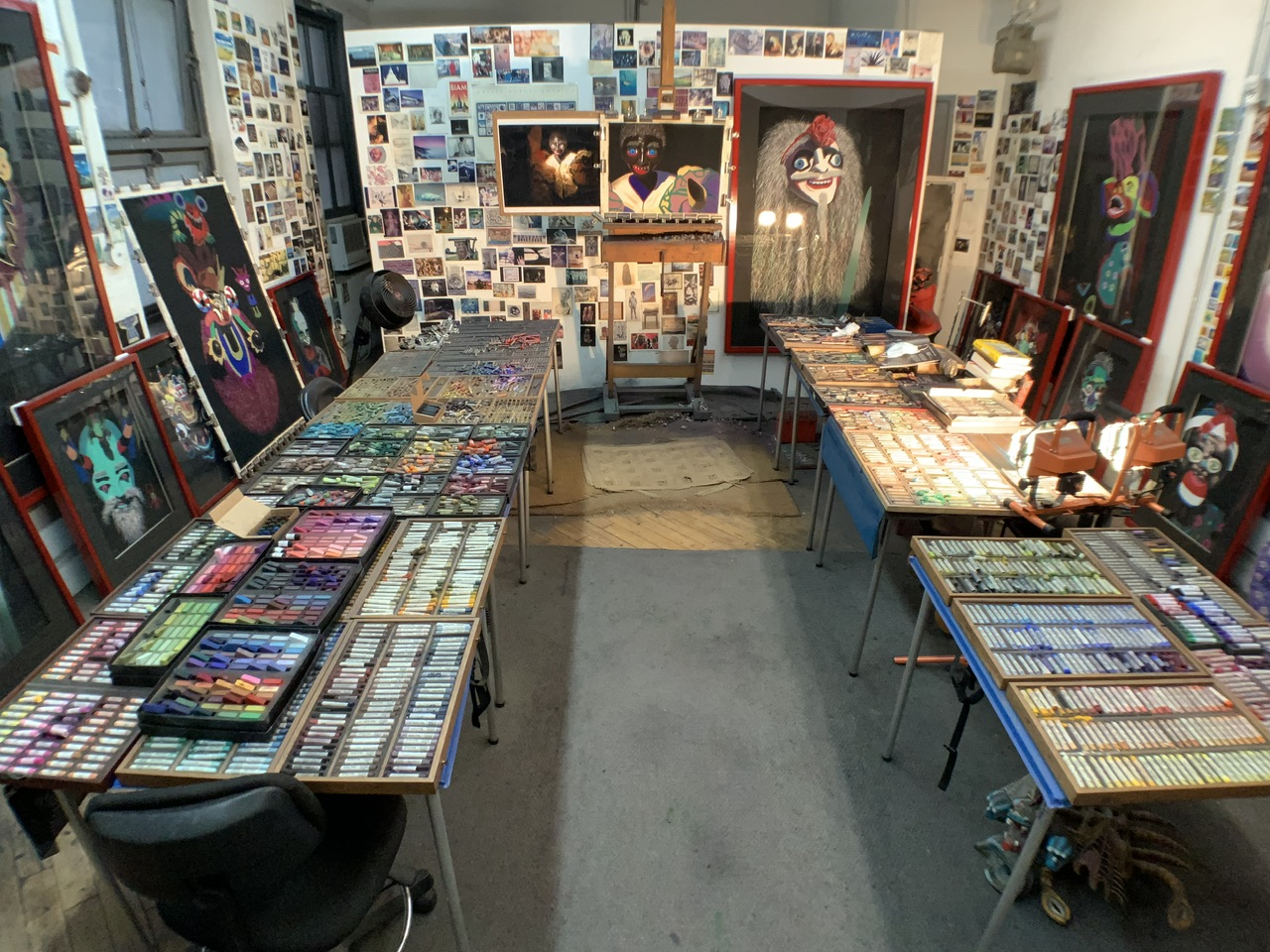
Barbara’s Studio
A: That’s a great question! I’d say that collectors of my work typically range in age from about 40 to their late 70s, they are college graduates with advanced degrees, they often don’t have kids, which is why they have disposable income and time to pursue their interests in art and culture. When I meet them (presuming my work was sold through a gallery or other third party), we usually have much to talk about – art, art history, photography, cinema, film history, dance, drama, music, travel, archaeology, Mexico, Central and South America, India, Asia – the list goes on and on.
Comments are welcome!
Q: What do your collectors have in common?

Screenshot from “Barbara Rachko: True Grit,” Photo: Jennifer Cox
A: Generally speaking, the people who collect my work typically range in age from about 40 to the late 70s, they are college graduates with advanced degrees, and they often don’t have kids, which is why they have disposable income and time to pursue their interests in art and culture. When I meet them (presuming my work was sold through a gallery or other third party), we usually have much to talk about – art, art history, photography, cinema, film history, dance, drama, music, travel, archaeology, Mexico, Central and South America, Bali, India – the list goes on and on.
Comments are welcome!

Q: Contemporary art has become very diverse and multidisciplinary in the last few decades. Do you welcome this trend? Is this trend part of your art practice? (Question from artamour)
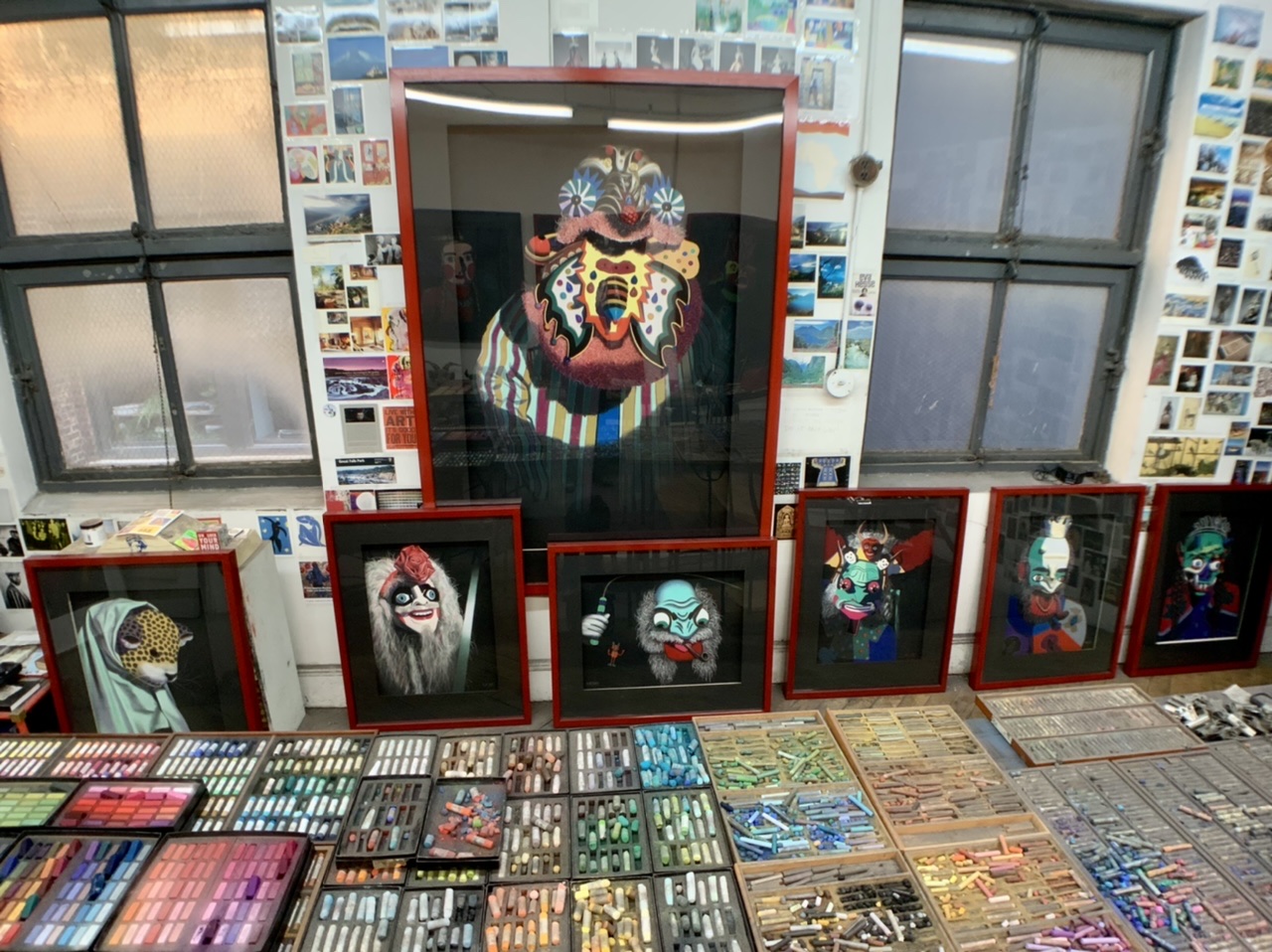
A: By definition trends in art come and go and I don’t see how any self-respecting artist can or should pay much attention to them. I continue to do my own thing, refining my soft pastel techniques, following wherever my interests, inspiration, and subject matter lead, all the while striving to become a better artist.
Comments are welcome!
Q: What about the importance of vision in your training in the Navy has helped you be able to see what you want to create in your art? (Question from “Arte Realizzata”)

A: I continue to reflect on what my experiences as a Naval officer contributed to my present career. Certainly, I learned attention to detail, time management, organization, and discipline, which have all served me well. I keep regular studio hours (currently 10:00 – 4:00 on Monday, Tuesday, Thursday, Friday, and Saturday) which I understand is rare among artists.
Prior to joining the Navy, I had financed my own flight training to become a commercial pilot and Boeing-727 Flight Engineer. However, my Naval career consisted entirely of monotonous paper-work jobs that were not the least bit intellectually challenging. Finding myself stuck in jobs that reflected neither my skills nor my interests, I made a major life change. When I left active duty at the Pentagon I resolved, “I have just resigned from the most boring job. I am going to do my best to never make BORING art!” Other than this, I an hard-pressed to pinpoint anything the Navy contributed to my art career.
Comments are welcome!
Pearls from artists* # 446

*an ongoing series of quotations – mostly from artists, to artists – that offers wisdom, inspiration, and advice for the sometimes lonely road we are on.
What stops us in our tracks? I am rarely stopped by something or someone I can instantly know. In fact, I have always been attracted to the challenge of getting to know what I cannot instantly categorize or dismiss, whether an actor’s presence, a painting, a piece of music, or a personal relationship. It is the journey towards the object of attraction that interests me. We stand in relation to one another. We long for the relationship that will change our vistas. Attraction is an invitation to an evanescent journey, to a new way of experiencing life or perceiving reality.
An authentic work of art embodies intense energy. It demands response. You can either avoid it, shut it out, or meet it and tussle. It contains attractive and complicated energy fields and a logic all its own. It does not create desire or movement in the receiver, rather it engenders what James Joyce labelled ‘aesthetic interest.’ You are stopped in your tracks. You cannot easily walk by it and go on with your life. You find yourself in relation to something that you cannot readily dismiss.
Anne Bogart in A Director Prepares: Seven Essays on Art and Theater
Comments are welcome!


 barbararachkoscoloreddust.com