Blog Archives
Pearls from artists* # 585
*an ongoing series of quotations – mostly from artists, to artists – that offers wisdom, inspiration, and advice for the sometimes lonely road we are on.
Improvisation, composition, writing, painting, theater, invention, all creative acts are forms of play, the starting place of creativity in the human growth cycle, and one of the great primal life functions. Without play, learning and evolution are impossible. Play is the taproot from which original art springs; it is the raw stuff that the artist channels and organizes with all his learning and technique. Technique itself springs from play, because we can acquire technique only by the practice of practice, by persistently experimenting and playing with our tools and testing their limits and resistances. Creative work is play; it is free speculation using the materials of one’s chosen form. The creative mind plays with the objects it loves. Artists play with color and space. Musicians play with sound and silence. Eros plays with lovers. Gods play with the universe. Children play with everything they can get their hands on.
Stephen Nachmanovitch in Free Play: Improvisation in Life and Art
Comments are welcome!
Pearls from artists* # 570
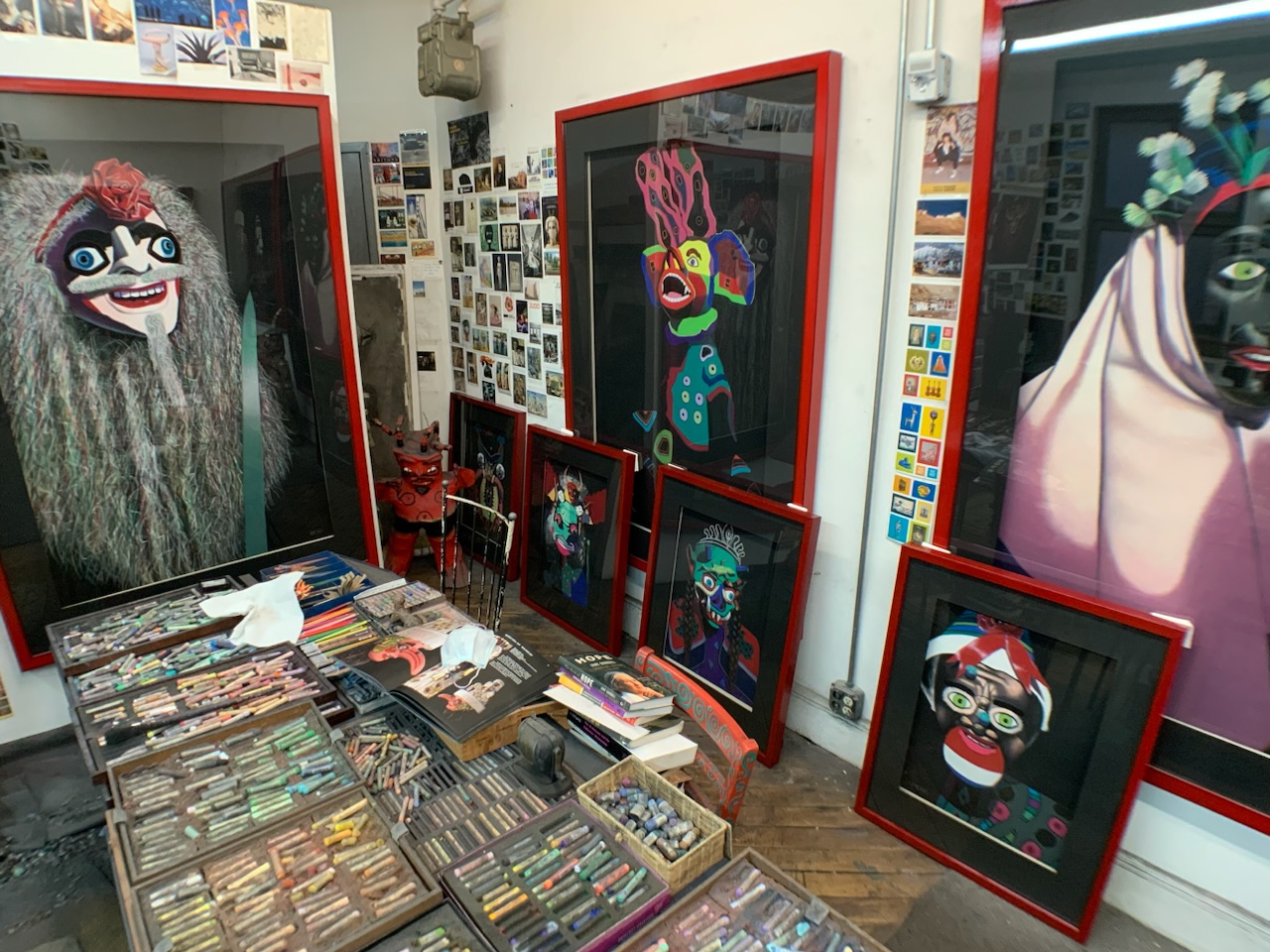
Barbara’s Studio
*an ongoing series of quotations – mostly from artists, to artists – that offers wisdom, inspiration, and advice for the sometimes lonely road we are on.
One of the main differences between the young girl who drew a line in chalk from the Metropolitan Museum all the way to her home on Park Avenue and the young woman who drew lines on canvas and paper twenty years later was that the latter understood the willfulness that drove the child. She was facing “the monster,” the consuming need to create, which was beyond her control but no longer beyond her comprehension. Helen [Frankenthaler] had long understood that her gift set her apart, and that it would be nearly impossible to describe how and why without sounding arrogant or cruel. “It’s saying I’m different, I’m special, consider me differently,” she explained years later. “And it’s also on the other side, a recognition that one is lonely, that one is not run of the mill, that the values are different, and yet we all go into the same supermarkets… and we are all moved one way or another by children and seasons, and dreams. So that art separates you…”
The separation she described was not merely the result of what one did, whether it be painting or sculpting or writing poetry. Helen said the distance between an artist and society was due to a quality both intangible and intrinsic, a “spiritual” or “magical” aspect that nonartists did not always understand and were sometimes frightened by. “They want you to behave a certain way. They want you to explain what you do and why you do it. Or they want you removed, either put on a pedestal or victimized. They can’t handle it.” Helen concluded that existing outside so-called normal life was simply the price an artist paid to create.
Mary Gabriel in Ninth Street Women
Comments are welcome!
Pearls from artists* # 558
Alexandria, VA
*an ongoing series of quotations – mostly from artists, to artists – that offers wisdom, inspiration, and advice for the sometimes lonely road we are on.
One of the main differences between the young girl who drew a line in chalk from the Metropolitan Museum all the way to her home on Park Avenue and the young woman who drew lines on canvas and paper twenty years later was that the latter understood the willfulness that drove the child. She was facing “the monster,” the consuming need to create, which was beyond her control but no longer beyond her comprehension. Helen [Frankenthaler] had long understood that her gift set her apart, and that it would be nearly impossible to describe how and why without sounding arrogant or cruel. “It’s saying I’m different, I’m special, consider me differently,” she explained years later. “And it’s also on the other side, a recognition that one is lonely, that one is not run of the mill, that the values are different, and yet we all go into the same supermarkets… and we all are moved one way or the other by children and seasons, and dreams. So the art separates you.”
The separation she described was not merely the result of what one did, whether it be painting or sculpting or writing poetry. Helen said the distance between an artist and society was due to a quality both tangible and intangible and intrinsic, a “spiritual” or “magical” aspect that nonartists did not always understand and were sometimes frightened by. “They want you to behave a certain way. They want you to explain what you do and why you do it. Or they want you removed, either put on a pedestal or victimized. They can’t handle it.” Helen concluded that existing outside so-called normal life was simply the price an artist paid to create.
Mary Gabriel in Ninth Street Women
Comments are welcome!
Pearls from artists* # 482

*an ongoing series of quotations – mostly from artists, to artists – that offers wisdom, inspiration, and advice for the sometimes lonely road we are on.
Devils’ heads with daring and disturbing eyes, twisted horns, abundant grey hair and hooked noses hang on the blue walls of Antonio Viscarra’s house. Long benches covered with old, multi-colored cushions in Bolivian motifs surround the concrete floor of the small room. Several dozen of these hanging faces, which seem to watch in silence from the darkness, are ready to be used in festivals and traditional dances.
The maskmaker or “maestro” as he is called, lives [deceased now] in the area of Avenida Buenos Aires, far from the political and administrative center of the city of La Paz, but rather at the very center of the other La Paz (Chuquiago in the Aymara language) where many peasant immigrants have settled, and which for that reason, is the center of the city’s popular culture.
Viscarra is the oldest creator of masks in La Paz, and his work has helped to conserve, and at the same time to rejuvenate, the tradition of using masks in Bolivian dances. If economic progress and alienation have contributed to the excessive adornment of new masks with glass and other foreign materials, Viscarra, in an attempt to recover the distinctive, original forms, has gone back to the 100-year-old molds used by his grandfather. His work has been exhibited in Europe, in the United States and in South America, Most important, however, is that Viscarra is transmitting his knowledge to his children, ensuring that this form of authentic Bolivian culture will never die.
…Viscarra inherited the old mask molds from his grandfather and was told to take good care of them because some day he might need them. After keeping them carefully put away for 50 years, the maestro used them again for an exhibition of masks prepared in 1984, slowly recreating the original masks, beautiful in their simplicity, in their delicate craftsmanship and in their cultural value. In this way, the masks which emerged from the old molds are regaining their past prestige and importance.
Antonio Viscarra, The mask Maker by Wendy McFarren in Masks of the Bolivian Andes, Editorial Quipus and Banco Mercantil
Comments are welcome!
Pearls from artists* # 455
*an ongoing series of quotations – mostly from artists, to artists – that offers wisdom, inspiration, and advice for the sometimes lonely road we are on.
You live like this, sheltered, in a delicate world, and you believe you are living. Then you read a book (Lady Chatterley, for instance), or you take a trip, or you talk with [someone], and you discover that you are not living, that you are hibernating. The symptoms of hibernating are easily detectable: first, restlessness. The second symptom (when hibernating becomes dangerous and might degenerate into death): absence of pleasure. That is all. It appears like an innocuous illness. Monotony, boredom, death. Millions live like this (or die like this) without knowing it. They work in offices. They drive a car. They picnic with their families. They raise children. And then some shock treatment takes place, a person, a book, a song, and it awakens them and saves them from death.
… Some never awaken. They are like the people who go to sleep in the snow and never awaken. But I am not in danger because my home, my garden, my beautiful life do not lull me. I am aware of being in a beautiful prison, from which I can only escape by writing.
Anaïs Nin in The Diary of Anaïs Nin, Volume 3: 1939-1944
Comments are welcome!
Pearls from artists* # 441
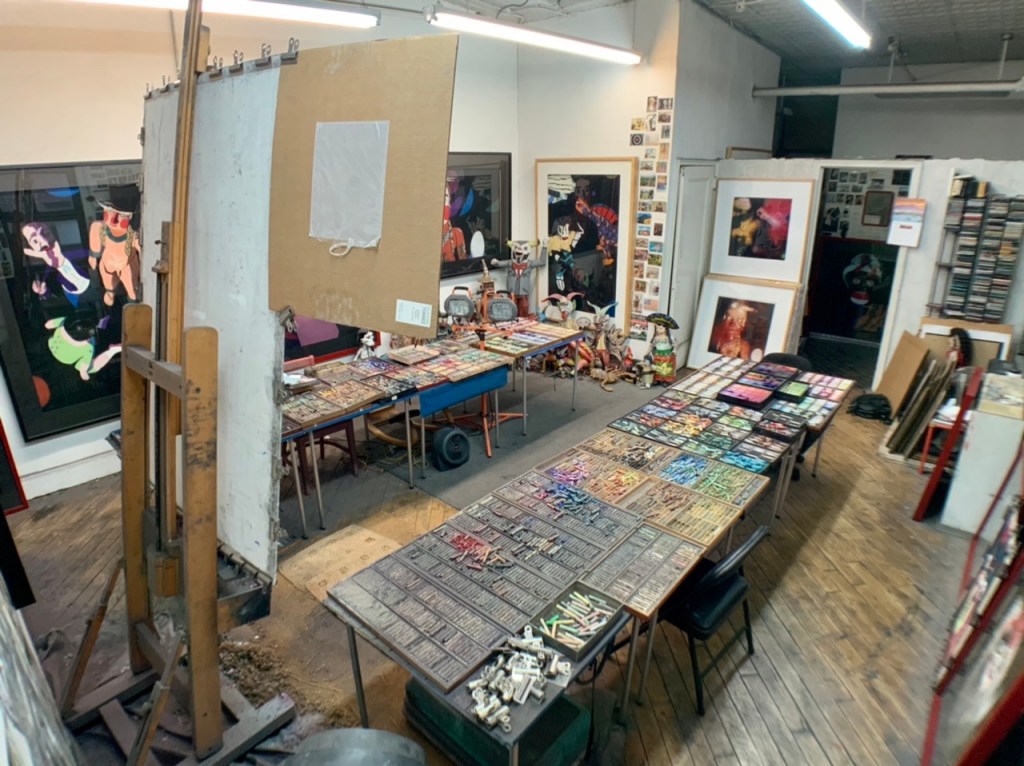
*an ongoing series of quotations – mostly from artists, to artists – that offers wisdom, inspiration, and advice for the sometimes lonely road we are on.
The most perennially popular category of art is the cheerful, pleasant, and pretty kind: meadows in spring, the shade of trees on hot summer days, pastoral landscapes, smiling children. This can be deeply troubling to people of taste and intelligence.
… The worries about prettiness are twofold. First, pretty pictures are alleged to feed sentimentality. Sentimentality is a symptom of insufficient engagement with complexity, by which one really means problems. The pretty picture seems to suggest that in order to make life nice, one merely has to brighten up the apartment with a depiction of some flowers. If we were to ask the picture what is wrong with the world, it might be taken as saying ‘You don’t have enough Japanese water gardens’ – a response that appears to ignore all the more urgent problems that confront humanity (primarily economic, but also moral, political, and sexual). The very innocence and simplicity of the picture seems to mitigate against any attempt to improve life as a whole. Secondly, there is the related fear that prettiness will numb us and leave us insufficiently critical and alert to the injustices surrounding us.
Alain de Botton and John Armstrong in Art as Therapy
Comments are welcome!
Pearls from artists* # 201

Barbara’s studio
* an ongoing series of quotations – mostly from artists, to artists – that offers wisdom, inspiration, and advice for the sometimes lonely road we are on.
Matisse needs to find life difficult. There has to be opposition and struggle: “You come out by your own means,” he says: “The essential thing is to come out, to express that sense of falling head over heals for a thing; the artist’s job is not to transpose something he’s seen but to express the impact the object made on him, on his constitution, the shock of it and the original reaction.”
I sense that Matisse has little faith in the way his painting is feted nowadays. A man of scrupulous integrity, he must wonder how much truth there is in all of that. There is a vein of gutsy courage in him that is as unyielding now as it ever was. Hard times have accustomed him to rely entirely on his own judgment and accept the solitude that this implies.
HM: I’m already a little too official. You need a bit of persecution. When you’ve been controversial and they finally welcome you in, something goes wrong. Very few people can see the picture itself; they just see the banknotes you could turn it into. You love your paintings less when they’re worth something. When they’re not worth a cent, they’re like desolate children.
Chatting with Henri Matisse: The Lost 1941 Interview, Henri Matisse with Pierre Courthion, edited by Serge Guilbaut, translated by Chris Miller
Comments are welcome!
Pearls from artists* # 175
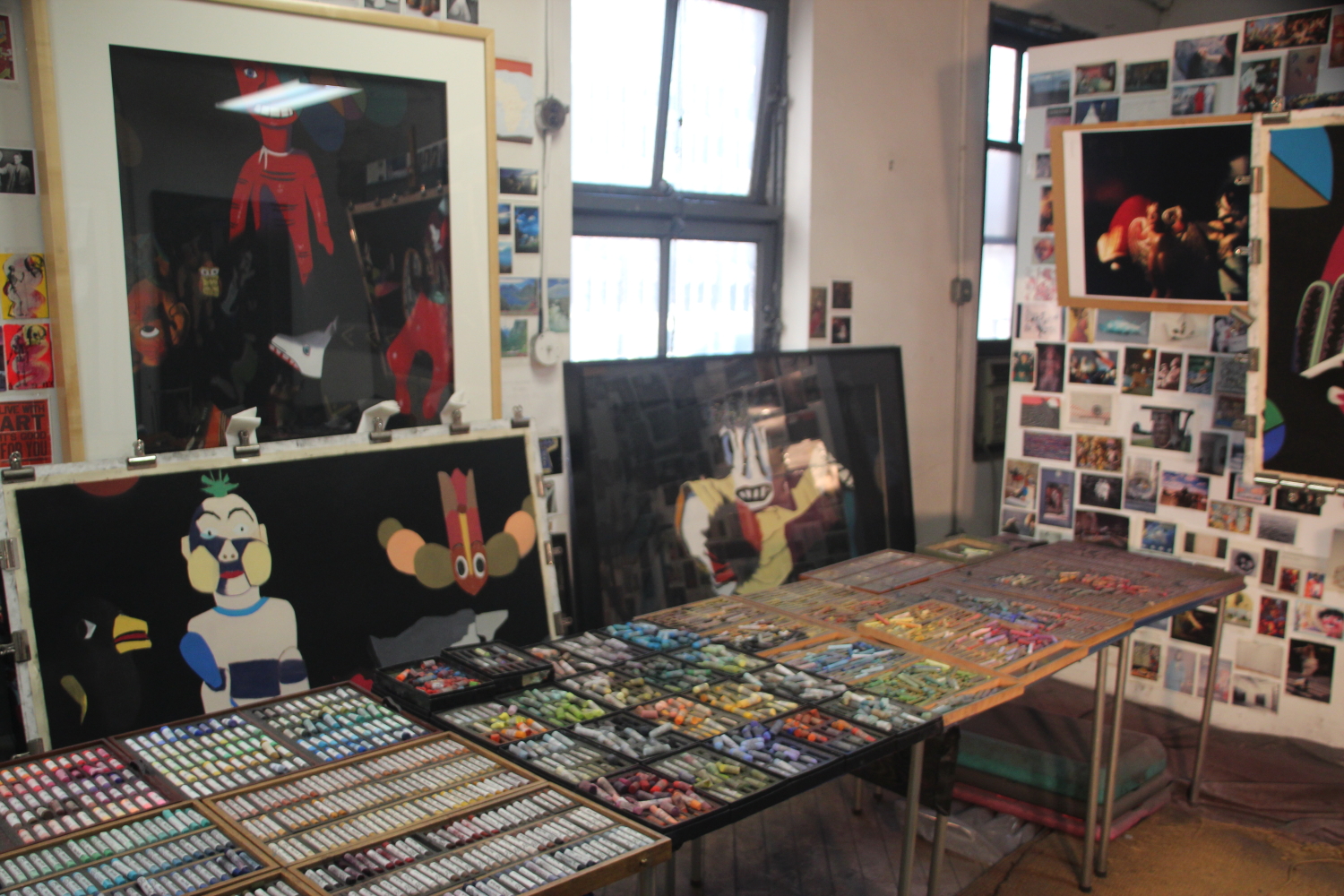
Barbara’s studio
* an ongoing series of quotations – mostly from artists, to artists – that offers wisdom, inspiration, and advice for the sometimes lonely road we are on.
I know this is a sentimental cliché, but I do feel toward my books very much as a parent must toward his children. As soon as someone says, “I did like your short stories, but I don’t like your novels,” or, “Of course, you only really came into your own with Anglo-Saxon Attitudes” – then immediately I want to defend all my other books. I feel this especially about Hemlock and Anglo-Saxon Attitudes – one child a bit odd but exciting, the other competent but not really so interesting. If people say they like one book and not the other, then I feel they can’t have understood the one they don’t like.
Angus Wilson in The Paris Review Interviews: Writers at Work 1st Series, edited and with an introduction by Malcolm Cowley
Comments are welcome!
Pearls from artists* # 84

My Alexandria living room
* an ongoing series of quotations – mostly from artists, to artists – that offers wisdom, inspiration, and advice for the sometimes lonely road we are on.
I have a stockpile of sculptures, paintings, and drawings – every work of art I have made that has not sold – in a storage space for which I pay every month as regularly as I pay my utility bills. This is a sensible arrangement, as I can leave this work to my children. Most of the time I never give it a thought, but this morning it flashed across my mind that if it were blown away I would be bereaved in a way that would hurt me very much. I have not been inordinately materialistic, but I am attached to my house, to my inherited belongings, and to the things that I have chosen for myself. All these objects add complexity to my emotional ties to people with whom I have shared, and share, my life, and to my aspirations for myself.
Anne Truitt in Turn: The Journal of an Artist
Comments are welcome!
Q: Can you speak about what draws you to the Mexican and Guatemalan figures that you collect?
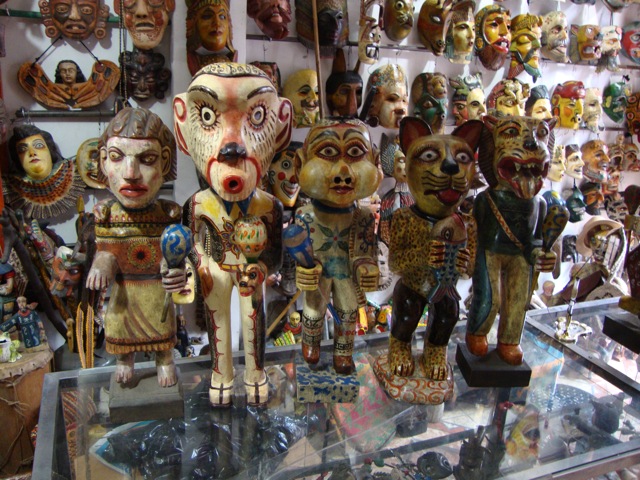
Shop in Panajachel, Guatemala, Photo: Donna Tang
A: I search the markets and bazaars of Mexico, Guatemala, and elsewhere for folk art objects – masks, carved wooden animals, papier mache figures, children’s toys – to bring back to New York to paint and photograph. Color is very important – the brighter and the more eye-catching the patterns are on these objects the better – plus they must be unique and have lots of personality. I try not to buy anything mass-produced or obviously made for the tourist trade. The objects must have been used or otherwise look like they’ve had a life (i.e., been part of religious festivities) to draw my attention. How and where each one comes into my possession is an important part of my creative process.
Finding, buying, and getting them back to the U.S. is always circuitous, but that, too, is part of the process, an adventure, and often a good story. Here’s an example. In 2009 I was in a small town on the shores of Lake Atitlan in Guatemala, called Panajachel. After returning from a boat ride across the lake, my friends and I were walking back to our hotel when we discovered a wonderful mask store. I spent some time looking around, made my selections, and was ready to buy five exquisitely-made standing wooden figures, when I learned that Tomas, the store owner, did not accept credit cards. I was heart-broken and thought, “Oh, no, I’ll have to leave them behind.” However, thanks to my good friend, Donna, whose Spanish is much more fluent than mine, the three of us brain-stormed until finally, Tomas had an idea. I could pay for the figures at the hotel up the block and in a few days when the hotel was paid by the credit card company, the hotel would pay Tomas. Fabulous! Tomas, Donna, and I walked to the hotel, where the transaction was made and the first hurdle was overcome. Working out the packing and shipping arrangements took another hour or two, but during that time Tomas and I became friends and exchanged telephone numbers (the store didn’t even have a telephone so he gave me the phone number of the post office next door, saying that when I called, he could easily run next door!). Most surprisingly, the package was waiting for me in New York when I returned home from Guatemala.
Comments are welcome!


 barbararachkoscoloreddust.com