Blog Archives
Pearls from artists* # 355

“The Champ,” soft pastel on sandpaper, 26″ x 20″
*an ongoing series of quotations – mostly from artists, to artists – that offers wisdom, inspiration, and advice for the sometimes lonely road we are on.
True art provides us with truth in a manner analogous to science. Its prophetic dimension – its knack for showing us the side of things that our interests blind us to – make it a source of knowledge, even though it is knowledge of a kind that instrumental reason has little time for. The psychologists who revolutionized our understanding of human psychology in the earliest twentieth century drew on two principal sources to build their concepts: the dream life of their patients and the great art of the past. Without this recognition of the primacy of imagination, Freud and Jung could never have drawn their maps of the psyche. Those who work for a better world would do well to follow their example and find the guiding patterns of life in the prophetic artistic works of the past and present. Only art can act as a counter-weight to that uniquely modern mentality that, wherever it becomes the only game in town, seeks to persuade us that the proper goal of human beings is to contain, dissect, and control everything – that even the most persistent mysteries are just problems to be solved.
J.F. Martel in Reclaiming Art in the Age of Artifice: A Treatise, Critique, and Call to Action
Comments are welcome!
Pearls from artists* # 354

“Epiphany,” soft pastel on sandpaper, 38″ x 58″
*an ongoing series of quotations – mostly from artists, to artists – that offers wisdom, inspiration, and advice for the sometimes lonely road we are on.
My earlier work had taught me that artistic activity is a form of reasoning, in which perceiving and thinking are indivisibly intertwined. A person who paints, writes, composes, dances, I felt compelled to say, thinks with his senses. This union of perception and thought turned out to be not merely a specialty of the arts. A review of what is known about perception, and especially about sight, made me realize that the remarkable mechanisms by which the senses understand the environment are all but identical with the operations described by the psychology of thinking. Inversely, there was much evidence that truly productive thinking in whatever area of cognition takes place in the realm of imagery. This similarity of what the mind does in the arts and what it does elsewhere suggested taking a new look at the long-standing complaint about the isolation and neglect of the arts in society and education. Perhaps the real problem was more fundamental: a split between sense and thought, which caused various deficiency diseases in modern man.
Rudolph Arnheim in Visual Thinking
Comments are welcome!
Q: Where did you grow up and what were some early milestones or experiences that contributed to you becoming an artist later in life?
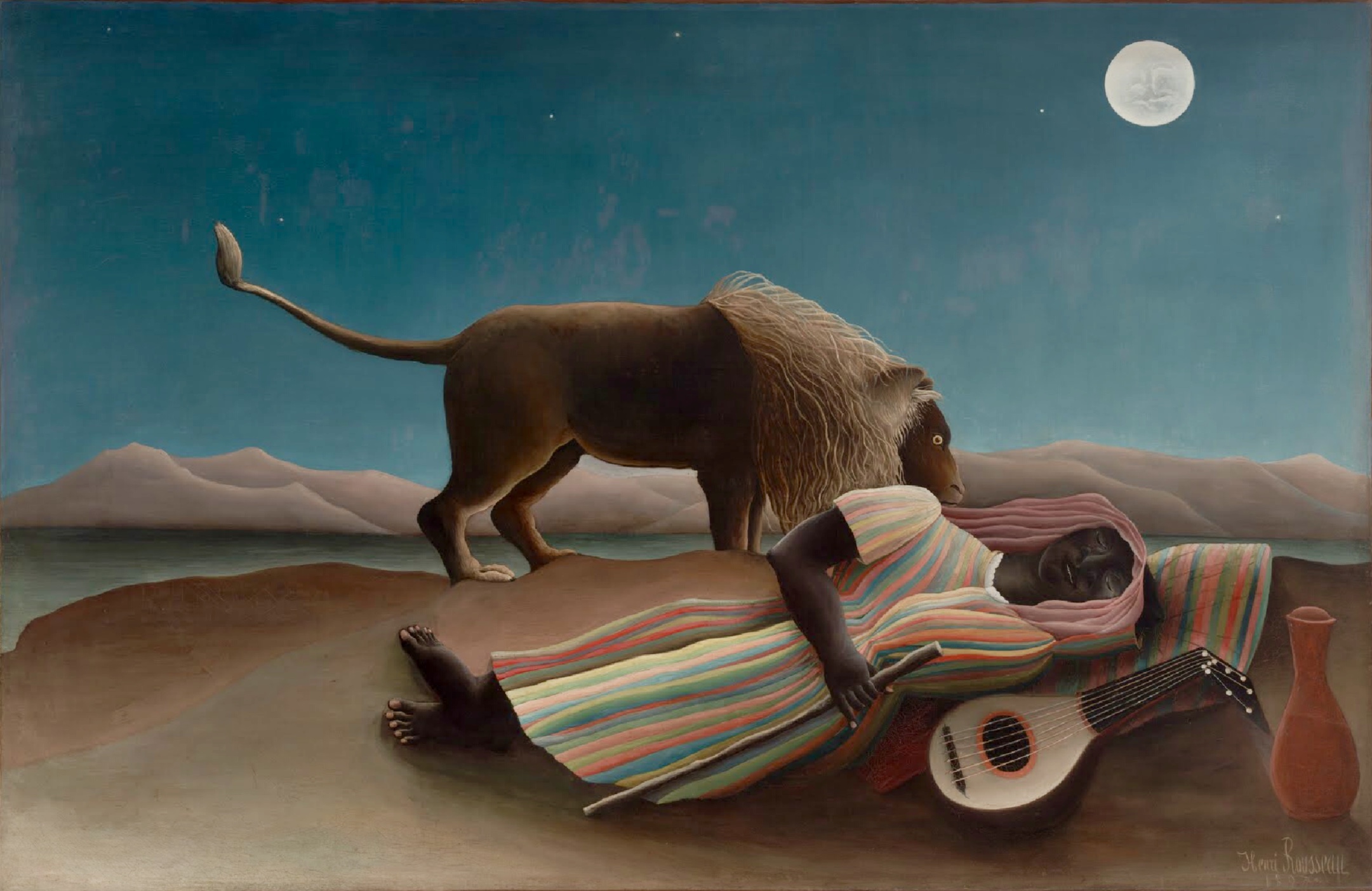
“The Sleeping Gypsy,” Henri Rousseau, oil on canvas, 1897
A: I grew up in a blue collar family in Clifton, New Jersey, a suburb about fifteen miles west of Manhattan. My father was a television repairman for RCA. My mother stayed home to raise my sister and me (at the time I had only one sister, Denise; my sister Michele was born much later). My parents were both first-generation Americans and no one in my extended family had gone to college yet. I was a smart kid who showed some artistic talent in kindergarten and earlier. I remember copying the Sunday comics, which in those days appeared in all the newspapers, and drawing small still lifes I arranged for myself. I have always been able to draw anything, as long as I can see it.
Denise, a cousin, and I enrolled in Saturday morning “art classes” at the studio of a painter named Frances Hulmes in Rutherford, NJ. I was about 6 years old. I continued the classes for 8 years and became a fairly adept oil painter. Since we lived so close to New York City, my mother often took us to museums, particularly to the Museum of Modern Art, the Metropolitan Museum of Art, and the Museum of Natural History. Like so many young girls, I fell in love with Rousseau’s “The Sleeping Gypsy” and was astonished by Picasso’s “Guernica” when it was on long-term loan to MoMA. I have fond memories of studying the dioramas at the Museum of Natural History (they are still my favorite part of the museum). As far as I know, there were no artists in my family so, unfortunately, I had no role models. At the age of 14 my father decided that art was not a serious pursuit – declaring, it is “a hobby, not a profession” – and abruptly stopped paying for my Saturday morning lessons. With no financial or moral support to pursue art, I turned my attention to other interests, letting my artistic abilities go dormant.
Comments are welcome!
Pearls from artists* # 338
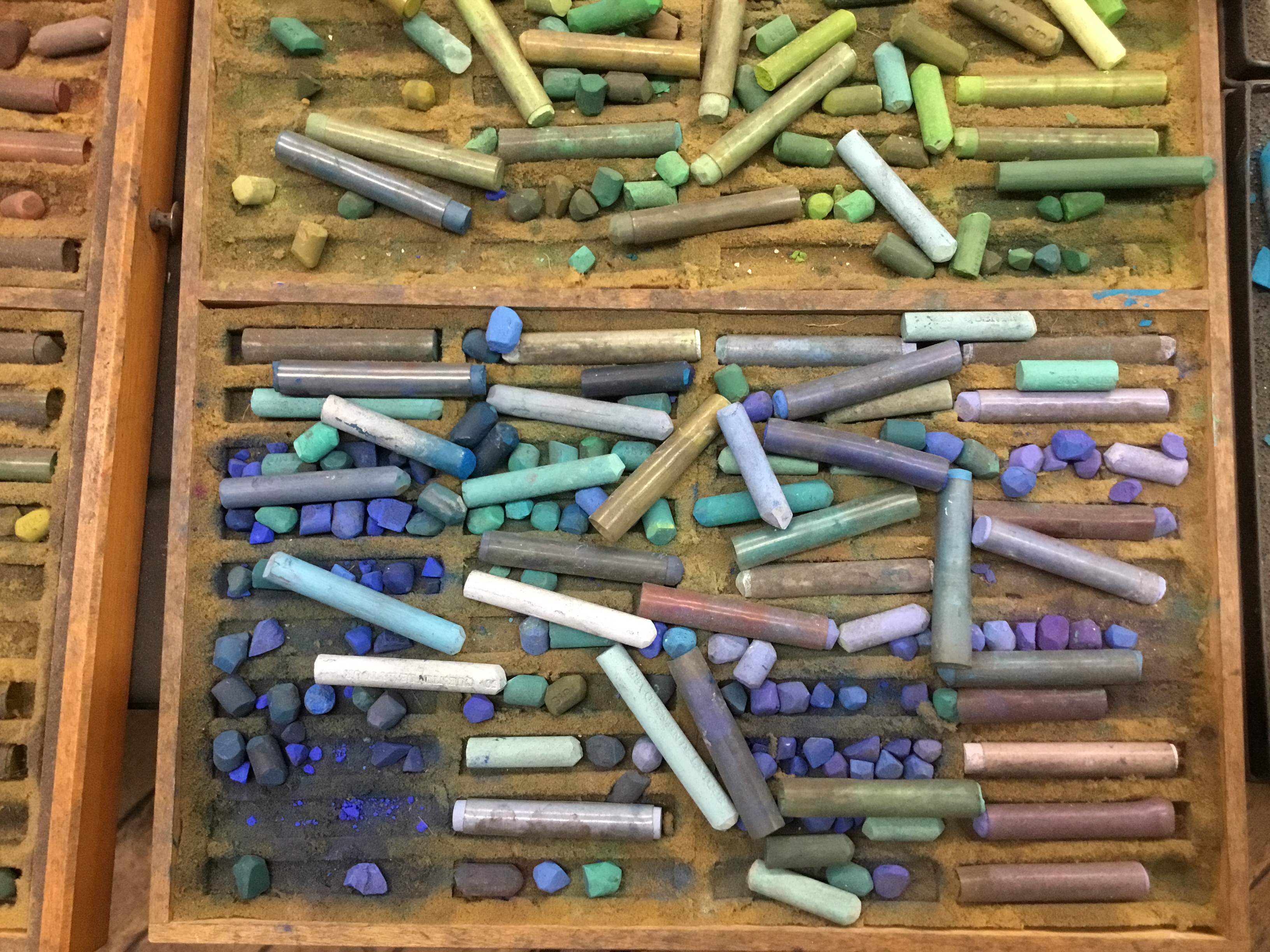
Pastels
*an ongoing series of quotations – mostly from artists, to artists – that offers wisdom, inspiration, and advice for the sometimes lonely road we are on.
Beauty without symbolic depth results in ornament. Symbol without beauty results in psychoanalysis. Only when the two meet can we speak of art. The artistic works that combine the two elements most compellingly are what are called the classics. In his magisterial book The Analogical Imagination, the theologian David Tracy defines the classic as a work exhibiting a permanent “excess of meaning.” We speak of classics as “timeless,” he says, not because they belong to time, but because they are perpetually timely; their relevance never wanes, and each generation, each percipient, must interpret them anew. According to Tracy, we know we are dealing with a classic when a work makes us realize that our general outlook on life is not as complete as we thought it was, that “something else might be the case.” In the light that the classic emanates, things suddenly seem less clear-cut than they used to seem – we find ourselves in the presence of something greater than we are, something potentially infinite. Classics take us to the apex of the numinous, the point of what Werner Herzog calls “ecstatic truth.”
J.F. Martel in Reclaiming Art in the Age of Artifice: A Treatise, Critique, and Call to Action
Comments are welcome!
Pearls from artists* # 314
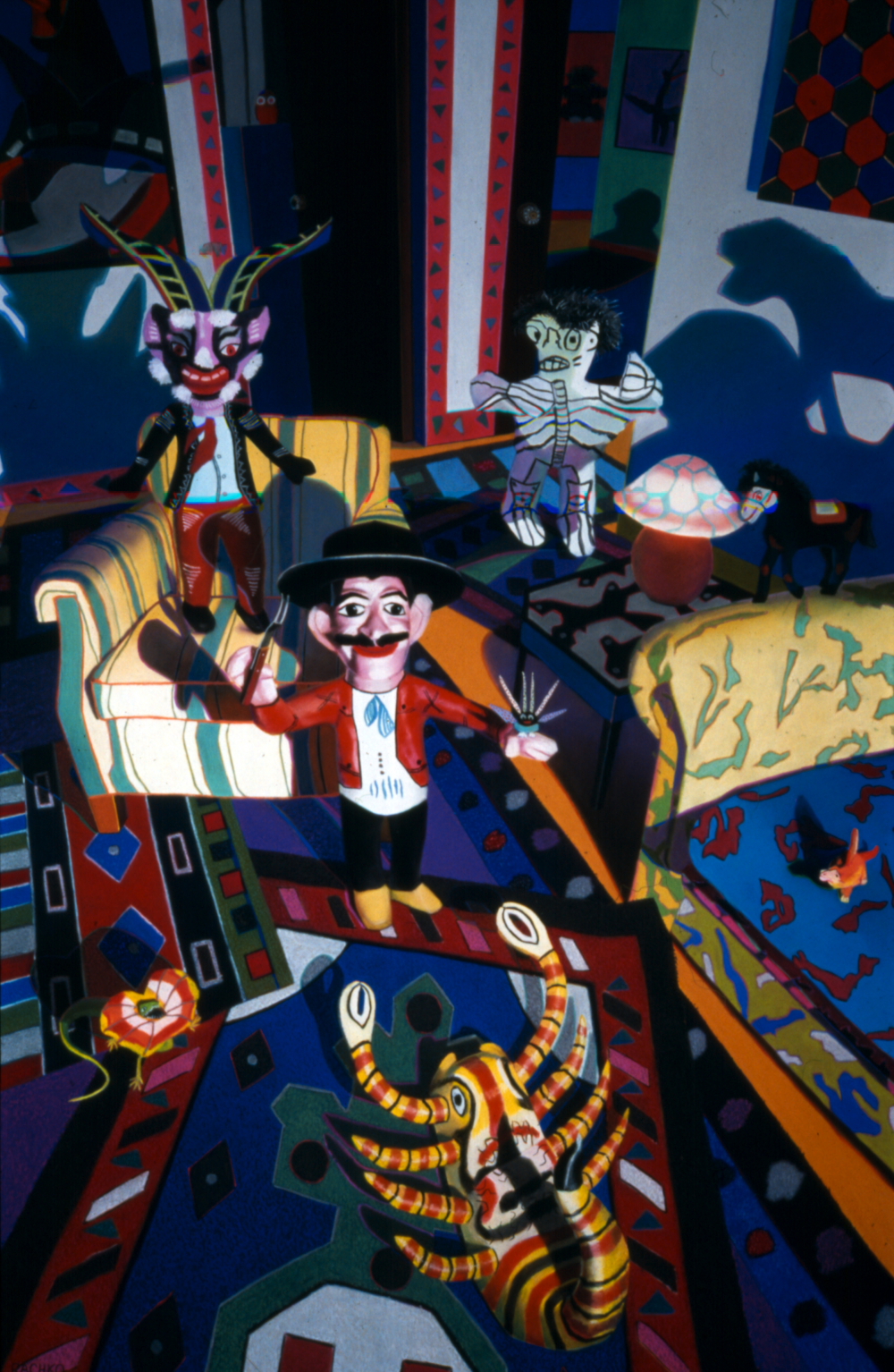
“He Just Stood There Grinning,” soft pastel on sandpaper, 58″ x 38″
*an ongoing series of quotations – mostly from artists, to artists – that offers wisdom, inspiration, and advice for the sometimes lonely road we are on.
For Leonora Carrington and many of her ‘sister’ surrealists, surrealism provided the intellectual, political and artistic milieu that enabled them to come into their own as artists and writers, and to gain recognition for their work in the wider world. Although some of these women had accepted their roles as muses in the lives of male artists, none believed that life as a muse trumped life as an artist. Asked in 1983 how she felt about the male surrealists’ view of women as muses, Leonora offered her testy, if retrospective rejoinder: ‘I thought it was bullshit… I didn’t have time to be anyone’s muse… I was too busy rebelling against my family and learning to be an artist.’ It is as artists and friends that we remember the women of surrealism today.
Whitney Chadwick in The Militant Muse: Love, War, and the Women of Surrealism
Comments are welcome!
Pearls from Artists* # 313

Barbara and Tomas in Panajachel, Guatemala
*an ongoing series of quotations – mostly from artists, to artists – that offers wisdom, inspiration, and advice for the sometimes lonely road we are on.
Proclaiming that the object in Surrealism was fundamental, [Andre] Breton suggests a radical transition in surrealist creation, one that liberated the poet-artist from all constraints in the making of the artistic object. Breton’s text calls for a “revolution of the object,” suggesting that in the placing of an object into a new context, and thus attributing it with a new meaning – also called a “detournement” – which takes precedence. Drawing in his interpretation of Hegelian subject-object relations, Breton describes the “object” as a work of art that relies on a philosophical procedure, affirming the surrealist process as one that is realized in the experience of apprehending the object through a dialectical method. Citing the work of Marcel Duchamp and Max Ernst, Breton explains that an object may become a product of surrealist creation through the simple “manipulation” of it. Here ”manipulation“ is defined as a procedure which reveals the object in its original and new state at the same time. If taking an object out of its original context and placing it in a new space creates the potential for a creative act, then this text seems to validate the surrealist practice of collecting. As the collector acquired objects and unites them in a gallery or a home, they assume new significance contingent upon their physical juxtaposition to other objects.
Moon Dancers: Yup’ik Masks and the Surrealists, edited by Jennifer Field, Introduction by Christina Rudofsky
Comments are welcome!
Pearls from artists* # 272
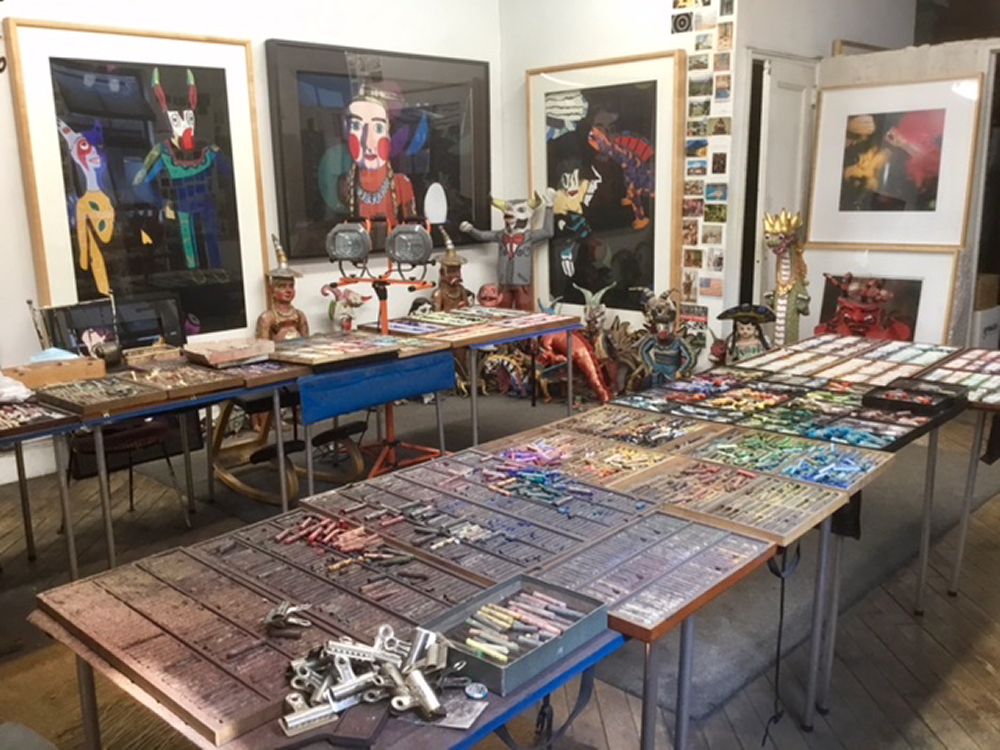
Barbara’s studio
* an ongoing series of quotations – mostly from artists, to artists – that offers wisdom, inspiration, and advice for the sometimes lonely road we are on.
One important distinction that can be made between physicists and novelists, and between the scientific and artistic communities in general, is what I shall call “naming.” Roughly speaking, the scientist tries to name things and the artist tries to avoid naming things.
To name a thing, one needs to have gathered it, distilled and purified it, attempted to identify it with clarity and precision. One puts a box around the thing and says what’s in the box is the thing and what’s not is not…
… The objects and concepts of the novelist cannot be named. The novelist might use the words love and fear, but these names do not summarize or convey much to the reader. For one thing, there are a thousand different kinds of love…
… Every electron is identical, but every love is different.
The novelist doesn’t want to eliminate these differences, doesn’t want to clarify and distill the meaning of love so that there is only a single meaning… because no such distillation exists. And any attempt at such a distillation would undermine the authenticity of readers’ reactions, destroying the delicate, participatory creative experience of a good reader reading a good book. In sense, a novel is not complete until it is read. And each reader completes the novel in a different way.
Alan Lightman in A Sense of the Mysterious: Science and the Human Spirit
Comments are welcome!
Pearls from artists* # 269
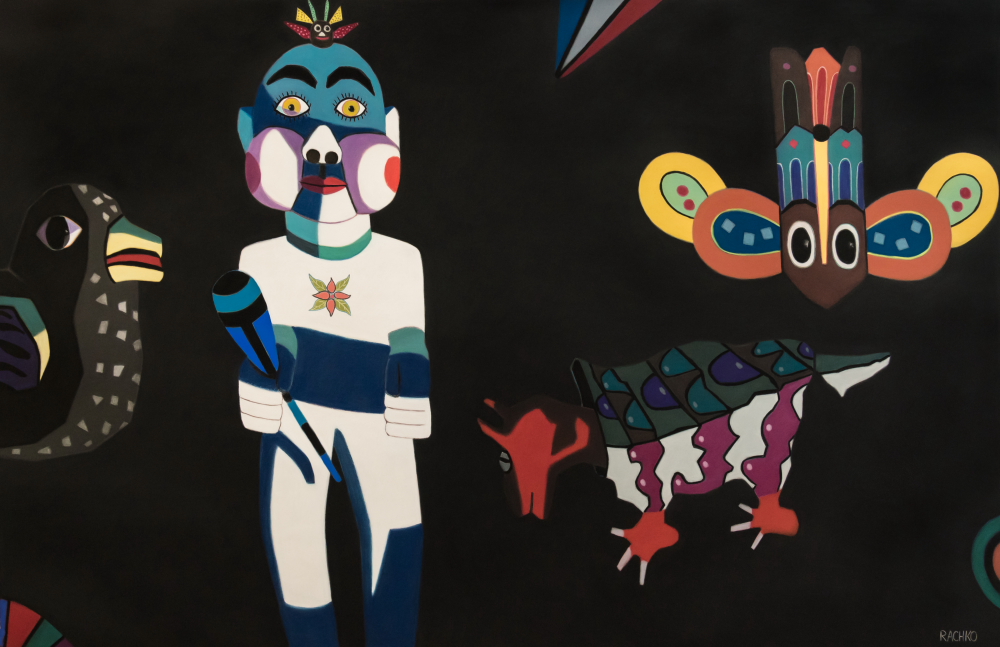
“White Star,” soft pastel on sandpaper, 38″ x 58″
* an ongoing series of quotations – mostly from artists, to artists – that offers wisdom, inspiration, and advice for the sometimes lonely road we are on.
In an artistic sense, cool came to refer to someone with a signature artistic style so integral as to exude an authentic mode-of-being in the world: Miles, Bogart, Brando, Eastwood, Greco, Elvis, Lady Day, Sinatra. Such a person created something from nothing and gave the world some new artistic or psychological “equipment for living,” to use a phrase of Kenneth Burke’s. A signature style is yours and can only be carried by you: it cannot be abstracted except through dilution and commodification since it reflects an individual’s complex personal experience.
Joel Dinerstein in The Origins of Cool in Postwar America
Comments are welcome
Q: What qualities do you think mark the highest artistic achievement?
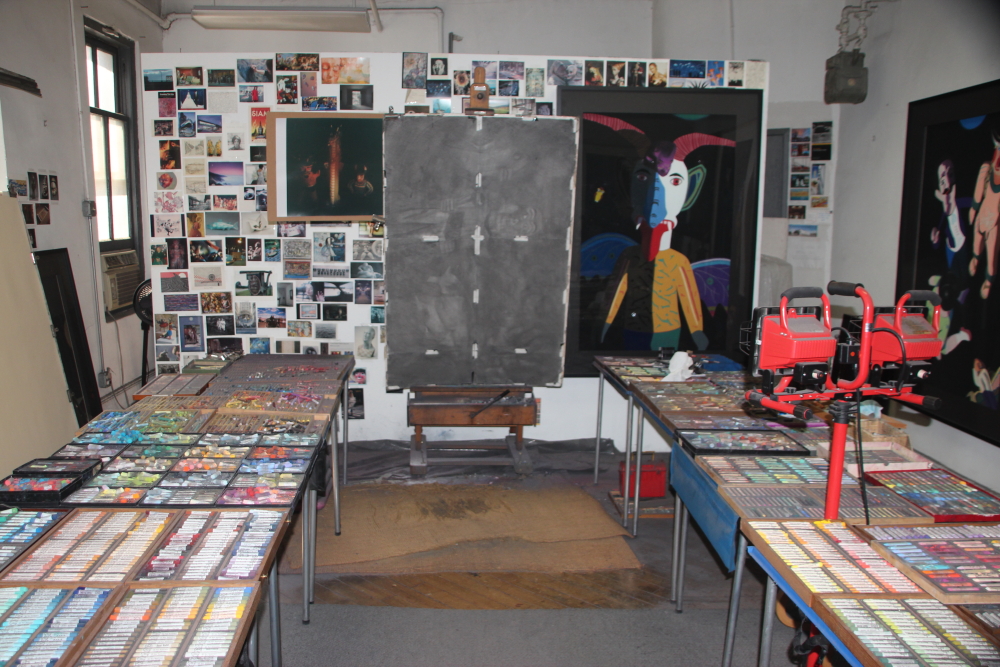
Barbara’s studio
A: If I may speak in the most general terms, several qualities come to mind that, for me, mark real artistic achievement:
- firm artistic control that allows the artist to create works that simultaneously demonstrate formal coherence while responding to inner necessity
- the creation of new forms and techniques that are adapted to expressing the artist’s highly personal vision
- an authentic and balanced fusion of form, method, and idea
- using material from one’s own idiosyncratic experiences and subtly transforming it in a personal inimitable way during the creative process
- the meaning of the thing created is rigorously subordinated to its design, which once established, generates its own internal principles of harmony and coherence
Comments are welcome!
Q: Can you speak about a book (or books) that deeply influenced you as an artist?

Barbara’s well-worn copy of “Camille Pissarro: Letters to His Son Lucien”
A: One such book that stands out is “Camille Pissaro: Letters to His Son Lucien.” The book is comprised of weekly letters from a father conveying wisdom about his craft, art, and life, over roughly twenty years, to a beloved son, who is just beginning his artistic journey. I discovered this gem about thirty years ago when I was just starting to find my way as an artist, too. Pissarro’s words are beautiful, poignant, and deeply felt. He has much to say to artists because, sadly, we still contend with the same problems, such as how to remain authentic and earn a living, how to deal with galleries and collectors, how to stay focused on the work, etc. I often enjoy rereading favorite passages simply because it makes me feel less alone as an artist.
Comments are welcome!



