Category Archives: Working methods
Q: How do you account for your intense compositions? (Question from Robin Plati via Facebook)
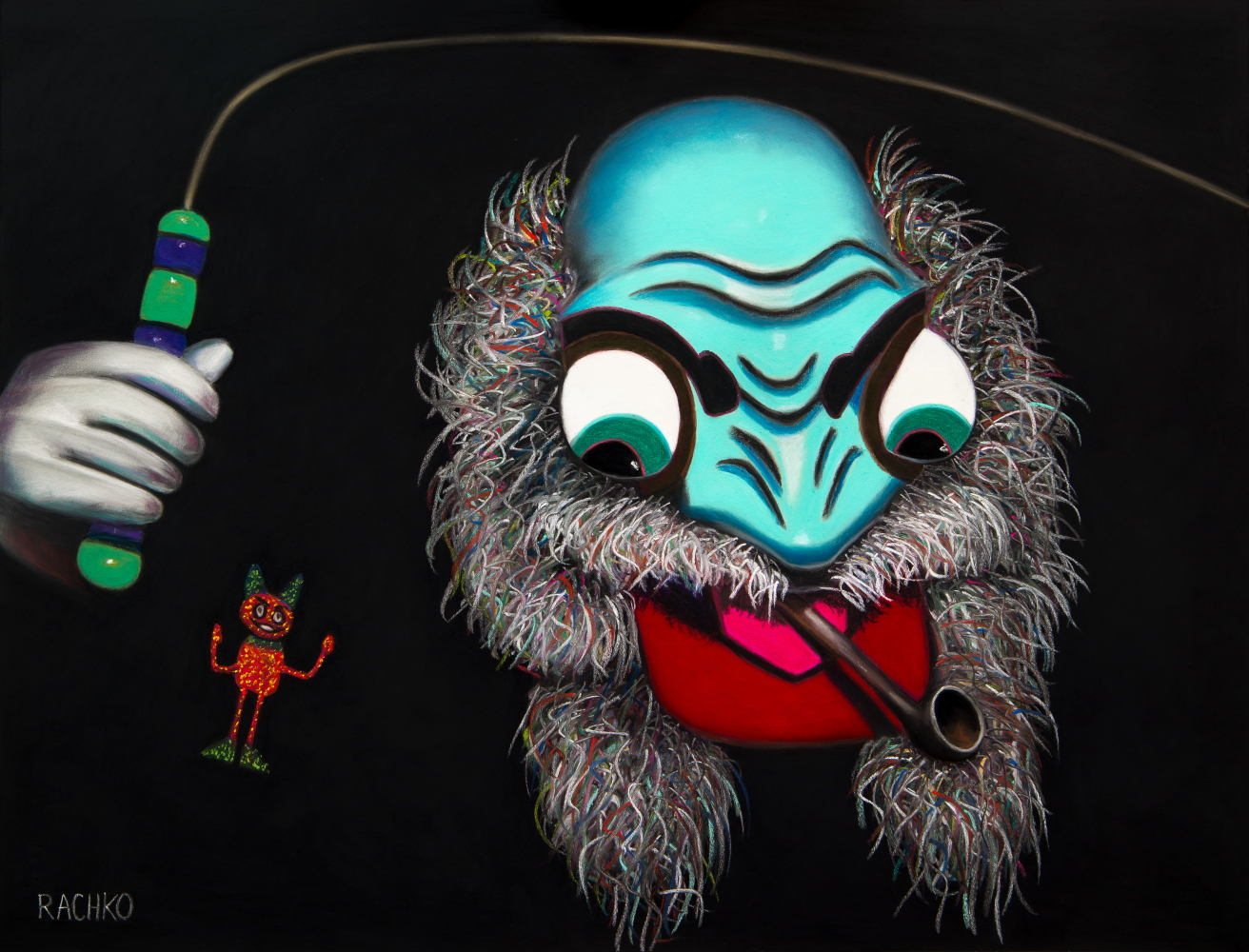
A: If I do say so, composition is something I’m known for. During the months I work on them, I devote many hours to looking at the painting on my easel and figuring out how to move the viewer’s eyes around in interesting ways. Everything you see is carefully worked out after hundreds of studio hours. Finished pastel paintings always have an inevitability about them. Change one detail and the entire composition is thrown off.
Comments are welcome!
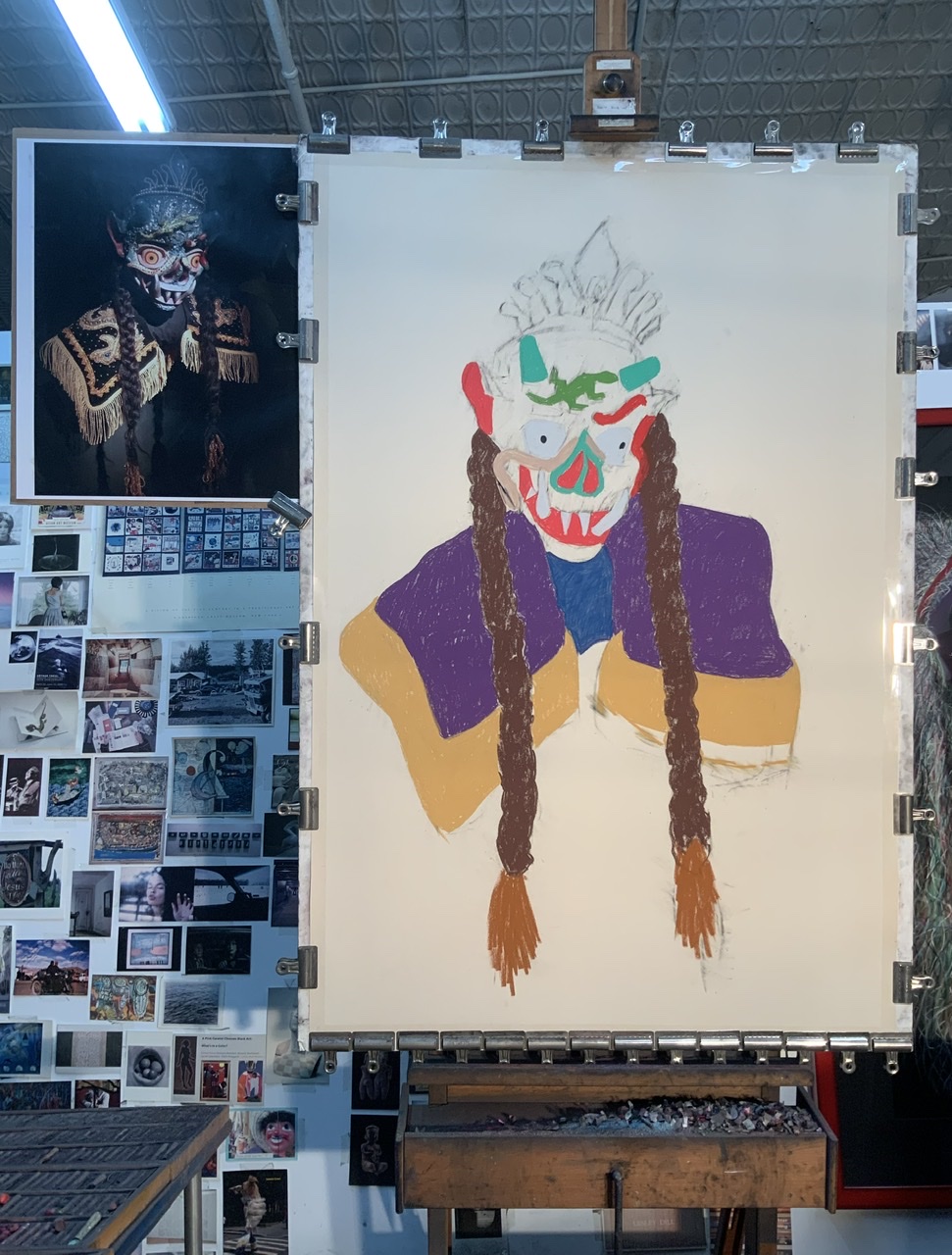
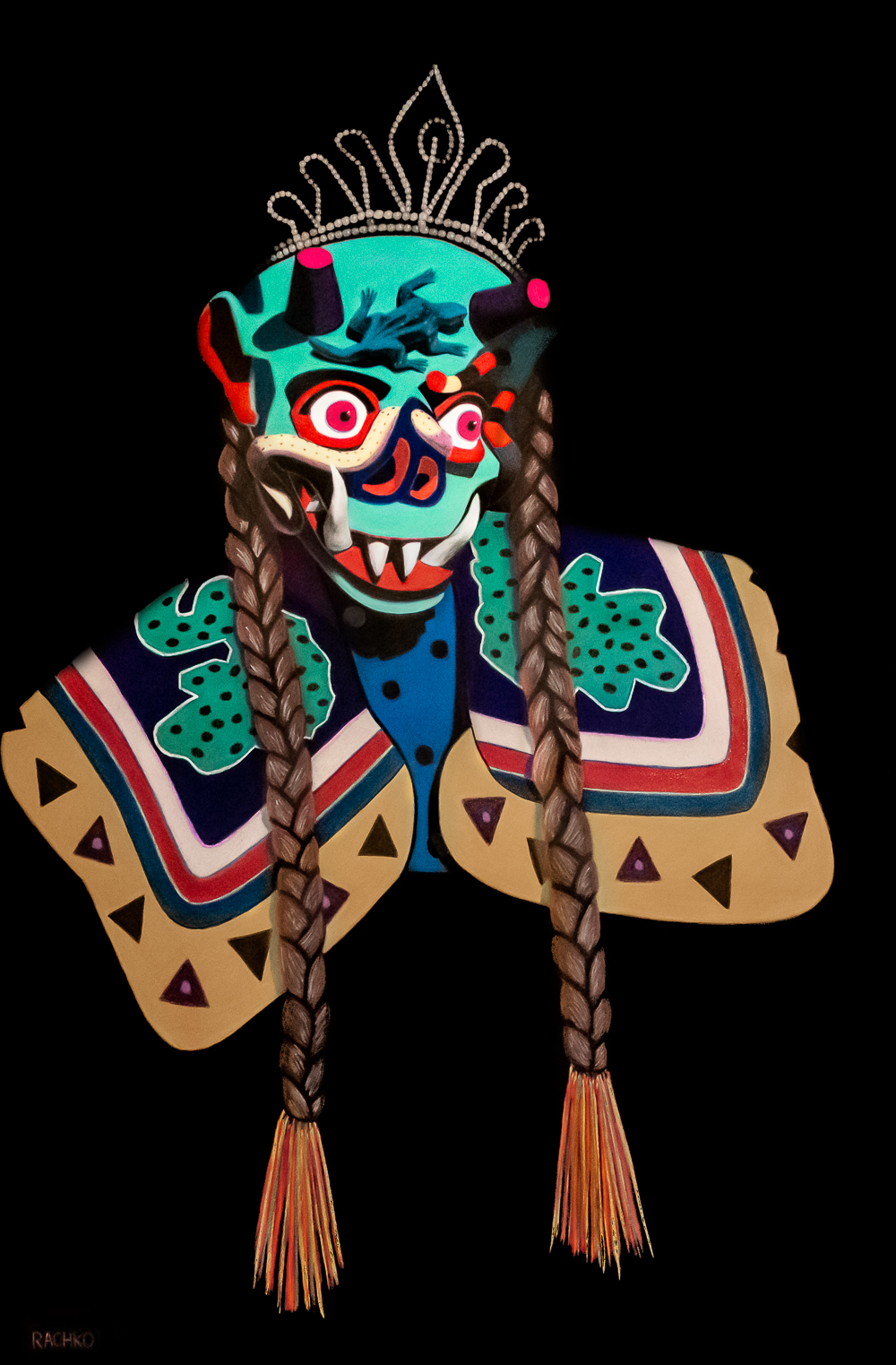
Start/Finish of ”Overlord,” soft pastel on sandpaper, 58” x 38” image, 70” x 50” framed
Comments are welcome!
Q: What’s on the easel today?
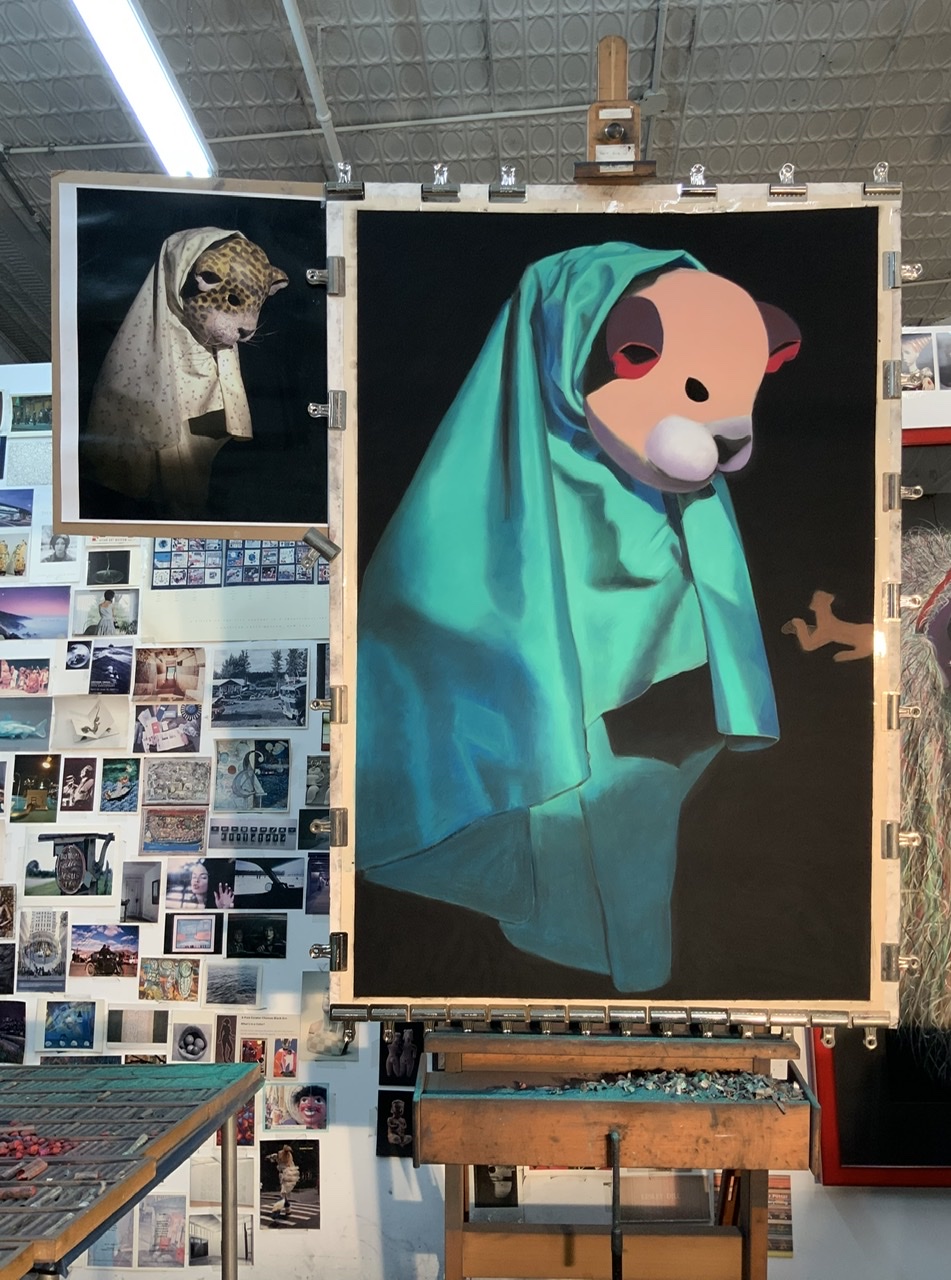
A: I continue working on “Wise One,” soft pastel on sandpaper, 58” x 38.”
Comments are welcome!
Q: What’s on the easel today?
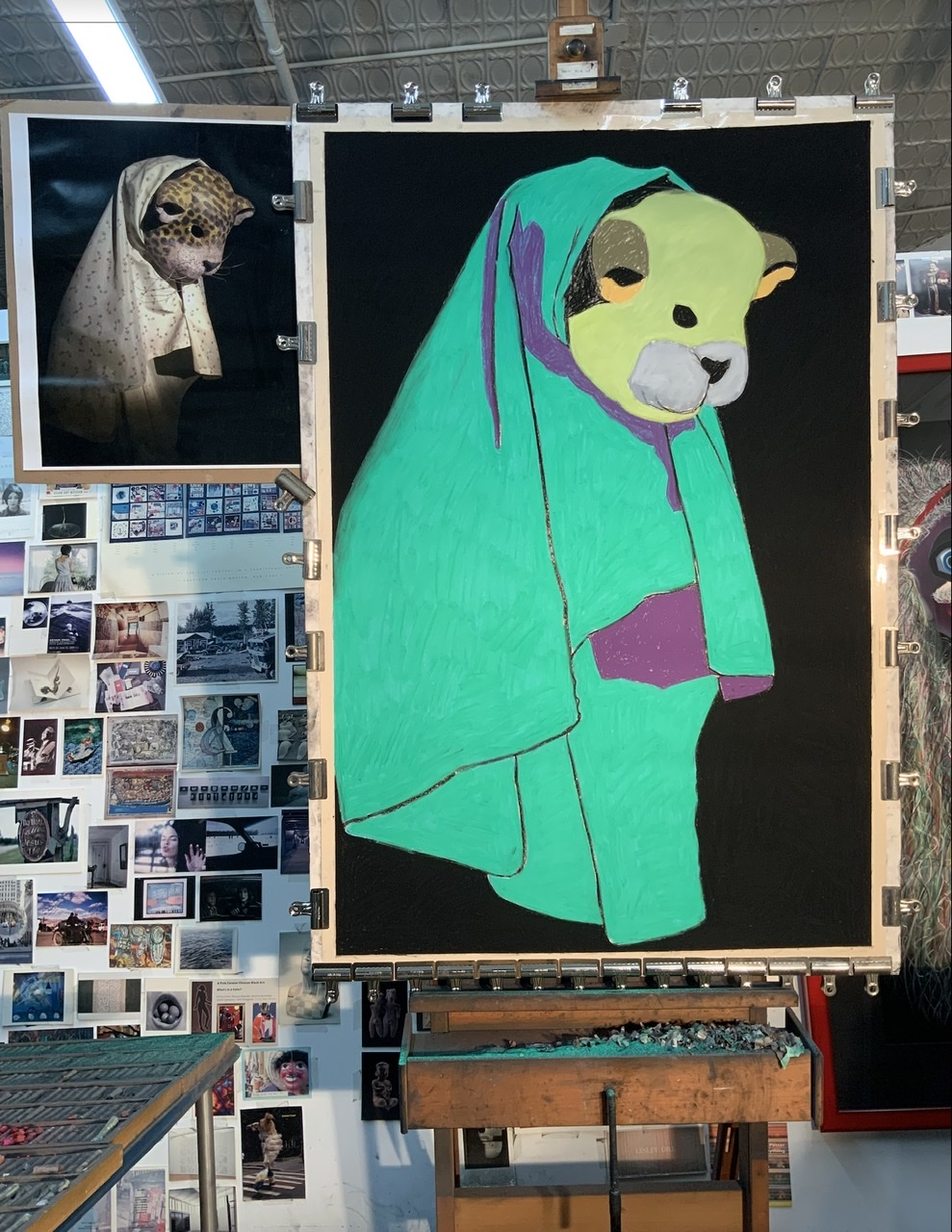
A: I started a new 58” x38” pastel painting. This is how it looks after the first day.
Comments are welcome!
Q: What is your process? (Question from artamour)
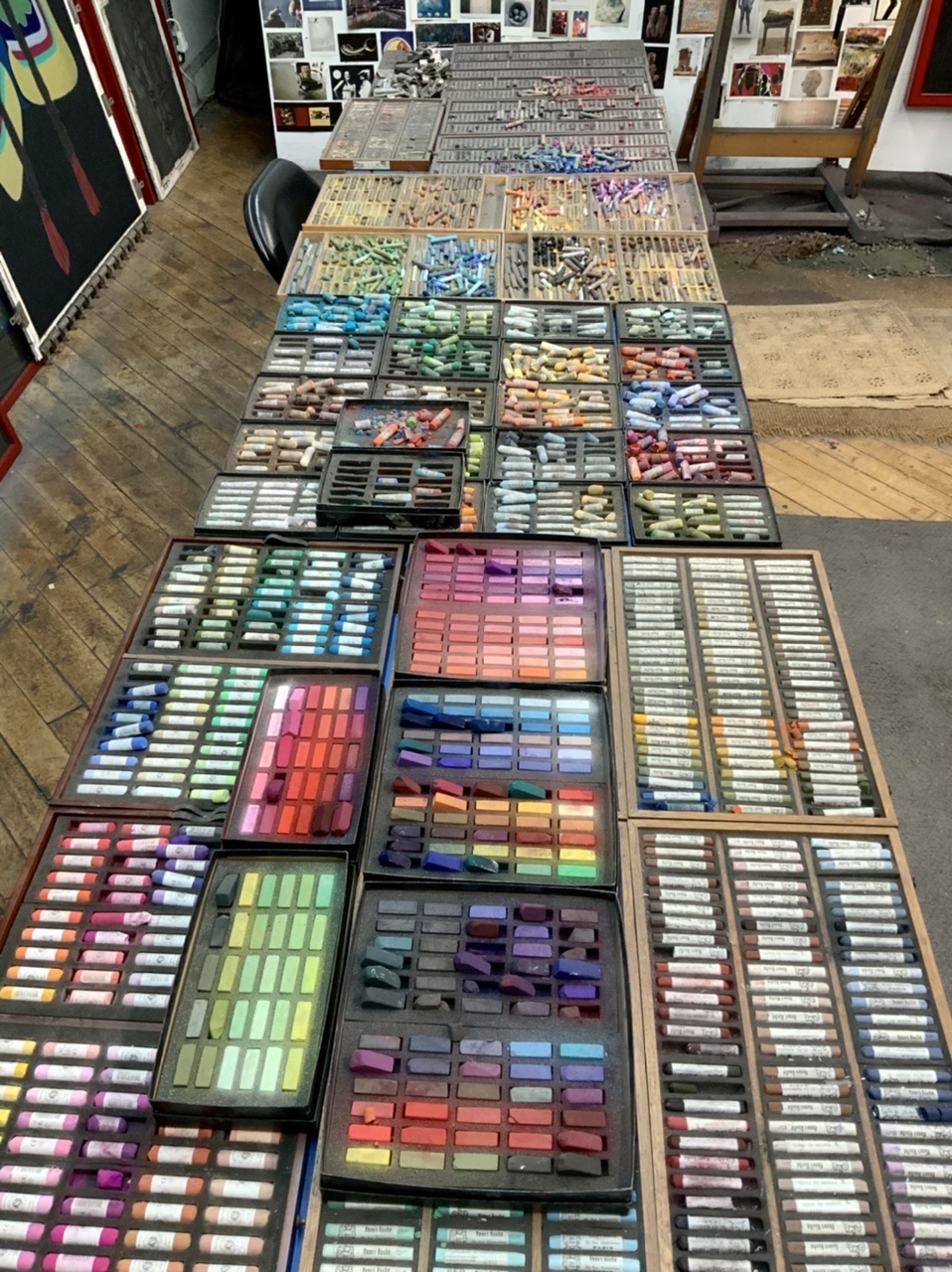
A: For thirty-six years I have worked exclusively in soft pastel on sandpaper. Pastel, which is pigment and a binder to hold it together, is as close to unadulterated color as an artist can get. It allows for very saturated color, especially employing the self-invented techniques I have developed and mastered. I believe my “science of color” is unique, completely unlike how any other artist works. I spend three to four months on each painting, applying pastel and blending the layers together to mix new colors on the paper.
The acid-free sandpaper support allows the buildup of 25 to 30 layers of pastel as I slowly and meticulously work for hundreds of hours to complete a painting. The paper is extremely forgiving. I can change my mind, correct, refine, etc. as much as I want until a painting is the best I can create at that moment in time.
My techniques for using soft pastel achieve rich velvety textures and exceptionally vibrant color. Blending with my fingers, I painstakingly apply dozens of layers of pastel onto the sandpaper. In addition to the thousands of pastels that I have to choose from, I make new colors directly on the paper. Regardless of size, each pastel painting takes three to four months and hundreds of hours to complete.
I have been devoted to soft pastel from the beginning. In my blog and in numerous interviews online and elsewhere, I continue to expound on its merits. For me no other fine art medium comes close.
My subject matter is unique. I am drawn to Mexican, Guatemalan, and Bolivian cultural objects—masks, carved wooden animals, papier mâché figures, and toys. On trips to these countries and elsewhere I frequent local mask shops, markets, and bazaars searching for the figures that will populate my pastel paintings. How, why, when, and where these objects come into my life is an important part of the creative process. Each pastel painting is a highly personal blend of reality, fantasy, and autobiography.
Comments are welcome!
Q: What’s on the easel today?


A: Here is a preliminary charcoal drawing in preparation for my next ”Bolivianos” pastel painting. With the most recent works I have been experimenting with scale. This will be a 58” x 38” version of ”Schemer,” 2019, 26” x 20.”
Comments are welcome!
Start/Finish of ”Impresario,” soft pastel on sandpaper, 58” x 38” image, 70” x 50” framed
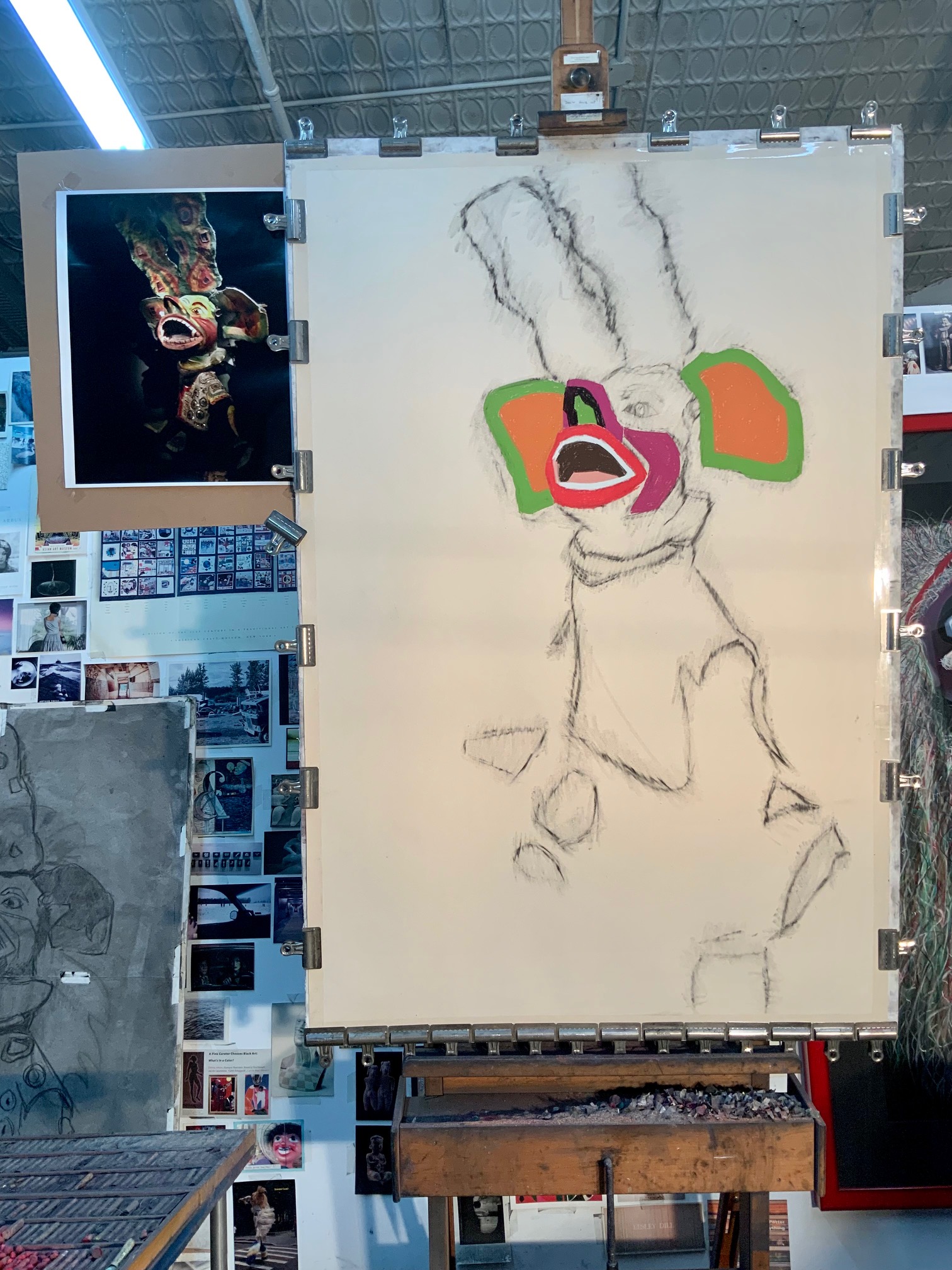

Note: the second photo was taken hundreds of hours and nearly five months later!
Comments are welcome!
Q: You wear gloves and a mask when you are working in your studio, right? Can you tell me what kinds? (Question from Britta Konau)
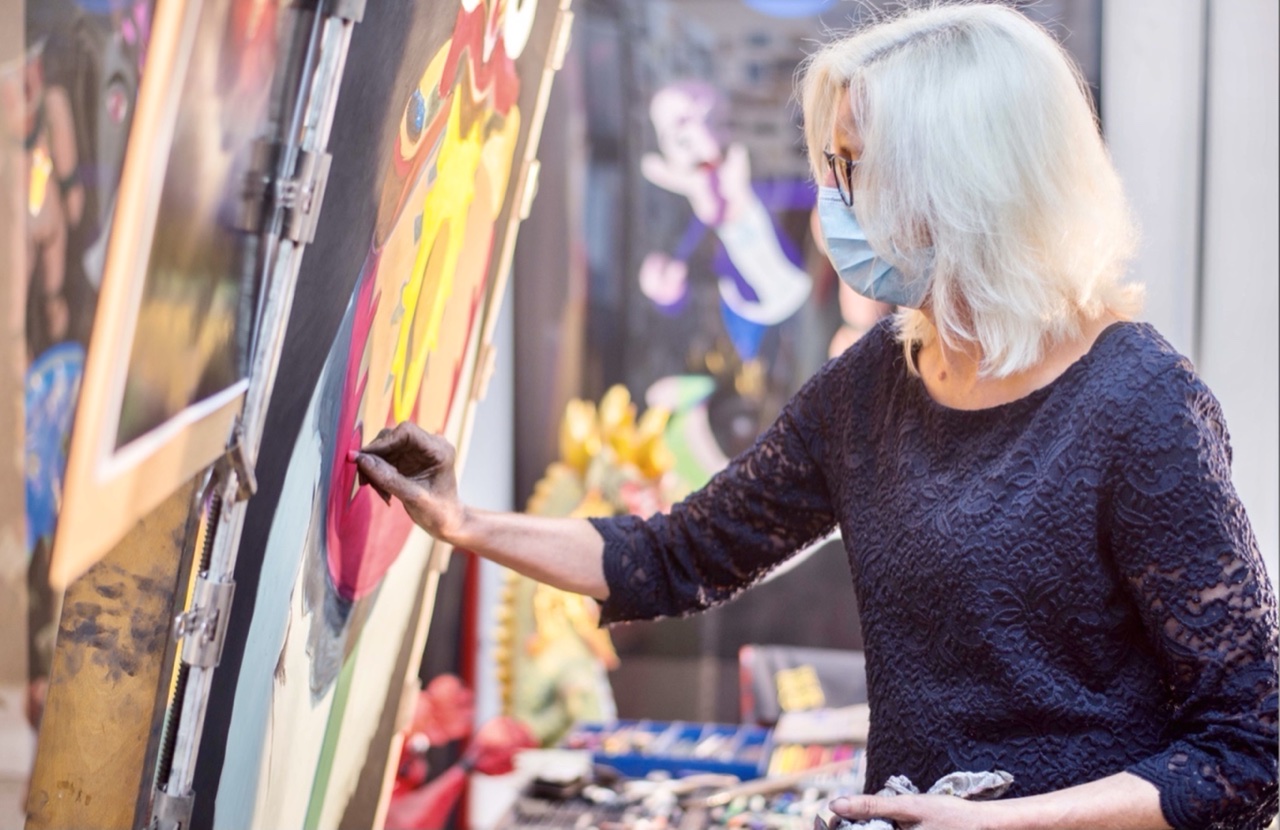
A: I wear a paper surgical mask – the type that has become ubiquitous since COVID – bought from a local medical supply store. I thoroughly coat my hands with barrier cream – Art Guard – to prevent pastel getting into my skin. The cream has an added benefit of making it easy to wash pastel off my hands. (Neither gloves nor individual finger cots ever worked for me. They made my fingers sweat and did not allow for the fine touch needed to blend new colors directly on sandpaper. Plus, they shredded from being rubbed against the paper’s grit). Also, it is very important that you work with your hand below your face so pastel dust falls below your nose, where you are less likely to breathe it in.
Comments are welcome!
Pearls from artists* # 494
*an ongoing series of quotations – mostly from artists, to artists – that offers wisdom, inspiration, and advice for the sometimes lonely road we are on.
Emile Cartailhac was a man who could admit when he was wrong. This was fortunate, because in 1902 the French prehistorian found himself writing an article for L’Anthropolgie in which he did just that. In “Mea culpa d’un sceptique” he recanted the views he had spent the previous 20 years forcefully and scornfully maintaining: that prehistoric man was incapable of fine artistic expression and that the cave paintings found in Altmira, northern Spain, were forgeries.
The Paleothithic paintings at Altamira, which were produced around 14,000 B.C., were the first examples of prehistoric cave art to be officially discovered. It happened by chance in 1879, when a local landowner and amateur archaeologist was busily brushing away at the floor of the caves, searching for prehistoric tools. His nine-year-old daughter, Maria Sanz de Sautuola – a grave little thing with cropped hair and lace-up booties – was exploring farther on when she suddenly looked up, exclaiming, “Look, Papa, bison!” She was quite right: a veritable herd, subtly colored with black charcoal and ocher, ranged over the ceiling. When her father published the finding in 1880, he was met with ridicule. The experts scoffed at the very idea that prehistoric man – savages really – could have produced sophisticated polychrome paintings. The esteemed Monsieur Cartailhac and the majority of his fellow experts, without troubling to go and see the cave for themselves, dismissed the whole thing as a fraud. Maria’s father died, a broken and dishonored man, in 1888, four years before Cartailhac admitted his error.
After the discovery of many more caves and hundreds of lions, handprints, horses, women, hyenas, and bison, the artistic abilities of prehistoric man are no longer in doubt. It is thought that these caves were painted by shamans trying to charm a steady supply of food for their tribes. Many were painted using the pigment most readily available in the caves at the time: the charred stick remnants of their fires. At its simplest, charcoal is the carbon-rich by-product of organic matter – usually wood – and fire. It is purest and least ashy when oxygen has been restricted during it’s heating.
In The Secret Lives of Color by Kassia St. Clair
Comments are welcome!
Q: What’s on the easel today?
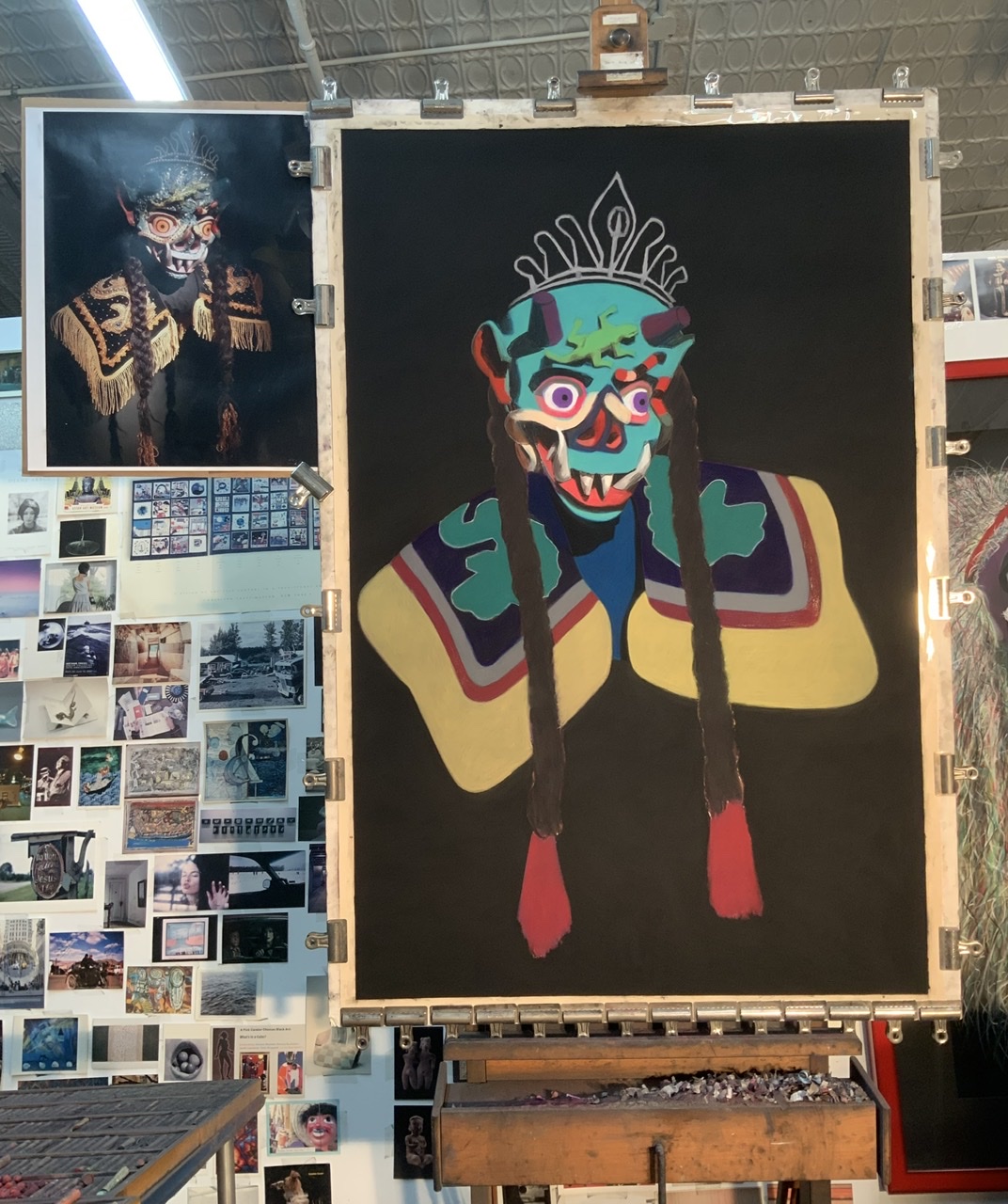
A: I’m working on a 58” x 38” pastel painting that is number 20 in the ”Bolivianos” series. It does not yet have a title. The mask depicted is a Supay. From Wikipedia:
In the Quechua, Aymara, and Inca mythologies, Supay was both the god of death and ruler of the Ukha, Pacha, and the Incan underworld, as well as a race of demons. Supay is associated with miners’ rituals.
With the Spanish colonization of the Americas, Christian priests used the name “Supay” to refer to the Christian Devil. However, unlike Europeans in relation to the Christian Devil, the indigenous people did not repudiate Supay but, being scared of him, they invoked him and begged him not to harm them.
Supay acquired a syncretic symbolism, becoming a main character of the diabladas of Bolivia (seen in the Carnival of Oruro), Peru and other Andean countries. The name Supay is now roughly translated into diablo (Spanish for devil) in most Southern American countries. In some of them, for example the northern region of Argentina, the underworld where Supay rules, is called “Salamanca”.
Comments are welcome!


 barbararachkoscoloreddust.com