Category Archives: An Artist’s Life
Pearls from artists* # 596

Film still from “Barbara Rachko: True Grit,” Directed by Jennifer Cox, Moto Films LLC
*an ongoing series of quotations – mostly from artists, to artists – that offers wisdom, inspiration, and advice for the sometimes lonely road we are on.
Being an artist is very hard work. Not only do you have to constantly develop your discipline, but if you have a desire to make a living, you have to be a good businessperson.
Agents, business managers, etc., etc., are not the authors of your career. They make suggestions. They are a part of your research team. You are the author. You are the center of your career. You have to run the show. I hope your show is about more than gold digging. I hope your show is about becoming the most engaging, enchanting, magical person that you can be – through your art. Art is ultimately transcendent. That’s a fact.
Anna Deavere Smith in Letters to a Young Artist: Straight-Up Advice on Making a Life in the Arts – For Actors, Performers, Writers, and Artists of Every Kind
Comments are welcome!
Pearls from artists* # 595

Film still from “Barbara Rachko: True Grit,” directed by Jennifer Cox, Moto Films LLC
*an ongoing series of quotations – mostly from artists, to artists – that offers wisdom, inspiration, and advice for the sometimes lonely road we are on.
One of the great paradoxes of the writing life is that our words – chosen carefully, so thoughtfully, with deep focus and concentration – those words once on the page go dead on us. Language is ours only when we are forming sentences, moving elements around, grappling with punctuation, speaking words aloud, feeling them on our lips. While we are shaping a scene into something we can hear and touch and see, that scene lives and breathes. We are inside language like painters, we are working in our medium: the tempera, the thin line, the wet oil on canvas, still in process, still alive.
But once we commit – once those words dry like paint, are affixed to the page – it becomes nearly impossible to see them. This? We think to ourselves. Our most loathsome critic emerges with a swirl of her cape. Really? What the hell is this? The sentences appear to have been written in another language – a dark dream language, tucked into some musty, inaccessible corner of our psyche. Attempting to discern its meaning is a bit like looking at our own face in the mirror. It is at once so familiar as to be invisible, and so intimate that we turn away, baffled, ashamed.
Can we ever see ourselves, really? Can we read ourselves?
It is a powerful conundrum because without the ability to see our writing afresh we cannot do the necessary work. How do we know whether a problem lies with the work, or with our inability to enter it? We need clarity, but not coldness. Openness, but not attachment. We want optimism, but that optimism must not go hand in hand with discernment. We’re not looking for a cheerleader, nor a fault-finding judge. We want to read ourselves with equanimity.
Dani Shapiro in Still Writing: The Pleasures and Perils of a Creative Life
Comments are welcome!
Pearls from artists* # 594
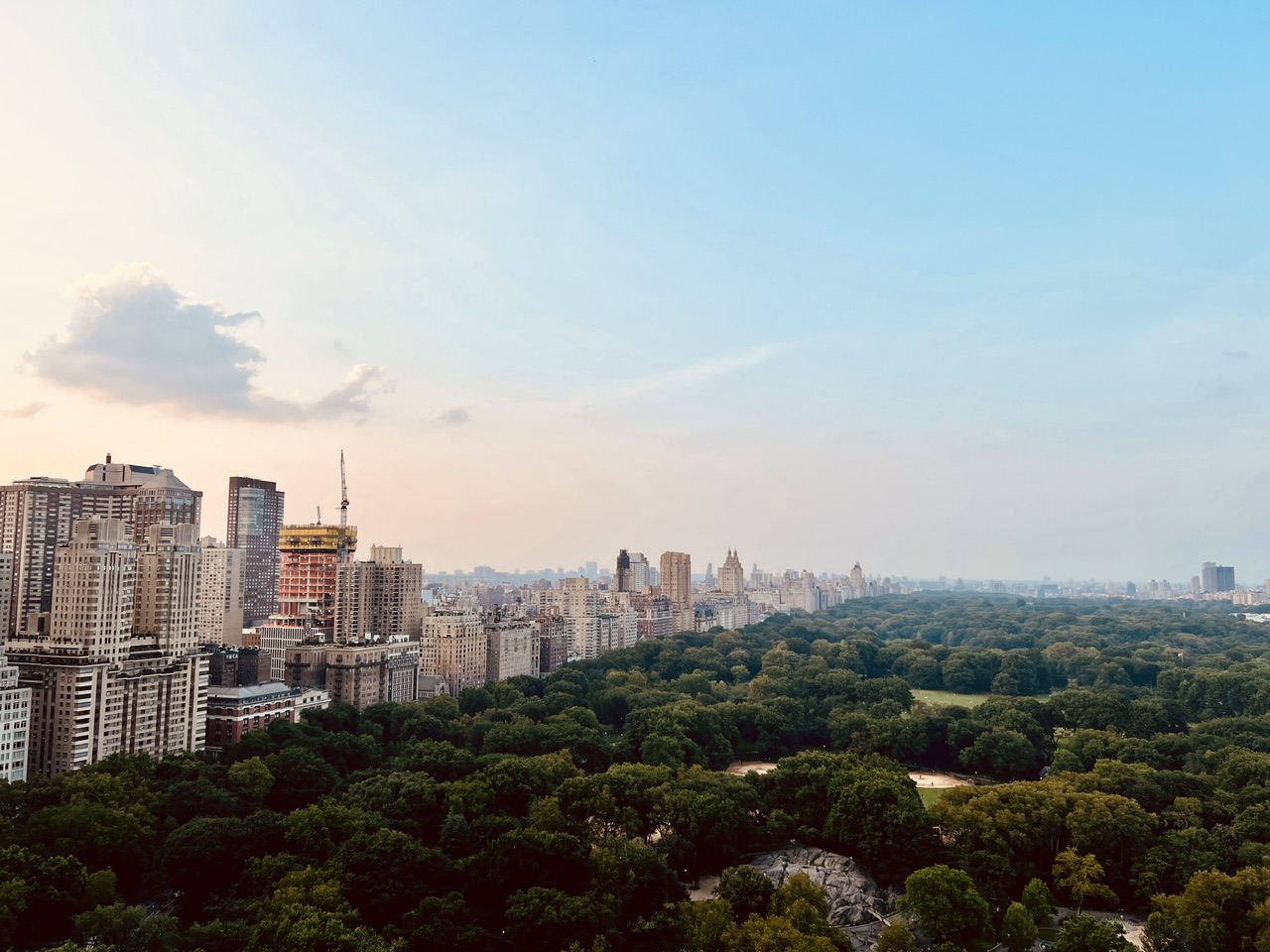
*an ongoing series of quotations – mostly from artists, to artists – that offers wisdom, inspiration, and advice for the sometimes lonely road we are on.
The creative artist and poet and saint must fight the actual (as opposed to ideal) gods of our society – the god of conformism as well as the gods of apathy, material success, and exploitive power. These are the “idols” of our society that are worshipped by multitudes of people.
Stephen Nachmanovitch in Free Play: Improvisation in Life and Art
Comments are welcome!
Our 2024 Winter Newsletter!

Laurels for our new documentary, “Barbara Rachko: True Grit”!
For today I have decided to forego my usual post and instead share our 2024 Winter Newsletter! Lots of exciting things have been (and are) happening! Please check out the link.
https://mailchi.mp/d71e7ada17b3/2024winternewsletter
Comments are welcome!
Pearls from artists* # 593
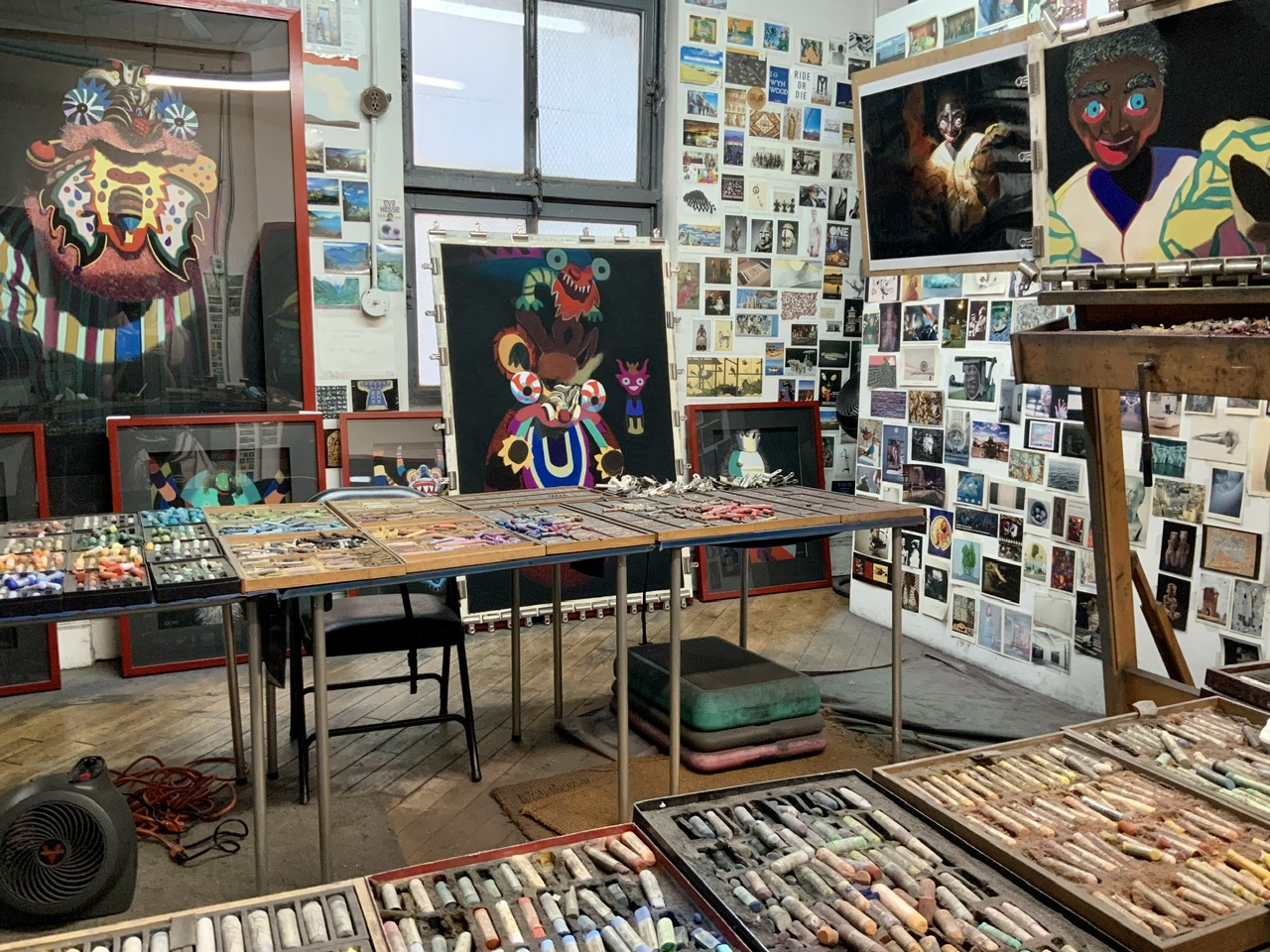
Barbara’s Studio with work in progress
*an ongoing series of quotations – mostly from artists, to artists – that offers wisdom, inspiration, and advice for the sometimes lonely road we are on.
Falling in love with beauty or with someone else’s artwork that touches us is easy. We can experience the rapture of it and go home. But falling in love with our instrument or with our work is more like falling in love with a person, in that we experience the rapture and delight of the discovery, but then we are saddled with the effort of fulfillment, with love’s labors and the hard lessons in which illusions are stripped away, in which we confront difficult pieces of self-knowledge, in which we have to stretch our physical, emotional, intellectual stamina to its limits, in which our patience and our ability to persevere and transcend ourselves are tested.
Stephen Nachmanovitch in Free Play: Improvisation in Life and Art
Comments are welcome!
Pearls from artists* # 592
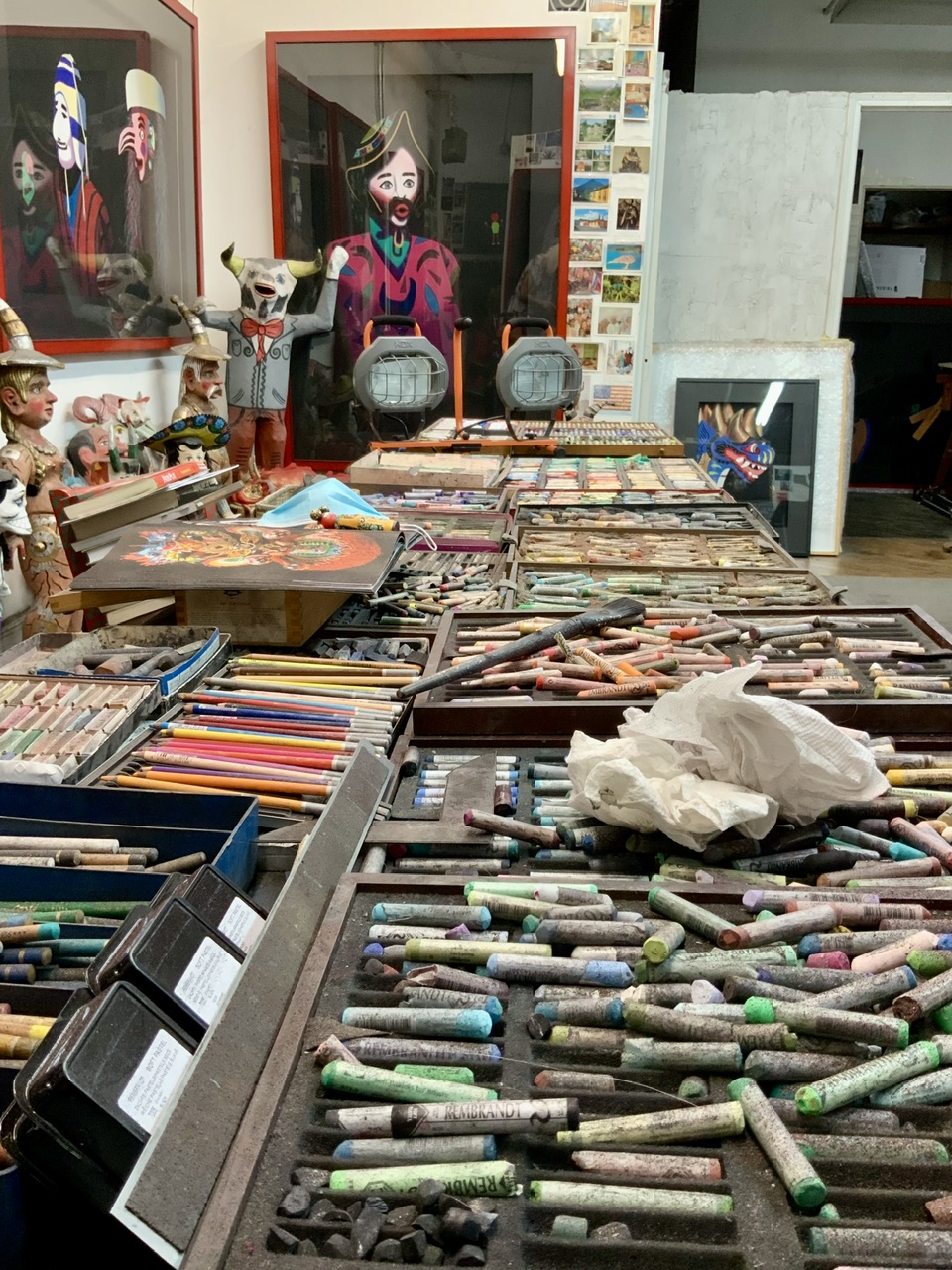
The Studio
*an ongoing series of quotations – mostly from artists, to artists – that offers wisdom, inspiration, and advice for the sometimes lonely road we are on.
There are millions of ways of composing and structuring artwork. Each piece, whether improvised or written down, danced or painted, can evolve its own structure, its own world. The word creative comes from “to make grow,” as in the act of cultivating plants. We grow or evolve a set of rules to incorporate the unfolding of our imagination. We create new rules of progression, fresh channels in which play can flow.
Stephen Nachmanovitch in Free Play: Improvisation in Life and Art
Comments are welcome!
Q: Would you talk about your first solo exhibition in a commercial gallery?

“Big Deal,” soft pastel on sandpaper, 58″ x 38″
A: Although I had exhibited in a number of non-profit galleries in Virginia, Washington, DC, Maryland, New Jersey, and New York, my first solo in a commercial gallery was at 479 Gallery, 520 Broadway, in July 1996. The previous summer I had entered a juried exhibition there. My work won first prize and I was awarded a solo show the following July.
This exhibition was soon followed by representation at an important New York gallery, Brewster Fine Arts, at 41 West 57th Street. I had my first two-person exhibition at Brewster in October 1996. The gallery specialized in art by Latin American artists. Besides myself, the sole non-Latina represented by Brewster was Leonora Carrington! I quickly began exhibiting alongside a group of illustrious artists: Leonora, Rufino Tamayo, Francisco Toledo, Francisco Zuniga, and other Latin American masters. I could hardly believe my good fortune!
Comments are welcome!

Pearls from artists* # 591

*an ongoing series of quotations – mostly from artists, to artists – that offers wisdom, inspiration, and advice for the sometimes lonely road we are on.
Like lîla, or divine creativity, art is a gift, coming from a place of joy, self-discovery, inner knowing. Play, intrinsically rewarding, doesn’t cost anything. As soon as you put a price on it, it becomes, to some extent, not play. Somewhere, therefore, we each have to map out for ourselves the tricky questions of money and the artist. This is a difficult issue because artists have to eat, equip themselves, and subsidize years of professional training. Yet the marketplace shifts our art at least to some degree out of the state of free play, and may in some cases contaminate it totally. Professional athletes face the same issues. Certainly they play to a great extent for love of their sport, but issues of money, prestige, and fame introduce a lot of non play as well.
Stephen Nachmanovitch in Free Play: Improvisation in Life and Art
Comments are welcome!

Q: How do you deal with rejection?
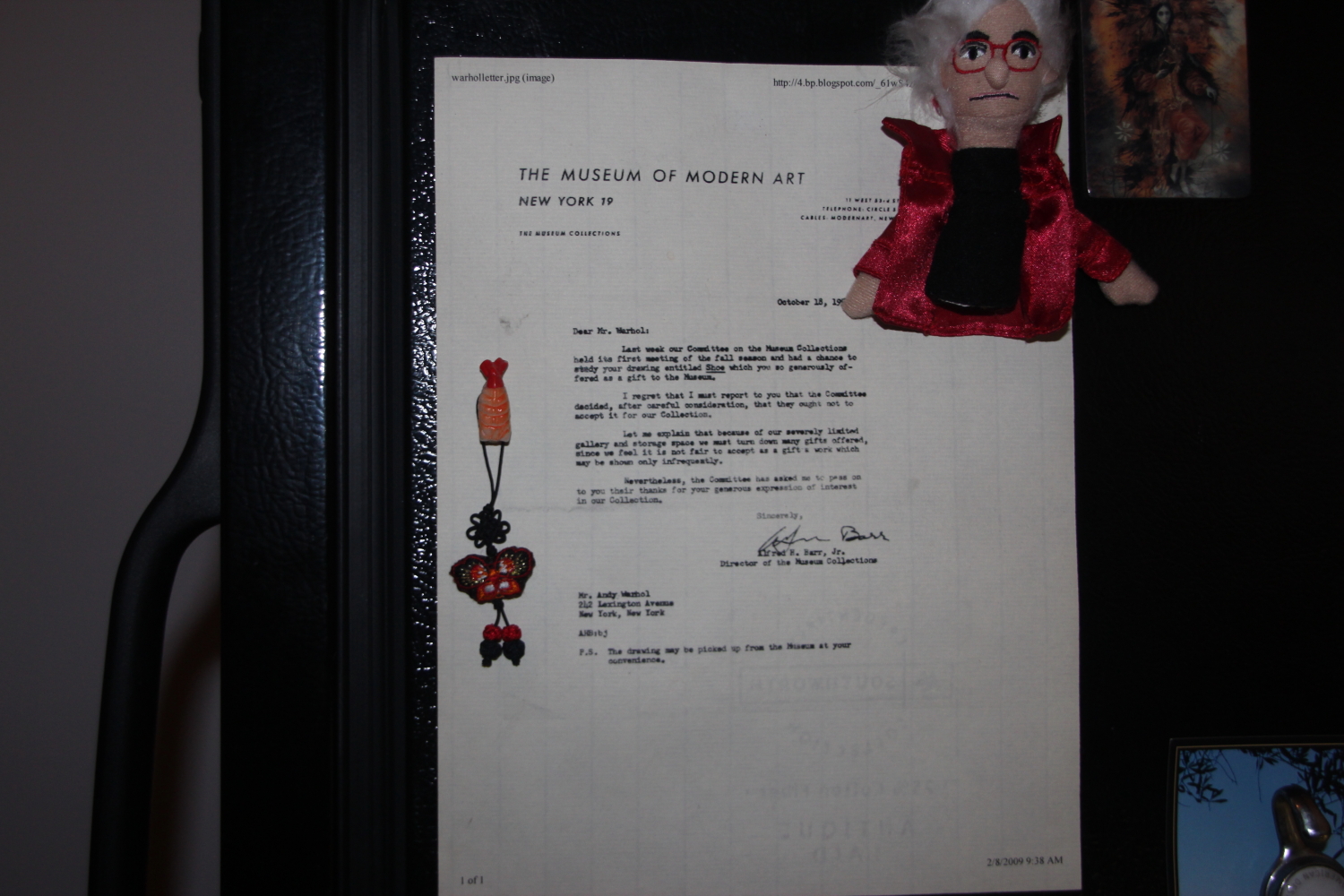
Letter from MoMA to Andy Warhol
A: I take the long view and try to remember that rejection is an occupational hazard that has plagued every artist throughout history. Even one of the most famous – Andy Warhol – had to endure innumerable rejections before his work was finally appreciated. So why should it be any different for my peers and me? Tacked to my refrigerator is a copy of a now classic letter, dated October 18, 1956. It reads:
Dear Mr. Warhol,
Last week our Committee on the Museum Collections held its first meeting of the fall session and had a chance to study your drawing entitled “Shoe,” which you so generously offered as a gift to the Museum.
I regret that I must report to you that the Committee decided, after careful consideration, that they ought not to accept it for our Collections.
Let me explain that because of our severely limited gallery and storage space we must turn down many gifts offered, since we feel it is not fair to accept as a gift a work which may be shown only infrequently.
Nevertheless, the Committee has asked me to pass on to you their thanks for your generous expression in our Collection.
Sincerely,
Alfred H. Barr, Jr.
Director of the Museum Collections
P.S. The drawing may be picked up from the Museum at your convenience.
I especially chuckle at the P.S. as, surely, here we have one of the biggest blunders by a museum professional in history!
Comments are welcome!



