Blog Archives
Q: Would you describe how you are taking soft pastel in new directions as a fine art medium?

Barbara at work, Photo: Marianne Barcellona
A: I have been devoted to soft pastel for more than thirty years. In this blog and in countless interviews online and elsewhere, I continue to expound on its merits. For me no other fine art medium comes close.
I have developed my own original methods for working with soft pastel, pushing this venerable 500-year-old medium to its limits and using it in ways that no one has done before. I have created a unique science of color in which I layer and blend pigments. When viewers (including fellow artists) see my work in person for the first time, they often ask, “What medium is this?”
My self-invented techniques for using soft pastel achieve rich velvety textures and exceptionally vibrant color. Blending with my fingers, I painstakingly apply dozens of layers of pastel onto acid-free sandpaper. In addition to the thousands of pastels that I have to choose from, I blend new colors directly on the paper. Each pastel painting takes about three months and hundreds of hours to complete.
My subject matter is singular. I am drawn to Mexican, Guatemalan, and Bolivian cultural objects—masks, carved wooden animals, papier mâché figures, and toys. On trips to these places and elsewhere I frequent local mask shops, markets, and bazaars searching for the figures that will populate my pastel paintings. How, why, when, and where these objects come into my life is an important part of the creative process. Each pastel painting is a highly personal blend of reality, fantasy, and autobiography.
Comments are welcome!
Q: Do you have a mentor?
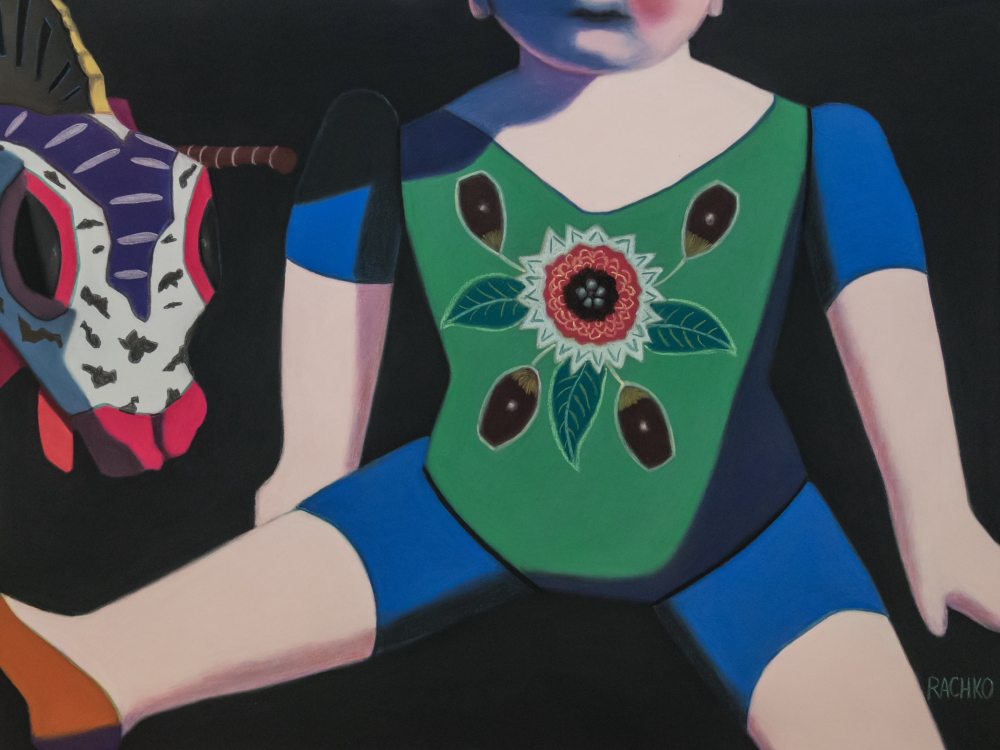
“Alone Together,” soft pastel on sandpaper, 20″ x 26″
A: No, but I often wish I did. How wonderful it would be to consult someone who’s been there, a productive and successful artist who could provide advice on all the concerns, especially the problems and dangers, inherent in a professional artist’s life.
But I have been at this for thirty years and found no such person! I think it’s because each artist’s career is highly unique as we chart are own individual paths. Unlike most professions, there are no firm rules or straight forward career milestones for making your way as an artist.
Besides the countless hours spent in the studio, I have always worked diligently to understand the art business. Certainly getting work seen, exhibited, reviewed, sold, etc. is as important as making it in the first place. It’s all part of being a professional artist.
Early on I developed the habit of relying on my own best judgment, both in creating the work and in getting it seen and collected. Certainly I have made plenty of mistakes. As a result though, I know a tremendous amount about the art business. And I enjoy sharing what I know in the hopes of steering other artists away from making similar missteps.
Comments are welcome!
Q: What do you think is an artist’s chief responsibility? Do you personally feel a responsibility to society?
Winter roses
A: All serious artists have the responsibility of developing our unique and special gifts to the best of our abilities and sharing our creative output with an appreciative audience. In other words we do good work and then we educate, and often create, the audience for it. This is the demanding, all-important task that gets me out of bed every day.
In showing what is possible artists cannot help but create a better society. Ours is essential work.
Comments are welcome!
Pearls from artists* # 177
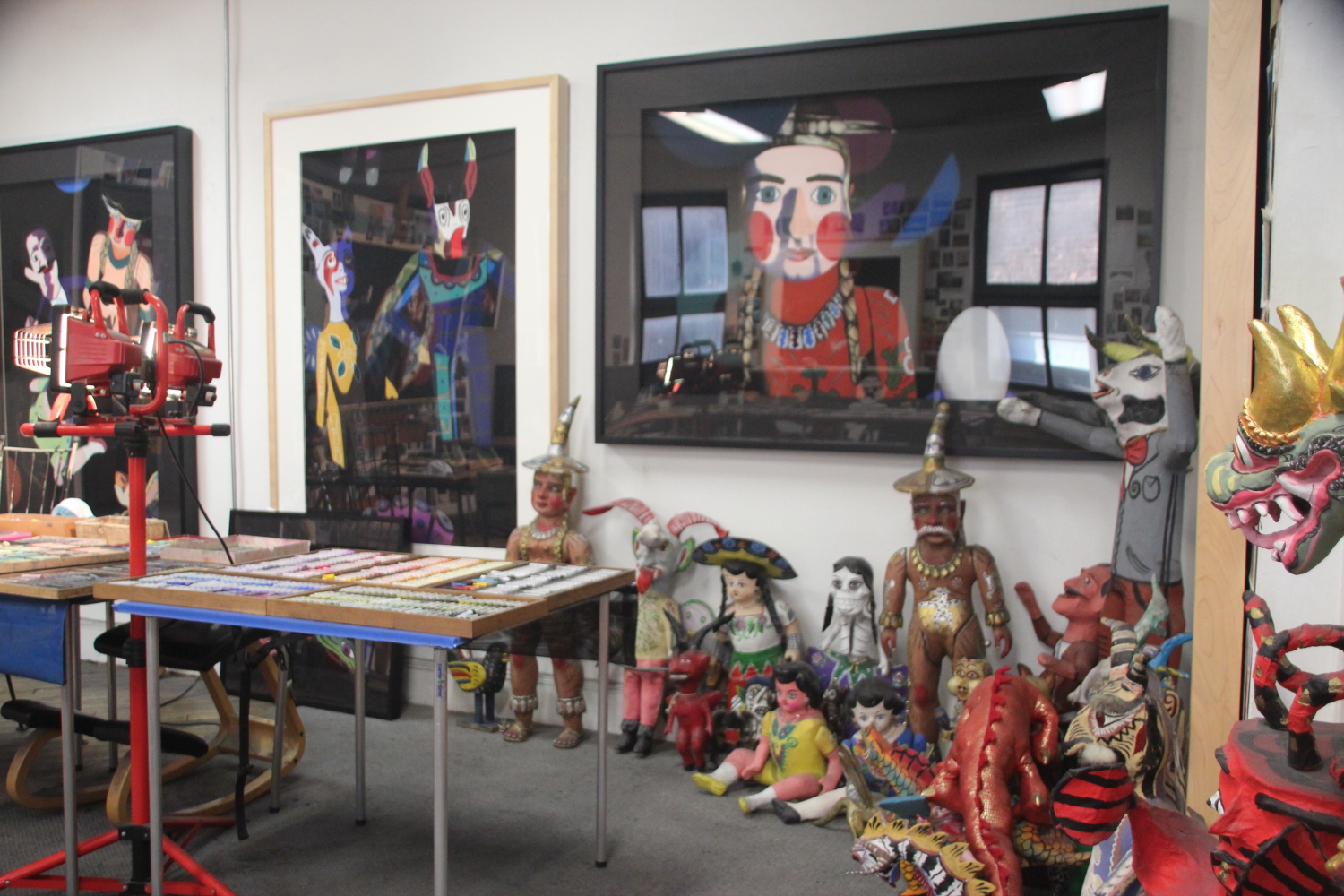
Barbara’s studio
* an ongoing series of quotations – mostly from artists, to artists – that offers wisdom, inspiration, and advice for the sometimes lonely road we are on.
Everyone but a lunatic has a reason for what he does. Yes, in that sense I am a determinist. But I believe, with Kant, that the mind is self-determined. That is, I believe intensely in the creative freedom of the mind. That is indeed absolutely essential to man’s security in a chaotic world of change. He is faced all the time with unique complex problems. To sum them up for action is an act of creative imagination. He fits the different elements together in a coherent whole and invents a rational act to deal with it. He requires to be free, he requires his independence and solitude of mind, he requires his freedom of mind and imagination. Free will is another matter – it is a term, or rather a contradiction in terms, which leads to continual trouble. The will is never free – it is always attached to an object, a purpose. It is simply the engine in the car – it can’t steer. It is the mind, the reason, the imagination that steers.
Joyce Carey in The Paris Review Interviews: Writers at work 1st Series, edited and with an introduction by Malcolm Cowley
Comments are welcome!
Q: Have any artists influenced you technically?
Barbara at work, Photo: Marianne Barcellona
A: I’d have to say no one, because my technique of using soft pastel on sandpaper is largely self-invented and it continues to slowly evolve. I apply up to thirty layers of pigment, blending it with my fingers, and creating new colors directly on the sandpaper. It is a rather meticulous process that suits my personality.
My unique way of applying and mixing pastel is a richly complex science of color. This intricate technique is one of the reasons that my pastel paintings cannot be forged by anyone.
Every great artist throughout history has invented their own techniques and created a world that is uniquely theirs, with its own iconography, its own laws, and its own specific concerns. Artists who are most worthy of the name create their own tasks and make and break their own rules.
Comments are welcome!
Pearls from artists* # 156
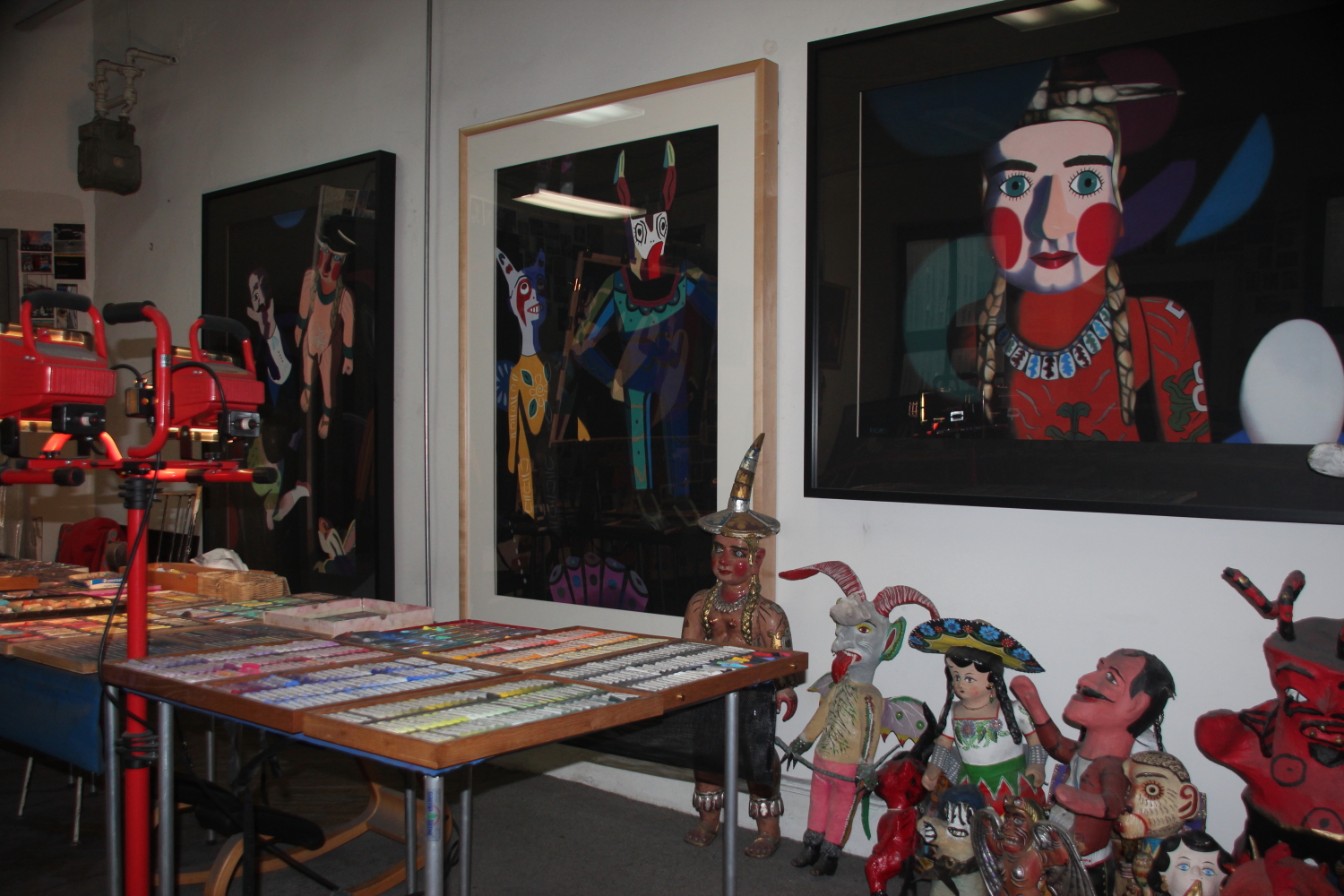
Barbara’s studio
Our vision is what makes us unique and special. Literally, vision means an artist’s unique way of seeing the world, the special and specific choices the artist makes when observing the world around him. It is also what the artist imagines and sees with his unique mind’s eye and brings out by way of his art. Vision is like a lighthouse, it guides the artist to a specific area of nature or life or to a subject that is personal to the artist, one that others might have overlooked. Vision also includes that which the artist’s conscience tells him the world ought to be – or what the world is lacking. Vision is that unique and special contribution we bring and add to life; it is that which no one can provide but us. Passion, inspiration, talent and skill all have to come together so that our vision can be achieved.
Samuel Adoquei in Origin of Inspiration: Seven Short Essays for Creative People
Comments are welcome!
Q: In terms of change where will you take your work next?

Barbara’s studio
A: That’s difficult to say because creating new pastel paintings is a somewhat mysterious process. Change happens on its own timetable and in its own way rather than from my efforts to exert conscious control over it. In essence it is my job to keep working in the studio, to be sensitive and true to my own creative process, and to go where the work leads. I doubt that I could work otherwise and still claim to be authentic.
Comments are welcome!
Q: Why do you prefer not to explain your titles and imagery?
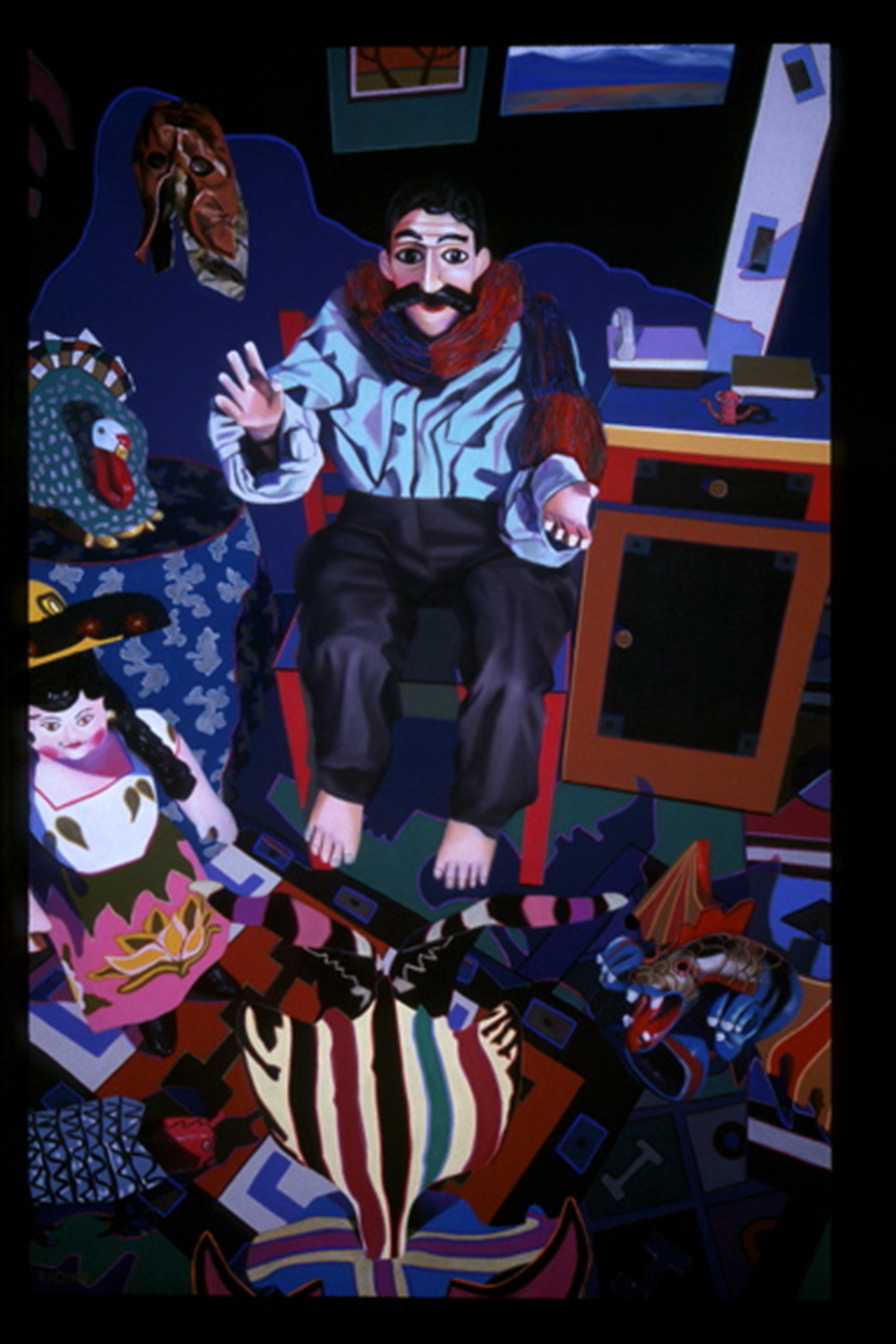
“Truth Betrayed by Innocence,” soft pastel on sandpaper, 58″ x 38″
A: It’s mainly because answers close down imagination and creativity. I enjoy hearing alternative interpretations of my pastel paintings. People are wildly imaginative and each person brings unique insights to their art viewing. By leaving meanings open, conversation is generated. Most artists want viewers to talk about their work.
Once at a public artist’s talk that I attended, I was told by an artist that my interpretation of her title was completely wrong. First of all, how can an interpretation honestly expressed by your audience be “wrong?” Art is as open to interpretation as a Rorschach test (art IS a kind of Rorshach test). Then she explained the thinking behind her title and succeeded in cutting off all further conversation. I felt belittled. Later several people told me that my interpretation was much more compelling. Still, the experience was mortifying and I hope to never do that to anyone.
Comments are welcome!
Q: You have written about how you came to your current subject matter, but what led you away from photorealism to work that while not exactly abstract, leans more in that direction?
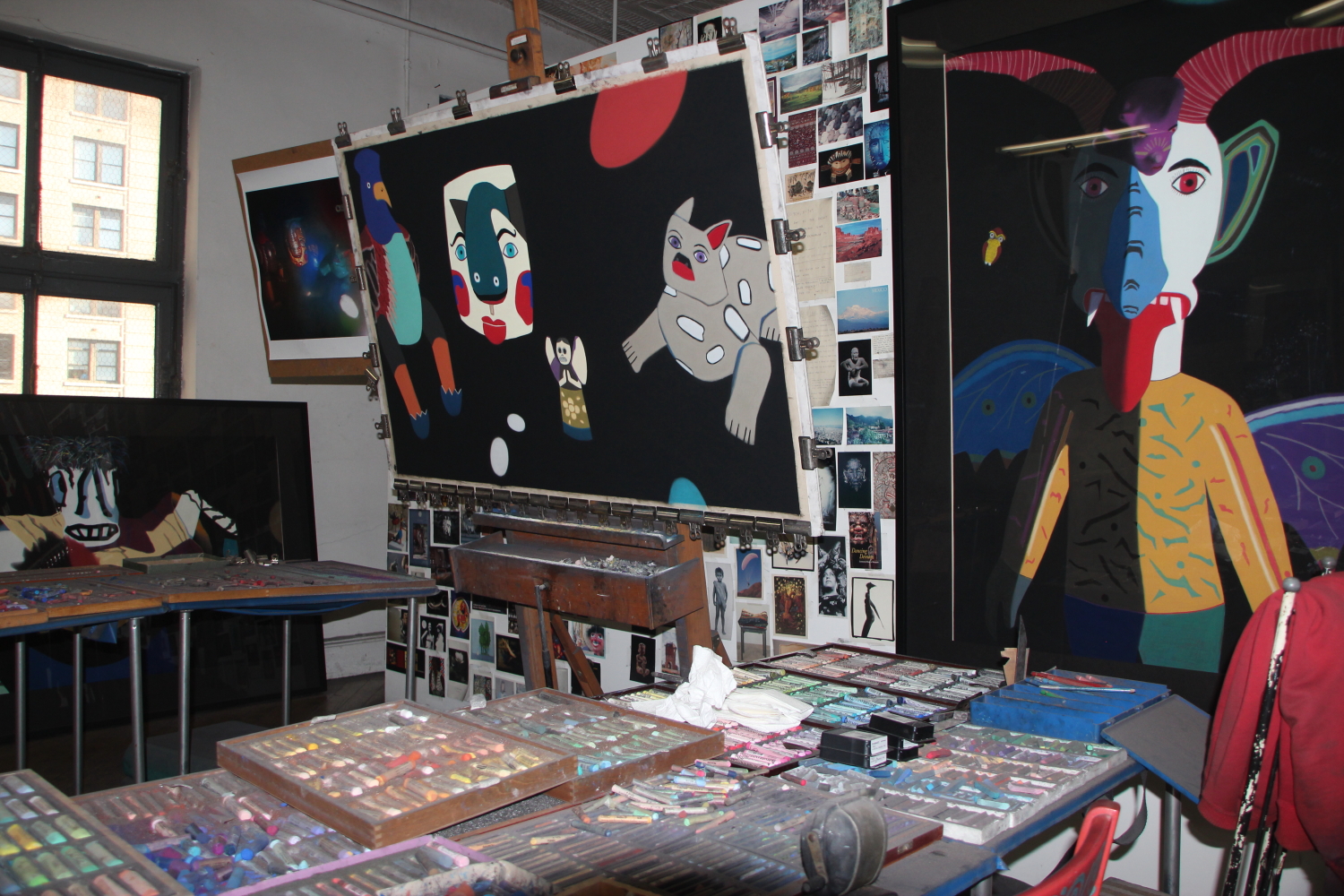
Barbara’s studio
A: Once I had achieved a high degree of technical facility with soft pastel, there was not much more to be gained from copying reality. Cameras do an excellent job of that so what would be the point?
Ultimately, all art lies in following an experience through to the end. Art is in the choices one makes. A visual artist’s private decisions about what to include and what to leave out become her unique inimitable style. Years ago I made a conscious decision to abandon photorealism. Since then I have been on a journey to work more from imagination and direct experience and less from physical reality.
It’s funny. I have always worked from photographs. Because I have a strong work ethic and substantial technical skill, I often feel like a slacker if I do not put in all the details that I see in the reference photo. That’s why the journey has been so slow, I think, as I convince myself it’s really ok to omit more and more details.
Comments are welcome!
Q: How important is the feedback of your audience? Do you ever think about who will enjoy your Art when you conceive it?

Painting, subject, reference photo
A: I can’t say that I think at all about audience reaction while I’m creating a painting in my studio. Although, of course I want people to respond favorably to the work.
Generally, I’m thinking about technical problems – making something that is exciting to look at, well-composed, vibrant, up to my exacting standards, etc. When I finish a painting, it is the best thing I am capable of making at that moment in time.
I think about a painting and look at it for so long and with such intensity, that it could hardly have turned out any differently. There is an inevitability to the whole lengthy process that goes all the way back to when I first laid eyes on the folk art figures in a dusty shop in a third world country. Looking at a newly-finished painting on my easel I often think, “Of course! I was drawn to this figure so that it could serve this unique function in this painting.”
Comments are welcome!



