Blog Archives
Pearls from artists* # 697

*an ongoing series of quotations – mostly from artists, to artists – that offers wisdom, inspiration, and advice for the sometimes lonely road we are on.
Serendipity (or synchronicity) is an occurrence of events that appear significantly related but have no discernible causal connection. The concept of synchronicity was developed by psychiatrist Carl Jung in the early 1900s. He defined it as ‘meaningful coincidences.’ They seem like ‘signs’ or ‘clues’ from the universe that provide missing pieces to your puzzle. Your brain is busy trying to solve your Art problem. You are open, tuned into what your unconscious already knows, and is trying to help you access. Thousands of thoughts a day pass through your brain as you navigate the world, but you suddenly see, hear, or think a flash of something that triggers your unconscious to put on the brake, and call out, ‘Wait! Stop! That’s it! That’s what we need!”
Kate Kretz in Art From Your Core: A Holistic Guide to Visual Voice
Comments are welcome!
Pearls from artists* # 650

Some of Barbara’s Mexican and Guatemalan folk art collection
*an ongoing series of quotations – mostly from artists, to artists – that offers wisdom, inspiration, and advice for the sometimes lonely road we are on.
Art objects are not just gifts for the viewer: they can hold profound, even mystical, revelations for the maker. When actualizing work that comes from your core, one of the greatest sources of pleasure is the recording of your art life journey, with the serendipitous connections, the seminal players, and meaningful symbols that return again and again. Art is an unconscious language that knows more about you than you know about yourself.
Kate Kretz in Art From Your Core: A Holistic Guide to Visual Voice
Comments are welcome!
Pearls from artists* # 649

*an ongoing series of quotations – mostly from artists, to artists – that offers wisdom, inspiration, and advice for the sometimes lonely road we are on.
Some of us spend our entire creative lives digging at the buried parts of ourselves to solve unknown mysteries that we are not even aware of. Unearthing those aspects is not an easy process, because our true psychic reality does not lie in our daily waking thoughts. It exists in the unconscious, in the form of an unfathomable, nonverbal sensory language, one that is so complex and runs so deep that we can only grasp at it, to attain small, amorphous bits. These bits can take any form, even uncharacteristic, surprising ones. We access, process, and finally transform them into what Saint Augustine called ‘visible signs of invisible realities.’
Kate Kretz in Art From Your Core: A Holistic Guide to Visual Voice”
Comments are welcome!
Pearls from artists* # 608

*an ongoing series of quotations – mostly from artists, to artists – that offers wisdom, inspiration, and advice for the sometimes lonely road we are on.
There is in all of these forms of expression a unitive experience that is the essence of the creative mystery. The heart of improvisation is the free play of consciousness as it draws, writes, paints, and plays with the raw material emerging from the unconscious. Such play entails a certain degree of risk.
Stephen Nachmanovitch in Free Play: Improvisation in Life and Art
Comments are welcome!
Pearls from artists* # 604
*an ongoing series of quotations – mostly from artists, to artists – that offers wisdom, inspiration, and advice for the sometimes lonely road we are on.
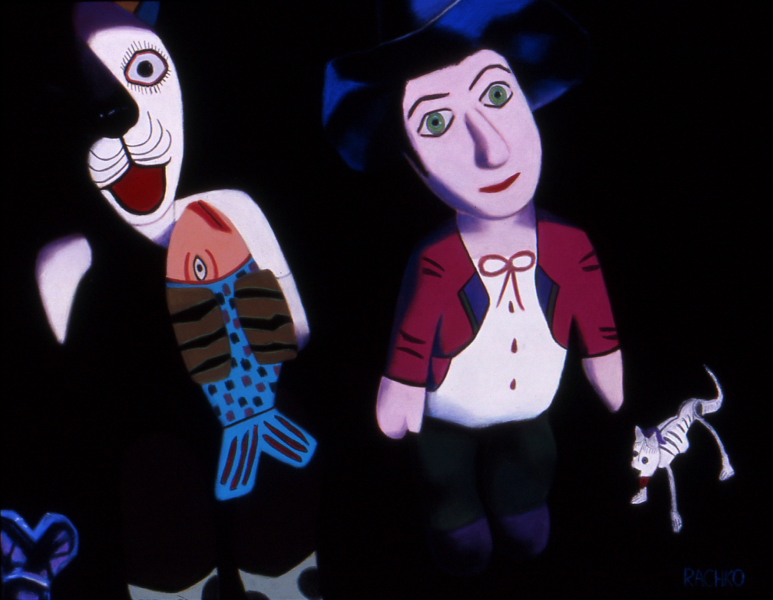
In dealing with unconscious mind, we’re dealing with an ocean full of rich, invisible life forms swimming underneath the surface. In creative work we’re trying to catch one of these fish; but we can’t kill the fish, we have to catch it in a way that brings it to life. In a sense we bring it amphibiously to the surface so it can walk around visibly; and people will recognize something familiar because they’ve got their own fish, who are cousins to your fish. Those fish, the unconscious thoughts, are not passively floating “down there;” they are moving, growing, and changing on their own, and our conscious mind is but an observer or interloper. That is why Jung calls the depths of the unconscious the “objective psyche.”
Stephen Nachmanovitch in Free Play: Improvisation in Life and Art
Comments are welcome!
Pearls from artists* #561

*an ongoing series of quotations – mostly from artists, to artists – that offers wisdom, inspiration, and advice for the sometimes lonely road we are on.
The most powerful symbols draw profound reactions from us. The symbolic images in great art attract and fascinate us; they stir our souls and move us beyond what can be easily expressed; ‘their pregnant language cries out to us that they mean more than they say.’
The unconscious produces symbols as part of a natural process within us. These images emerge out of the context of our lived experience… Jung saw the meaning-making process as one that not only requires attendance to the real context of our lives and history, but also involves profound inner listening. It asks us to use our rational capacities, but also our feeling and imaginal ones.
Symbolic images redirect our psychic energy, bringing together conscious and unconscious material and producing the lessening of conflict. In this way, they activate a transcendent function within the psyche. We experience this as the discovery of personal meaning and healing. This transformation is not the result of formulaic operations, but rather is a dynamic process that requires our authentic and vulnerable participation. The process challenges the whole of who we are and requires deep moral effort. That the unconscious would produce moving, powerful compensatory symbols inside us at all points to a fact that our culture may not have fully grasped – that there is a force working within us which is always driving us towards healing growth and greater consciousness… Despite our suffering, the psyche is always ultimately seeking both a healthy homeostatic balance and our ever-unfolding growth and unique development.
Gary Bobroff in Carl Jung: Knowledge in a Nutshell
Comments are welcome!
Q: Can you explain how you choose colors? (Question from Maria Cox via Instagram)

A: I am wild about color! As I work to create a pastel painting, I apply a color, back up from my easel to see how it interacts with and affects the rest of the painting, and then I make revisions. This process necessitates countless color changes and hundreds of hours during months of work. I apply pastel using a meticulous layering process. Were you to x-ray one of them, the earlier, discarded versions of a pastel painting would be visible. All the while I carefully fine-tune and refine how the colors and shapes interact with each other.
The goal is to make an exciting painting that no one, especially me as the maker, has ever seen before. I have no desire to repeat myself, to make art that resembles work by any other artist, or to be forced into a niche.
I try to select intense, vibrant colors that are exciting to look at, that work well in relationship to each other, and that will grab the viewer. Sometimes I deliberately choose colors for their symbolic meanings. For example, I selected a dark purple for the alternating triangles (the ones with the pink dots above) in “Overlord” because purple denotes royalty.
I have been working with soft pastel for 37 years so I have a fairly intricate science of color at my disposal. No doubt, many unconscious factors are at play, too. More on that in future posts.
Comments are welcome!
Pearls from artists* # 453
*an ongoing series of quotations – mostly from artists, to artists – that offers wisdom, inspiration, and advice for the sometimes lonely road we are on.
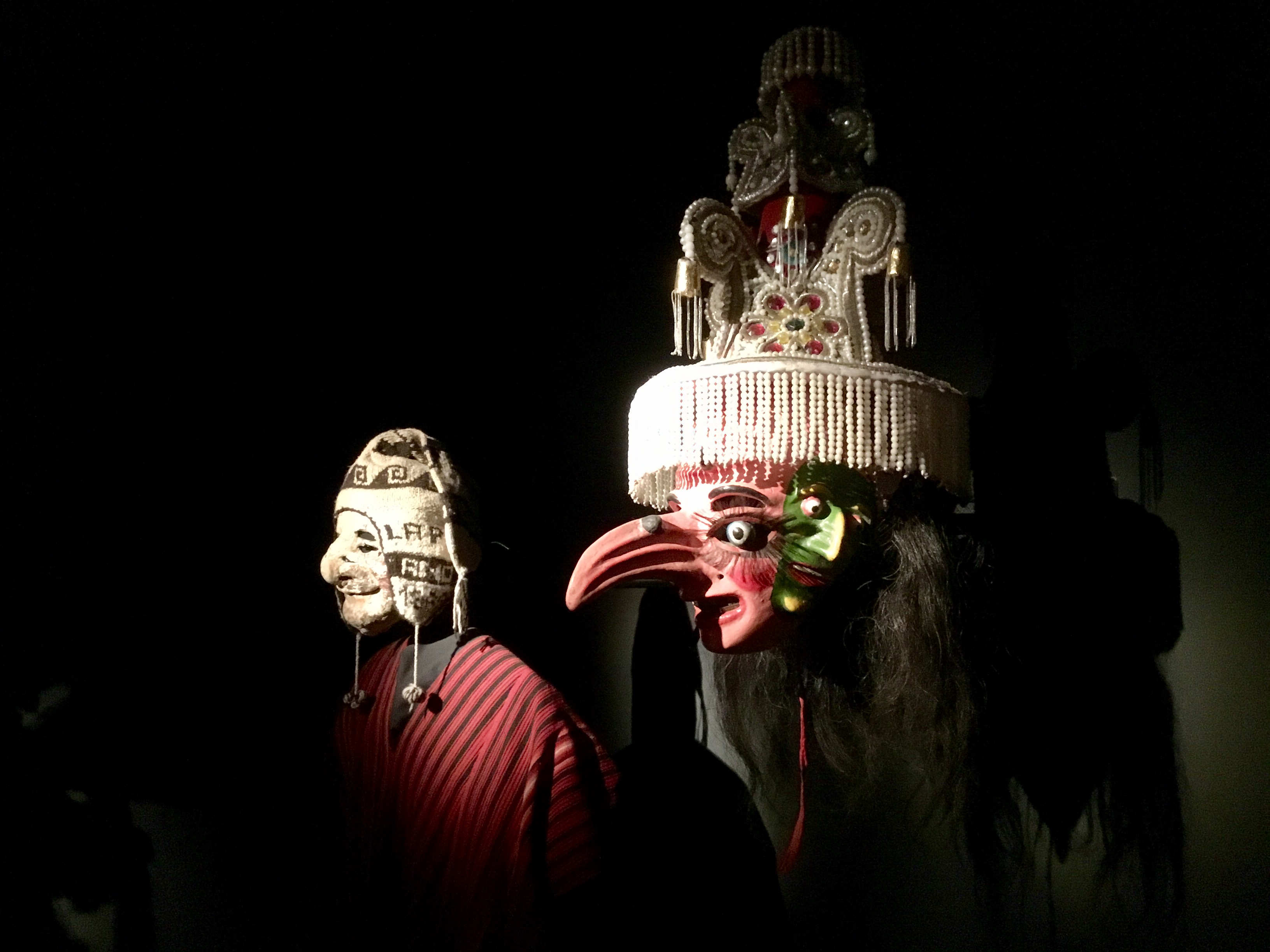
Art begins in the struggle for equilibrium. One cannot create from a balanced state. Being off balance produces a predicament that is always interesting on stage. In the moment of unbalance, our animal instincts prompt us to struggle towards equilibrium and this struggle is endlessly engaging and fruitful. When you welcome imbalance in your work, you will find yourself instantly face to face with your own inclination towards habit. Habit is an artist’s opponent. In art, the unconscious repetition of familiar territory is never vital or exciting. We must try to remain awake and alive in the face of our inclinations towards habit. Finding yourself off balance provides you with an invitation to disorientation and difficulty. It is not a comfortable prospect. You are suddenly out of your element and out of control. And it is here the adventure begins. When you welcome imbalance, you will instantly enter new and unchartered territory in which you feel small and inadequate in relation to the task at hand. But the fruits of this engagement abound.
Anne Bogart in A Director Prepares: Seven Essays on Art and Theatre
Comments are welcome!
Pearls from artists* # 418
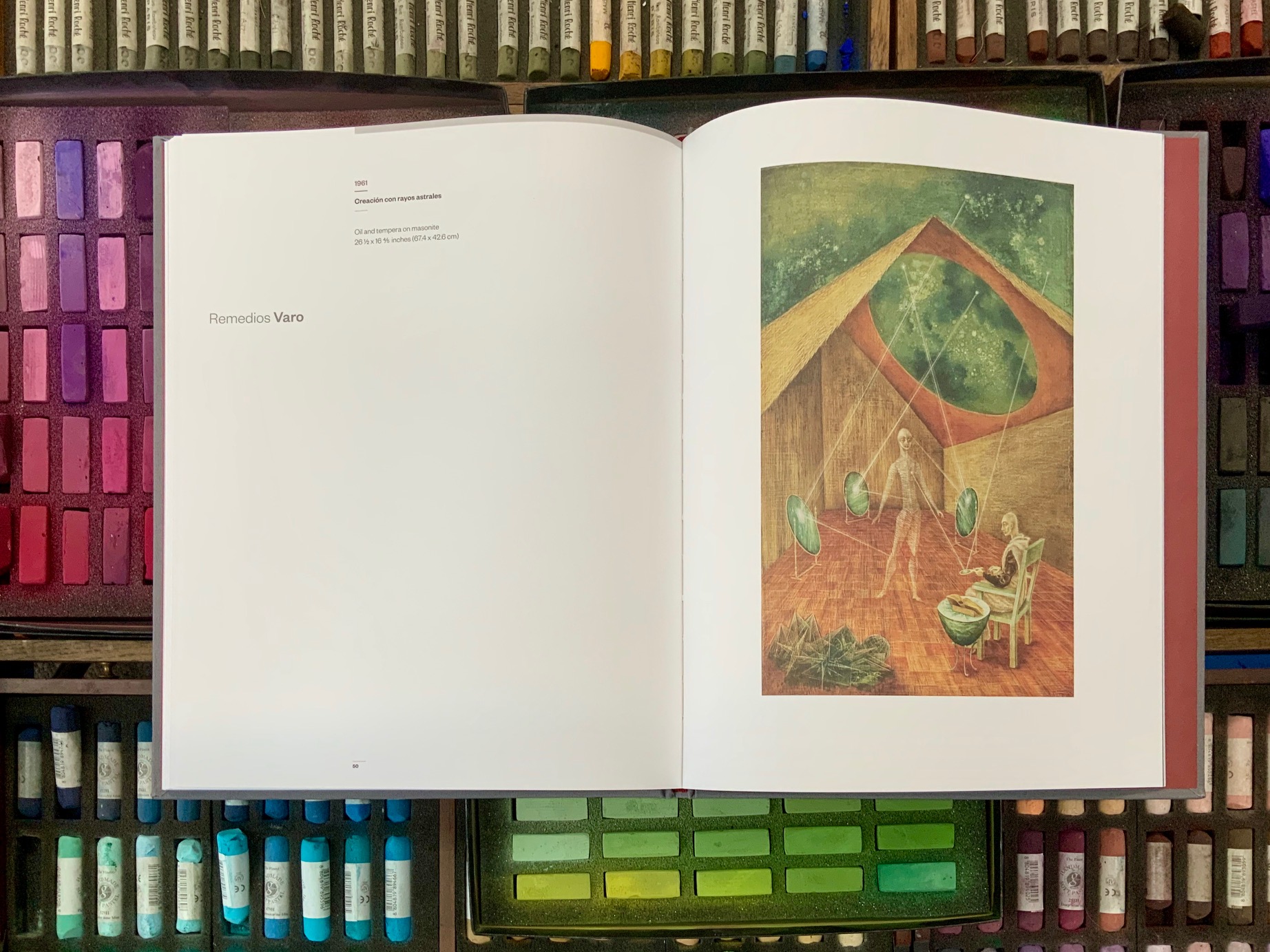
A Remedios Varo Plate from “Science and Surrealism”
*an ongoing series of quotations – mostly from artists, to artists – that offers wisdom, inspiration, and advice for the sometimes lonely road we are on.
… both Surrealism’s birth and infancy coincided with probably the most momentous period in the history of physics. The first Surrealist text, written by Andre Breton and Philippe Soupault and titled Magnetic Fields, deployed the spontaneous technique of ‘automatic writing,’ which supposedly allowed direct access to unconscious material. It appeared in 1920 but was written in the previous year, coinciding with the expedition led by the English astrophysicist, Arthur Eddington, to observe the solar eclipse from the island of Principe off the west coast of Africa. It was this journey that proved predictions set out in Einstein’s General Theory of Relativity (1916) about the gravitational deflection of light by the sun. Eddington’s experiment led not only to Einstein’s instant, mythic status as the ‘new Copernicus’ and the swift popularization of Relativity, but more specifically its appearance in the early theoretical writings of Surrealism’s principle spokesman, Breton, which helped lay the foundations of the movement. Breton’s subsequent manifesto texts of 1924 and 1929, extending his discussion of what he deemed the narrow, restrictive logic of Western though, can be situated within the same historical context that bore the revolutionary discoveries of quantum mechanics, culminating in 1927.
“Sibylline Strangeness: Surrealism and Modern Physics,” by Gavin Parkinson in Science in Surrealism, published by Gallery Wendy Norris
Comments are welcome!
Pearls from artists* # 404

“Broken,” soft pastel on sandpaper, 38″ x 58″ image, 50″ x 70″ framed
* an ongoing series of quotations – mostly from artists, to artists – that offers wisdom, inspiration, and advice for the sometimes lonely road we are on.
Before we can even think of ecological rescue, global disarmament, or economic reform, we must find a way back to what science fiction writers call our homeworld. The term encompasses more than the biosphere; it also includes our homes, our places of work, our communities, families, friends, and lovers. It includes our technologies and tools, the physical body, the sensible soul, and the unconscious psyche. We need a faith to restore our capacity to feel, to affect and be affected with the same passionate intensity as our forebears, whose powers of feeling astound us so in the records and art of the past. The death of affect, to borrow a phrase from JG Ballard, is the true catastrophe of our spectral age, our spiritual Hiroshima. It makes questions such as whether life’s riddles are answered at the Vatican, in Tibet, or by the Large Hadron Collider utterly meaningless, since it removes the ground we need to pose such questions in the first place. Neither religion nor science can give us back the ground. Only the imagination can. Only art can mend the rupture of the soul and the world, the body and the earth.
J.F. Martel in Reclaiming Art in the Age of Artifice: A Treatise, Critique, and Call to Action
Comments are welcome!


 barbararachkoscoloreddust.com