Blog Archives
Pearls from artists* # 67

Negombo, Sri Lanka
* an ongoing series of quotations – mostly from artists, to artists – that offers wisdom, inspiration, and advice for the sometimes lonely road we are on.
John Robin Baitz: I was just thinking that you still manage to write with some kind of miraculous hope.
Athol Fugard: You’ve got to. Implicit in the act of creation on the part of the artist is: I make it because I want to share it with you. At the end of my process you are waiting for me… Pascal says “Imagine a cell in darkness and the inmates are shackled together. Every morning at dawn, the door opens and the person at the end of the line is taken out and executed and the door is closed. Those left behind read their fate in the opening and closing of the door every day. it is a metaphor of the human condition.” That is Pascal.
Camus comes to that paragraph and says, “There is no question about it – that is an image of the human condition. What do we do during those 24 hours between the opening and closing of the door? Do we cry? Or do we tap the next person in the chain and say ‘What’s your name? I’m Athol Fugard. Who are you?'” And that’s how we create meaning. At the end of the process you are waiting. And that is the act of faith. That is the hope that every artist has.
Quoted by Anne Bogart in “and then you act: making art in an unpredictable world”
Comments are welcome!
Q: Would you speak about the practical realities – time and expenses – involved in making your pastel-on-sandpaper paintings? What might people be surprised to learn about this aspect of art-making?
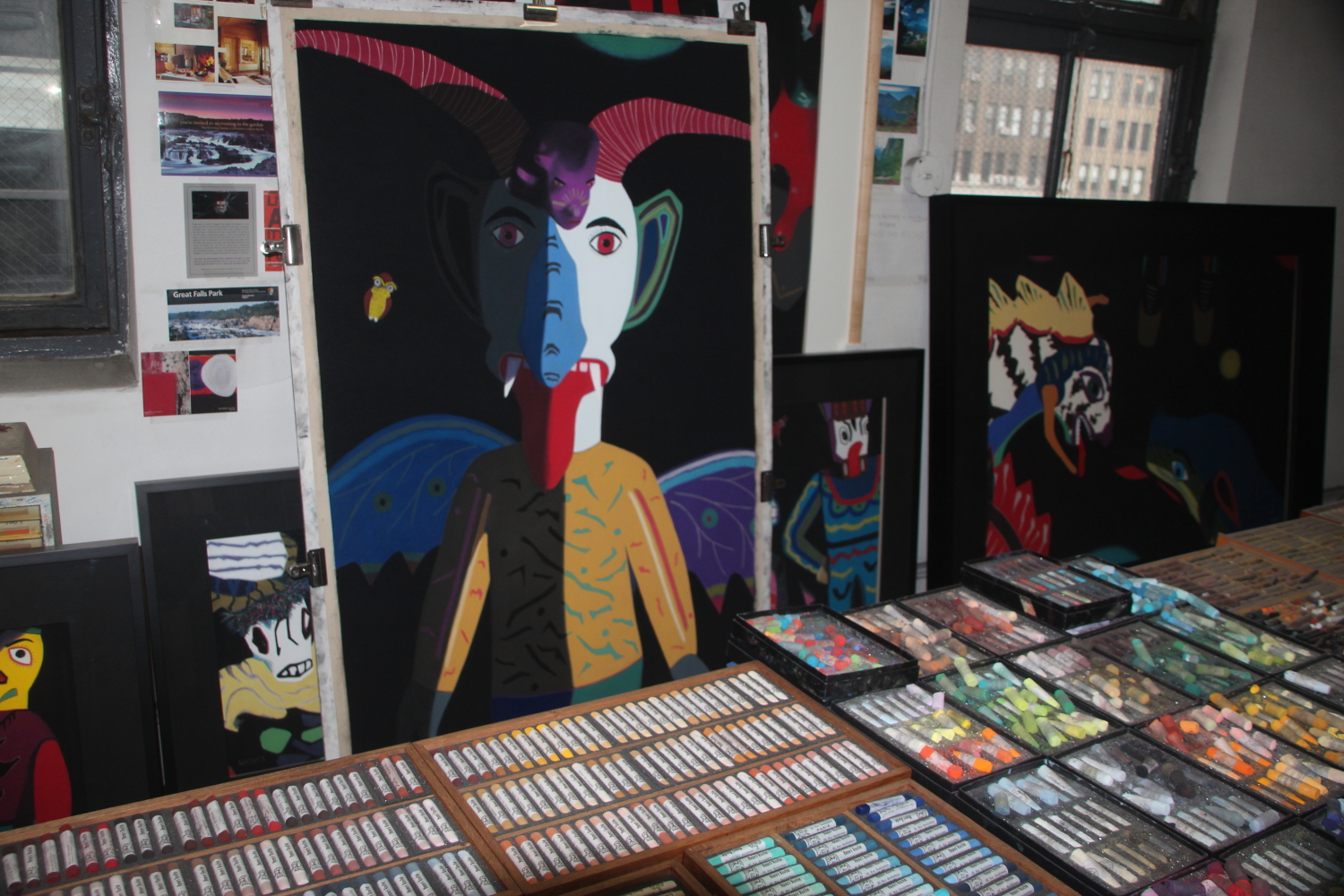
Studio
A: I have often said that this work is labor-intensive. In a good year I can complete five or six large (38″ x 58″) pastel paintings. In 2013 I am on track to make four, or, on average, one completed painting every three months. I try to spend between thirty-five and forty hours a week in the studio. Of course, I don’t work continuously all day long. I work for awhile, step back, look, make changes and additions, think, make more changes, step back, etc. Still, hundreds of hours go into making each piece in the “Black Paintings” series, if we count only the actual execution. There is also much thinking and preparation – there is no way to measure this – that happen before I ever get to stand before an empty piece of sandpaper and begin.
As far as current expenses, they are upwards of $12,000 per painting. Here is a partial breakdown:
$4500 New York studio, rent and utilities ($1350/month) for three months
$2500 Supplies, including frames (between $1500 – $1700), photographs, pastels (pro-rated), paper
$2000 Foreign travel to find the cultural objects, masks, etc. depicted in my work (approximate, pro-rated)
$3000 Business expenses, such as computer-related expenses, website, marketing, advertising, etc.
This list leaves out many items, most notably compensation for my time, shipping and exhibition expenses, costs of training (i.e. ongoing photography classes), photography equipment, etc. Given my overhead, the paintings are always priced at the bare minimum that will allow me to continue making art.
I wonder: ARE people surprised by these numbers? Anyone who has ever tried it knows that art is a tough road. Long ago I stopped thinking about the cost and began doing whatever is necessary to make the best paintings. The quality of the work and my evolution as an artist are paramount now. This is my life’s work, after all.
Comments are welcome!
Q: You have sometimes spoken about your early work as a portrait artist. When and why did you start making portraits? Do you still do them?

“Bryan,” soft pastel on sandpaper, 22″ x 28″, 1988
A: In 1989 I was a Naval officer working at the Pentagon and I hated my job as a computer analyst. Although it was terrifying to leave the security of a paycheck for the uncertainty of an artist’s existence, I made the leap. In retrospect it was one of the best decisions of my life. When I resigned from active duty (I remained in the Navy Reserve, which provided a part-time job and a small income; in 2003 I retired as a Navy Commander), I needed a way to make a living.
Prior to this career change, I worked hard to develop my portrait skills. I volunteered to run a life drawing class at The Art League School in Alexandria, VA, where I made hundreds of figure drawings using charcoal and pastel. I spent a semester commuting between Washington, DC and New York to study artistic anatomy at the New York Academy of Art. I spent another semester studying gross anatomy with medical students at Georgetown University Medical School. So I was well prepared to devote myself to making portraits.
For a time I made a living making commissioned photo-realist portraits in soft pastel on sandpaper. However, after about two years I became bored. I remember thinking, “I did not leave a boring job just to make boring art!” Furthermore, I had no interest in doing commissions because what I wanted to accomplish as an artist did not coincide with what portrait clients wanted. I completed my final portrait commission in 1990 and never looked back. To this day I remain loathe to do a commission of any kind.
Comments are welcome!
Pearls from artists* # 38
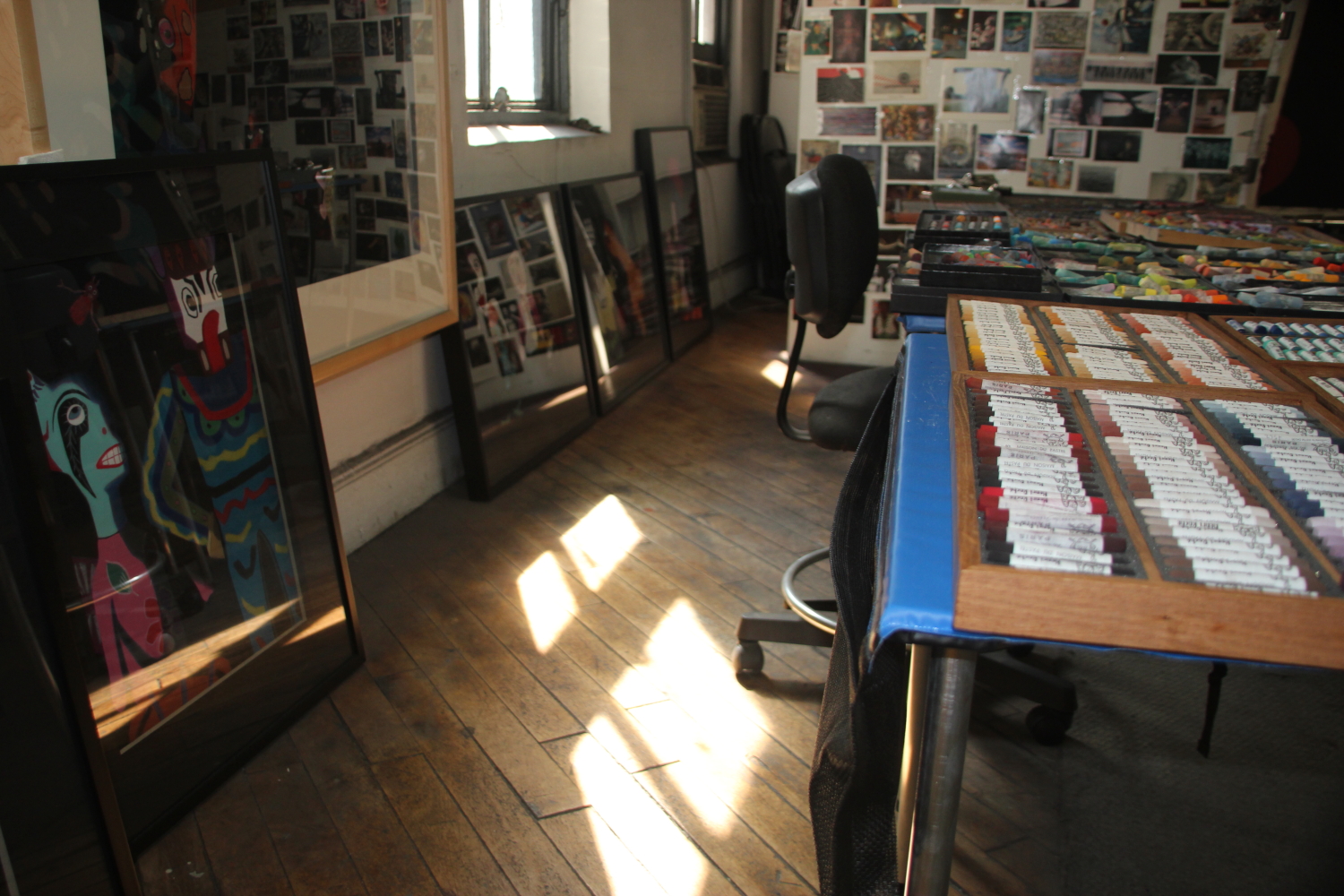
Morning sun at the studio
* an ongoing series of quotations – mostly from artists, to artists – that offers wisdom, inspiration, and advice for the sometimes lonely road we are on.
It’s one thing to be intelligent and it’s another to enjoy thinking, to relish the time spent alone with one’s thoughts, to happily muse, imagine, and analyze. Artists, who are introspective by nature, typically enjoy spending time in this fashion and may even prefer solitude to the company of others. Able to work by themselves, artists are often lost in a state of dreamy thoughtfulness of the sort described by the painter Hans Hofmann when he wrote, ” The first red spot on a white canvas may at once suggest to me the meaning of ‘morning redness,’ and from there I dream further with my color.” Artists are not introspective, thoughtful, lost in time and space because they wish to ignore the world. They’re introspective because out of that attitude artistic answers flow.
Eric Maisel in A Life in the Arts
Comments are welcome!
Pearls from artists* # 37
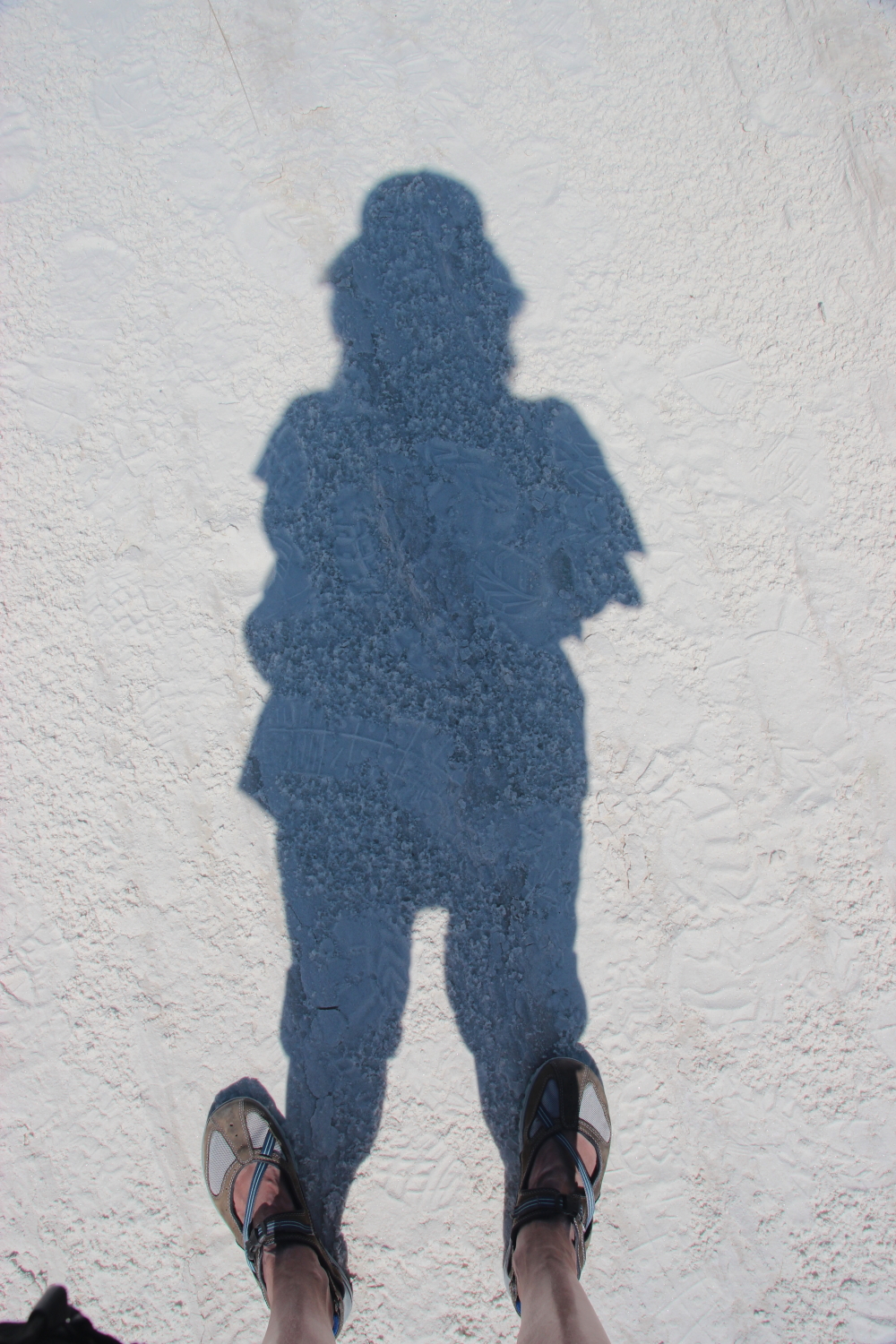
Self portrait, White Sands, NM
* an ongoing series of quotations – mostly from artists, to artists – that offers wisdom, inspiration, and advice for the sometimes lonely road we are on.
Certainly the most compelling thing in both personal life and art is to be yourself. When we engage attentively and honestly, pay attention to the insights that come to us, see our denial and faulty thinking, and engage in uncovering the obstacles and blocks to our expression, we realize that art is a wonderful medium for personal growth.
If we realize all this, we do ourselves justice when we claim to be an artist. We really mean it, and we own it. Today, as we start working on whatever it is we’re doing, let’s claim our role as artists, being attentive to process as much as finished results.
Ian Roberts in Creative Authenticity: 16 Principles to Clarify and Deepen Your Artistic Vision.
Comments are welcome!
Q: Is there an overarching narrative in your photographs with Mexican and Guatemalan figures?
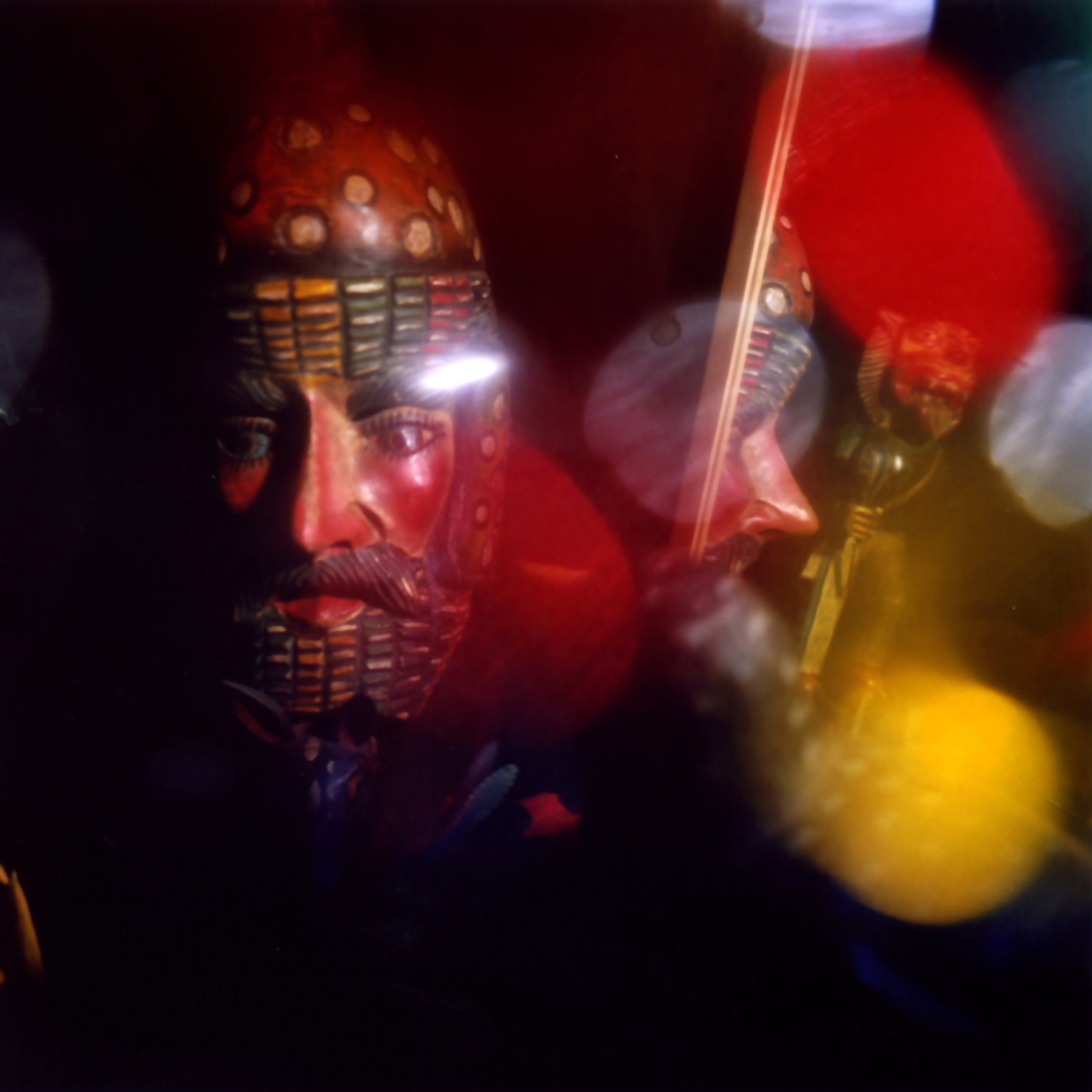
Untitled chromogenic print, 24″ x 24,” edition of 5
A: Maybe, but that’s something for the viewer to judge. I never specify exactly what my work is about for a couple of reasons: my thinking about the meaning of my work constantly evolves, plus I wouldn’t want to cut off other people’s interpretations. Everything is equally valid. I heard Annie Leibovitz interviewed some time ago on the radio. She said that after 40 years as a photographer, everything just gets richer. It doesn’t get easier, it just gets richer. I’ve been a painter for 27 years, a photographer for 11, and I agree completely. Creating this work is an endlessly fascinating intellectual journey. I realize that I am only one voice in a vast art world, but I hope that through the ongoing series of questions and answers on my blog, I am conveying some sense of how artists work and think.
Comments are welcome!
Q: Do you listen to music while you work?

A corner of the studio
A: I always have the stereo on when I work in my studio, either tuned in to WBGO (the Newark-based jazz station), WNYC (for news and talk radio; Leonard Lopate, Fresh Air, etc.), WFMU (Fordham University’s radio station, to learn what college kids are listening to) and other local radio stations. I still listen to cd’s, I read the lyrics and the liner notes, and I prefer to listen to music the way artists intended it, meaning that I listen to entire albums from start to finish instead of jumping around between single tracks by different artists. When it comes to music, I’m interested in everything: jazz (especially classic jazz artists like Thelonious Monk, Miles Davis, John Coltrane, Art Blakely, etc.), blues, classical, pop, rock, world music (especially artists from Brazil, Cuba, and any country in Africa), electronic, indy, experimental, ancient music, etc. You name it, I probably listen to it, and if I don’t, I’m eager to learn all about it. When I’m working, certain artists are better to listen to at particular points in a painting. For example, one of my favorite artists to start a new painting with is Lady Gaga. The beat, her energy, and sheer exuberance are perfect when I’m standing in front of my easel with a blank piece of sandpaper in front of me. Gaga’s music gets me moving and working fast, putting down colors instinctively without thinking about them, just feeling everything.
It’s a different story when I am at my apartment and am shooting a photo setup. Then I might or might not listen to music. Lately it’s more about working fast (I shoot 24 images in about 15 minutes), choosing a variety of interesting vantage points, getting surprising effects, etc.
Comments are welcome!
Q: Why do you work in series?
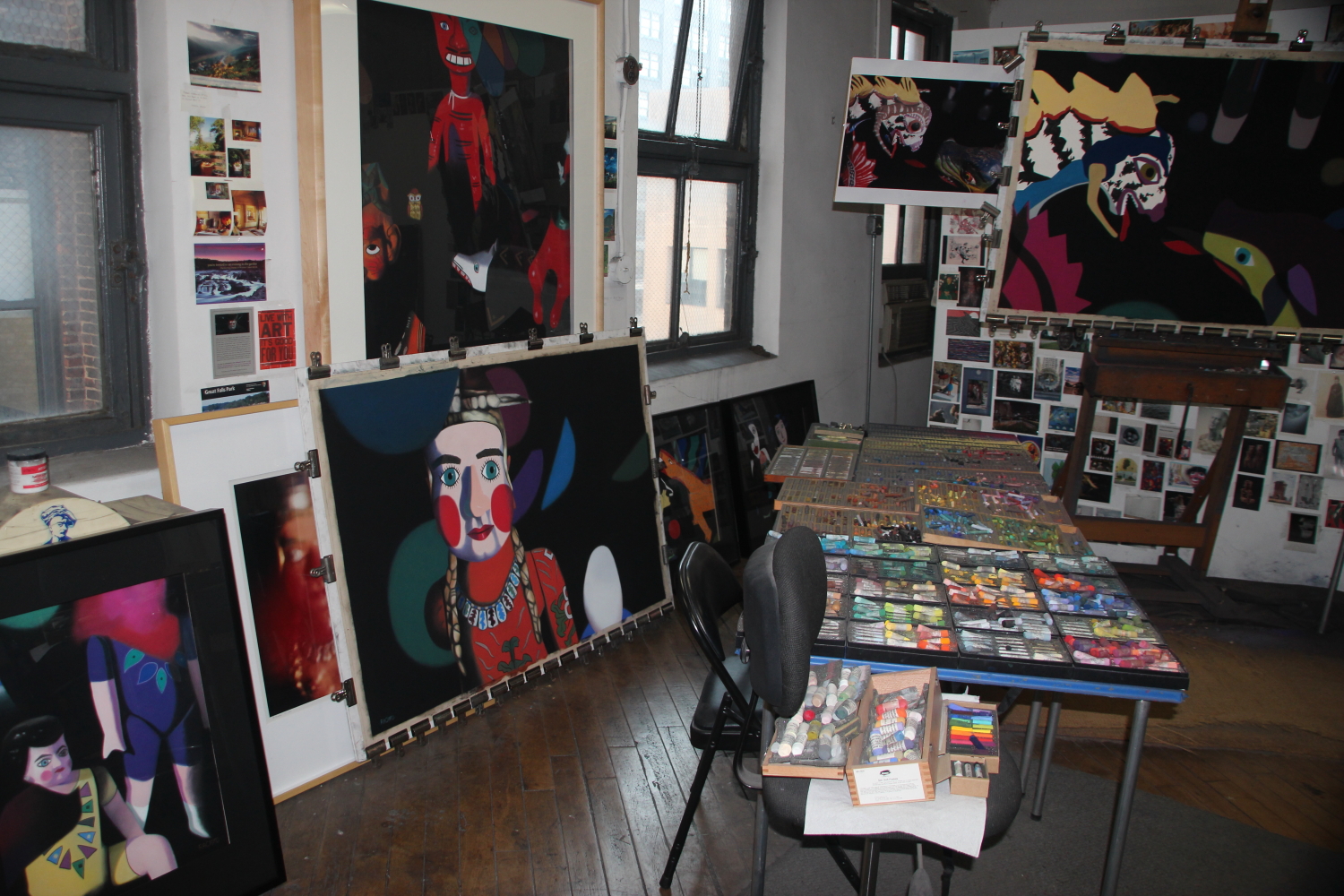
The studio recently
A: I don’t really have any choice in the matter. It’s more or less the way I have always worked so it feels natural. Art-making comes from a deep place. In keeping with the aphorism ars longa, vita brevis, it’s a way of making one’s time on earth matter. Working in series mimics the more or less gradual way that our lives unfold, the way we slowly evolve and change over the years. Life-altering events happen, surely, but seldom do we wake up drastically different – in thinking, in behavior, etc. – from what we were the day before. Working in series feels authentic. It helps me eke out every lesson my paintings have to teach. With each completed piece, my ideas progress a step or two further.
Last week I went to the Metropolitan Museum to see an exhibition called, “Matisse: In Search of True Painting.” It demonstrates how Matisse worked in series, examining a subject over time and producing multiple paintings of it. Matisse is my favorite artist of any period in history. I never tire of seeing his work and this particular exhibition is very enlightening. In fact, it’s a must-see and I plan to return, something I rarely do because there is always so much to see and do in New York. As I studied the masterpieces on the wall, I recognized a kindred spirit and thought, “Obviously, working in series was good enough for Matisse!”
Comments are welcome!
Q: Does your work look different to you on days when you are sad, happy, etc.?
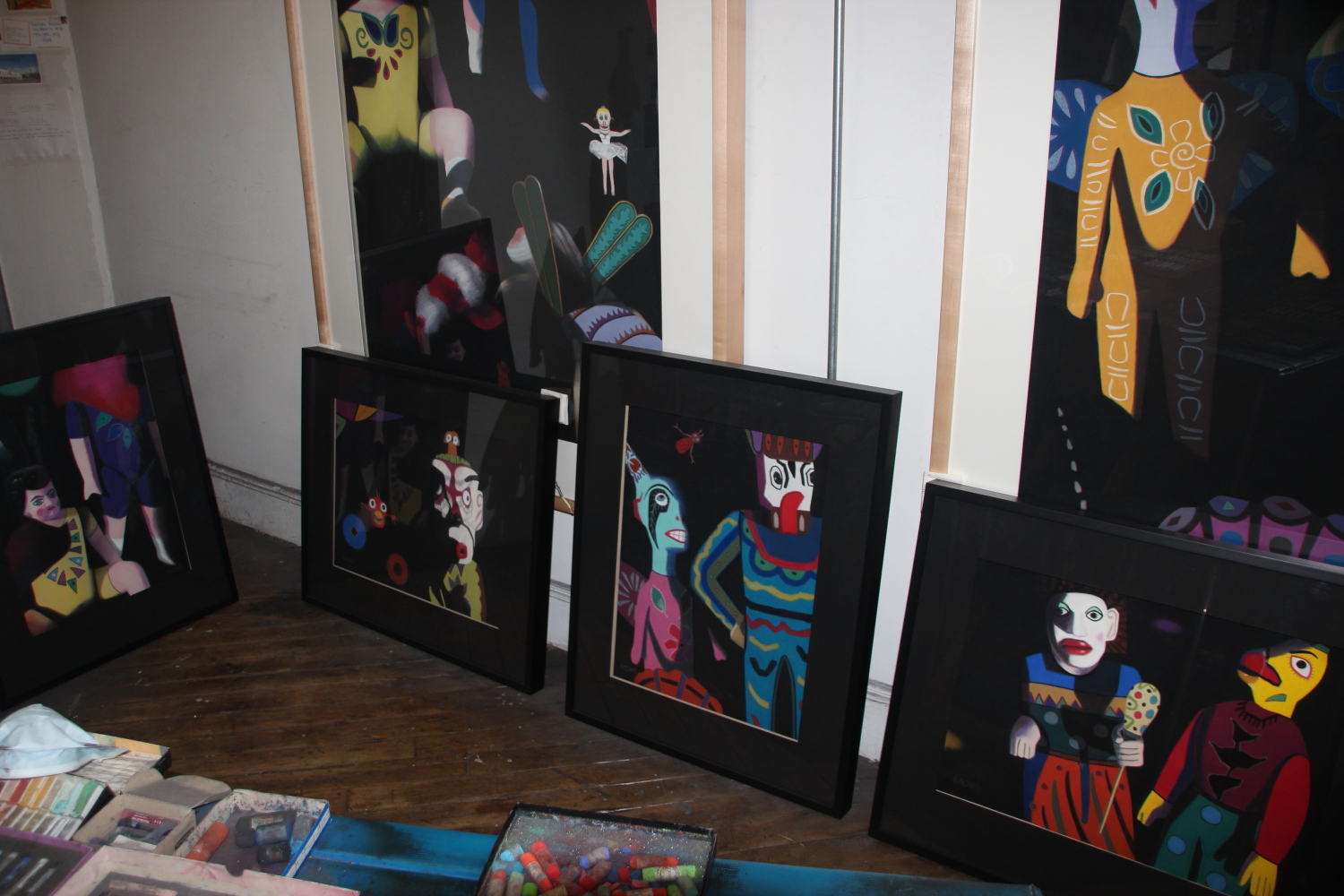
Recent work
A: I’m more critical on days when I am sad so that the faults, imperfections, and things I wish I had done better stand out. Fortunately, all of my work is framed behind plexiglas so I can’t easily go back in to touch up newly-perceived faults. It reminds me of the expression, “Always strive to improve, whenever possible. It is ALWAYS possible!” However, I’ve learned that re-working a painting is a bad idea. You are no longer deeply involved in making it and the zeitgeist has changed. The things you were concerned with are gone: some are forgotten, others are less urgent. For most artists the work is autobiography. Everything is personal. When I look at a completed pastel painting, I usually remember exactly what was happening in my life as I worked on it. Each piece is a snapshot – maybe even a time capsule, if anyone could decode it – that reflects and records a particular moment. When I finally pronounce a piece finished and sign it, that’s it, THE END. It’s as good as I can make it at that point in time. I’ve incorporated everything I was thinking about, what I was reading, how I was feeling, what I valued, art exhibitions I visited, programs that I heard on the radio or watched on television, music that I listened to, what was going on in New york, in the country, in the world, and so on. It is still a mystery how this heady mix finds its way into the work. During the time that I spend on it, each particular painting teaches me everything it has to teach. A painting requires months of looking, reacting, correcting, searching, thinking, re-thinking, revising. Each choice is made for a reason and as an aggregate these decisions dictate what the final piece looks like. On days when I’m sad I tend to forget that. On happier days I remember that the framed pastel paintings that you see have an inevitability to them. If all art is the result of one’s having gone through an experience to the end, as I believe it is, then the paintings could not, and should not, look any differently.
Comments are welcome.


 barbararachkoscoloreddust.com