Blog Archives
Pearls from artists* # 625

Downtown Manhattan
*an ongoing series of quotations – mostly from artists, to artists – that offers wisdom, inspiration, and advice for the sometimes lonely road we are on.
Think of one of those rare, truly exceptional outings to the cinema. In the lobby afterward the experience elicits from us a language of paralysis and disappearance: “I forgot myself. It could have gone on forever.” Stepping out onto the street, we feel that somehow nothing is as it was before. The passing cars, the night sky above the glass towers, the streetlights reflected on the wet pavement: everything glows with a strange immediacy and newness. It is as if the film had done something to the world. A similar thing might happen when we put down a great novel or take in a powerful piece of music.
The Book of Revelation contains a memorable line: “Behold, I make all things new.” Reflecting on this ancient text, the critic Northrop Frye defined the Apocalypse as “the way the world looks once the ego has disappeared.” Every great artistic work is a quiet apocalypse. It tears off the veil of ego, replacing old impressions with new ones at once inexorably alien and profoundly meaningful. Great works of art have a unique capacity to arrest the discursive mind, raising it to a level of reality that is more expansive than the egoic dimension we normally inhabit. In this sense, art is the transfiguration of the world.
J.F. Martel in Reclaiming Art in the Age of Artifice: A Treatise,Critique, and Call to Action
Comments are welcome!
Pearls from artists* # 614

*an ongoing series of quotations – mostly from artists, to artists – that offers wisdom, inspiration, and advice for the sometimes lonely road we are on.
The artist has accepted his fate with open eyes, and I do not believe that he wishes any charity in relation to his self-assumed sacrifice. He wants nothing but the understanding and love of what he does. There can be no other rewards. The foregoing therefore is not in the spirit of asking for a charitable contribution, but rather the clearing of the way for what is really the motivating factor for this strange phenomenon: the creation of art.
Mark Rothko in The Artist’s Reality: Philosophies of Art
Comments are welcome!
Pearls from artists* # 598
*an ongoing series of quotations – mostly from artists, to artists – that offers wisdom, inspiration, and advice for the sometimes lonely road we are on.
For art to appear, we have to disappear. This may sound strange, but in fact it is a common appearance. The elementary case, for most people, is when our eye or ear is “caught” by something: a tree, a rock, a cloud, a beautiful person, a baby’s gurgling, spatters of sunlight reflected off some wet mud in the forest, the sound of a guitar wafting unexpectedly out of a window. Mind and sense are arrested for a moment, fully in the experience. Nothing else exists. When we “disappear” in this way, everything around us becomes a surprise, new and fresh. Self and environment unite. Attention and intention fuse. We see things just as we and they are, yet we are able to guide and direct them to be one just the way we want them. This lively and vigorous state of mind is the most favorable to the germination of original work of any kind. It has its roots in child’s play, and its ultimate flowering in full-blown artistic creativity.
Stephen Nachmanovitch in Free Play: Improvisation in Life and Art
Comments are welcome!
Pearls from artists* # 582

*an ongoing series of quotations – mostly from artists, to artists – that offers wisdom, inspiration, and advice for the sometimes lonely road we are on.
Strange, but the artist has never made a fuss about being denied those estimable virtues other men would not do without: intellectuality, good judgment, a knowledge of the world, and rational conduct. It may be charged, that he has even fostered the myth. In his intimate journals Vollard tells us that Degas feigned deafness to escape disputations and harangues concerning things he considered false and distasteful. If the speaker or subject changed, his hearing immediately improved. We must marvel at his wisdom since he must have only surmised what we know definitely today: tThat the constant repetition of falsehood is more convincing than the demonstration of truth. It is understandable, then, how the artist might actually cultivate this moronic appearance, this deafness, this inarticulateness, in an effort to evade the million irrelevancies which daily accumulate concerning his work. For, while the authority of the doctor or plumber is never questioned, everyone deems himself a good judge and an adequate arbiter of what a work of art should be and how it should be done.
Mark Rothko in The Artist’s Reality: Philosophies of Art, edited by Christopher Rothko
Comments are welcome!
Pearls from artists* # 523
*an ongoing series of quotations – mostly from artists, to artists – that offers wisdom, inspiration, and advice for the sometimes lonely road we are on.
How strange the human mind is! When I first began, I think I should have been willing to work at it from the top of a church steeple, whereas now, even to think of finishing requires a real effort. And all this, simply because I have been away from it for so long. It is the same with my picture and with everything else I do. There is always a thick crust to be broken before I can give my whole heart to anything; a stubborn piece of ground, as it were, that resists the attack of plough and hoe. But with a little perseverance the hardness suddenly gives and it becomes so rich in fruit and flowers that I am quite unable to gather them all.
The Journal of Eugene Delacroix edited by Hubert Wellington
Comments are welcome!
Pearls from artists* # 513
*an ongoing series of quotations – mostly from artists, to artists – that offers wisdom, inspiration, and advice for the sometimes lonely road we are on.
… you will never be able to create anything interesting out of your life if you don’t believe that you’re entitled to at least try. Creative entitlement doesn’t mean behaving like a princess or acting as though the world owes you anything whatsoever. No, creative entitlement simply means believing that you are allowed to be here, and that – merely by being here – you are allowed to have a voice and a vision of your own.
The poet David Whyte calls this sense of creative entitlement “the arrogance of belonging,” and claims that it is an absolutely vital privilege to cultivate if you wish to interact more vividly with life. Without this arrogance of belonging, you will never be able to take any creative risks whatsoever. Without it, you will never push yourself out of the suffocating insulation of personal safety into the frontiers of the beautiful and the unexpected.
The arrogance of belonging is not about egotism or self-absorption. In a strange way, it’s the opposite; it is a divine force that will actually take you out of yourself and allow you to engage more fully with life. Because often what keeps you from creative living is your self-absorption (your self-doubt, your self-disgust, your self-judgment, your crushing sense of self-protection). The arrogance of belonging pulls you out of the darkest depths of self-hatred – not by saying “I am the greatest!” but merely saying “I am here!”
Elizabet Gilbert in Big Magic: Creative Living Beyond Fear
Comments are welcome!
Pearls from artists* # 505

*an ongoing series of quotations – mostly from artists, to artists – that offers wisdom, inspiration, and advice for the sometimes lonely road we are on.
… I myself was once “at the top: – with a book that sat on the bestseller list for more than three years. I can’t tell you how many people said to me during those years, “How are you ever going to top that?” They’d speak of my great good fortune as though it were a curse, not a blessing, and would speculate about how terrified I must feel at the prospect of not being able to reach such phenomenal heights again.
But such thinking assumes there is a “top” – and that reaching that top (and staying there) is the only motive one has to create. Such thinking assumes that the mysteries of inspiration operate on the same scale as we do – on a limited human scale of success and failure, of winning and losing, of comparison and competition, of commerce and reputation, of units sold and influence wielded. Such thinking assumes that you must be constantly victorious – not only against your piers, but also against an earlier version of your own poor self. Most dangerously of all, such thinking assumes if you cannot win, then you must not continue to play.
But what does any of that have to do with vocation? What does any of that have to do with the pursuit of love? What does any of that have to do with the strange communion between the human and the magical? What does any of that have to do with faith? What does any of that have to do with the quiet glory of merely making things, and then sharing those things with an open heart and no expectations?
Elizabeth Gilbert in Big Magic: Creative Living Beyond Borders
Comments are welcome!
Pearls from artists* # 491
*an ongoing series of quotations – mostly from artists, to artists – that offers wisdom, inspiration, and advice for the sometimes lonely road we are on.
We look at ancient Egyptian painting today and may find it slightly comic, but what the Egyptians were trying to do with the figure was reveal the various aspects of the person’s body in the most characteristic aspect. The face is in profile because that reveals the most about the person’s face, but the shoulders are not in profile, they’re facing the viewer, because that’s the most revealing angle for the shoulders. The hips are not in profile, but the feet are. It gives a strange, twisted effect, but it was natural to the Egyptians. They were painting essences, and in order to paint an essence you have to paint it from its most characteristic angle. So they would simply combine the various characteristic essences of the human body. This was a piece of spiritual art. It wasn’t trying to reproduce photographic reality, it was trying to reproduce and combine all the essential features of a person within one figure.
Walter Murch in The Conversations: Walter Murch and the Art of Editing Film by Michael Ondaatje
Comments are welcome!
Pearls from artists* # 488
*an ongoing series of quotations – mostly from artists, to artists – that offers wisdom, inspiration, and advice for the sometimes lonely road we are on.
To be astonished is to be caught unawares by the revelation of realities denied or repressed in the everyday. Astonishment has an intellectual as well as an emotional component – in it, the brain and the heart come together. Far from distracting us from the strange and the uncanny in life, the astonishment evoked by great artistic works puts them square in our sights. The work demands that we feel and think the mystery of our passage through this body, on this earth, in this universe. We realize afterward that the world is not what we thought it was: something hidden, impossible to communicate though clearly expressed in the work has risen into the light of awareness, and the share of the Real to which we are privy is proportionately expanded.
JF Martel in Reclaiming Art in the Age of Artifice: A Treatise, Critique, and Call to Action
Comments are welcome!
Pearls from artists* # 467
*an ongoing series of quotations – mostly from artists, to artists – that offers wisdom, inspiration, and advice for the sometimes lonely road we are on.
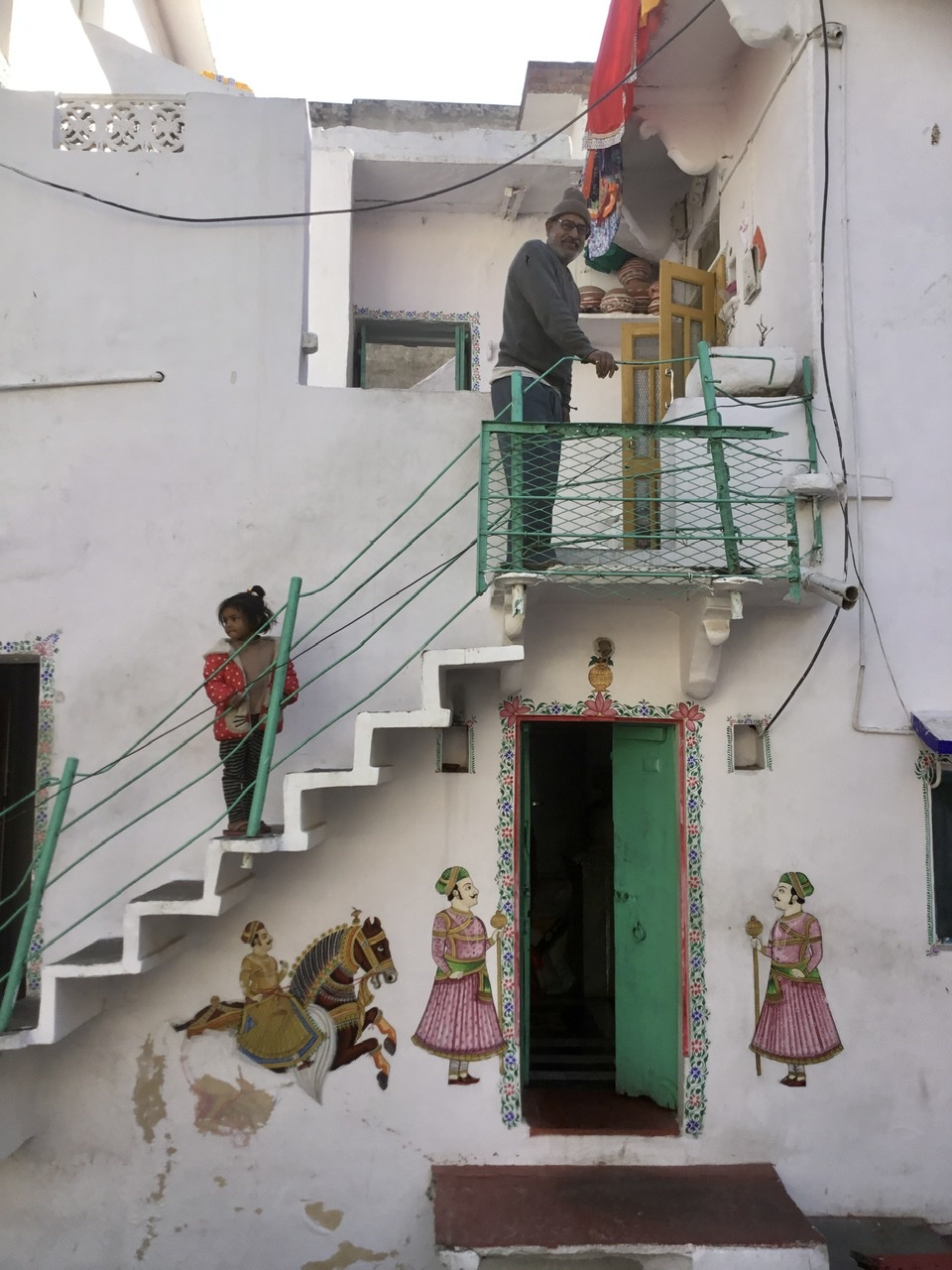
As students confronted with images of India through film and photography, we are challenged to begin to be self-conscious of who we are as “seers.” Part of the difficulty of entering the world of another culture, especially one with as intricate and elaborate a visual articulation as India’s, is that, for many of us, there are no “manageable models.” There are no self-evident ways of recognizing the shapes and forms of art, iconography, ritual life and daily life that we see. Who is Śiva, dancing wildly in a ring of fire? What is happening when the priest pours honey and yogurt over the image of Viṣṇu? Why does the woman touch the feet of the ascetic beggar? For those who enter the visible world of India through the medium of film, the onslaught of strange images raises a multitude of questions. These very questions should be the starting point for our learning. Without such self-conscious questions, we cannot begin to “think” with what we see and simply dismiss it as strange. Or worse, we are bound to misinterpret what we see by placing it solely within the context of what we already know from our own world of experience.
Diana L. Eck in Darsan: Seeing the Divine Image in India
Comments are welcome!


 barbararachkoscoloreddust.com