Blog Archives
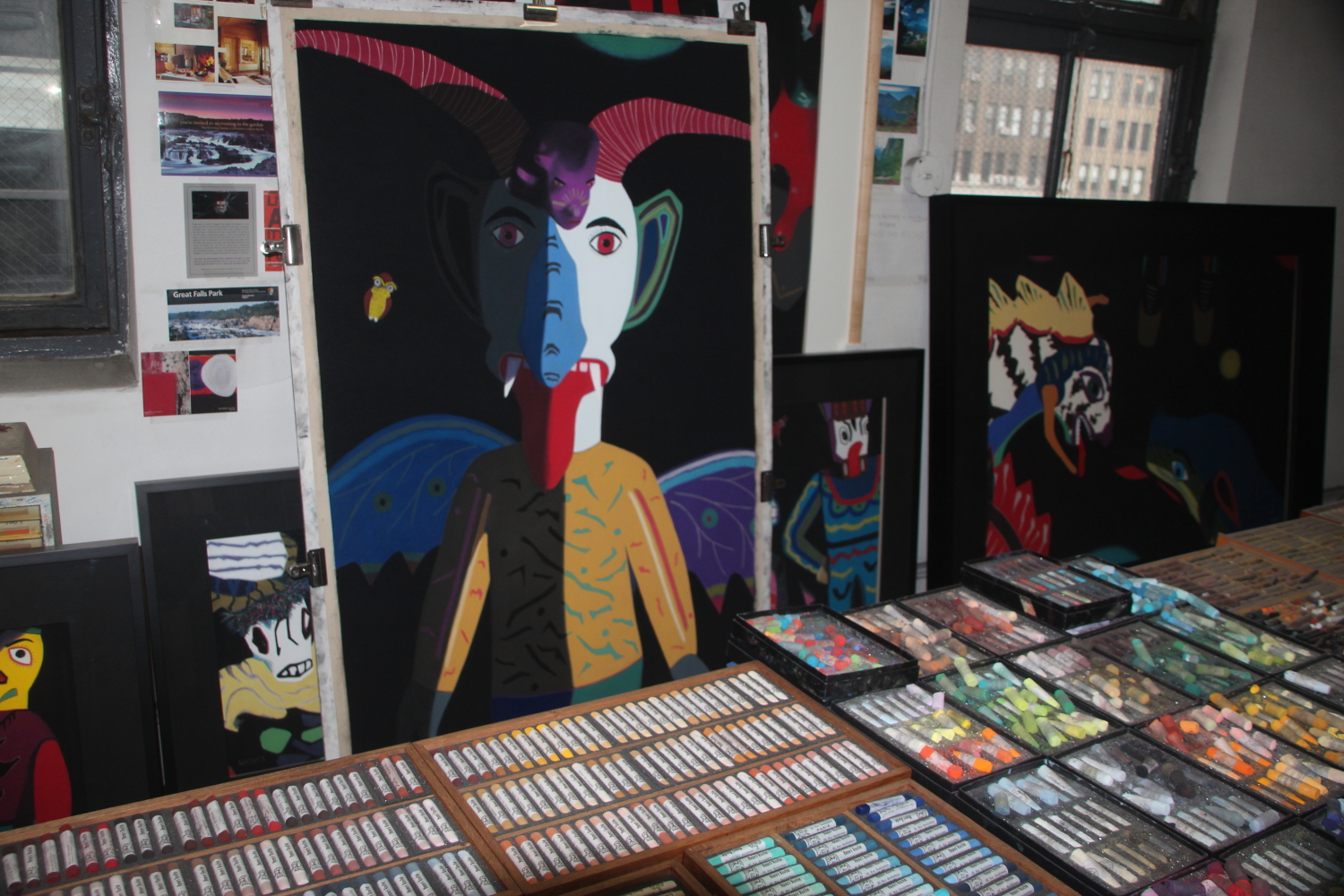
Q: Would you speak about the practical realities – time and expenses – involved in making your pastel-on-sandpaper paintings? What might people be surprised to learn about this aspect of art-making?
Studio
A: I have often said that this work is labor-intensive. In a good year I can complete five or six large (38″ x 58″) pastel paintings. In 2013 I am on track to make four, or, on average, one completed painting every three months. I try to spend between thirty-five and forty hours a week in the studio. Of course, I don’t work continuously all day long. I work for awhile, step back, look, make changes and additions, think, make more changes, step back, etc. Still, hundreds of hours go into making each piece in the “Black Paintings” series, if we count only the actual execution. There is also much thinking and preparation – there is no way to measure this – that happen before I ever get to stand before an empty piece of sandpaper and begin.
As far as current expenses, they are upwards of $12,000 per painting. Here is a partial breakdown:
$4500 New York studio, rent and utilities ($1350/month) for three months
$2500 Supplies, including frames (between $1500 – $1700), photographs, pastels (pro-rated), paper
$2000 Foreign travel to find the cultural objects, masks, etc. depicted in my work (approximate, pro-rated)
$3000 Business expenses, such as computer-related expenses, website, marketing, advertising, etc.
This list leaves out many items, most notably compensation for my time, shipping and exhibition expenses, costs of training (i.e. ongoing photography classes), photography equipment, etc. Given my overhead, the paintings are always priced at the bare minimum that will allow me to continue making art.
I wonder: ARE people surprised by these numbers? Anyone who has ever tried it knows that art is a tough road. Long ago I stopped thinking about the cost and began doing whatever is necessary to make the best paintings. The quality of the work and my evolution as an artist are paramount now. This is my life’s work, after all.
Comments are welcome!
Pearls from artists* # 50

The Getty Museum, Los Angeles
The important thing is the intersection between intuition and discipline, because you have to be alert and at the same time invisible. The eye has to be alert and capture very quickly everything you have inside you – I don’t know how to explain it. What the eye sees is the synthesis of what you are or what you’ve learned to do, this is the language of photography…
Graciela Iturbide in Eyes to Fly With
Comments are welcome!
Pearls from artists* # 49

Untitled, 24″ x 24″ chromogenic print, edition of 5
* an ongoing series of quotations – mostly from artists, to artists – that offers wisdom, inspiration, and advice for the sometimes lonely road we are on.
The beauty of art is better, “higher,” according to Hegel, than the beauty of nature because it is made by human beings and is the work of the spirit. But the discerning of beauty in nature is also the result of traditions of consciousness, and of culture – in Hegel’s language, of spirit.
The responses to beauty in art and to beauty in nature are interdependent. As Wilde pointed out, art does more than school us on how and what to appreciate in nature. (He was thinking of poetry and painting. Today the standards of beauty in nature are largely set by photography.) What is beautiful reminds us of nature as such – of what lies beyond the human and the made – and thereby stimulates and deepens our sense of the sheer spread and fullness of reality, inanimate as well as pulsing, that surrounds us all.
A happy by-product of this insight, if insight it is: beauty regains its solidity, its inevitability, as a judgment needed to make sense of a large portion of one’s energies, affinities, and admirations; and the usurping notions appear ludicrous.
Imagine saying, “That sunset is interesting.”
Paolo Dilonardo and Anne Jump, editors, Susan Sontag At the Same Time: Essays and Speeches
Comments are welcome!
Pearls from artists* # 48

“Big Deal,” with double portrait of the author
* an ongoing series of quotations – mostly from artists, to artists – that offers wisdom, inspiration, and advice for the sometimes lonely road we are on.
Until the invention of photography, the painted (or sculptural) portrait was the only means of recording and presenting the likeness of a person. Photography took over this role from painting and at the same time raised our standards for judging how much an informative likeness should include.
This is not to say that photographs are in all ways superior to painted portraits. They are more informative, more psychologically revealing, and in general more accurate. But they are less tensely unified. Unity in a work of art is achieved as a result of the limitations of the medium. Every element has to be transformed in order to have its proper place within these limitations. In photography the transformation is to a considerable extent mechanical. In a painting each transformation is largely the result of a conscious decision by the artist. Thus the unity of a painting is permeated by a far higher degree of intention. The total effect of a painting (as distinct from its truthfulness) is less arbitrary than that of a photograph; its construction is more intensely socialized because it is dependent on a greater number of human decisions. A photographic portrait may be more revealing and accurate about the likeness and character of the sitter; but it is likely to be less persuasive, less (in the very strict sense of the word) conclusive. For example, if the portraitist’s intention is to flatter or idealize, he will be able to do so far more convincingly in a painting than with a photograph.
Geoff Dyer, editor, Selected Essays: John Berger
Comments are welcome!
Pearls from artists* # 40
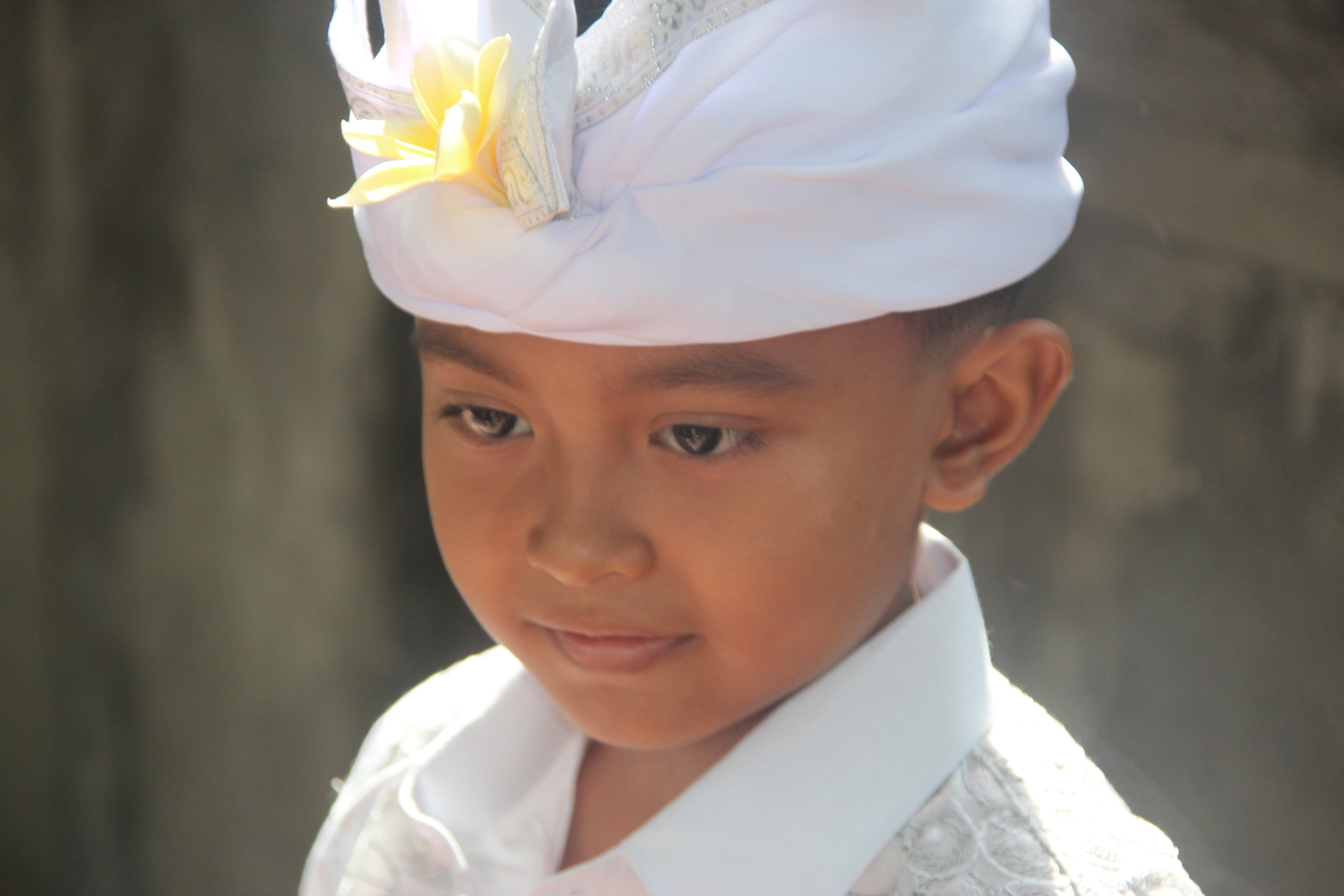
Balinese boy in Hindu dress
* an ongoing series of quotations – mostly from artists, to artists – that offers wisdom, inspiration, and advice for the sometimes lonely road we are on.
A film is a succession of snapshots more or less posed, and it only very rarely gives us the illusion of the unexpected and rare. Ninety films out of a hundred are merely interminable poses. One doesn’t premeditate a photograph like a murder or a work of art.
Photography is rather like those huge American department stores where you find all you want: old master paintings, locomotives, playing cards, tempests, gardens, opera glasses, pretty girls. But steer clear at all costs of the floorwalkers. They are terrible chatterbox bores who have no idea what they are saying.
A photographer for the Daily Mirror said to me: “The most beautiful photos I’ve ever taken were on a day I had forgotten my film.”
That photographer is a poet, perhaps, but quite certainly an imbecile. The photographer’s personality?
Obviously each of them blows his nose in his own fashion. But the most successful photographs are not those that required the most trouble.
That would be just too easy.
Carlo Rim in On the Snapshot
Comments are welcome!
Q: Can you speak in more detail about how losing your husband, Dr. Bryan C. Jack, on 9/11 affected your artistic practice?

“She Embraced It and Grew Stronger,” 2003, 58″ x 38″, first large pastel-on-sandpaper painting completed after Bryan was killed
A: On September 11, 2001, Bryan, who was a high-ranking, career, federal government employee, a brilliant economist (with an IQ of 180 he is still the smartest man I’ve ever met) and a budget analyst at the Pentagon, was en route to Monterrey, CA to give his monthly guest lecture for an economics class at the Naval Postgraduate College there. He had the horrible misfortune of flying out of Dulles airport and boarding the plane that was high-jacked and crashed into the Pentagon, killing 189 people.
Losing him was the biggest shock of my life, devastating in every possible way. I think about him every day and I continually think about how easily I, too, could have been killed on 9/11. I had decided not to travel with Bryan to California, a place I absolutely love visiting, only because the planned trip was too short. His plane crashed directly into my (Navy Reserve) office on the fifth floor, e-ring of the Pentagon. I still imagine how close we came to Bryan having been killed on the plane and me perishing in the building. To this day I believe that I was spared for a reason and I strive to make every day count.
The six months after 9/11 passed by in a blur, except that I vividly remember an October 2001 awards ceremony at the DAR Hall in Washington, DC. I was picked up by a big black limousine, sent by the Department of Defense. At the ceremony I sat with members of the president’s cabinet. I accepted the Defense Exceptional Civilian Service Medal for Bryan, an award he would have accepted himself had he been alive, and was addressed face-to-face by George Bush, Jr., not someone I particularly liked (to put it nicely). Later Bryan was given more awards – a Presidential Rank Award, a Defense Distinguished Civilian Service Medal, and the Defense of Freedom Medal. Many other honors came in and I’ll mention two. Bryan’s hometown of Tyler, Texas named a magnet school after him – Dr. Bryan C. Jack Elementary School (the principal and I cut the ribbon at the opening ceremony) – and Stanford University set up the “Bryan Jack Memorial Scholarship,” which annually helps two deserving students attend Stanford Business School.
The following summer I was ready to – I HAD to – get back to work so my first challenge was to learn how to use Bryan’s 4 x 5 view camera. In July 2002 I enrolled in a one-week view camera workshop at the International Center of Photography in New York. Much to my surprise I already knew quite a lot from watching Bryan. Thankfully, I was soon on my way to working again. After the initial workshop, I decided to begin with the basics since I had never formally studied photography before. I threw myself into learning this new (to me) medium. Over the next few years I enrolled in a series of classes at ICP, starting with Photography I. Along the way I learned to use Bryan’s extensive camera collection (old Leicas, Nikons, Mamiyas, and more) and to make my own large chromogenic prints in the darkroom. In October 2009 it was extremely gratifying to have my first solo photography exhibition with HP Garcia in New York (please see the exhibition catalogue on the sidebar). I remember tearing up at the opening as I imagined Bryan looking down at me with his beautiful smile, beaming as he surely would have, so proud of me for having become a photographer.
Comments are welcome!
Q: Your relationship with photography has changed considerably over the years. How did you make use of photography in your first series of pastel-on-sandpaper paintings, “Domestic Threats”?
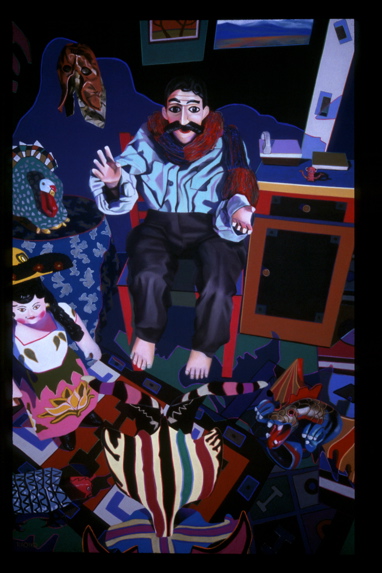
“Truth Betrayed by Innocence,” 2001, 58″ x 38″, the last pastel painting for which Bryan photographed the setup
A: When my husband, Bryan, was alive I barely picked up a camera, except to photograph sights encountered during our travels. Throughout the 1990s and beyond (ending in 2007), I worked on my series of pastel-on-sandpaper paintings called, “Domestic Threats.” These were realistic depictions of elaborate scenes that I staged in our 1932 Sears house in Alexandria, Virginia, and later, in a New York sixth floor walk-up apartment, using the Mexican masks, carved wooden animals, and other folk art figures that I found on our trips to Mexico. I staged and lit these setups, while Bryan photographed them using his Toyo-Omega 4 x 5 view camera. We had been collaborating this way almost from the beginning (we met on February 21, 1986). Having been introduced to photography by his father at the age of 6, Bryan was a terrific amateur photographer. He would shoot two pieces of 4 x 5 film at different exposures and I would select one, generally the one that showed the most detail in the shadows, to make into a 20 x 24 photograph. The photograph would be my starting point for making the pastel painting. Although I work from life, too, I could not make a painting without mostly looking at a reference photo. After Bryan was killed on 9/11, I had no choice but to study photography. Over time, I turned myself into a skilled photographer.
Comments are welcome!
Pearls from artists* # 27
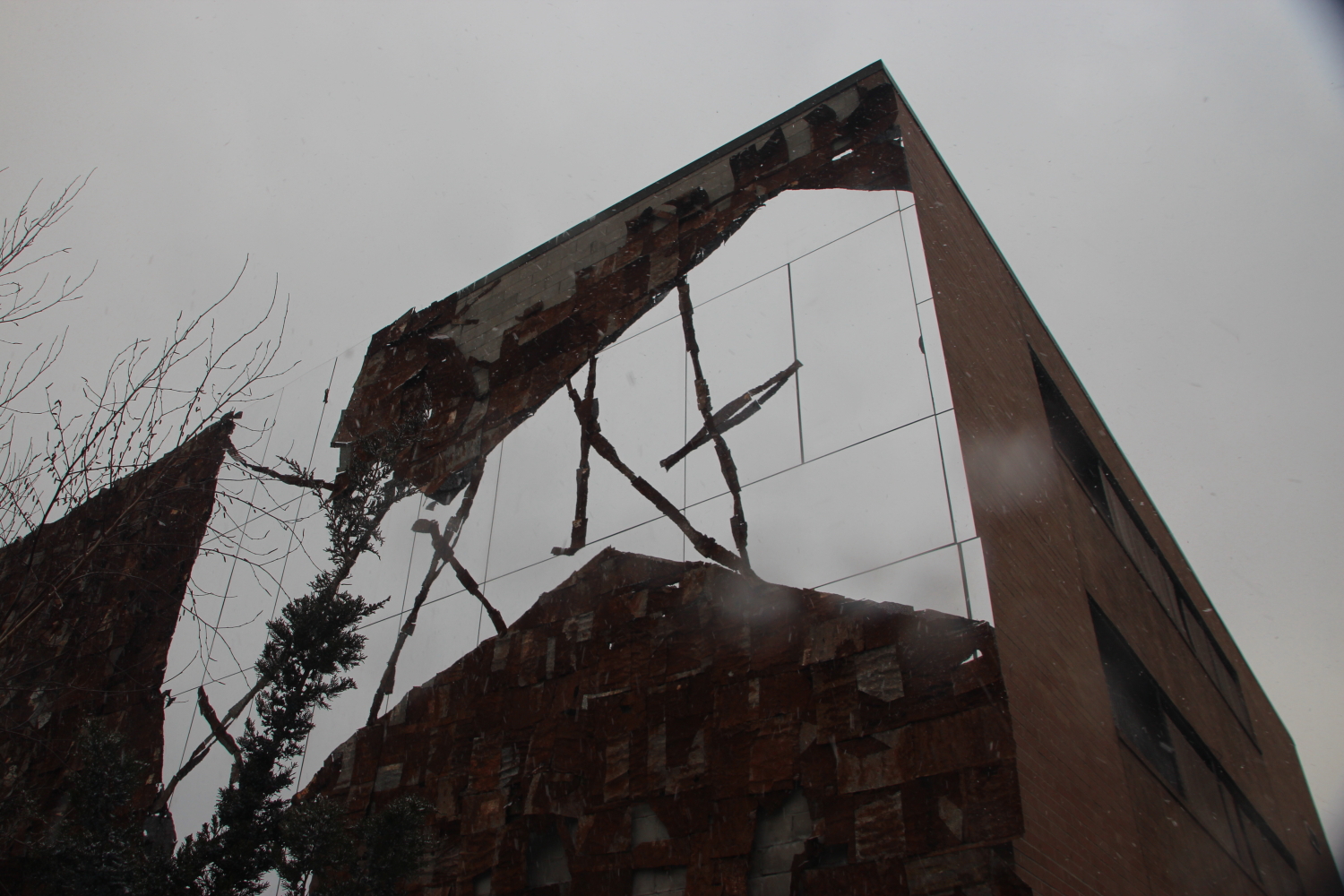
Broken Bridge II, by El Anatsui, on the High Line
* an ongoing series of quotations – mostly from artists, to artists – that offers wisdom, inspiration, and advice for the sometimes lonely road we are on.
Of course, when people said a work of art was interesting, this did not mean that they necessarily liked it – much less that they thought it beautiful. It usually meant no more than that they thought they ought to like it. Or that they liked it, sort of, even though it wasn’t beautiful.
Or they might describe something as interesting to avoid the banality of calling it beautiful. Photography was the art where “the interesting” first triumphed, and early on: the new, photographic way of seeing proposed everything as a potential subject for the camera. The beautiful could not have yielded such a range of subjects; and it soon came to seem uncool to boot as a judgment. Of a photograph of a sunset, a beautiful sunset, anyone with minimal standards of verbal sophistication might well prefer to say, “Yes, the photograph is interesting.”
What is interesting? Mostly, what has not previously been thought beautiful (or good). The sick are interesting, as Nietzsche points out. The wicked, too. To name something as interesting implies challenging old orders of praise; such judgments aspire to be found insolent or at least ingenious. Connoisseurs of “the interesting” – whose antonym is “the boring” – appreciate clash, not harmony. Liberalism is boring, declares Carl Schmitt in The Concept of the Political, written in 1932. (The following year he joined the Nazi Party). A politics conducted according to liberal principles lacks drama, flavor, conflict, while strong autocratic politics – and war – are interesting.
Paolo Dilonardo and Anne Jump, editors, Susan Sontag: At the Same Time
Comments are welcome!
Pearls from artists* # 25
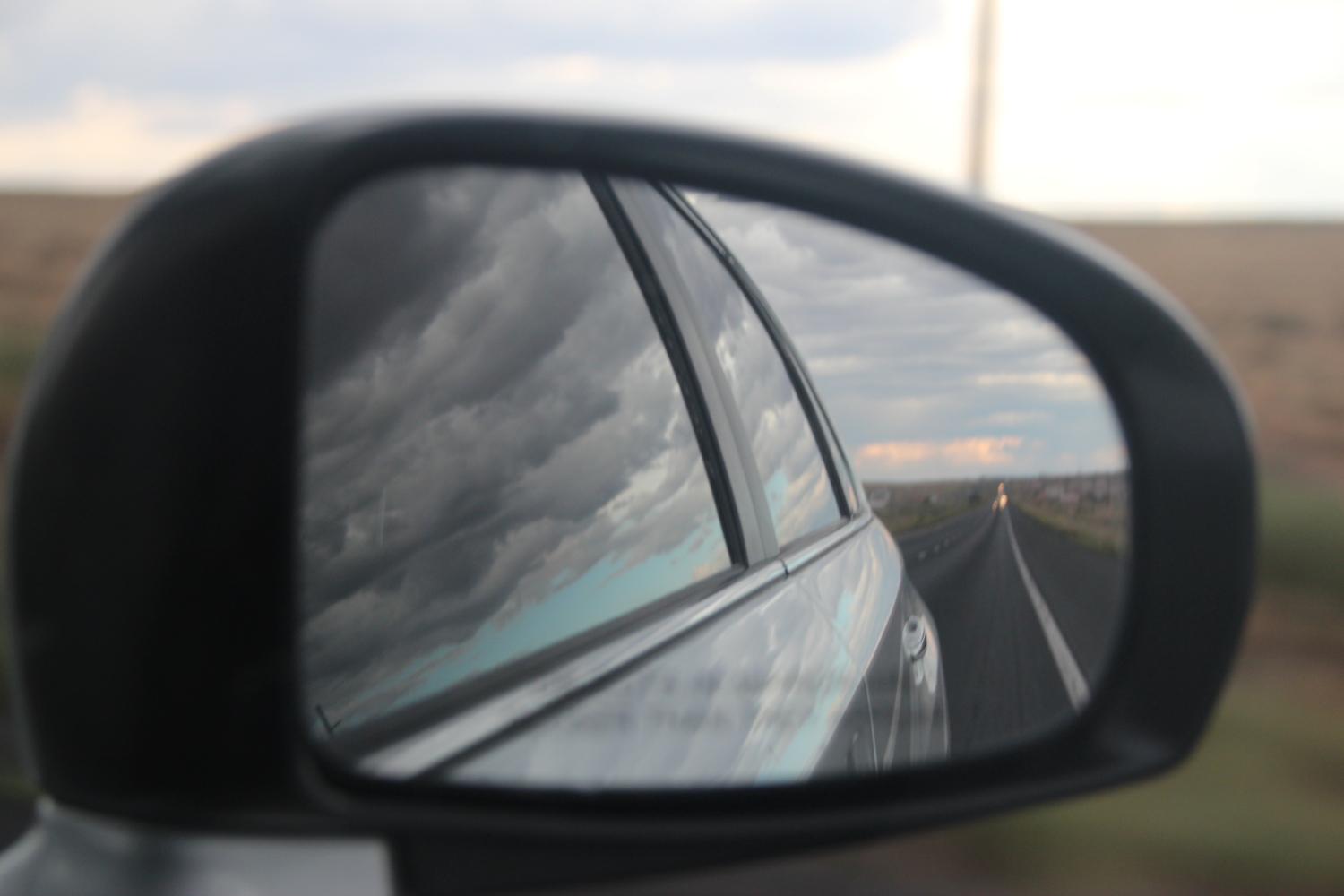
Arizona highway (Donna at the wheel)
* an ongoing series of quotations – mostly from artists, to artists – that offers wisdom, inspiration, and advice for the sometimes lonely road we are on.
February 21, 1924. A hell of a day yesterday. Bitter disappointment awaits the worker in photography.
After risking my neck to get the 8 x 10 camera on la azotea – flat roof – over Tina’s room, the highest vantage point of Lucerna 12, and after straining my back and stripping my nerves to capture a sweep of scurrying cloud forms, development revealed fog – ruinous fog – unmistakably from extraneous light – and a beautiful negative it was, or might have been!
The demon fog can play such uncanny tricks – always I am confounded, disconcerted, mystified until the trouble has been located. All morning I squinted and poked and probed, finally patching with felt the supposed leak due to a warped back, but I lost my negative, as fine a one as any of clouds I have done.
In a blue funk, I was ready to quit, and when Galvan called, accepted his suggestion that we ride into the country and then walk for a while.
North, and out of el distrito federal, he took us to a barranca – gorge – close by – in fact, hardly twenty minutes drive away, yet, from the desolation of this cactus covered gulch we seemed a hundred miles away from any city street. Cactus and rock and the tortuous curves of el arroyo seco – the dry gulch – a bleakness to the spot intensified by a lowering sky, black wrathful clouds, angrily unable to spill their burden of rain. We climbed, we shot, we lay on the dead grass and watched the sunset edge the clouds with rose, and all around stiff cacti in spreading silhouette. Tea with Galvan, his three old aunts and Don pepe – cajeta de Celaya, te, pasas – jelly from Celaya, tea, raisins, and sweet bread.
I feel better, to hell with photography, art, women and all.
Yet – I wished for my camera today. Those serrated stalks of the maguey, their bold uncompromising leaves cutting the horizon, they would make a fine jagged base to a typical Mexican sky.
Nancy Newhall, editor, The Daybooks of Edward Weston: Two Volumes in One: I. Mexico II. California
Comments are welcome!
Q: What would you be if you were not an artist?
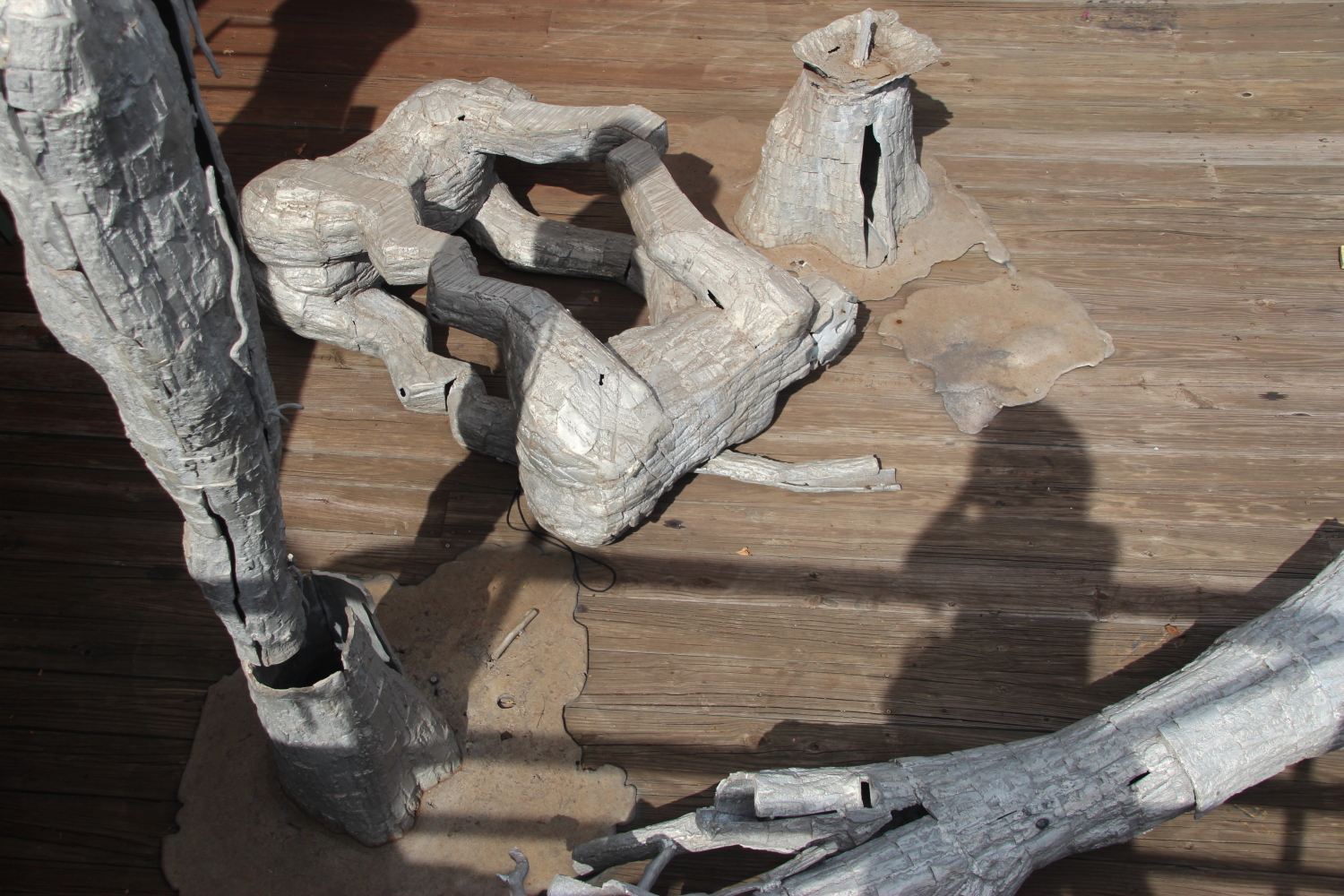
Self-portrait on a Hudson River barge
A: I honestly have no idea, but whatever it might be, there is a good chance that I’d be bored! In my younger days boredom was a strong motivator. I left the active duty Navy out of boredom. I couldn’t bear not being intellectually challenged (most of my jobs consisted of paper-pushing), not using my flying skills (at 27 I was a licensed commercial pilot and Boeing 727 flight engineer), and not developing my artistic talent. In what surely must be a first, by spending a lot of time and money training me for jobs I hated, the Navy turned me into a hard-working artist! And once I left the Navy there was no plan B. There was no time to waste. It was “full speed ahead.”
Art is a calling. You do not need to be told this if you are among those who are called. It’s all about “the work,” that all-consuming focus of an artist’s life. If a particular activity doesn’t make you a better artist, you avoid it. You work hard to nourish and protect your gifts. As artists we invent our own tasks, learn whatever we need in order to progress, and complete projects in our own time. It is life lived at its freest.
My art-making has led me to fascinating places: Mexico, Guatemala, Brazil, Argentina, Uruguay, France, England, Italy, Bali, Java and more; and to in-depth studies of intriguing subjects: drawing, color, composition, art and art history, the art business, film and film history, photography, mythology, literature, music, jazz history, and archaeology, particularly that of ancient Mesoamerica (the Olmec, Zapotec, Mixtec, Aztec, Maya, etc.). And this rich mixture continually grows! For anyone wanting to spend their time on earth learning and meeting new challenges, there is no better life than that of an artist.
I SO agree with this exchange that I read years ago between between Trisha Brown and Mikhail Baryshnikov in the New York Times. I wrote it on a piece of paper and taped it to my studio wall:
Trisha: How do you think we keep going? Are we obsessed?
Mikhail: We do it because there’s nothing better. I’m serious. Because there is nothing more exciting than that. Life is so boring, that’s why we are driven to the mystery of creation.
Comments are welcome.


 barbararachkoscoloreddust.com