Blog Archives
Pearls from artists* # 358
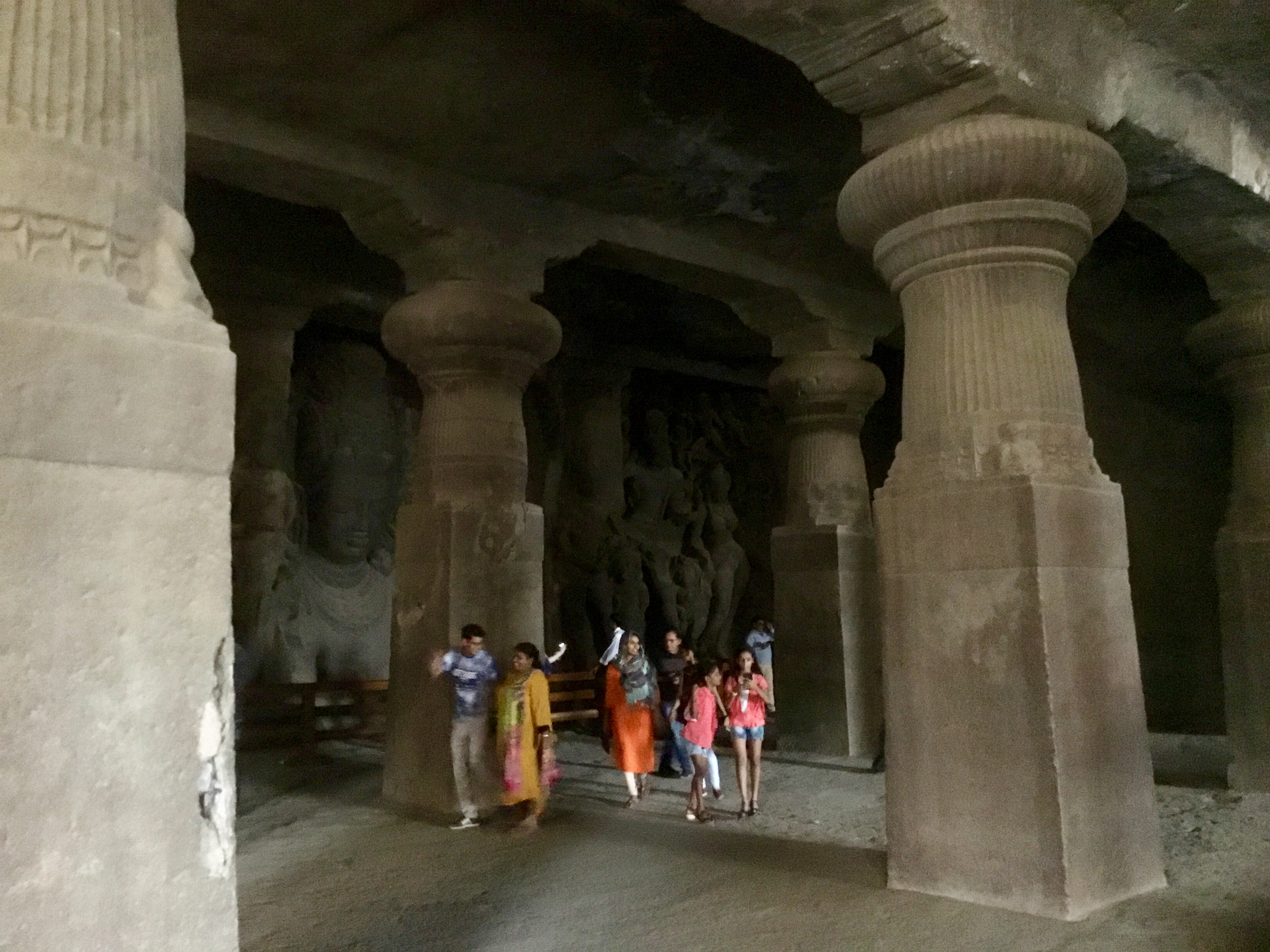
Elephanta Caves, India
*an ongoing series of quotations – mostly from artists, to artists – that offers wisdom, inspiration, and advice for the sometimes lonely road we are on.
According to [Rudolph] Arnheim, the way in which we reach out for and grasp the “object we see, either in our immediate range of perception or through the medium of photography, is dependent upon who we are and what we recognize from past experience.” The visual imprint of an image, an object, or a scene upon the eye is not at all “objective.” In the image-making process of thinking, we see, sort, and recognize according to the visual phenomenology of our own experience. What people notice in the “same” image – be it an image of a dancing Siva or a film of a Hindu festival procession – depends to some extent on what they can recognize from the visual experience of the past. In the case of film, of course, it also depends on what the photographer has seen and chosen to show us. Arnheim writes that the eye and the mind, working together in the process of cognition, cannot simply note down images that are “already there.” “We find instead that direct observation, far from being a mere ragpicker, is an exploration of the form-seeking, form-imposing mind, which needs to understand but cannot until it casts what it sees into manageable models.”
Diana L. Eck in Darsan: Seeing the Divine Image in India
Comments are welcome!
Q: (Part II) Would you share your story of how creating art enabled you to heal after losing your husband on 9/11?

“The Champ,” soft pastel on sandpaper, 35” x 28.5” framed. The first of my “Bolivianos”.
A: Continued from last Saturday’s post…
Because I use reference photos for my pastel paintings, the first challenge was to learn how to use Bryan’s 4 x 5 view camera. At that time I was not a photographer. Always Bryan had taken reference photos for me.
In July 2002 I enrolled in a view camera workshop at New York’s International Center of Photography. Much to my surprise I had already absorbed quite a lot from watching Bryan. After the initial workshop, I continued more formal studies of photography for a few years. In 2009, I am proud to say, I was invited to present a solo photography exhibition at a New York gallery!
In 2003 I resumed making my “Domestic Threats” series of pastel paintings, something that had seemed impossible after Bryan’s death. The first large pastel painting that I created using a reference photograph taken by me confirmed that my life’s work could continue. The title of that painting, “She Embraced It and Grew Stronger,” was autobiographical. “She” is me, and “it” meant continuing on without Bryan and living life for both of us.
Having had a long successful run, the “Domestic Threats” series finally ended in early 2007. Around that time I was feeling happier and had come to better terms with losing Bryan. While this is a tragedy I will never truly be at peace with, dealing with the loss became easier with time.
Then in 2007 I suddenly became blocked and did not know where to take my work next. I had never experienced creative block and for a full-time professional artist, this was a painful few months. Still, I continued to go to the studio every day and eventually, thanks to a confluence of favorable circumstances, the block ended.
My next pastel painting series was called, “Black Paintings.” I viewed the black background as literally, the very dark place that I was emerging from, exactly like the figures emerging in these paintings. The figures themselves were wildly colorful and full of life, but that black background is always there.
Still the work continues to evolve. Recently I began my third pastel painting series called, “Bolivianos,” based on a mask exhibition encountered in La Paz at the Museum of Ethnography and Folklore. Many people have proclaimed this to be my most bold, daring, and exciting pastel painting series yet. And I think they may be right! Continuing on the journey I began 30+ years ago, I am looking forward to creating many new, striking pastel paintings!
Comments are welcome!
Q: How has your use of photography changed over the years?
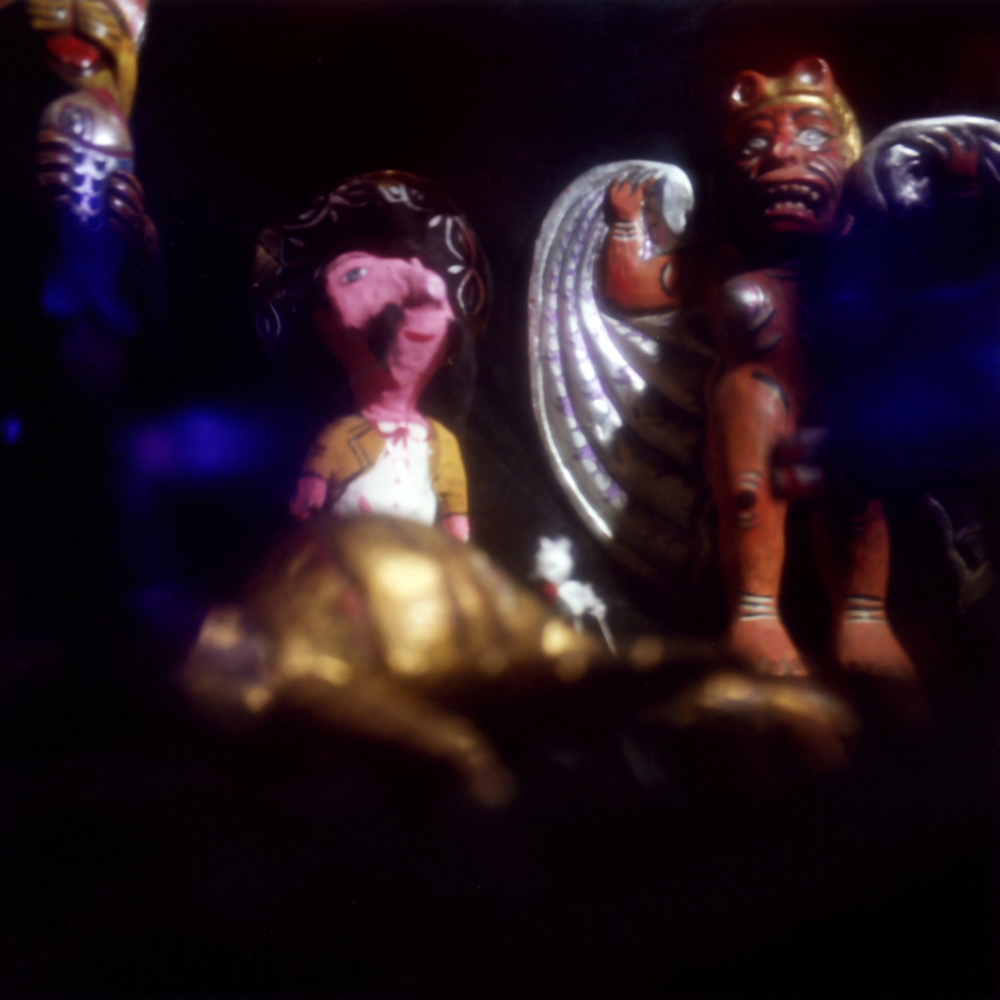
Untitled, 24″ x 24″ c-print
A: When my husband, Bryan, was alive I barely picked up a camera, except to photograph sights encountered during our travels.
Throughout the 1990s and ending in 2007, I worked on my series of pastel-on-sandpaper paintings called, “Domestic Threats.” These were realistic depictions of elaborate scenes that I staged first in our 1932 Sears house in Alexandria, Virginia, next in a New York sixth floor walk-up apartment, and finally in my current New York apartment.
I use Mexican masks, carved wooden animals, and other folk art figures that I discovered on trips to Mexico. I staged and lit these setups, while Bryan photographed them using his Toyo-Omega 4 x 5 view camera. We had been collaborating this way almost from the beginning (circa 1991). Having been introduced to photography by his father at the age of 6, Bryan was a terrific amateur photographer.
Bryan would shoot two pieces of 4 x 5 film at different exposures and I would select one, generally the one that showed the most detail in the shadows, to make into a 20 x 24 photograph. The photograph would be my starting point for making the pastel painting. Although I work from life, too, I could not make a painting without mostly looking at a reference photo.
After Bryan was killed on 9/11, I had no choice but to study photography. I completed a series of photography classes at the International Center of Photography in New York, turned myself into a skilled photographer, and presented my first solo photography exhibition at HP Garcia in New York in 2009.
Comments are welcome!
Q: Is there a pastel painting that you are most proud of?

“She Embraced It and Grew Stronger,” soft pastel on sandpaper, 58″ x 38,” 2003
A: Without a doubt I am most proud of “She Embraced It and Grew Stronger.”
After Bryan was killed on 9/11, making art again seemed an impossibility. When he was alive I would spend weeks setting up and lighting the tableau I wanted to paint. Then Bryan would shoot two negatives using his Toyo-Omega 4 x 5 view camera. I would select one and order a 20″ x 24″ reference photo to be printed by a local photography lab.
“She Embraced It…” is the first large pastel painting that I created without using a photograph taken by Bryan. This painting proved that I had learned to use his 4 x 5 view camera to shoot the reference photographs that were (and still are) integral to my process. My life’s work could continue!
Certainly the title is autobiographical. ‘She’ in “She Embraced It and Grew Stronger” is me and ‘It’ means continuing on without Bryan and living life for both of us.
Comments are welcome!
Q: Do you use a sketchbook?
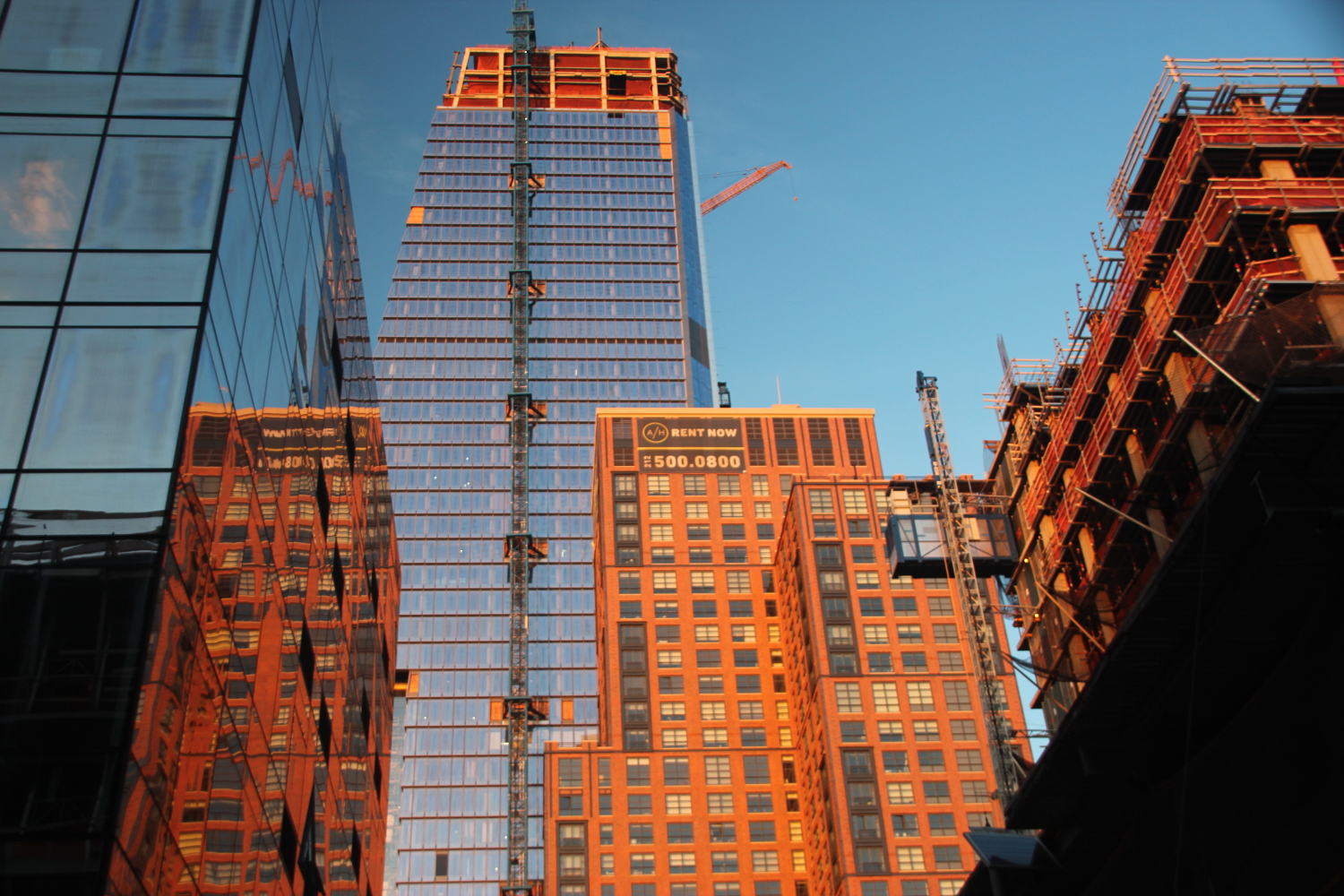
Hudson Yards, NYC
A: I used to use a sketchbook early on, when I was just beginning to find my way as an artist. Sketching on location helped to crystalize my ideas about art, about technique, and about what I hoped to accomplish in the near term. These days I spend so many hours in the studio – it’s my day job – that I often need a mental and physical break from using my eyes and from looking at and composing images.
What I do instead is to walk around New York (and elsewhere) with a camera. Photography for me sometimes serves as an alternative to sketching. It’s a way to continue to think about art, to experiment, and to contemplate what makes an arresting image without actually having to be working in the studio.
Comments are welcome!
Q: How do you decide how much to charge for your paintings?

Barbara’s studio
A: What to charge for my work is a complex question. The prices of my pastel paintings take into account many tangible and intangible factors. Here are a few:
Sales history.
My thirty-year-long exhibition history.
The costs of maintaining a studio in New York. My overhead goes up annually, but I do not raise prices every year to offset these expenses.
The countless hours of labor, cost of art materials, framing, photography, transportation, foreign travel, etc. that go into creating a painting.
Costs for marketing, social media, advertising, website design and upkeep, ongoing education, etc.
Somewhat less quantifiable factors such as my reputation as an artist, the real demand for my work, goodwill, the fact that I work full-time as a professional artist, etc.
Comments are welcome!
Pearls from artists* # 126

Self-portrait with “Blue Misterioso”
* an ongoing series of quotations – mostly from artists, to artists – that offers wisdom, inspiration, and advice for the sometimes lonely road we are on.
Photography is an elegiac art, a twilight art. There is no subject the photographer might attempt that could not be touched with pathos. All photogrpahs are memento mori. To take a photograph is to participate in another person’s (or thing’s) mortality, vulnerability, mutability. precisely by slicing out this moment and freezing it, all photographs testify to time’s relentless melt.
Photography by Susan Sontag in Anthology: Selected Essays from Thirty Years of The New York Review of Books, edited by Robert S. Silvers and Barbara Epstein
Comments are welcome!
Q: How do you experience art in New York?

Lower Manhattan
A: As a New York artist I am very fortunate to live in a city with a vibrant, exciting cultural scene. Simply put, art is in the air here and I take inspiration from everything I see and experience: painting, photography, sculpture, installation, performance art, public art, dance, theater, film, opera, jazz, etc. This city itself is an endlessly fascinating place. Visually it is always thrilling! I never know what I am going to see – good and bad – whenever I leave my apartment.
I have been living here since April 1997. The city provides a heady mix to ponder and this mix mysteriously enriches, influences, and somehow finds its way into the work. I have been an artist for nearly thirty years and I continue to be intrigued with watching the intricacies of how my creative process evolves and grows.
Comments are welcome!
Q: Why do people need art in their daily lives?
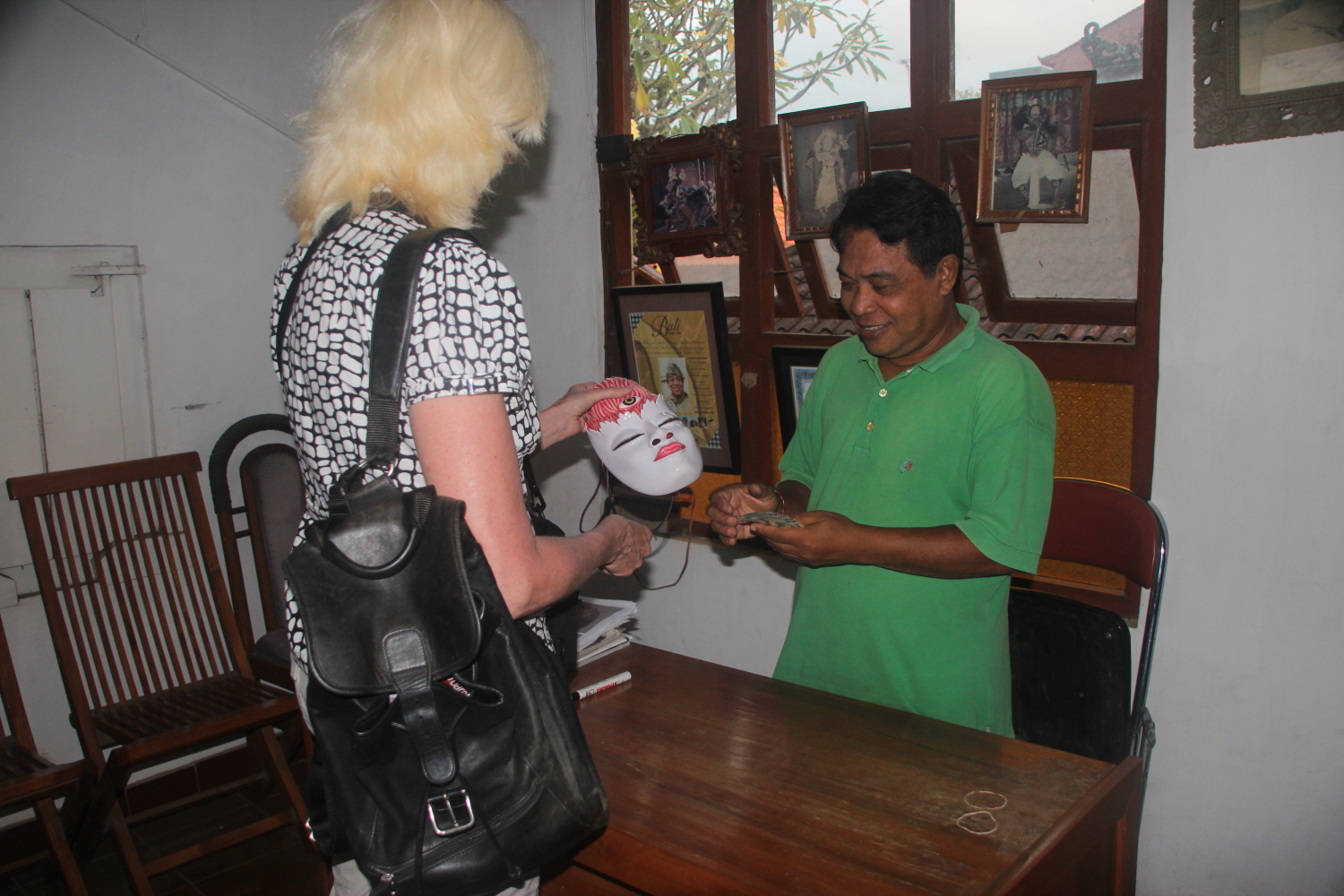
With Ida Bagus Anom, Mas, Bali; Photo: Donna Tang
A: That is for each person to decide, but as someone who devotes every waking moment to my work and to becoming a better artist, I cannot imagine my life without art.
I will tell you a little about what art has done for me. In my younger days boredom was a strong motivator. I left the active duty Navy out of boredom. I couldn’t bear not being intellectually challenged (most of my jobs consisted of paper-pushing), not using my flying skills (at 27 I was a licensed commercial pilot and Boeing-727 flight engineer), and not developing my artistic talents. In what surely must be a first, the Navy turned me into a hard-working and disciplined artist. And once I left the Navy there was no plan B. There was no time to waste. It was “full speed ahead.”
Art is a calling. You do not need to be told this if you are among those who are called. It’s all about “the work,” that all-consuming focus of an artist’s life. If a particular activity doesn’t seem likely to make me a better artist, I tend to avoid it. I work hard to nourish and protect my gifts. As artists we invent our own tasks, learn whatever we need in order to progress, and complete projects in our own time. It is life lived at its freest.
My art-making has led me to fascinating places: Mexico, Guatemala, Brazil, Argentina, Uruguay, France, England, Italy, Bali, Java, Sri Lanka, and more; and to in-depth studies of intriguing subjects: drawing, color, composition, art and art history, the art business, film and film history, photography, mythology, literature, music, jazz and jazz history, and archaeology, particularly that of ancient Mesoamerica (Olmec, Zapotec, Mixtec, Aztec, Maya, etc.). And this rich mixture continually grows! For anyone wanting to spend their time on earth learning and meeting new challenges, there is no better life!
Comments are welcome!
Pearls from artists* # 70

New York, NY
* an ongoing series of quotations – mostly from artists, to artists – that offers wisdom, inspiration, and advice for the sometimes lonely road we are on.
Ultimately, whether you like a photograph or not, it has a history behind it. When people look at a photograph, they want to believe in its authenticity, that they’re looking at something special that can’t be repeated. The artist’s eye, the photographer’s eye, has created a moment of truth by pushing the button on the camera. The issue is not that the moment is separate from the rest of the photograph; it is the element that links what’s happening to the rest of the image, and the photographer creates a higher meaning, a higher sensibility, in that instant. That’s difficult to achieve for most people who are involved in photography as artists. It’s an essential part of basic photography that’s learned on the street and in traditional ways that people used to do photography.
Roger Ballen in Lines, Marks, and Drawings: Through the Lens of Roger Ballen
Comments are welcome!


 barbararachkoscoloreddust.com