Blog Archives
Q: How do you decide when a pastel painting is finished?

“Magisterial,” soft pastel on sandpaper, 58” x 38” in progress
A: During the months that it takes to create a pastel painting, I search for arresting colors that work well together. The goal is to make a painting that I have never seen before and that leads the viewer’s eyes around in interesting ways. To do this I build up and blend together as many as 25 to 30 layers of pigment. I am able to complete some areas, like the background, fairly easily – maybe with just six or seven layers of black Rembrandt pastel. The more realistic parts of a pastel painting take many more applications. In general, details always take plenty of time to refine and perfect.
No matter how many pastel layers I apply, however, I never use fixatives. It is difficult to see this in reproductions of my work, but some of the finished surfaces achieve a texture akin to velvet. My technique involves blending each layer with my fingers, pushing the pastel deep into the tooth of the sandpaper, and mixing new colors directly on the paper. Fortunately, the sandpaper holds plenty of pigment so I am able to include lots of details.
Before I pronounce a pastel painting finished, I let it sit against a wall in my studio for a few days so I can look at it later with fresh eyes. I consider a piece done when it is as good as I can make it, when adding or subtracting something would diminish what is there. Always, I try to push myself and my materials to their limits, using them in new and unexpected ways.
Comments are welcome.
Pearls from artists* # 672

*an ongoing series of quotations – mostly from artists, to artists – that offers wisdom, inspiration, and advice for the sometimes lonely road we are on.
Let me now, therefore, turn directly to the question of the European individual and, for a start, cite the observations of the Swiss psychologist, Carl G. Jung, throughout whose works the term “individuation” is used to indicate the psychological process of achieving individual wholeness. Jung makes the point that in the living of our lives every one is us is required by his society to play some specific social role. In order to function in the world we are all continually enacting parts Jung calls personnae, from the Latin persona, meaning “mask, false face,” the mask worn by an actor on the Roman stage, through which he “sounded” (per-sonare, “to sound through). One has to appear in some mask or other if one is to function socially at all; and even those who choose to reject such masks can only put on others, representing rejection, “Hell no!” or something of this sort. Many of the masks are playful, opportunistic, superficial; others, however, go deep, very deep, much deeper than we know. Just as every body consists of a head, two arms, a trunk, two legs, etc., so does every living person consist, among other features, of a personality, a deeply imprinted persona through which he is made known no less to himself than to others, and without which he would not be. It is silly, therefore, to say, for example, “Let’s take off our masks and be natural!” And yet – there are masks and masks. There are the masks of youth, the masks of age, the masks of the various social roles, and the masks also that we project upon others spontaneously, which obscure them, and to which we then react.
Joseph Campbell in Myths to Live By
Comments are welcome!
Q: Why do you have so many pastels?

Barbara’s Studio
A: Our eyes can see infinitely more colors than the relative few that are made into pastels. When I layer pigments onto the sandpaper substrate, I mix new colors directly on the paper. The short answer is, I need lots of pastels so that I can make new colors.
I have been working exclusively with soft pastel for 40 years. Whenever I feel myself getting into a rut in how I select and use my colors, I look around for new materials to try. Fortunately, new brands of soft pastels are continually coming onto the market. There are pastels that are handmade by artists – I love discovering these – and new colors manufactured by well-known pastel companies. Some sticks of soft pastel are oily, some are buttery, some more powdery, some crumble easily, some are more durable. Each one feels distinct in my hand.
Furthermore, they each have unique mixing properties. It’s an under-appreciated science that I stumbled upon (or maybe I invented it, I’m not sure since I cannot know how other pastel painters work). In this respect soft pastel is very different from other paint media. Oil painters, for example, need only a few tubes of paint to make any color in the world. I don’t go in much for studying color theory as a formal discipline. If you want to really understand and learn how to use color, try soft pastel and spend 10,000+ hours (the amount of time Malcolm Gladwell says, in his book, “Outliers,” that it takes to master a skill) figuring it all out for yourself!
Comments are welcome.
Q: Why do you have so many pastels?

Barbara’s Studio
A: Our eyes can see infinitely more colors than the relative few that are made into pastels. When I layer pigments onto the sandpaper substrate, I mix new colors directly on the painting. This has the result of making many of my colors unrepeatable. The short answer is, I need lots of pastels so that I can mix new colors.
I have been working exclusively with soft pastel for nearly 40 years. Each pastel stick has unique mixing properties that depend on what was used as a binder to hold the dry pigment together. Some soft pastels are oily, some are buttery, some are powdery, some crumble easily, some are harder. Each one feels slightly different when I apply it to the sandpaper.
Soft pastel is distinct among paint media. Oil painters need only a few tubes of paint to make any number of colors, but pastels are not easily combined to form new colors. I learned how to mix colors by experimenting. In the process I developed a personal and unique science of color-mixing and blending. This is one of the factors that makes my work so recognizable and sets it apart from that of other pastel painters.
Comments are welcome.
Q: Many of the world’s cultures have a mask tradition. Is there something special about Bolivian masks that first attracted you to them?

Bolivian Carnival Mask
A: My subject matter emerges directly from my travels. I visited Bolivia in 2017. What I especially liked then – and now – about Bolivian Carnival masks, is that they include additional textures – feathers, fur, costume jewelry, sequins, fabric, etc. that add to their physical presence. Masks from most of the other countries I’ve visited tend to be made of wood and/or paper mache and nothing else. In my view such masks are not as dramatic nor do they offer much expressive potential. They feel dead. They lack a certain “soulfulness.”
Furthermore, textures are challenging to render in soft pastel. For more than three decades I have been striving to improve my pastel techniques. By now I have a vast repertoire from which to select. As was true in my earlier series, with “Bolivianos” an important personal goal is to keep adding to the repertoire.
It takes months to create a pastel painting, which means I need masks that will hold my attention every day over the course of three or four months. I never want to be bored in the studio. If I am bored while making the work, those feelings will be directly transferred and I will make a boring pastel painting, something I hope never to do! The masks need to have a really strong ‘presence.’ Then as I slowly make a pastel painting, one that is exciting to work on from start to finish, I can transform my subject into something surprising and powerful that has never existed before!
Comments are welcome!
Q: What is your process? (Question from artamour)
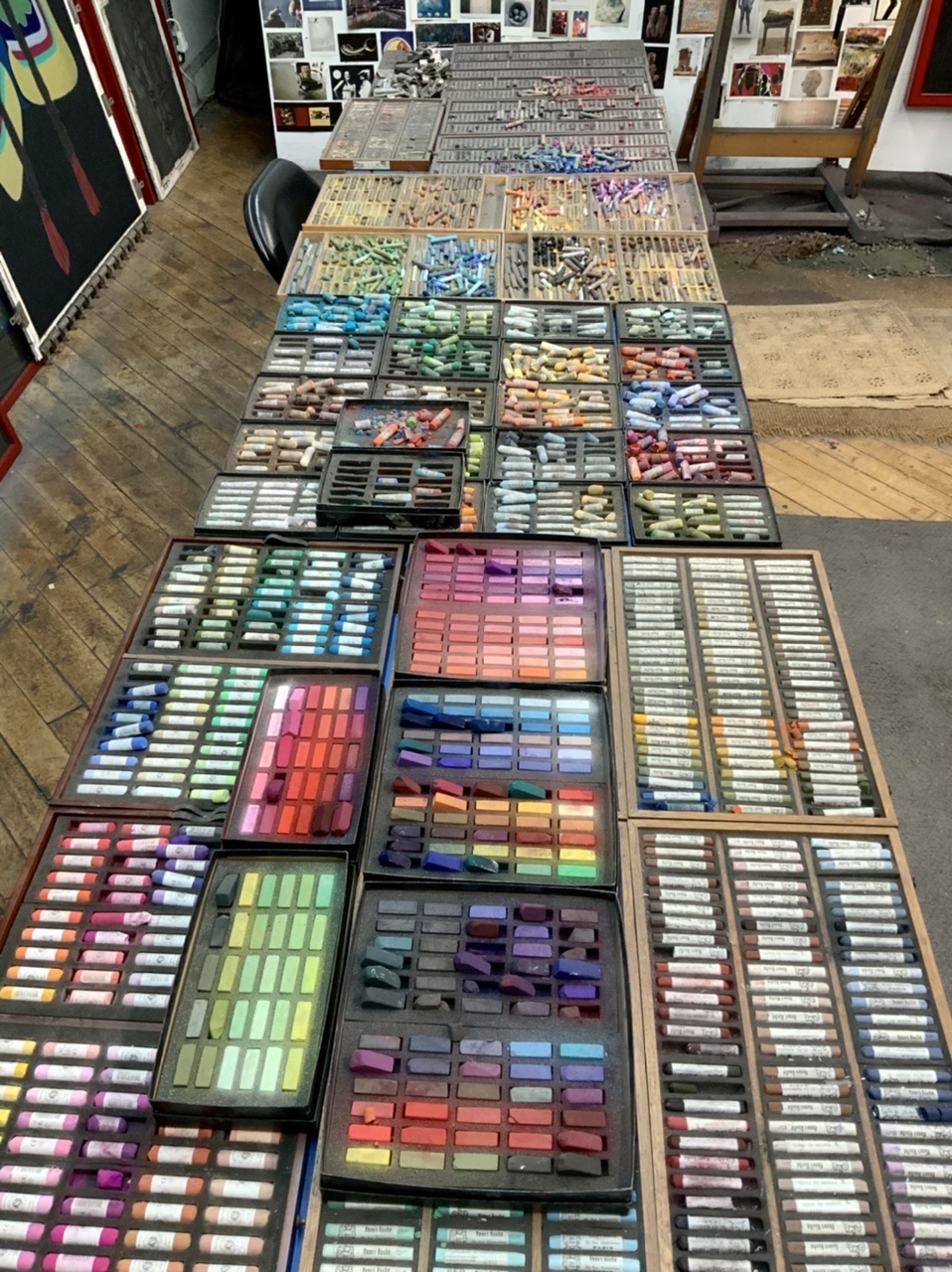
A: For thirty-six years I have worked exclusively in soft pastel on sandpaper. Pastel, which is pigment and a binder to hold it together, is as close to unadulterated color as an artist can get. It allows for very saturated color, especially employing the self-invented techniques I have developed and mastered. I believe my “science of color” is unique, completely unlike how any other artist works. I spend three to four months on each painting, applying pastel and blending the layers together to mix new colors on the paper.
The acid-free sandpaper support allows the buildup of 25 to 30 layers of pastel as I slowly and meticulously work for hundreds of hours to complete a painting. The paper is extremely forgiving. I can change my mind, correct, refine, etc. as much as I want until a painting is the best I can create at that moment in time.
My techniques for using soft pastel achieve rich velvety textures and exceptionally vibrant color. Blending with my fingers, I painstakingly apply dozens of layers of pastel onto the sandpaper. In addition to the thousands of pastels that I have to choose from, I make new colors directly on the paper. Regardless of size, each pastel painting takes three to four months and hundreds of hours to complete.
I have been devoted to soft pastel from the beginning. In my blog and in numerous interviews online and elsewhere, I continue to expound on its merits. For me no other fine art medium comes close.
My subject matter is unique. I am drawn to Mexican, Guatemalan, and Bolivian cultural objects—masks, carved wooden animals, papier mâché figures, and toys. On trips to these countries and elsewhere I frequent local mask shops, markets, and bazaars searching for the figures that will populate my pastel paintings. How, why, when, and where these objects come into my life is an important part of the creative process. Each pastel painting is a highly personal blend of reality, fantasy, and autobiography.
Comments are welcome!
Q: You wear gloves and a mask when you are working in your studio, right? Can you tell me what kinds? (Question from Britta Konau)
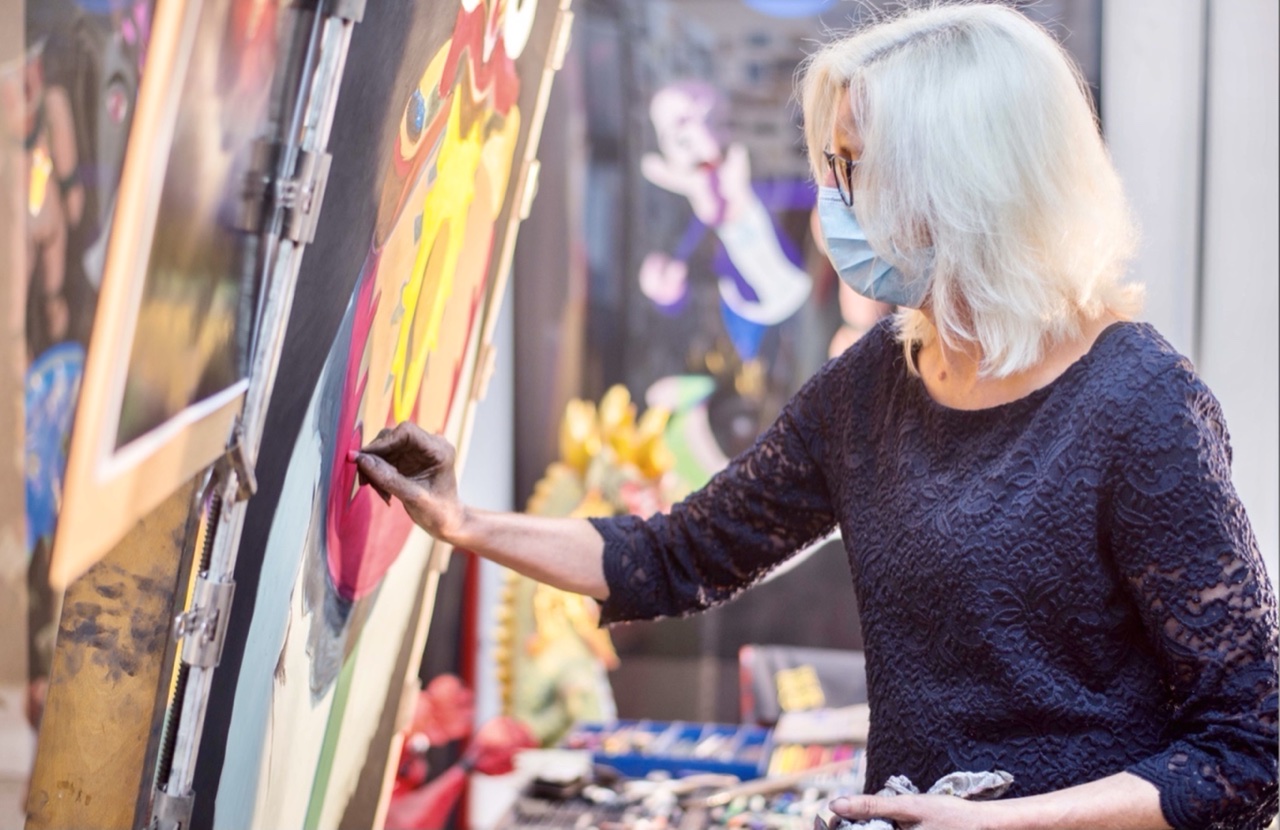
A: I wear a paper surgical mask – the type that has become ubiquitous since COVID – bought from a local medical supply store. I thoroughly coat my hands with barrier cream – Art Guard – to prevent pastel getting into my skin. The cream has an added benefit of making it easy to wash pastel off my hands. (Neither gloves nor individual finger cots ever worked for me. They made my fingers sweat and did not allow for the fine touch needed to blend new colors directly on sandpaper. Plus, they shredded from being rubbed against the paper’s grit). Also, it is very important that you work with your hand below your face so pastel dust falls below your nose, where you are less likely to breathe it in.
Comments are welcome!
Q: When did you start using the sandpaper technique and why (Question from “Arte Realizzata”)

A: In the late 1980s when I was studying at the Art League School in Alexandria, VA, I enrolled in a three-day pastel workshop with Albert Handel, an artist known for his southwest landscapes in pastel and oil paint. I had just begun working with soft pastel and was experimenting with paper. Handel suggested I try Ersta fine sandpaper. I did and nearly three decades later, I’ve never used anything else.
This paper is acid-free and accepts dry media, mainly pastel and charcoal. It allows me to build up layer upon layer of pigment and blend, without having to use a fixative. The tooth of the paper almost never gets filled up so it continues to hold pastel. (On the rare occasion when the tooth DOES fill up, which sometimes happens with problem areas that are difficult to resolve, I take a bristle paintbrush, dust off the unwanted pigment, and start again). My entire technique – slowly applying soft pastel, blending and creating new colors directly on the paper, making countless corrections and adjustments, rendering minute details, looking for the best and/or most vivid colors – evolved in conjunction with this paper.
I used to say that if Ersta ever went out of business and stopped making sandpaper, my artist days would be over. Thankfully, when that DID happen, UArt began making a very similar paper. I buy it in two sizes – 22″ x 28″ sheets and 56″ wide by 10-yard-long rolls. The newer version of the rolled paper is actually better than the old, because when I unroll it, it lays flat immediately. With Ersta I would lay the paper out on the floor for weeks before the curl would give way and it was flat enough to work on.
Comments are welcome!
Q: Why do you make a preliminary drawing before you begin a pastel painting?

A: I make a preliminary charcoal drawing because that’s how I like to begin thinking about and planning a new pastel painting. I always make preliminary drawings the same size as the upcoming pastel painting. While I draw, I make decisions about the overall composition, decide where the major light and dark shapes will be, and envision the likely problem areas that lie ahead. These drawings are done quickly. I spend perhaps an hour on them.
Once the drawing is in my head I no longer need it. So I put it away and when it’s time to begin a subsequent pastel painting, I erase it. I wipe it out with a paper towel and make the next preliminary charcoal drawing directly on top. These are ephemeral tools, existing only for as long as I need them.
Comments are welcome!
Pearls from artists* # 437
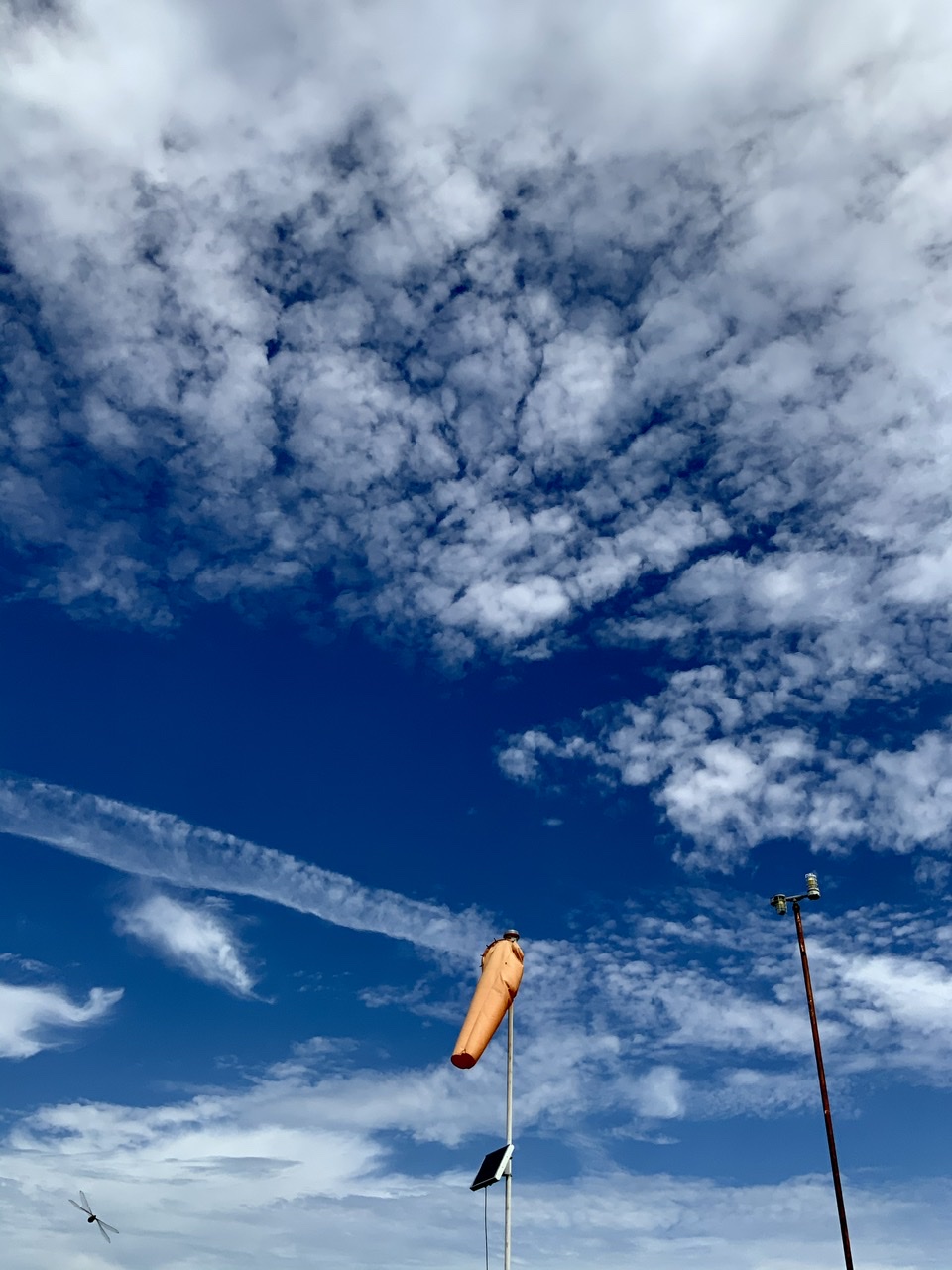
Dragonfly on final approach
* an ongoing series of quotations – mostly from artists, to artists – that offers wisdom, inspiration, and advice for the sometimes lonely road we are on.
There really is nothing to fear in fantasy unless you are afraid of the uncertainty. This is why it’s hard for me to imagine that anyone who likes science can dislike fantasy. Both are based so profoundly on the admission of uncertainty, the welcoming acceptance of unanswered questions. Of course, the scientist seeks to ask how things are the way they are, not to imagine how they might be otherwise. But are the two operations opposed, or related? We can’t question reality directly, only by questioning our conventions, our belief, our orthodoxy, our construction of reality. All Galileo said, all Darwin said, was, “It doesn’t have to be the way we thought it was.”
Ursula K. Le Guin in No Time to Spare: Thinking About What Matters
Comments are welcome!


 barbararachkoscoloreddust.com