Blog Archives
Q: How did your ebook “From Pilot to Painter” come to be? (Question from “Arte Realizzata”)
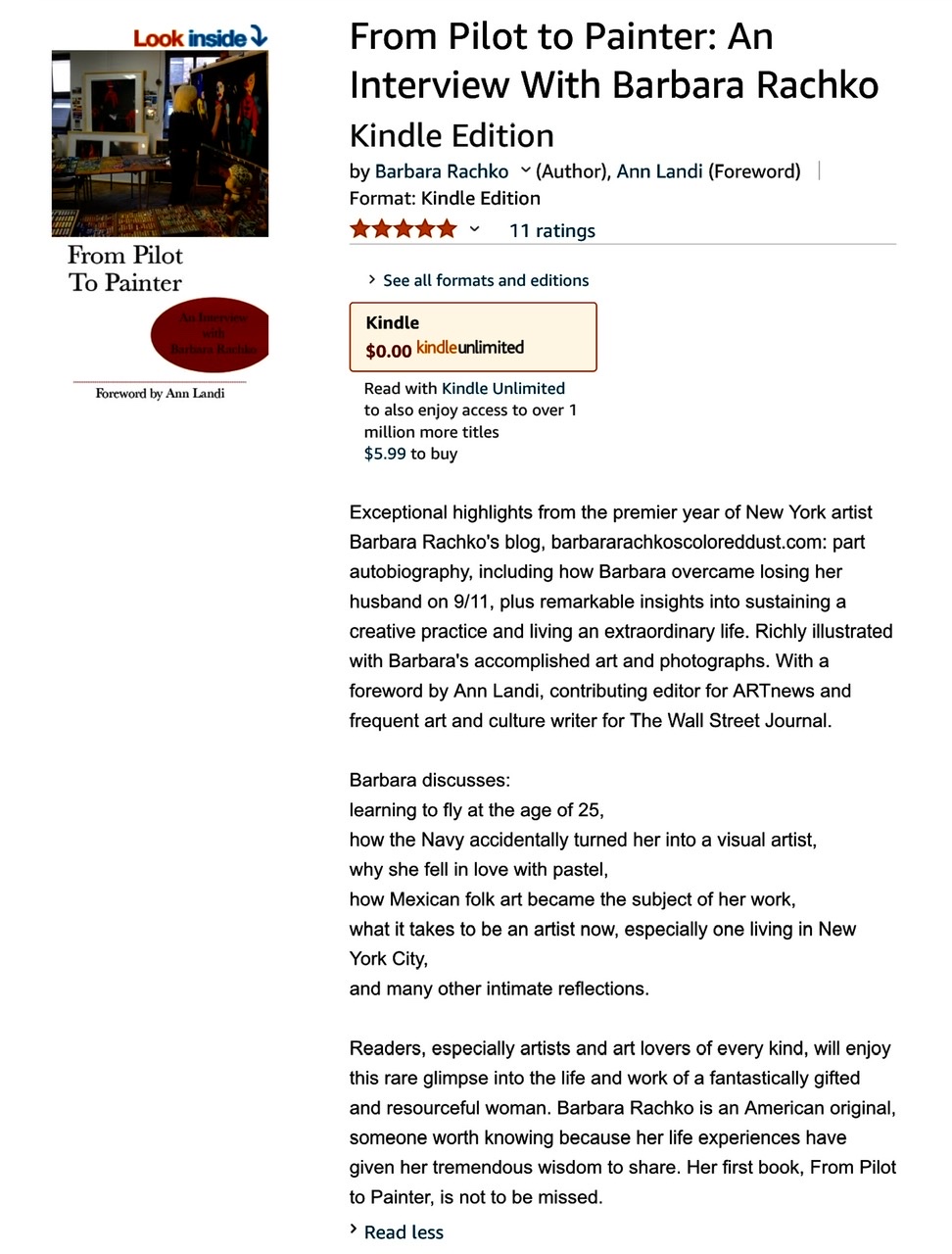
A: It was my longtime assistant, Barbra Drizin’s, idea and more than I’d care to admit, I was resistant. I said, “I am much too busy to write an ebook!” Barbra went on to explain that we could start with material I had already written for my blog, expand on it, add reproductions of my pastel paintings, etc. With her persuasion, I agreed! Barbra made the initial selections and together we added and revised text, organized the material, and worked out countless details. I asked my friend, Ann Landi, to write a foreword and Barbra found an editor to put everything into Amazon’s ebook format.
Now I am extremely pleased that my ebook FROM PILOT TO PAINTER is available not only on Amazon, but also on iTunes. It is based on my blog and is part memoir, including the loss of my husband on 9/11, insights into my creative practice, and intimate reflections on what it’s like to be an artist living in New York City. The ebook includes material not found on the blog, plus 25+ reproductions of my vibrant pastel-on-sandpaper paintings, a Foreword by Ann Landi, the founder of Vasari21.com and longtime critic for ARTnews, and more.
Comments are welcome!
Q: When did you start using the sandpaper technique and why (Question from “Arte Realizzata”)

A: In the late 1980s when I was studying at the Art League School in Alexandria, VA, I enrolled in a three-day pastel workshop with Albert Handel, an artist known for his southwest landscapes in pastel and oil paint. I had just begun working with soft pastel and was experimenting with paper. Handel suggested I try Ersta fine sandpaper. I did and nearly three decades later, I’ve never used anything else.
This paper is acid-free and accepts dry media, mainly pastel and charcoal. It allows me to build up layer upon layer of pigment and blend, without having to use a fixative. The tooth of the paper almost never gets filled up so it continues to hold pastel. (On the rare occasion when the tooth DOES fill up, which sometimes happens with problem areas that are difficult to resolve, I take a bristle paintbrush, dust off the unwanted pigment, and start again). My entire technique – slowly applying soft pastel, blending and creating new colors directly on the paper, making countless corrections and adjustments, rendering minute details, looking for the best and/or most vivid colors – evolved in conjunction with this paper.
I used to say that if Ersta ever went out of business and stopped making sandpaper, my artist days would be over. Thankfully, when that DID happen, UArt began making a very similar paper. I buy it in two sizes – 22″ x 28″ sheets and 56″ wide by 10-yard-long rolls. The newer version of the rolled paper is actually better than the old, because when I unroll it, it lays flat immediately. With Ersta I would lay the paper out on the floor for weeks before the curl would give way and it was flat enough to work on.
Comments are welcome!

Q: Would you speak about the creative process that resulted in your 1994 pastel painting, “Amok”?

A: Behind me in the photo above is one of my circa 1994 50” x 40” c-prints, signed by both Bryan, my late husband, and me. The photo was my reference for a pastel painting titled, “Amok” (right, above).
I staged these photos in our Alexandria house (staged photography was popular then), refined the composition over days or weeks, and lit the scene using two tungsten studio lights. I was careful to accentuate the shadows, doing what I could to light everything as though it were a film noir set. (Film noir is still a favorite movie genre of mine).
In those days I knew nothing about photography so I considered these photos collaborations, since Bryan clicked the shutter. (He typically shot two pieces of film using his old Toyo Omega 4 x 5 view camera with a rented wide angle lens). Bryan was reluctant to take any credit- insisting that the idea, concept, etc. were mine – but I persuaded him to also sign the photos. (How I wish he were still around to fill in forgotten details about our collaboration).People enjoyed and often asked to purchase the reference photos so I sometimes had them enlarged and sold them. The dragon in the foreground is significant because it was my first purchase in Oaxaca during our initial trip to Mexico.
If anyone is interested, please remind me to tell the (long) story about how I got it home on the plane!
Comments are welcome!
Q: What do you enjoy most about being an artist?
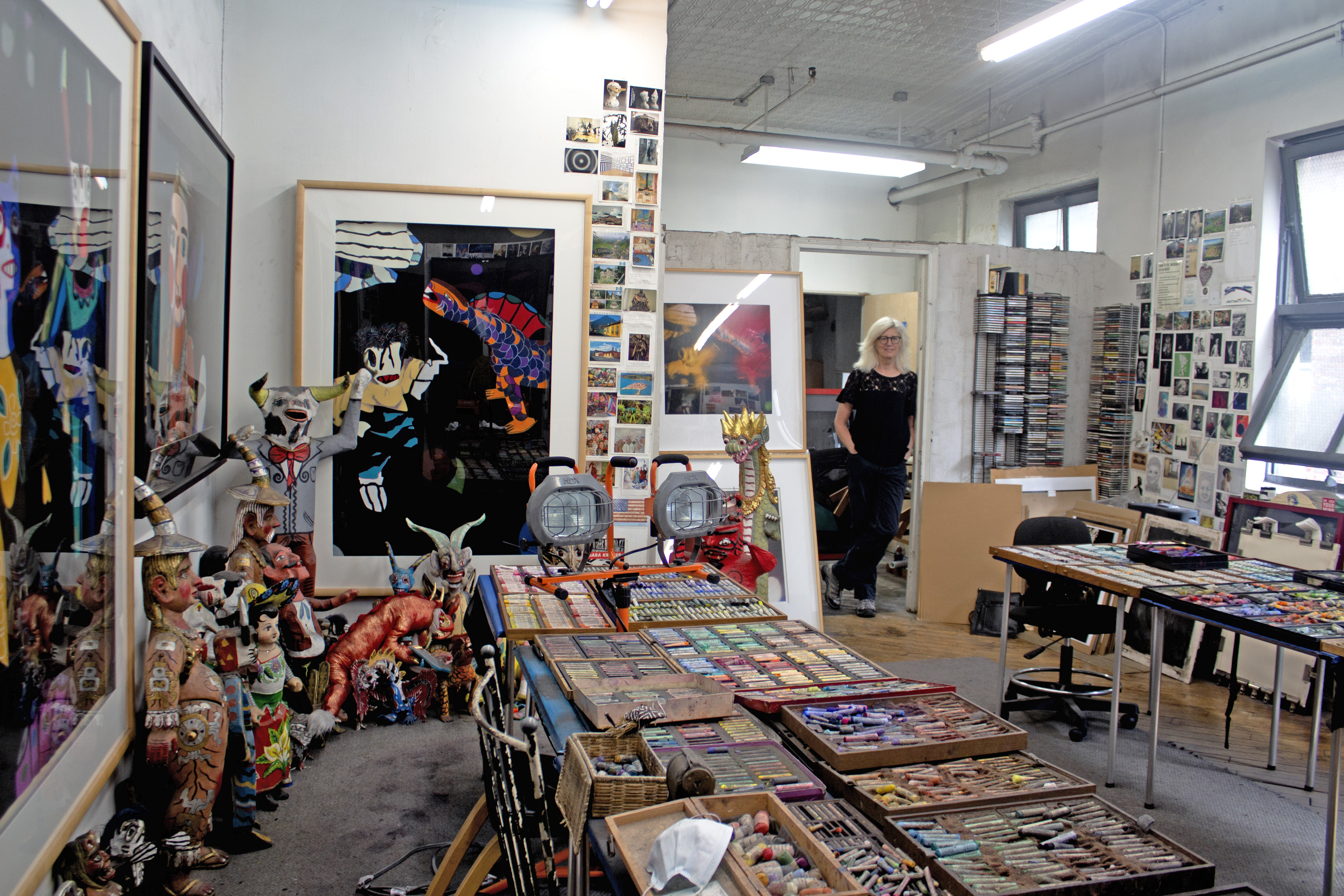
Barbara’s studio
A: This is a question I like to revisit every so often because life as an artist does not get easier; just the opposite, in fact. Visual artists tend to be “one man bands.” We do it all notwithstanding the fact that everything gets more difficult as we get older. It’s good to be reminded about what makes all the sacrifice and hard work worthwhile.
Even after thirty-four years as an artist, there are so many things to enjoy! I make my own schedule, set my own tasks, and follow new interests wherever they may lead. I am curious about everything and am rarely bored. I continually push my pastel technique as I strive to become a better artist. There is still so much to learn!
My relationship with collectors is another perk. I love to see pastel paintings hanging on collectors’ walls, especially when the work is newly installed and the owners are excited to take possession. This means that the piece has found a good home, that years of hard work have come full circle! And it’s often the start of a long friendship. After living with my pastel paintings for years, collectors tell me they see new details never noticed before and they appreciate the work more than ever. It’s extremely gratifying to have built a network of supportive art-loving friends around the country. I’m sure most artists would say the same!
Comments are welcome!
Q: What do you enjoy most about being an artist?
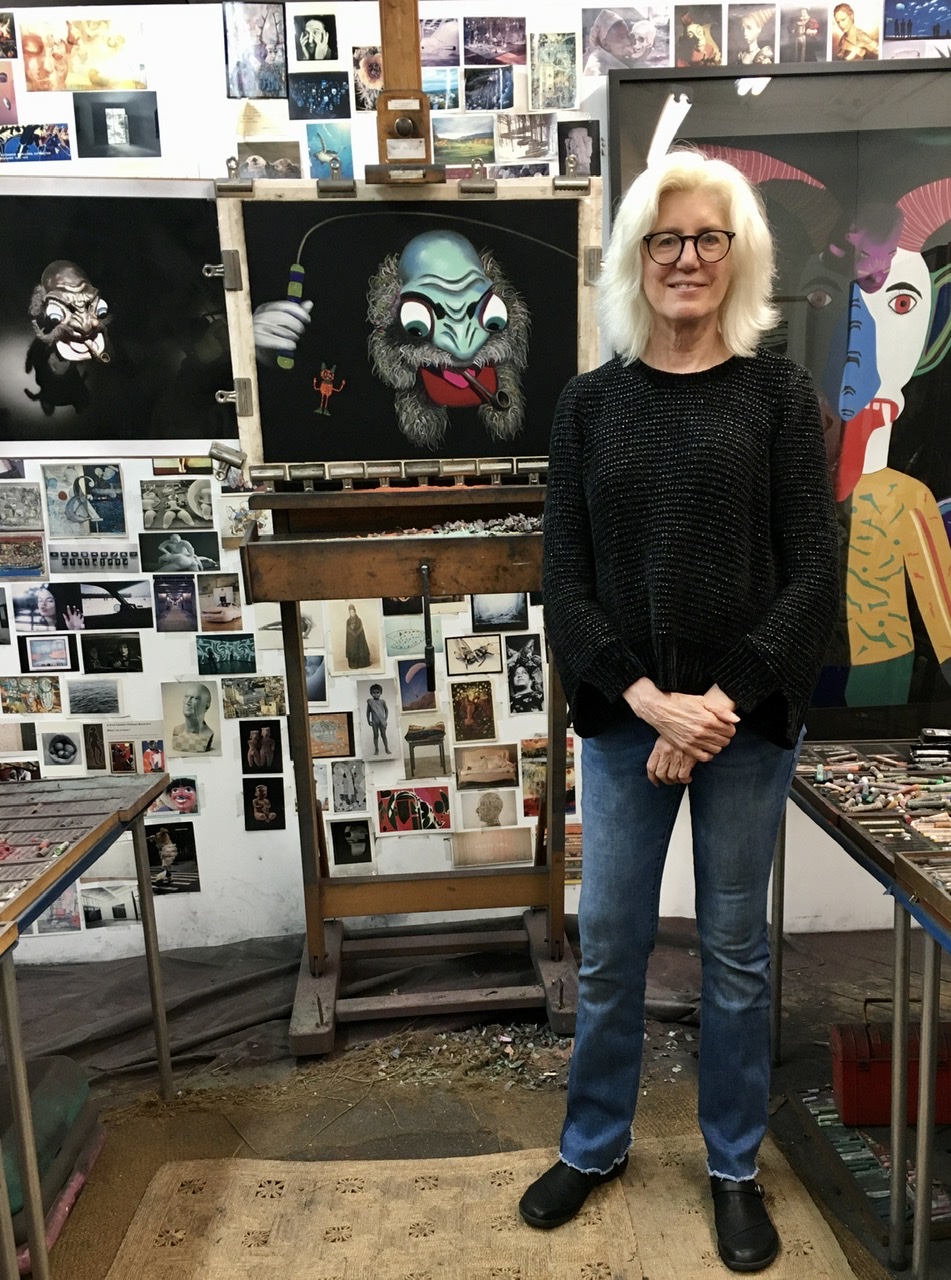
With “Majordomo,” soft pastel on sandpaper, 20” x 26”
A: This is a question I enjoy revisiting every so often because life as an artist does not get easier; just the opposite, in fact. Visual artists tend to be “one man bands.” We do it all notwithstanding the fact that everything gets harder as we get older. So it’s good to be reminded about what makes all the sacrifice and hard work worthwhile.
There are so many things to enjoy! I make my own schedule, set my own tasks, and follow new interests wherever they may lead. I am curious about everything and am rarely bored. I continually push my pastel technique and strive to become a better artist. There is still so much to learn!
My relationship with collectors is another perk. I love to see pastel paintings hanging on collectors’ walls, especially when they’re newly installed and the owners are excited to take possession. This means that the piece has found a good home, that years of hard work have come full circle! And it’s often the start of a long friendship. After living with my pastel paintings for years, collectors tell me they see new details never noticed before and they appreciate the work more than ever. It’s extremely gratifying to have built a network of supportive art-loving friends around the country. I’m sure most artists would say the same!
Comments are welcome!
Q: What’s on the easel today?
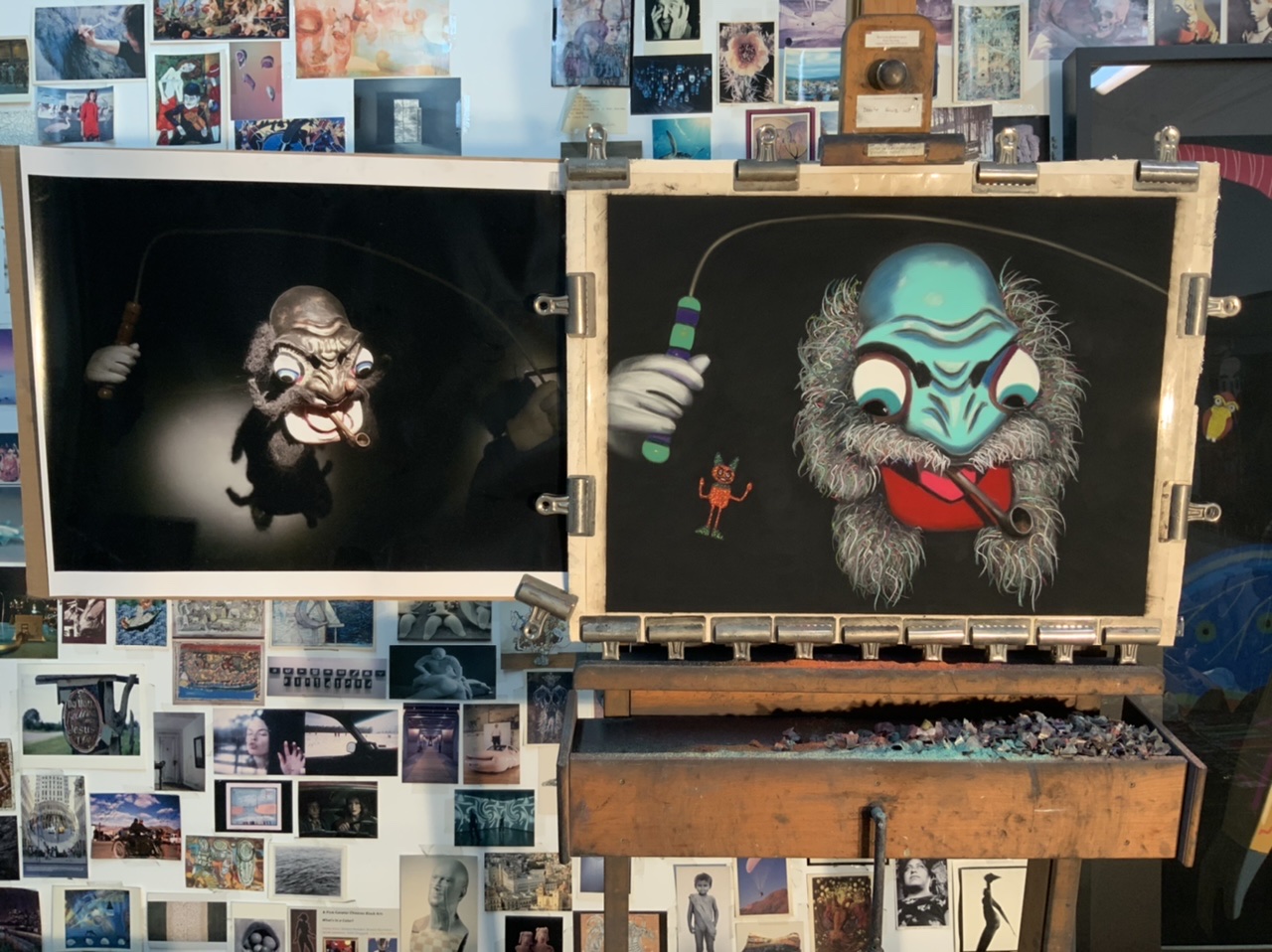
Work in progress
A: “Majordomo,” 20” x 26,” soft pastel on sandpaper, is coming along. After today’s studio session, I will put it aside and add finishing details when I am able to see it fresh again. I‘ve been looking at this piece too long to know what else it needs now.
Comments are welcome!
Q: Do you enjoy being interviewed?
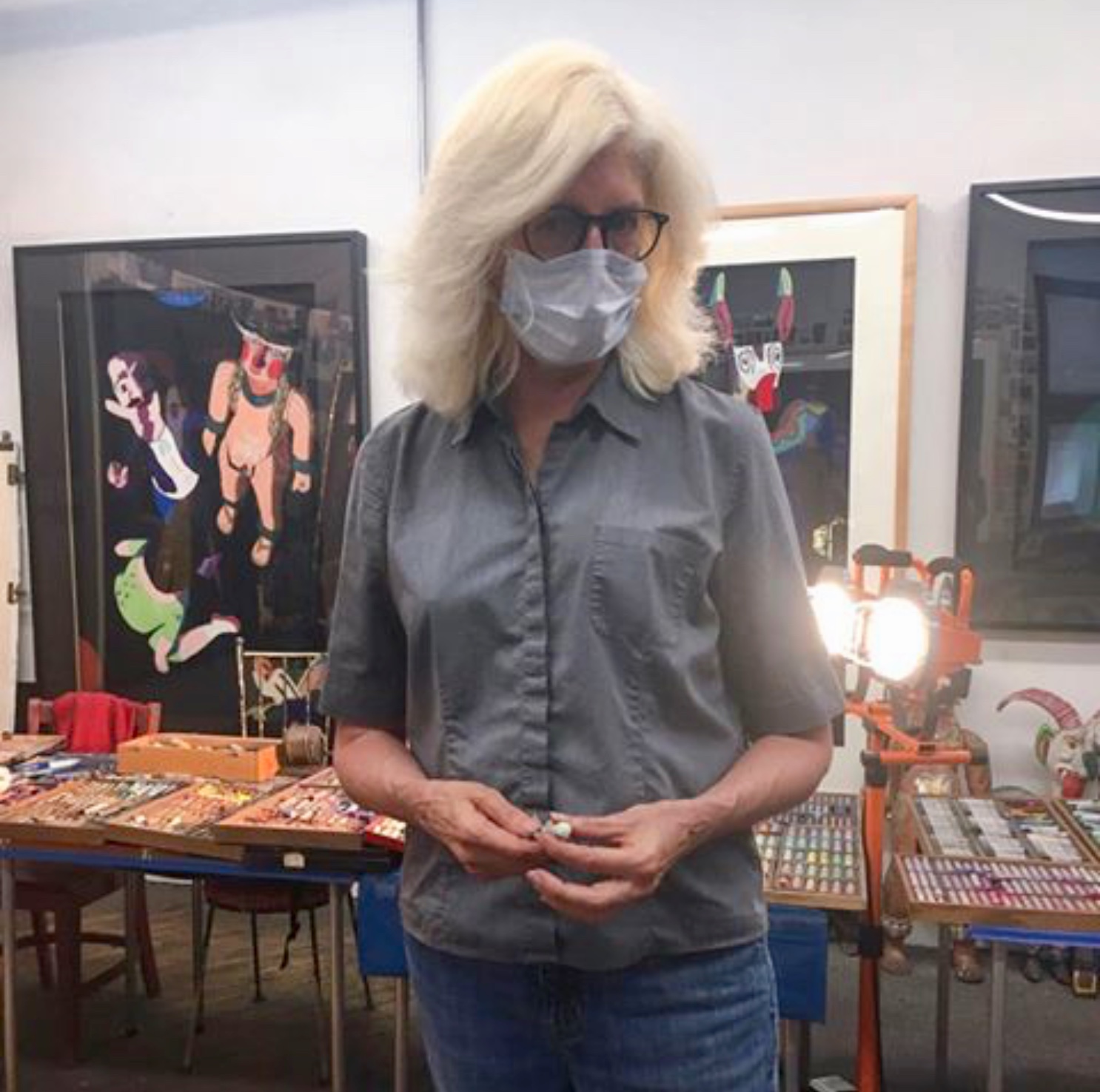
In the studio
A: I do very much. Each new interview is another opportunity to discover what is remembered, what is kept because it still seems important, and how certain details are selected from amongst all the accumulated memories of a lifetime. My own story is continually evolving as some facts are left out or rearranged, and others added. New connections keep being made while some others are discarded. I find it fascinating to read over old interviews and compare them with what I remember in the present.
Comments are welcome!
Q: Can you tell us about the different series of work you have created and what they embody?
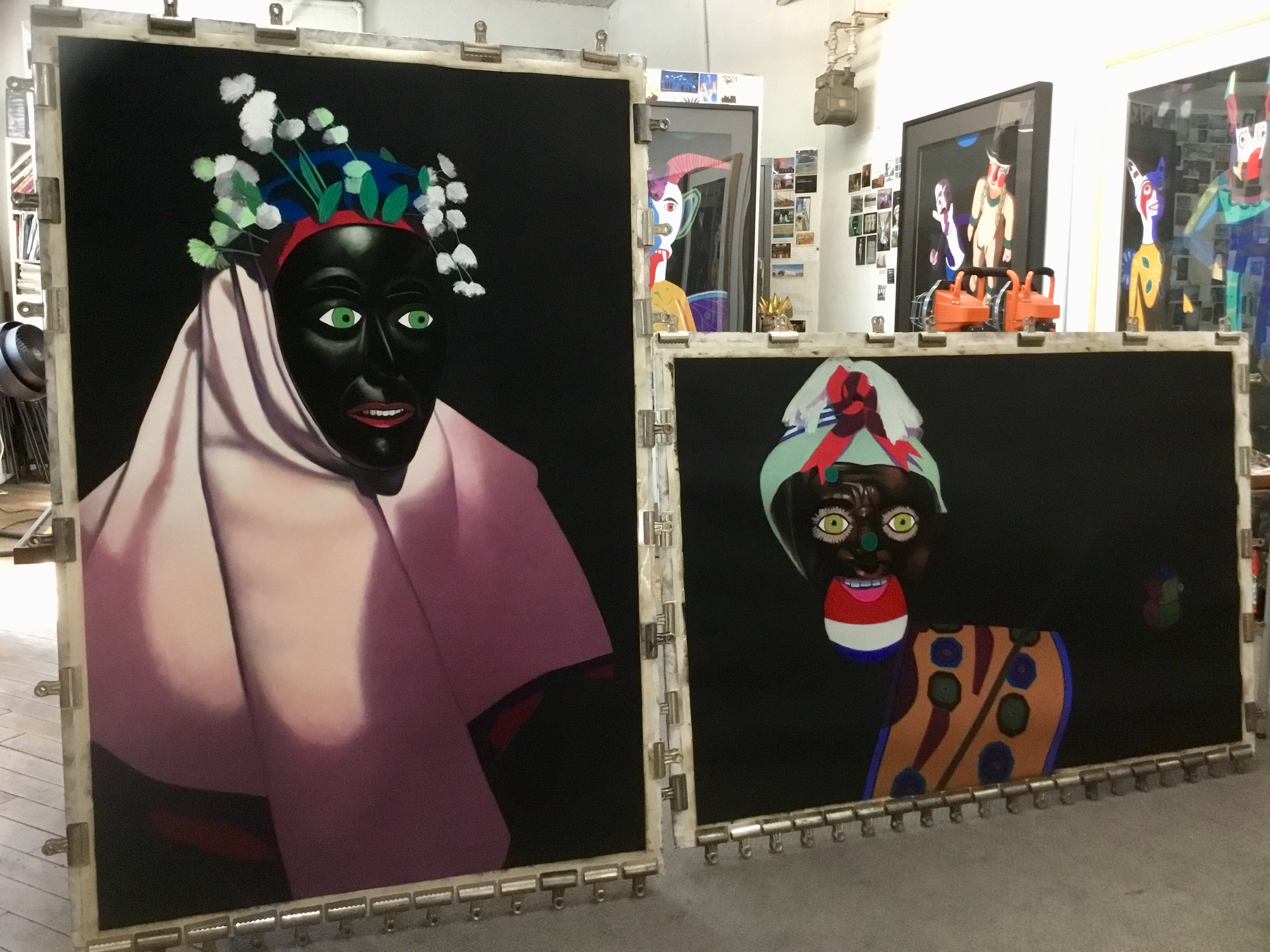
Barbara’s studio with work in progress
A: The Black Paintings series of pastel-on-sandpaper paintings grew directly from an earlier series, Domestic Threats. While both use cultural objects as surrogates for human beings acting in mysterious, highly-charged narratives, in the Black Paintings I replaced all background details of my actual setup (furniture, rugs, etc.) with lush black pastel. In this work the ‘actors’ are front and center.
While traveling in Bolivia two years ago, I visited a mask exhibition at the National Museum of Ethnography and Folklore in La Paz. The masks were presented against black walls, spot-lit, and looked eerily like 3D versions of my Black Paintings. I immediately knew I had stumbled upon a gift. So far I have completed nine pastel paintings in the Bolivianos series. One is awaiting finishing touches, one is in progress now, and I am planning the next one.
All of my pastel paintings are an example of a style called “contemporary conceptual realism” in which things are not quite as innocent as they seem. In this sense each painting is a kind of Trojan horse. There is plenty of backstory to my images, although I usually prefer not to over-explain them. Some mystery must always remain in art.
The world I depict is that of the imagination and this realm owes little debt to the natural world. I recently gave an art talk where I was reminded how fascinating it is to learn how others respond to my work. As New York art critic Gerrit Henry once remarked, “What we bring to a Rachko… we get back, bountifully.”
Comments are welcome!
Q: What do you see when you look back at your early efforts?
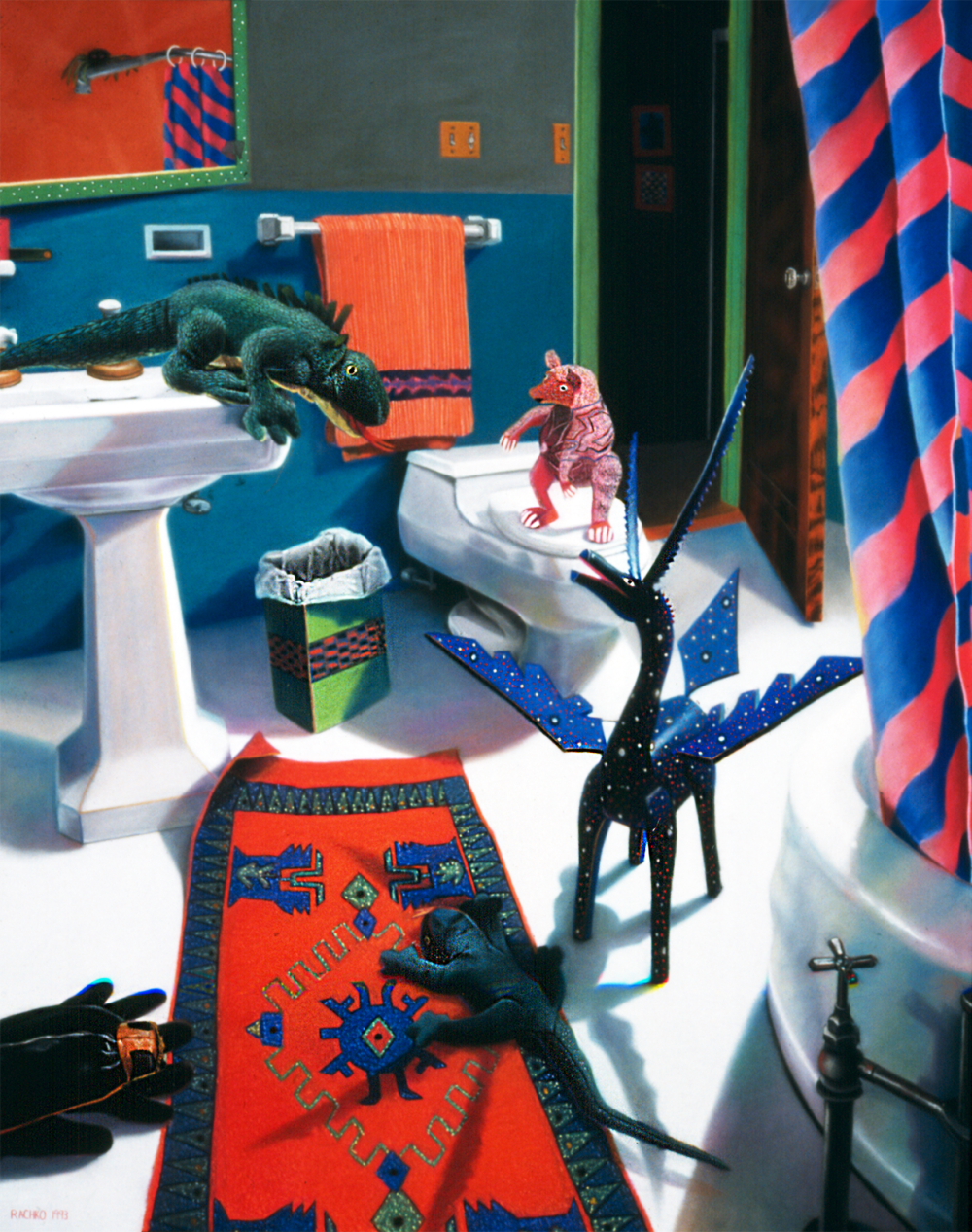
“Myth Meets Dream,” soft pastel on sandpaper, 47″ x 38,” 1993
A: I see continuity in subject matter and in medium, surely. For thirty-three years I have been inspired by foreign travel and research. In addition, I remain devoted to pushing the limits of what soft pastel can do and to promoting its merits as a fine art medium.
Here and there I see details I would render differently now; not exactly mistakes, but things that maybe could be done better. Fortunately, I think, all of my work is framed behind glass or plexiglas, making it extremely difficult to attempt revisions.
Perhaps most important of all, I see the long personal road that has advanced my work to its present state. Each gain has been hard-fought.
Comments are welcome!
Q: What’s on the easel today?
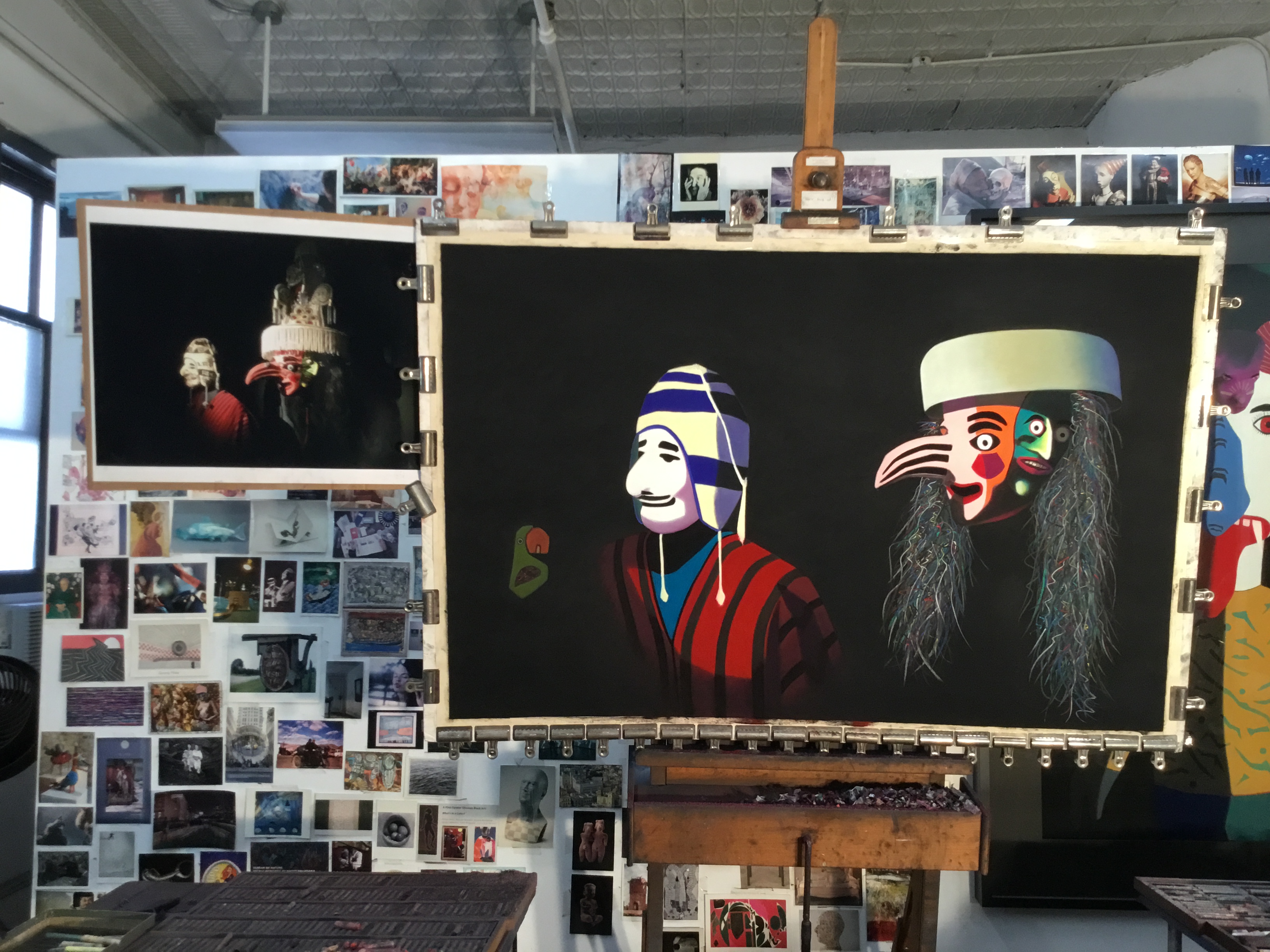
Work in progress
A: I continue working on “Acolytes,” soft pastel on sandpaper, 38” x 58.” It’s slow going at this stage as I refine my drawing and bring everything to a high state of finish. My work is all about details.
Comments are welcome!


 barbararachkoscoloreddust.com