Blog Archives
Pearls from artists* # 374
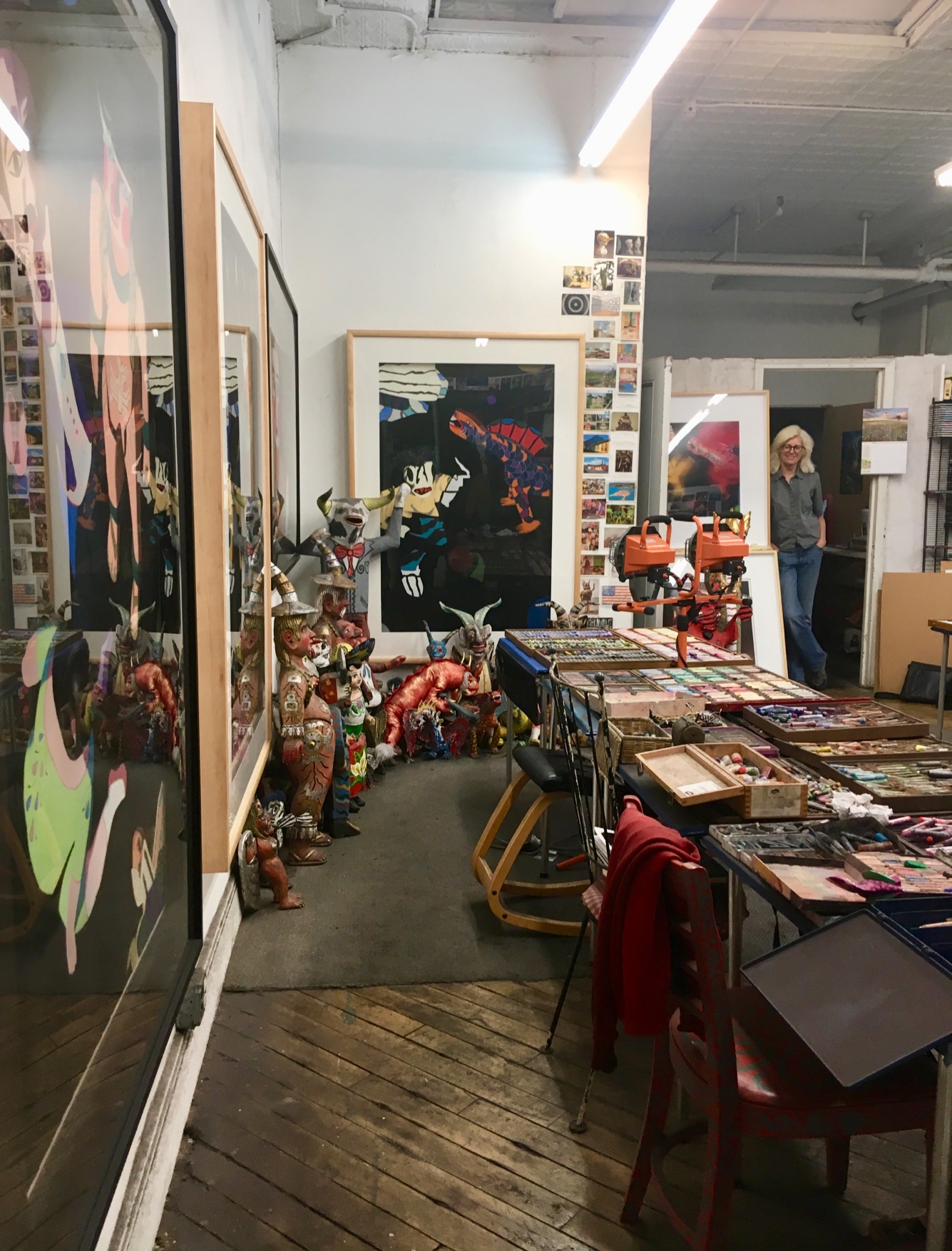
Barbara’a studio
* an ongoing series of quotations – mostly from artists, to artists – that offers wisdom, inspiration, and advice for the sometimes lonely road we are on.
Finally, [John] Graham said, of all the arts, painting was the most difficult because one false move on a canvas could mean the difference between a great painting and a failure. A writer could always resurrect a word, but a line or a shape was so ephemeral that, once changed, it was almost always lost for good. “To create life one has to love. To create a great work of art one has to love truth with the passion of a maniac. If society does not perceive this love, perhaps humanity will.” …The artists… came away… feeling as though they were not aberrations but part of a long tradition of individuals who had ignored fashion to create culture.
Mary Gabriel in Ninth Street Women
Comments are welcome!
Q: What’s on the easel today?
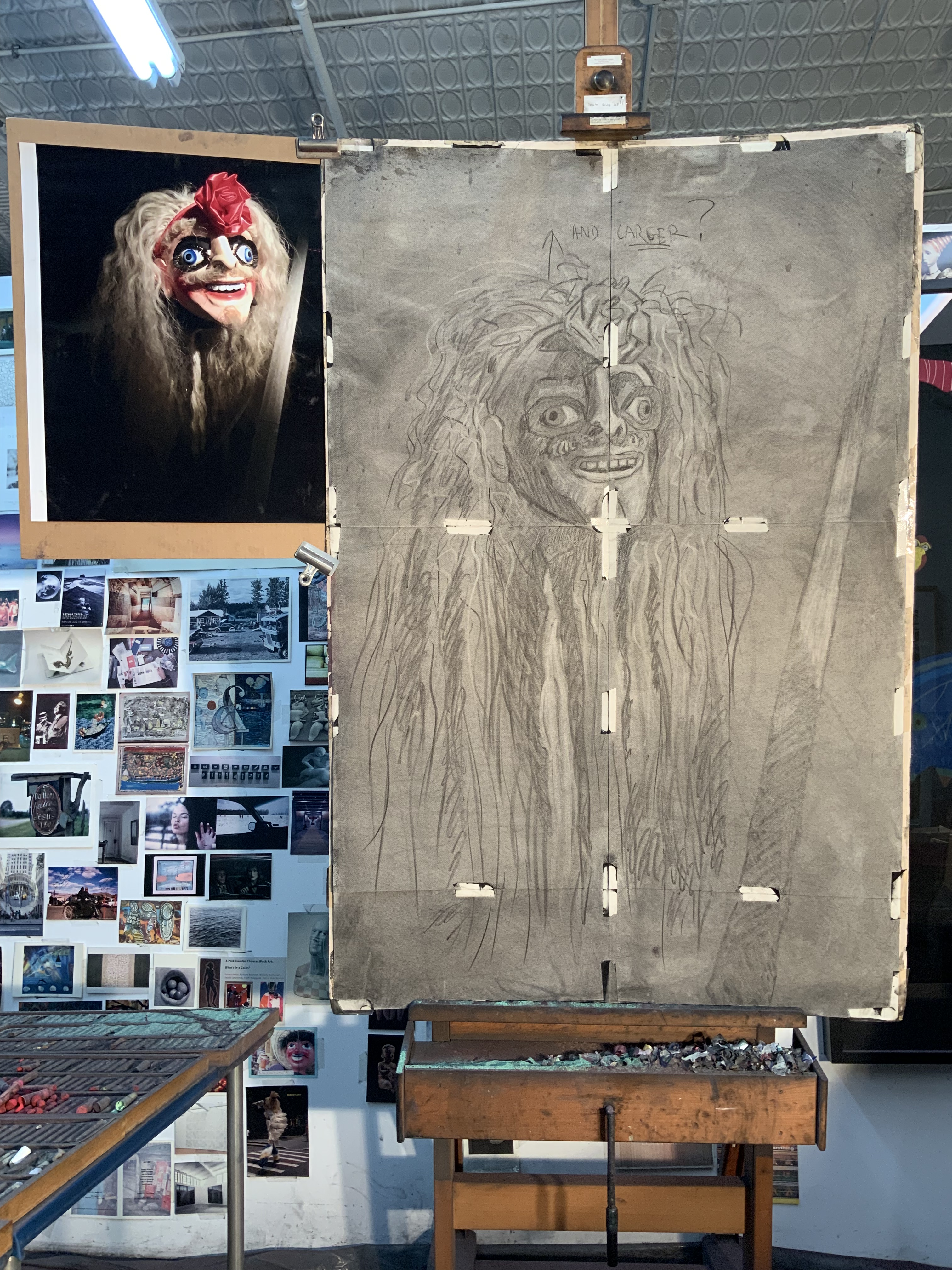
Preliminary sketch
A: This is a preliminary charcoal sketch for my next large (58” x 38”) pastel painting. I loved seeing “The Champ,” 26” x 20,” blown-up as a poster in the London Underground so I decided to create a larger original. Now I can’t wait to tackle all that hair! So far the sketch resembles a Rastafarian, but who knows if that will carry over to the pastel painting! Stay tuned.
Comments are welcome!
Pearls from artists* # 349
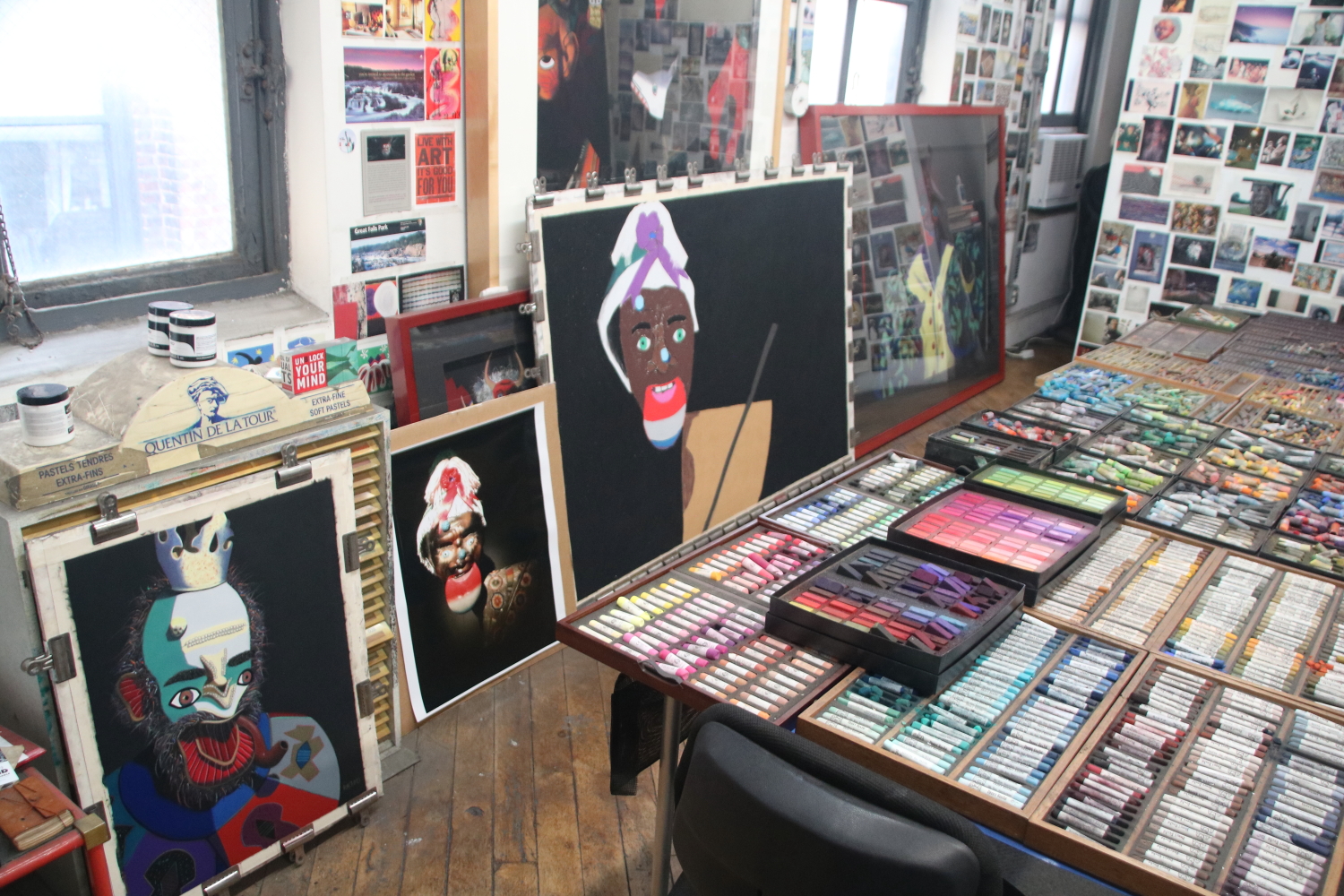
Barbara’s studio
*an ongoing series of quotations – mostly from artists, to artists – that offers wisdom, inspiration, and advice for the sometimes lonely road we are on.
If Dostoyevsky, Flaubert, and so many others were able to create great artistic works, it was because they were able to pull off something few adults can find it in themselves to do: they were able to suspend all final judgments about life and the universe in order to play…
The spirit of work is concerned with self-preservation. It evaluates concepts and ideas in terms of their practical value. Building roads, raising walls, running elections, debating policies, educating the young – all of these are purposive actions ultimately aimed at upholding social structures, changing those structures, or promoting one’s place within society. The spirit of work is the home of the ego, the part of us that has evolved to survive and thrive. One of the conditions of the artistic creation seems to be the ability to move frame this frame of mind into the spirit of play. As many artist have said in varying ways, the trick is to forget everything and create for the sake of creating. No worthwhile play, of course, is without effort. As the painstaking care Flaubert put into every line of his books makes clear, the spirit of play is sometimes the most exciting. Nevertheless, art remains in essence a game, an activity undertaken for its own sake, no matter how difficult. Like all games, it requires the establishment of a perimeter within which things that one might take very seriously in ordinary life are given only relative value. The perimeter suspends all the conventional rules, allowing the artist to turn the world on its head and let the imagination roam freely.
No sooner have we entered the spirit of play than we see things differently.
J.F. Martel in Reclaiming Art in the Age of Artifice: A Treatise, Critique, and Call to Action
Comments are welcome!
Q: Would you speak about the meaning of your work and the different materials you use?
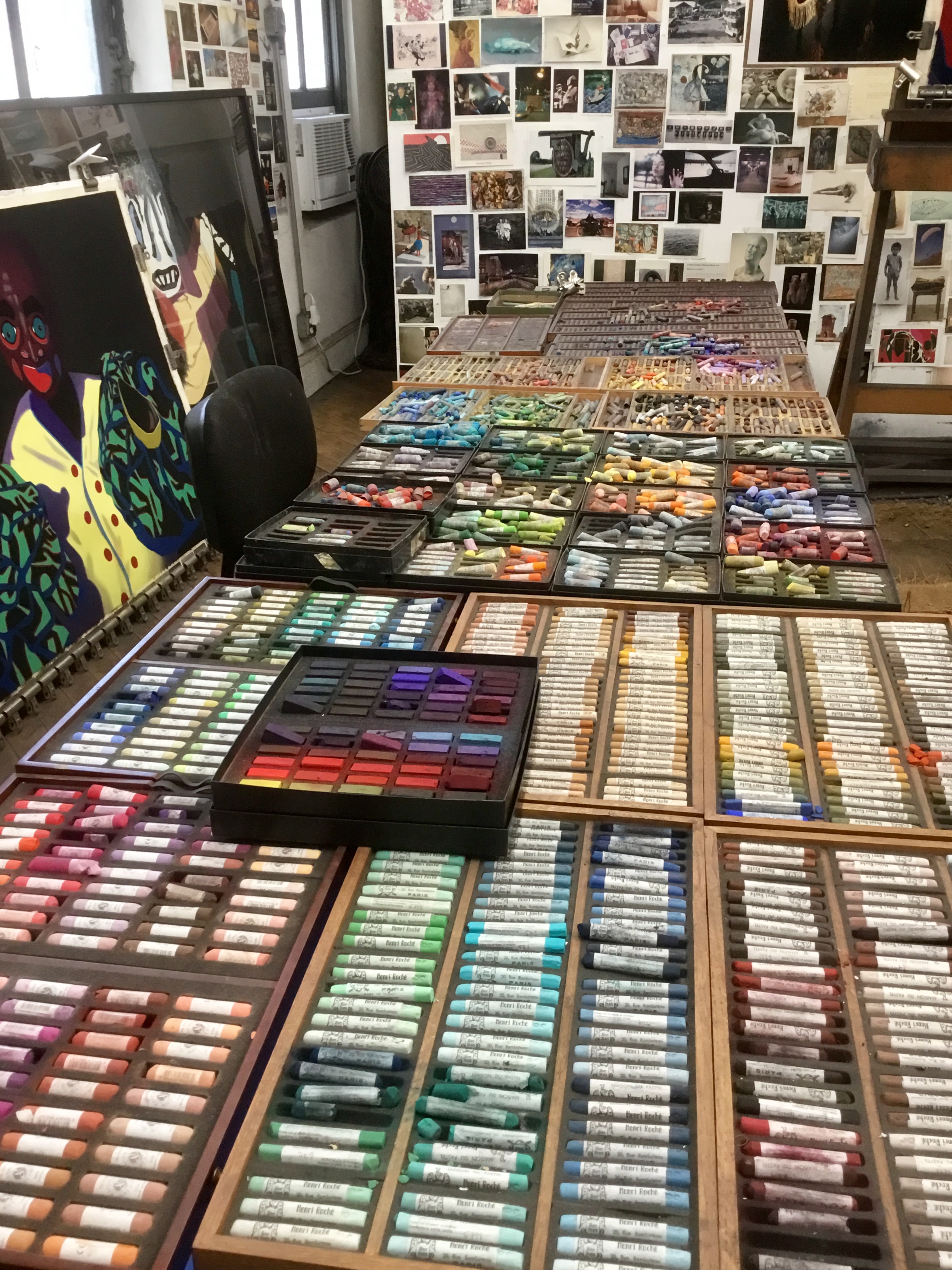
About half of Barbara’s pastels
A: It is as difficult to explain the meaning of my art as it is to interpret the meaning of life! I am invested in and concerned with process: foreign travel, prodigious reading, devotion to craft, months of slow meticulous work in the studio trying to create an exciting work of art that has never been seen before, etc. I love making pastel paintings! Many years ago I challenged myself to push the limits of what soft pastel can achieve. I am still doing so.
I leave it to others – viewers, arts writers, critics, art historians – to study my creative journey and talk about meanings. I believe an artist is inspired to create and viewers ponder the creation. I would not presume to tell anyone how to react to my work.
For many years I have been devoted to promoting soft pastel as a fine art medium. There are excellent reasons it has been around for five hundred years! It is the most permanent of media. There’s no liquid binder to cause oxidizing or cracking over time, as happens with oil paint. Pastel colors are intense because they are close to being pure pigment. Pastel allows direct application (no brushes) with no drying time and no color changes.
I use UArt acid-free sandpaper. This is not sandpaper from a hardware store. It is made for artists who work in pastel and allows me to build up layers of pigment without using a fixative. My process – slowly applying and layering pastels, blending and mixing new colors directly on the paper, making countless adjustments, searching for the best and/or most vivid colors – continually evolves. Each pastel painting takes months to create.
Comments are welcome!

Q: Do your materials have properties that allow you to maximize what you depict in your work?
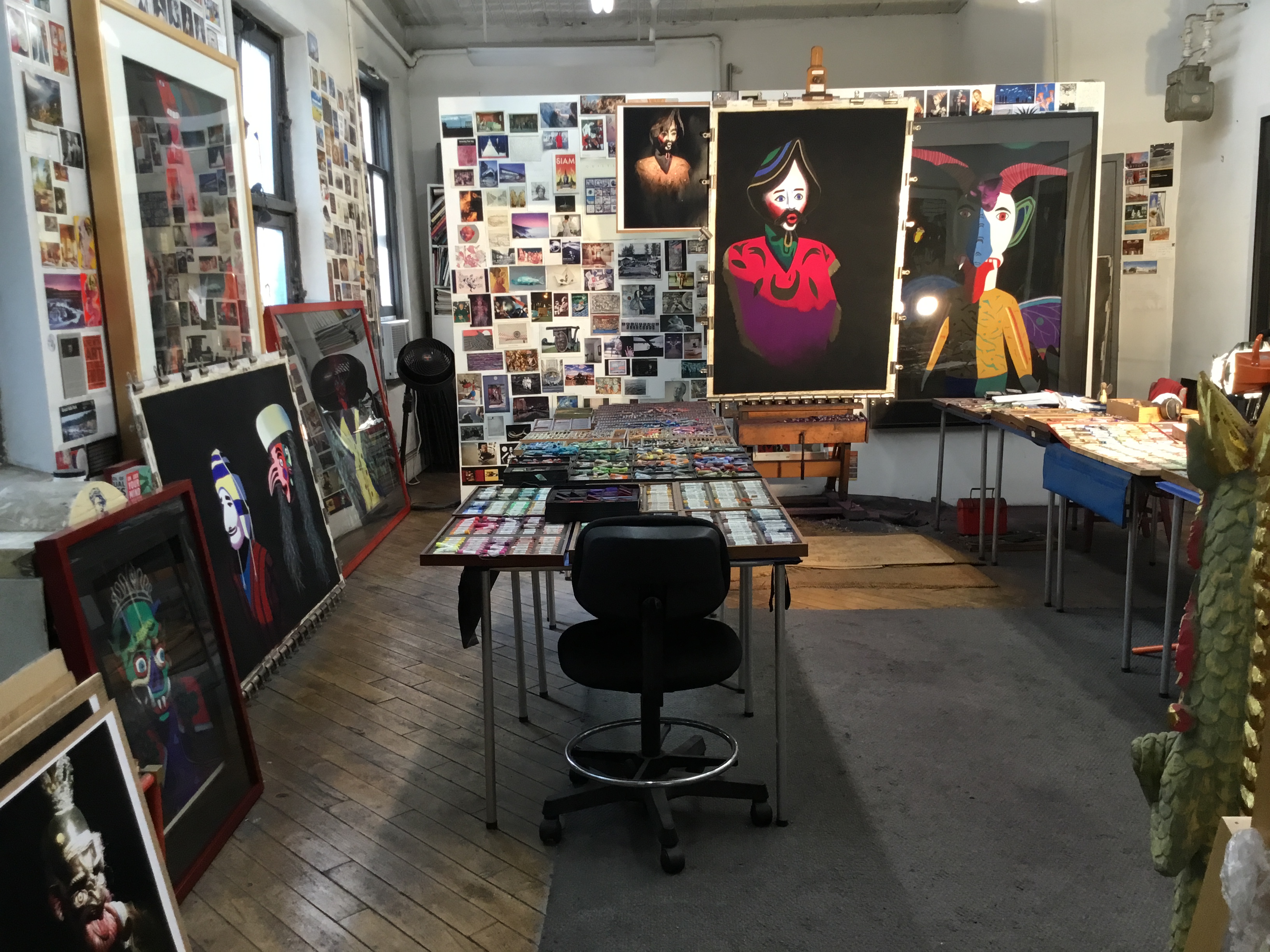
Barbara’s studio
A: I work exclusively in soft pastel on sandpaper. Pastel, which is pigment and a binder to hold it together, is as close to unadulterated pigment as an artist can get. It allows for very saturated color, especially as I utilize the self-invented techniques developed and mastered over more than thirty years as an artist. I believe my “science of color” to be unique, completely unlike how any other artist works. I spend three or four months on each painting, applying pastel and blending the layers together to mix new colors directly on the paper.
The sandpaper support allows the build up of 25 to 30 layers of pastel as I slowly and meticulously work for hundreds of hours to complete a painting. The paper is extremely forgiving. I can change my mind, correct, refine, etc. as much as I want until a painting is the best I can create at that moment in time.
Comments are welcome!
Pearls from artists* # 286
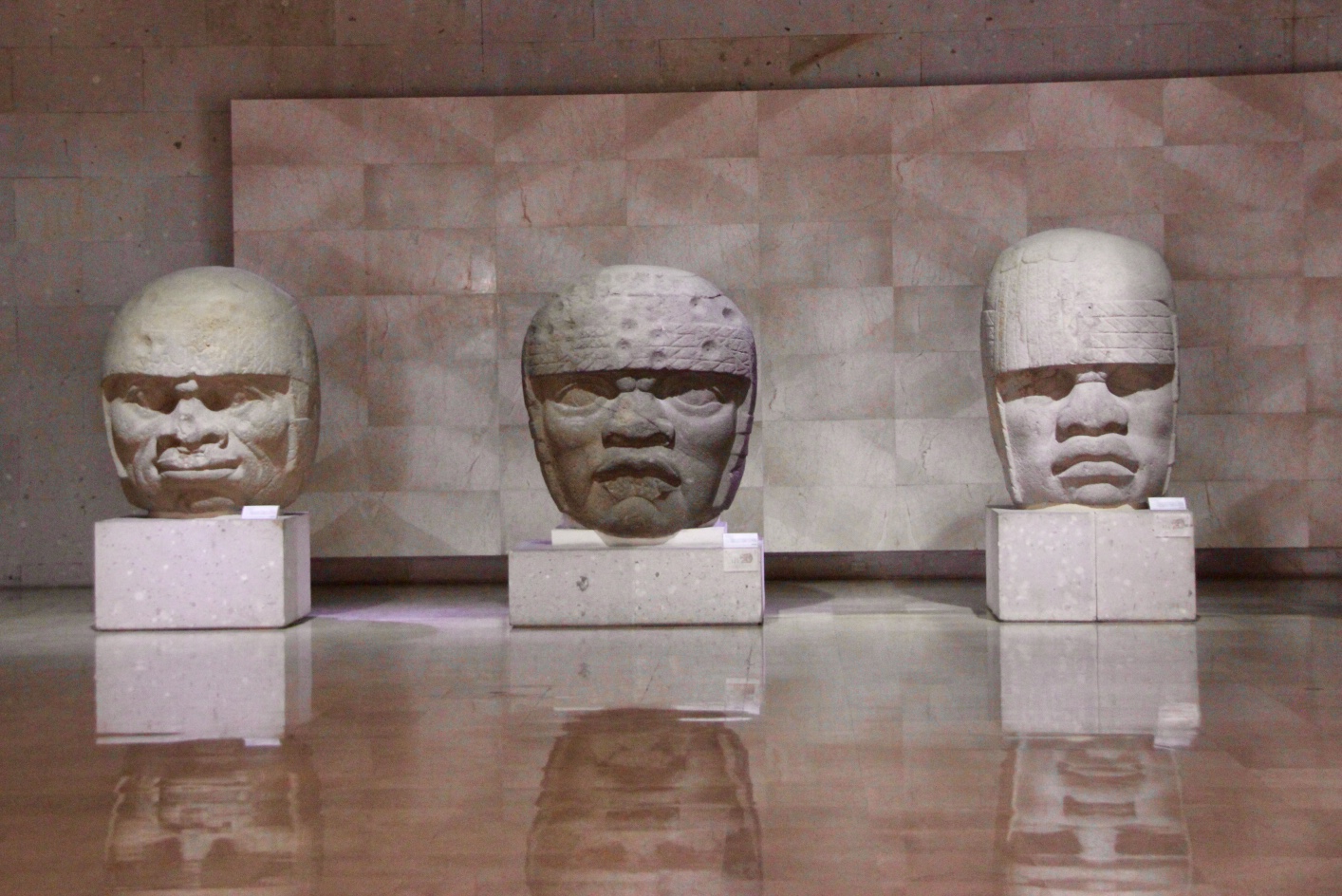
Museo de Antropología de Xalapa
*an ongoing series of quotations – mostly from artists, to artists – that offers wisdom, inspiration, and advice for the sometimes lonely road we are on.
All real art is or was modern in its time,
daring and new,
demonstrating a constant change in seeing and feeling.
If revival had been a perpetual virtue,
we would still live in caves and earth pits.
In art, tradition is to create,
not to revive.
Joseph Albers quoted in Ruins in Reverse by Lauren Hinkson in Joseph Albers in Mexico
Comments are welcome!
Q: How do you stay motivated to create new work?
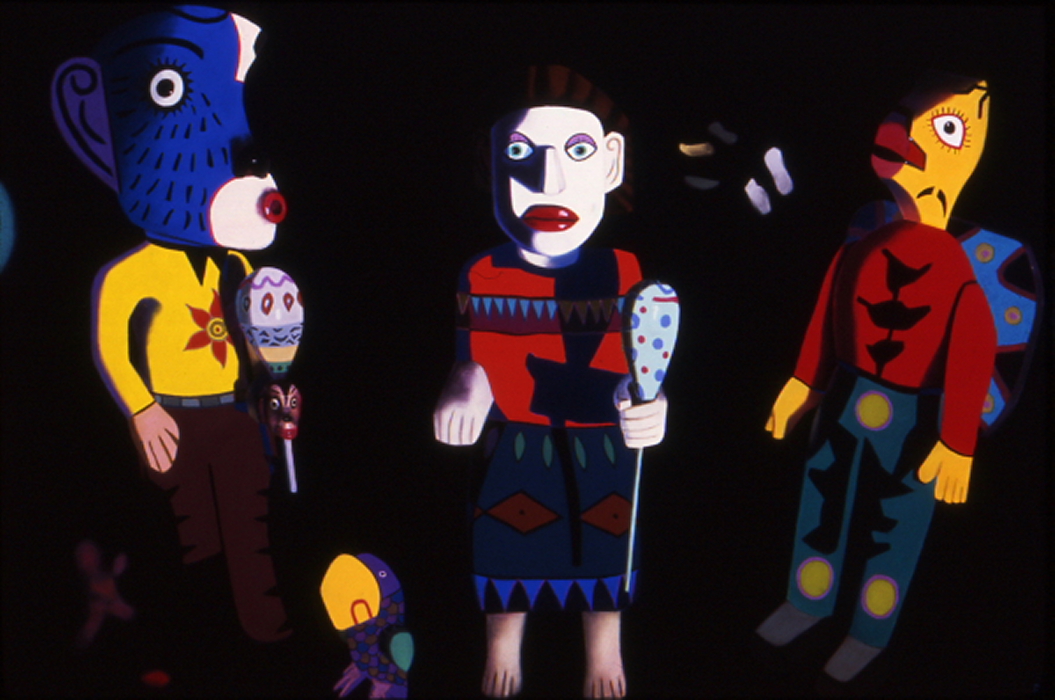
“False Friends,” 50” x 70,” one of Cheryll and John’s pastel paintings
A: There are many reasons to continue to make art. First, I am fascinated by my months- if not years-long creative process. It begins with travel to remote destinations and ends in framed pastel paintings in my studio, hanging in galleries, at art fairs, in collectors’ homes, etc. Each new pastel painting is another thread in an expanding tapestry that is my entire body of work. It’s fascinating to never know where the process, or the paintings, will end up nor who will be touched by the work.
My pastel paintings continue to garner appreciation among a growing list of collectors. Here’s a recent email from a couple that has been collecting my work from the beginning.
hello barbara,
merry christmas!
we are thrilled and thrilled and thrilled for your good news from miami and naples.
. . . “tense peace, a tumultuous stillness” . . .
we know we love you and we love your work.
how lucky are we to live with your work in our home, in our lives.
we love to read how others describe it.
thanks for sharing.
happy us to have you and your art in our lives,
love to you,
john & cheryll
your work stopped me in my tracks decades ago.
the sight of your work never left me.
i knew that i had to have it near me at some time, no matter what the cost.
i began immediately to negotiate with john.
you know the story . . .
i promised that i would not buy a single thing for five years if i could have one piece of your art.
i held true for the five years and beyond, adding three more pieces of your work.
if we had the wherewithal, your work would be on every floor.
there is never a day that goes by without thinking how brilliant that work is and how it has enriched our deepest sense of visual joy.
we see the rain pouring down, the snow falling, the clouds scudding by, in false friends.
i admit, we don’t allow the sun to shine on them. i couldn’t bear for her to be damaged.
your thoughtful, brilliant words kept us from changing the highly-reflective plexi to something that would have dulled the drama of us walking in front of and being a part of the work.
we still have those words.
it took about one-half of one second for my thinking to change.
and, man, are we grateful.
it never occurred to us that your work wouldn’t be sought after.
always, we walk into a museum and see your work on the walls.
on the walls of the hemi-cycle at the corcoran.
on the walls of the whitney.
on the walls of the met breurer.
on any large white space that would allow each piece to breathe.
we have always known, deep in our marrow that your work is singular.
you have always had our hearts . . . since the second i walked into the torpedo factory, a first-grade teacher with a first-grade teacher’s salary, and knew that i’d sell my honda civic and walk rather than not have in reality, the frogs thought they were men (i know that the title of the piece is something like that . . . the decades have blurred the words).
so, we waited and then . . .
sigh . . .
all the best to you.
we are excited out of our ever-loving minds for you.
but . . . we’ve always known . . .
love,
c & j
Comments are welcome!
Q: What qualities do you think mark the highest artistic achievement?
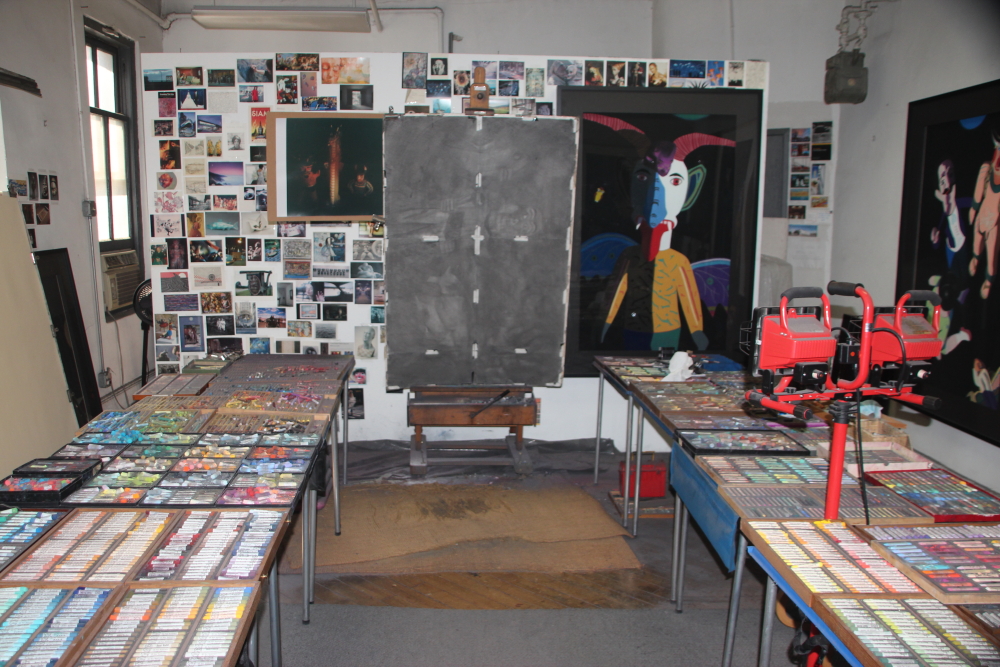
Barbara’s studio
A: If I may speak in the most general terms, several qualities come to mind that, for me, mark real artistic achievement:
- firm artistic control that allows the artist to create works that simultaneously demonstrate formal coherence while responding to inner necessity
- the creation of new forms and techniques that are adapted to expressing the artist’s highly personal vision
- an authentic and balanced fusion of form, method, and idea
- using material from one’s own idiosyncratic experiences and subtly transforming it in a personal inimitable way during the creative process
- the meaning of the thing created is rigorously subordinated to its design, which once established, generates its own internal principles of harmony and coherence
Comments are welcome!
Pearls from artists* # 188
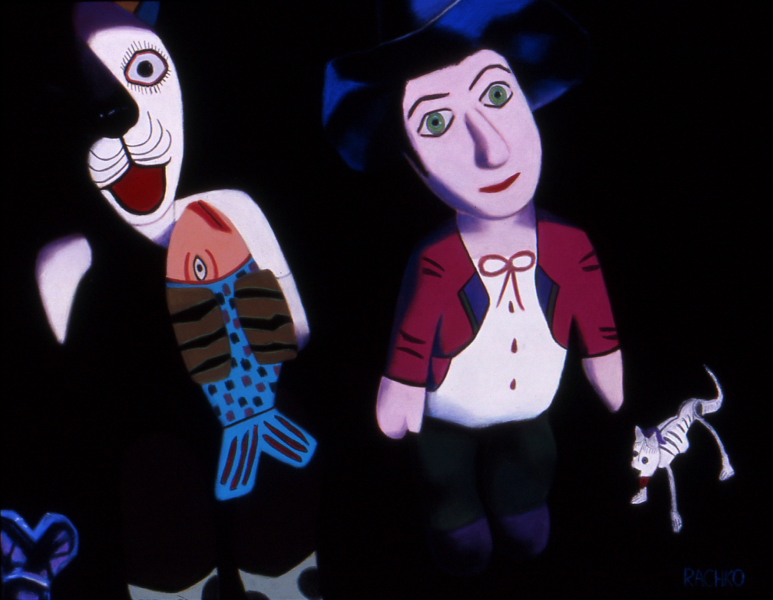
“Offering,” soft pastel on sandpaper, 20″ x 26″
* an ongoing series of quotations – mostly from artists, to artists – that offers wisdom, inspiration, and advice for the sometimes lonely road we are on.
HM: In order to create a work of art, you need an artist, an object, the work, and the audience. Indeed, where there’s no audience, there’s no artist. Renoir used to say, “No painters in Hamlet.” meaning that on a desert island you wouldn’t paint.
( I confess I am a little surprised. For my part, I find it difficult to believe that the true artist cannot work without hope. It seems to me that art is first and foremost an internal necessity, a need to escape from life. It is true that this is closer to the mystics’ point of view and that the artist, if he does not work directly for his contemporaries, at least looks forward to some future resonance. Nonetheless, I ask the same question again.)
PC: Even a true painter wouldn’t paint on a desert island?
HM: No… Painting is a means of communication, a language. An artist is an exhibitionist. Take away his spectators and the exhibitionist slinks off with his hands in his pockets.
The audience is the material in which you work. You don’t see the face of the audience. It’s huge, an immense mass. The public is – listen, it’s the man you encounter one fine day, who says, “Monsieur Matisse, I can’t tell you how much I love your picture, the one you exhibited at the salon,” and this man is a clerk who could never spend a red cent on painting. The public is not the buyer; the public is the sensitive material on which you hope to leave an imprint.
PC: Through the picture, the audience returns to the source of emotion.
HM: Yes, and the artist is the actor, the fellow with the wheedling voice who won’t rest until he’s told you his life story.
Chatting with Henri Matisse: The Lost 1941 Interview, Henri Matisse with Pierre Courthion, edited by Serge Guilbaut, translated by Chris Miller
Comments are welcome!
Q: How many pastel paintings do you have in progress now?
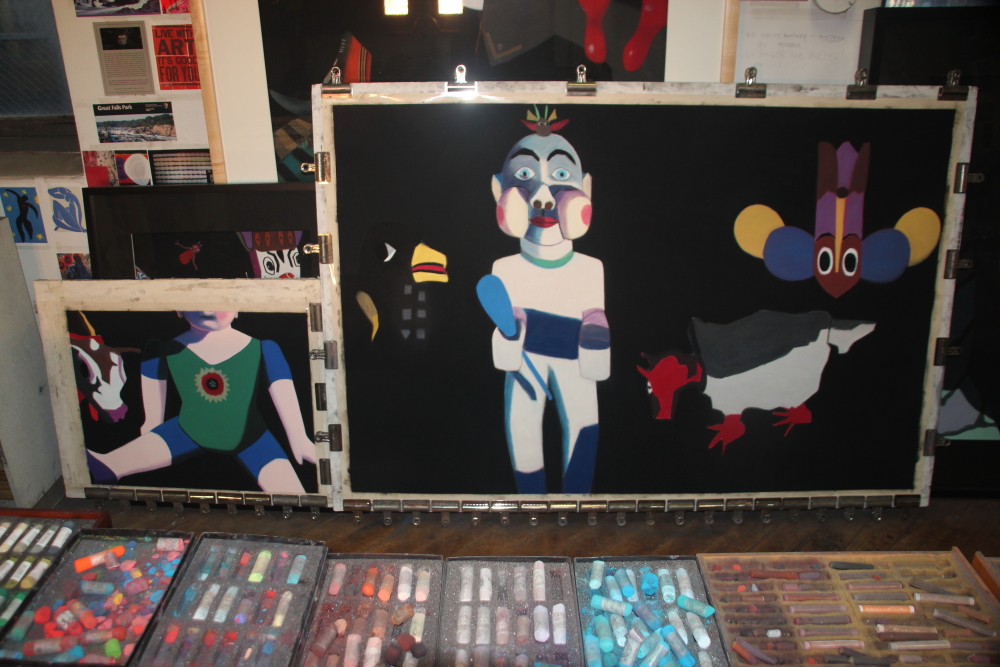
Work in progress
A: Making pastel-on-sandpaper paintings is a slow and meticulous process. I work full-time in my studio so that in a good year I can produce five finished pieces. Typically two are in progress at a time so that I can switch off when problems develop.
A downside to looking at a painting for months is that there comes a point when I can’t see the flaws any more. Then it’s definitely time to take a break.
When I put a painting that has been resting back onto my easel, I see it with fresh eyes again. Areas that need work immediately stand out. Problem areas become easily resolvable because I have continued to think about them while the painting was out of my sight.
Comments are welcome!


 barbararachkoscoloreddust.com