Blog Archives
Q: When did you begin drawing and painting? (Question from “Cultured Focus Magazine”)

A: This is a long story because my path to becoming a professional artist has been unusually circuitous.
I grew up in a blue collar family in suburban New Jersey. My parents were both first-generation Americans and no one in my family had gone to college. I was a smart kid, who showed some artistic talent in kindergarten and earlier. At the age of 6, my sister, my cousin, and I enrolled in Saturday morning painting classes at the studio of a local artist. I continued the classes for about 8 years and became a fairly adept oil painter.
At the age of 15 my father decided that art was not a serious pursuit – he called it a hobby, not a profession – and abruptly stopped paying for my Saturday morning lessons. Unfortunately, there were no artists or suitable role models in my family. So with neither financial nor moral support to pursue art, I turned my attention to very different interests.
Cut to ten years later. When I was 25, I earned my private pilot’s license and spent the next two years amassing other flying licenses and ratings, culminating in a Boeing-727 flight engineer’s certificate.
At 29, I joined the Navy. By then I was an accomplished civilian pilot with thousands of flight hours so I expected to fly jets. However, in the early 1980s women were not allowed in combat. There were very few women Navy pilots and those few were restricted to training male pilots. There were no women pilots landing on aircraft carriers.
In the mid-1980s I was in my early 30s, a lieutenant on active duty in the Navy, working a soul-crushing job as a computer analyst on the midnight shift in a Pentagon basement. It was literally and figuratively the lowest point of my life. I was completely bored and miserable.
Remembering the joyful Saturdays of my youth when I had taken art classes with a local New Jersey painter, I enrolled in a drawing class at the Art League School in Alexandria, Virginia. Initially I wasn’t very good, but it was wonderful to be around other women and a world away from the mentality of the Pentagon. I was having fun again! I enrolled in more classes and became a very motivated full-time art student who worked nights at the Pentagon. As I studied and improved my skills, I quickly discovered my preferred medium – soft pastel on sandpaper.
Although I knew I had found my calling, for more than a year I agonized over whether or not to leave the financial security of a Navy paycheck. Finally I did make up my mind and resigned my commission, effective on September 30, 1989. With Bryan’s (my then boyfriend’s) support, I left the Navy to devote my time to making art.
I’m probably one of the few people who can name THE day I became a professional artist! That day was October 1, 1989. Fortunately, I have never needed another job. I remained in the Navy Reserve for the next 14 years, working primarily at the Pentagon for two days each month and two weeks each year. I commuted by train to Washington, DC after I moved to Manhattan in 1997. Finally on November 1, 2003, I officially retired as a Navy Commander.
Life as a self-employed professional artist is endlessly varied, fulfilling, and interesting. I have never regretted my decision to pursue art full-time.
Comments are welcome!
Pearls from artists* # 630

*an ongoing series of quotations – mostly from artists, to artists – that offers wisdom, inspiration, and advice for the sometimes lonely road we are on.
During the Victorian age, women, with their ‘smaller,’ less ‘creative’ brains, were considered incapable of becoming professional artists and were often restricted to ‘craft’ or ‘design’ (genres not considered ‘fine art’ by the establishment). This perception made it very difficult not only for women to be taken seriously as artists, but for their (and their female predecessors’) work to be sold. In order to get around this, nineteenth-century art dealers were known to scratch out a female artist’s signature and replace it with that of a male contemporary, which explains why many works by women have only just come to light. (No wonder so many of them hid self-portraits among their still lifes).
Katy Hessel in The Story of Art Without Men
Comments are welcome!
Pearls from artists* # 627

In Hanga Roa, Rapa Nui (Easter Island), one of the most remote places on Earth!
*an ongoing series of quotations – mostly from artists, to artists – that offers wisdom, inspiration, and advice for the sometimes lonely road we are on.
We cannot afford to walk sightless among miracles. Nor can we protect ourselves from suffering. We do work that thrusts us into the pulsing heart of this world, whether or not we’re on the mood, whether or not it’s difficult or painful or we’d prefer to divert our eyes. When I think of the wisest people I know, they share one defining trait: curiosity. They turn away from the minutiae of their lives – and focus on the world around them. They are motivated by a desire to explore the unfamiliar. They are drawn toward what they don’t understand. They enjoy surprise. Some of these people are seventy, eighty, close to ninety years old, but they remind me of my son and his friend on the day I sprung them from camp. Courting astonishment. Seeking breathless wonder.
Dani Shapiro in Still Writing: The Perils and Pleasures of a Creative Life
Comments are welcome!
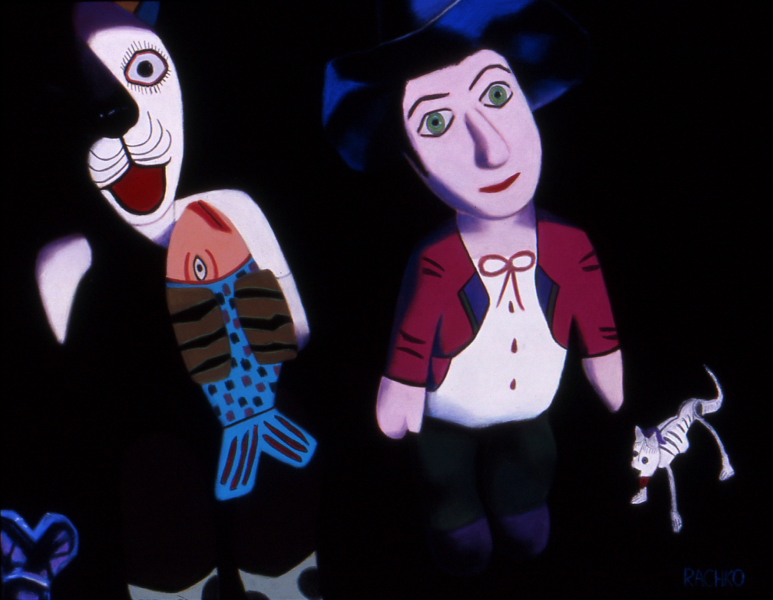
Q: How large is your collection of Mexican folk art objects?

Part of my collection
A: I began collecting these figures in the early 1990s. I haven’t counted them, but my guess is that I have amassed around 200 pieces of various sizes. This includes some Guatemalan figures. I went to Guatemala in 2009 and 2010. Since I divide my time between a house in Alexandria, VA, an apartment in Manhattan, and a studio in Chelsea, a portion of my folk art collection resides in each of these places.
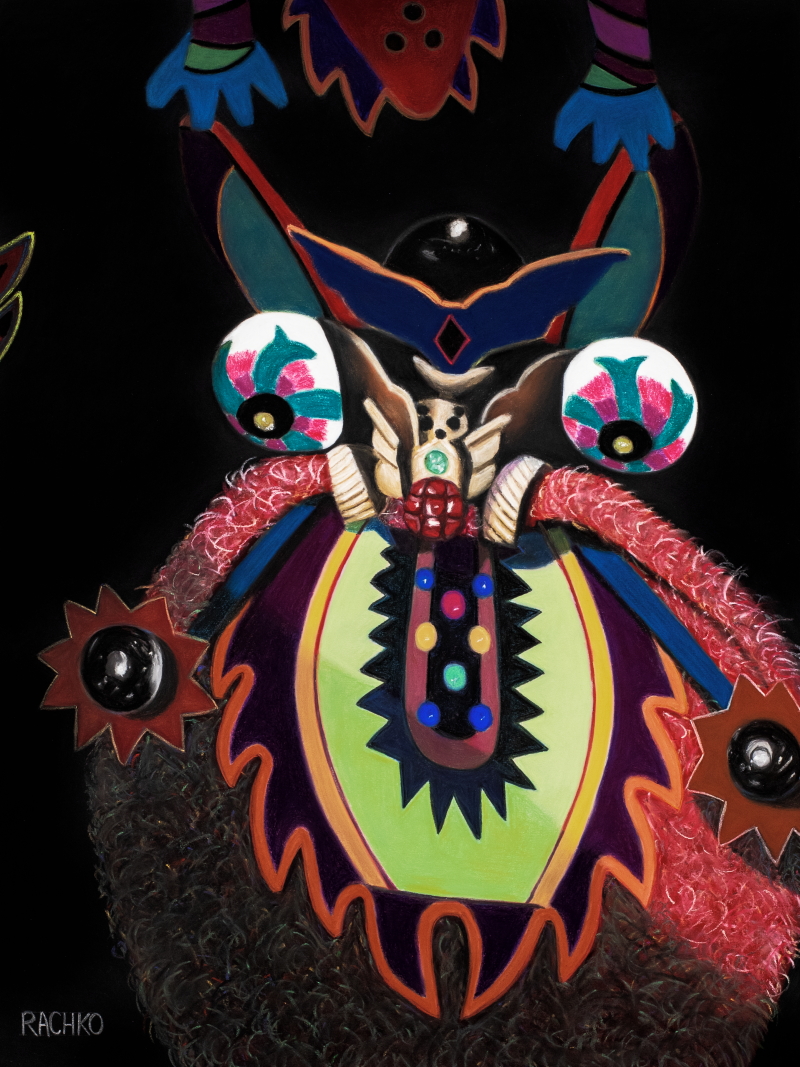
Since 2017 I have been creating pastel paintings in the “Bolivianos” series, which exclusively use my photographs of Bolivian Carnival masks as source material. Occasionally, I will add one of my smaller Mexican or Guatemalan figures to improve and enrich a painting’s composition. Otherwise, my Mexican collection sits gathering dust. My thinking and my ideas, not to mention my travels, have evolved and just naturally moved on with time.
Comments are welcome!
Pearls from artists* # 604
*an ongoing series of quotations – mostly from artists, to artists – that offers wisdom, inspiration, and advice for the sometimes lonely road we are on.
In dealing with unconscious mind, we’re dealing with an ocean full of rich, invisible life forms swimming underneath the surface. In creative work we’re trying to catch one of these fish; but we can’t kill the fish, we have to catch it in a way that brings it to life. In a sense we bring it amphibiously to the surface so it can walk around visibly; and people will recognize something familiar because they’ve got their own fish, who are cousins to your fish. Those fish, the unconscious thoughts, are not passively floating “down there;” they are moving, growing, and changing on their own, and our conscious mind is but an observer or interloper. That is why Jung calls the depths of the unconscious the “objective psyche.”
Stephen Nachmanovitch in Free Play: Improvisation in Life and Art
Comments are welcome!
Q: When did you begin seriously studying photography?

A: After I lost my husband, Bryan, on 9/11 – as I’ve discussed elsewhere, Bryan photographed most of the setups for my “Domestic Threats” series – I needed to find a way to continue making art. In June 2002 I began studying photography at the International Center of Photography (ICP) in New York. I took a one week 4 x 5 view camera workshop because Bryan had photographed the setups with a Toyo-Omega view camera. I was surprised to discover that I had absorbed quite a bit of technical information just by watching him. Once I completed the workshop, I decided to start over from the beginning and to learn as much as I could about photography. So I enrolled in Photography I. Over the next several years I completed about a dozen courses at ICP, eventually learning to make my own large-scale chromogenic prints.
Around 2007 I began working seriously as a photographer, creating my photographic series, “Gods and Monsters,” with Bryan’s Mamiya 6 camera. In October 2009 HP Garcia Gallery in New York gave me my first solo photography exhibition.
Comments are welcome!
Q: What do collectors say about your work?
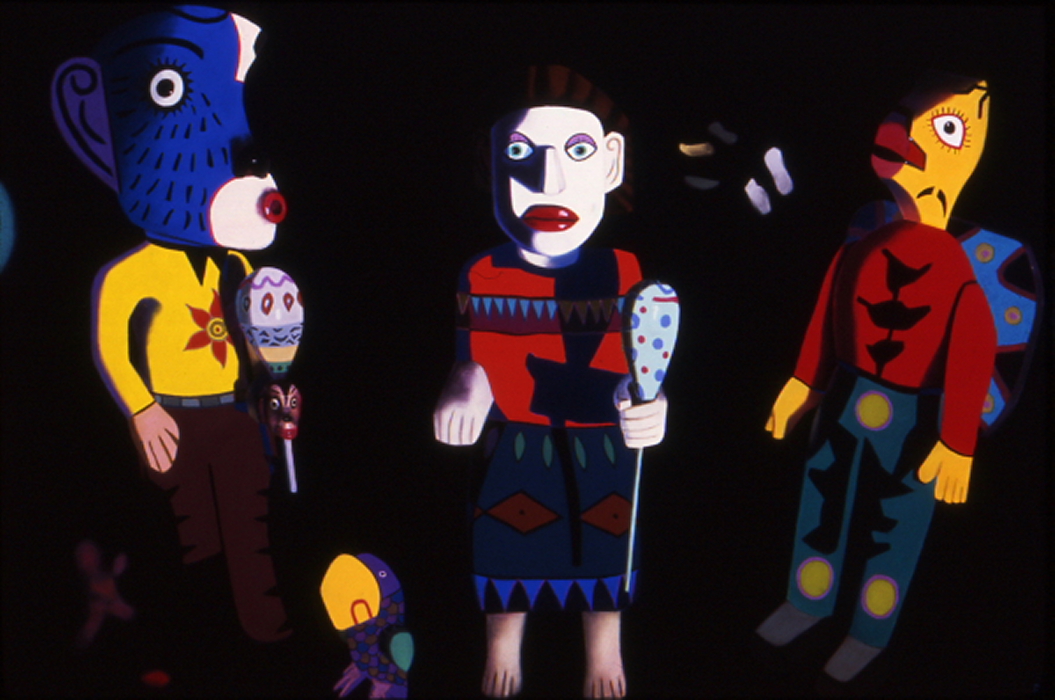
A: Here’s a quote from Cheryll Chew and John Frye, who own four of my pastel paintings.
We walked into her studio in 1994 and saw “In Reality the Frogs Were Men.” That instant on that day, my consuming passion with Barbara Rachko’s work began. We had absolutely no resources to buy “In Reality . . .” I did, however, know without a doubt that one day we would have her work, no matter what it took to get it.
We, years later, have “Scene Eleven: Bedroom,” “Scene Nine: Living Room,” “Scene Five: Kitchen,” and “False Friends.”
We have unorthodox appreciations and every single day, those pieces of art quicken the pulse and bring us pure pleasure.
Her pieces make us want to dance wildly around the room and wave our arms in the air. We are deeply grateful that her work is in our home. Her art balances the everyday domestic with the unthinkably rare, lovely, and maniacal. That is an edgy state of being that we thrive in.
Not long ago, we read an article about Nan Goldin. In the article was a phrase that says precisely what Barbara Rachko’s work does for us . . .
all of the pleasure circuits are deeply fulfilled by looking. . .
Nan Goldin The Look of Love: Matchmaking at the Louvre
NY Times,10.27.2011
Comments are welcome!
Pearls from artists* # 598
*an ongoing series of quotations – mostly from artists, to artists – that offers wisdom, inspiration, and advice for the sometimes lonely road we are on.
For art to appear, we have to disappear. This may sound strange, but in fact it is a common appearance. The elementary case, for most people, is when our eye or ear is “caught” by something: a tree, a rock, a cloud, a beautiful person, a baby’s gurgling, spatters of sunlight reflected off some wet mud in the forest, the sound of a guitar wafting unexpectedly out of a window. Mind and sense are arrested for a moment, fully in the experience. Nothing else exists. When we “disappear” in this way, everything around us becomes a surprise, new and fresh. Self and environment unite. Attention and intention fuse. We see things just as we and they are, yet we are able to guide and direct them to be one just the way we want them. This lively and vigorous state of mind is the most favorable to the germination of original work of any kind. It has its roots in child’s play, and its ultimate flowering in full-blown artistic creativity.
Stephen Nachmanovitch in Free Play: Improvisation in Life and Art
Comments are welcome!
Pearls from artists* # 589

Barbara’s studio… where plenty of mistakes happen!
*an ongoing series of quotations – mostly from artists, to artists – that offers wisdom, inspiration, and advice for the sometimes lonely road we are on.
In school, in the workplace, in learning an art or sport, we are taught to fear, hide or avoid mistakes. But mistakes are of incalculable value to us. There is first the value of mistakes as the raw material of learning. If we don’t make mistakes, we are unlikely to make anything at all. Tom Watson, for many years the head of IBM, said “Good judgment comes from experience. Experience cones from bad judgment.” But more important, mistakes and accidents can be the irritating grains that become pearls; they present us with unforeseen opportunities, they are fresh sources of inspiration in and of themselves. We come to regard our obstacles as ornaments, as opportunities to be exploited and explored.
Seeing and using the power of mistakes does not mean that anything goes. Practice is rooted in self-correction and refinement, working toward clearer and more reliable technique. But when a mistake occurs, we can treat it either as an invaluable piece of data about our technique or as a grain of sand around which we can make a pearl.
Stephen Nachmanovitch in Free Play: Improvisation in Life and Art
Comments are welcome!
Pearls from artists* # 578

Hudson Yards, New York City
*an ongoing series of quotations – mostly from artists, to artists – that offers wisdom, inspiration, and advice for the sometimes lonely road we are on.
He [His Holiness Ngawang Tenzing Zangbo, the Sherpas’ Tengboche abbot and overseer of all Buddhist gompas in Nepal] said that he is not surprised to see Westerners flocking to Tibetan monasteries in Nepal. “In the West, there are too many distractions,” he said. “People long to come to these mountains. Here you can learn things through your heart.” He noted that Kathmandu also drew many Himalayan people because of its proximity to sacred places, but was confident that many lamas among them would return to remote areas and practice a wholesome religion free of urban temptations. He hopes that the spiritual boom will result in higher levels of religious life all around the region and not the further degradation of monastic life through materialism. He sounded as if it might be touch-and-go in some places.
Barbara Crossette in So Close to Heaven: The Vanishing Buddhist Kingdoms of the Himalayas
Comments are welcome!


 barbararachkoscoloreddust.com