Blog Archives
Pearls from artists* # 629

Basquiat X Warhol Exhibition at Fondation Louis Vuitton, Paris. Photo: Christine Marchal
*an ongoing series of quotations – mostly from artists, to artists – that offers wisdom, inspiration, and advice for the sometimes lonely road we are on.
… scientists are right there with artists in insisting art is fundamental to being human. Art is one of our oldest creations (humans invented paint long before the wheel), one of our earliest means of communication (we drew long, long, long before we could write), and one of our most universal urges (we all engage with art, whether preschoolers, Parisians, or Paleolithic cave dwellers). I began to notice that art – or what scientists dispassionately call “human-made two- or three-dimensional structures that remain unchanged: – was everywhere: hung over the register at the hardware store, spray-painted on a bakery window, cock-eyed in a dive-bar bathroom. As humans, we’ve filled our lives with art since practically forever. The earliest known painting keeps getting older, but the last time I checked, archaeologists had traced the oldest portrait to a cave in Indonesia, where around 45,000 years ago, artists put their finishing touches on a fat figure with purple testifies for a chin. In other words, before Neanderthals went extinct, before mammoths died out, before we figured out how to harvest food or heal bloody wounds, humans applied themselves to painting a portrait of a warty pig. “It is clear that the creation of beautiful and symbolic objects is a characteristic feature of the human way of life,” wrote the biologist J.Z. Young. “They are as necessary as food or sex.”
Bianca Booker in Get the Picture: A Mind-Bending Journey Among the Inspired Artists and Obsessive Art Fiends Who Taught Me How to See
Comments are welcome!

Q: I saw your book of photos. Very nice. How do you keep track of inventory? I have struggled with that. (Question from Laura Fischer Saxon via Facebook).
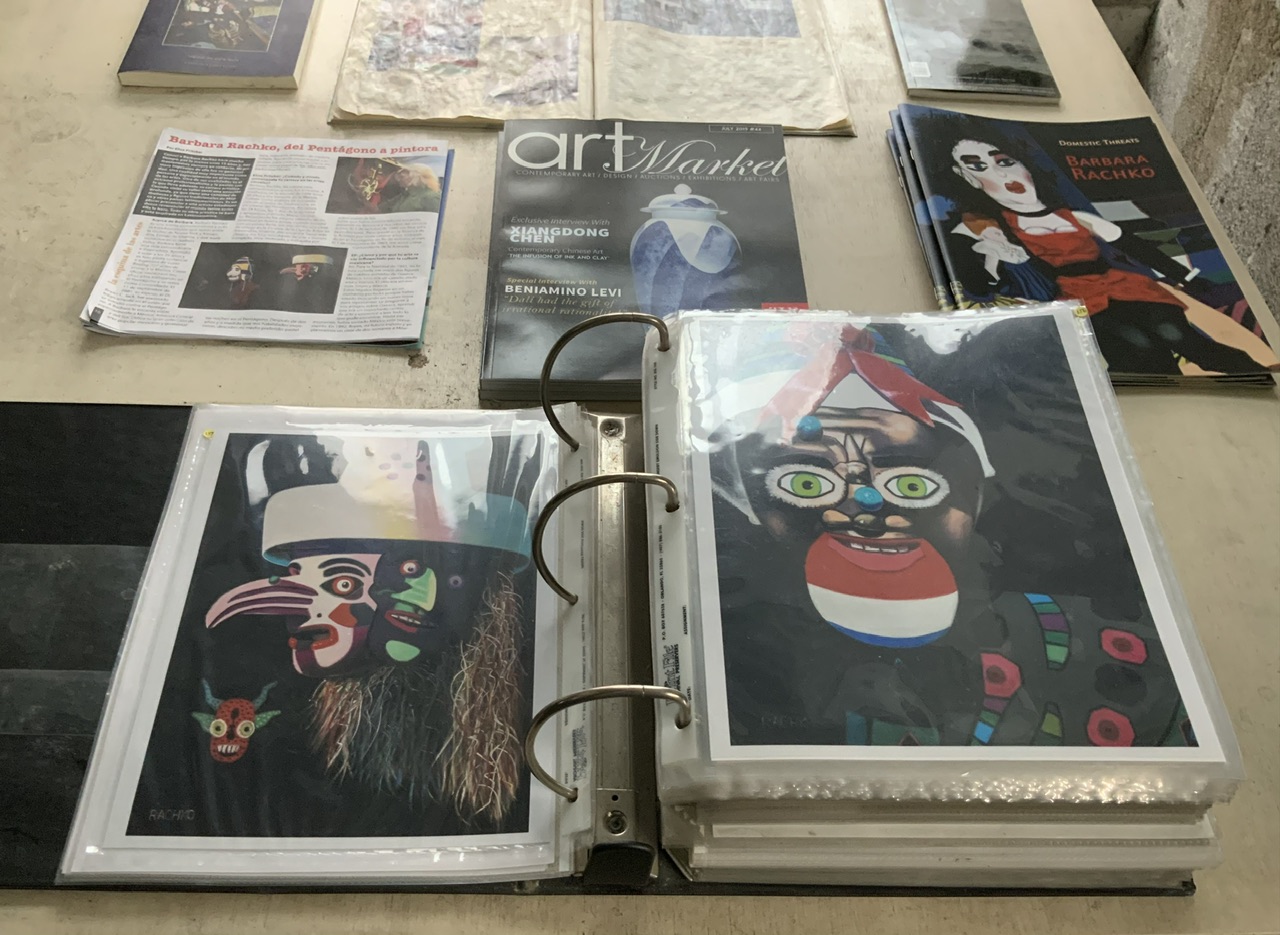
Barbara’s portfolio book
A: Every time I finish a pastel painting I order an 8” x 10” c-print at Duggal Visual Solutions. I started doing this in the 1980s when I was a portrait artist and the company that represented me needed photos of my work to show to potential clients. I’ve just continued making 8” x 10”photos all these years in order to document my work!
Pastel is an extremely slow medium so even though I have been working more than 37 years, the two pastel paintings in progress now are numbers 160 and 161. The portfolio book also has early press clippings, reviews from before the internet (when everything was on paper), and a few photos of early solo exhibitions in the 1990s.
BTW what a great question! No one has ever asked me this before!
Comments are welcome!
Q: This portrait has an interesting story. Can you explain? (Question from Anna Rybat via Facebook)
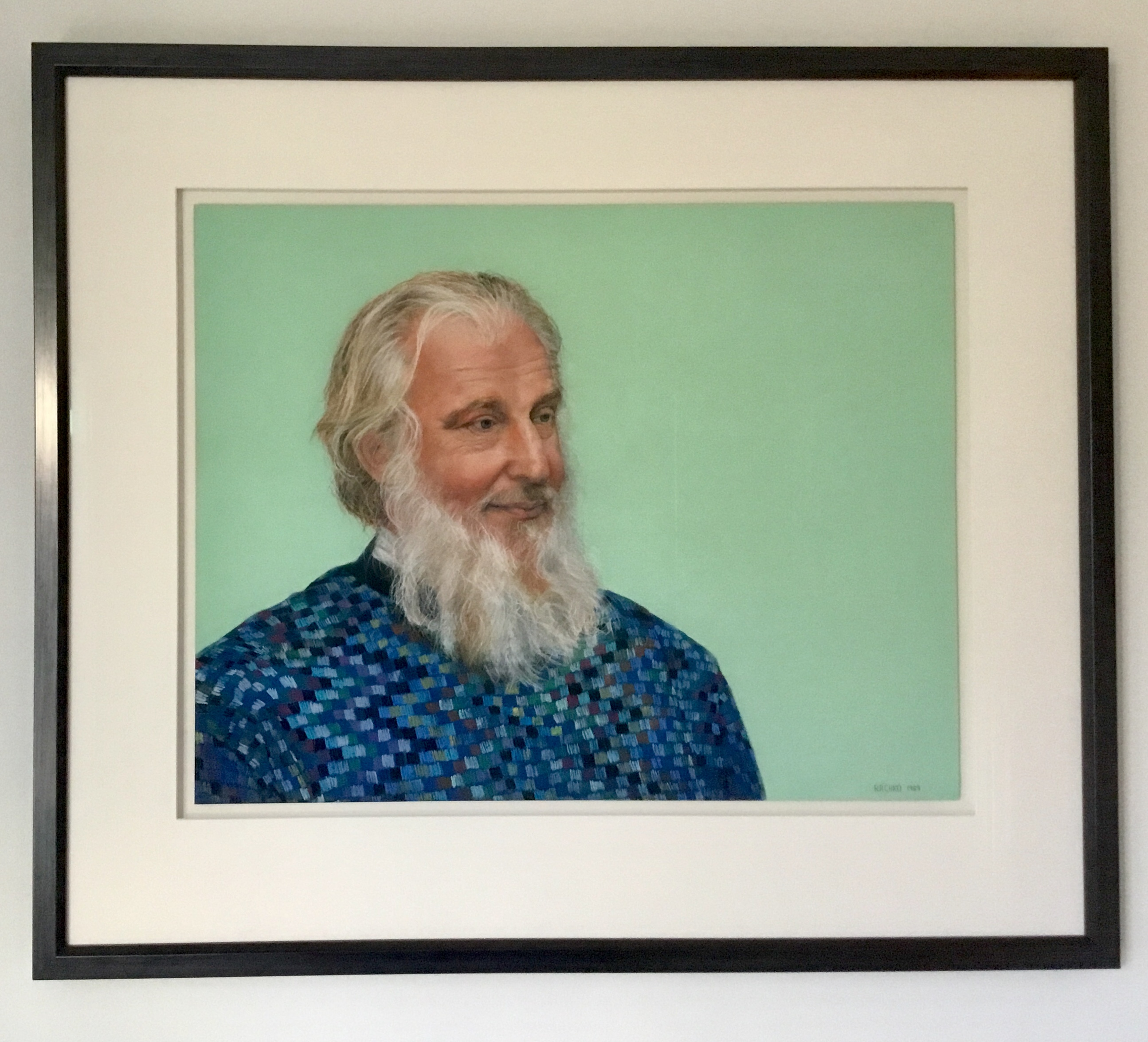
A: “John” was one of several portraits I made of friends in 1988-90 to build up my portfolio for the portrait company I worked for when I left the active duty Navy. I had gifted it to John Breeskin, the psychologist/friend pictured.
When he died, someone sent it back to me. (I hadn’t known he died). I must have not been working that day so for some reason, it was delivered to a print studio on another floor in my building. When the printer moved out, he found it and got in touch with me. By that time he had had “John” for more than a year and never bothered to tell me! The packaging had been removed so I have no idea who sent it or where exactly it came from.
Comments are welcome!
Pearls from artists* # 577

In the Studio
*an ongoing series of quotations – mostly from artists, to artists – that offers wisdom, inspiration, and advice for the sometimes lonely road we are on.
What is the popular conception of the artist? Gather a thousand descriptions and the resulting composite is the portrait of a moron: he is held to be childish, irresponsible, and ignorant or stupid in everyday affairs.
The picture does not necessarily involve censure or unkindness. These definitions are attributed to the artist’s preoccupation with his particular kind of fantasy and to the unworldly nature of the fantastic itself. The bantering tolerance granted to the absentminded professor is extended to the artist. Biographers contrast the artless news of his judgments with the high attainment of his art, and while his naïveté or rascality are gossiped about, they are viewed as signs of Simplicity and Inspiration, which are the Handmaidens of Art. And if the artist is inarticulate and lacking in the usual repositories of fact and information, how fortunate, it is said, that nature has contrived to divert him from all worldly distractions so he may be single-minded in regards to his special office.
Mark Rothko in The Artist’s Reality: Philosophies of Art, edited and with an introduction by Christopher Rothko
Comments are welcome!
Q: How does art help you explore and understand other cultures? (Question from Arte Realizzata)
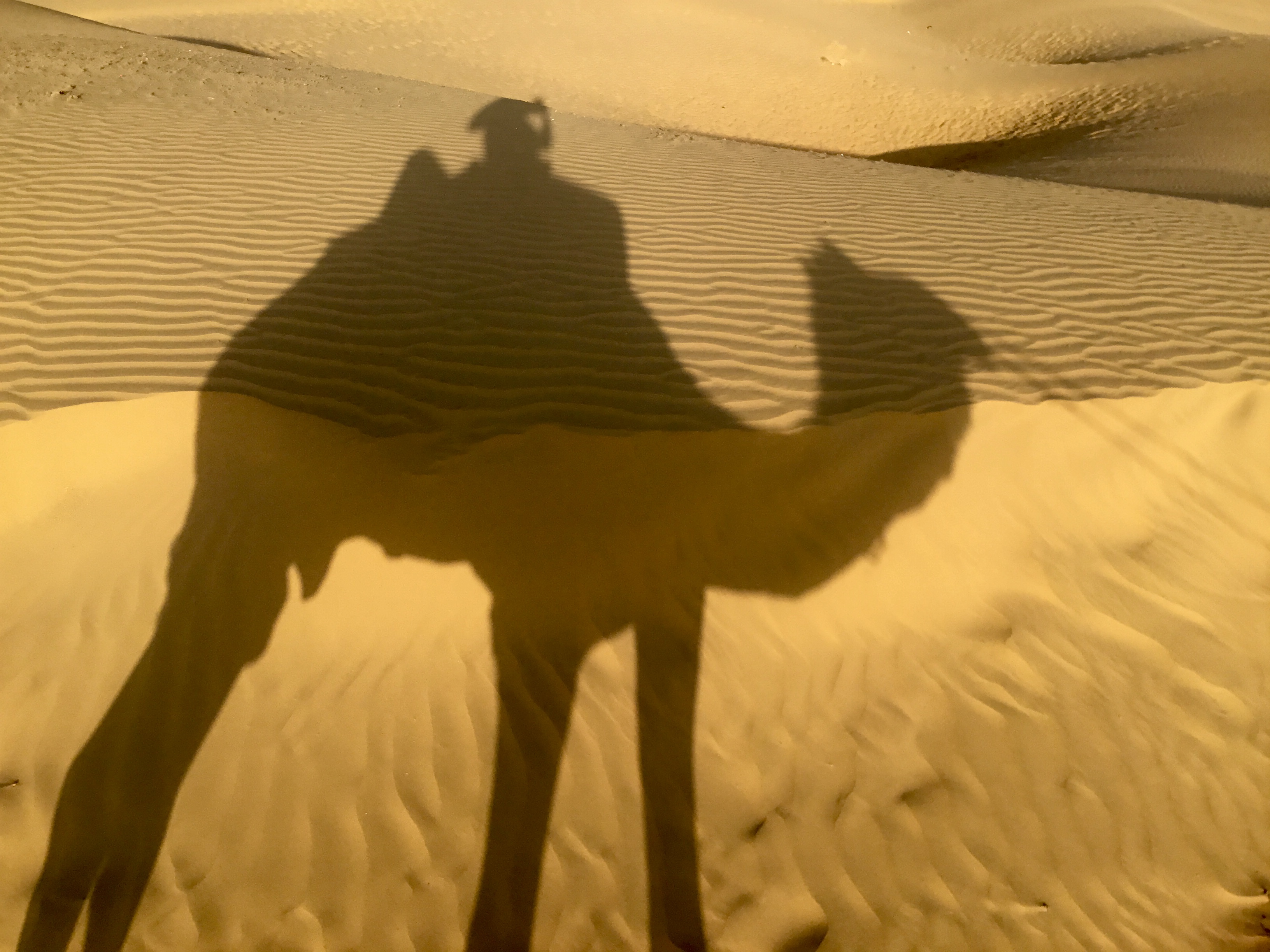
A: Art helps me explore and understand other cultures by revealing our shared humanity across space and time. For me art and travel are intertwined; there is no better education! My art-making has led me to visit fascinating places in search of source material, ideas, and inspiration: to Mexico, Guatemala, Brazil, Argentina, Uruguay, France, England, Italy, Bali, Java, Sri Lanka, and India. I have seen firsthand that people all over the world are the same.
Art has led me to undertake in-depth studies of intriguing subjects: drawing, color, composition, art, art history, the art business, film, film history, photography, mythology, literature, music, jazz, jazz history, and archaeology, particularly that of ancient Mesoamerica (Olmec, Zapotec, Mixtec, Aztec, and Maya), and South America (the Inca and their ancestors).
This rich mixture of creative influences continually grows. For anyone wanting to spend their time on earth studying, learning, and meeting new challenges, there is hardly anything more fascinating than to be a well-travelled, perpetually curious artist!
Comments are welcome!

Q: Do you remember the first pastel painting that you ever made?
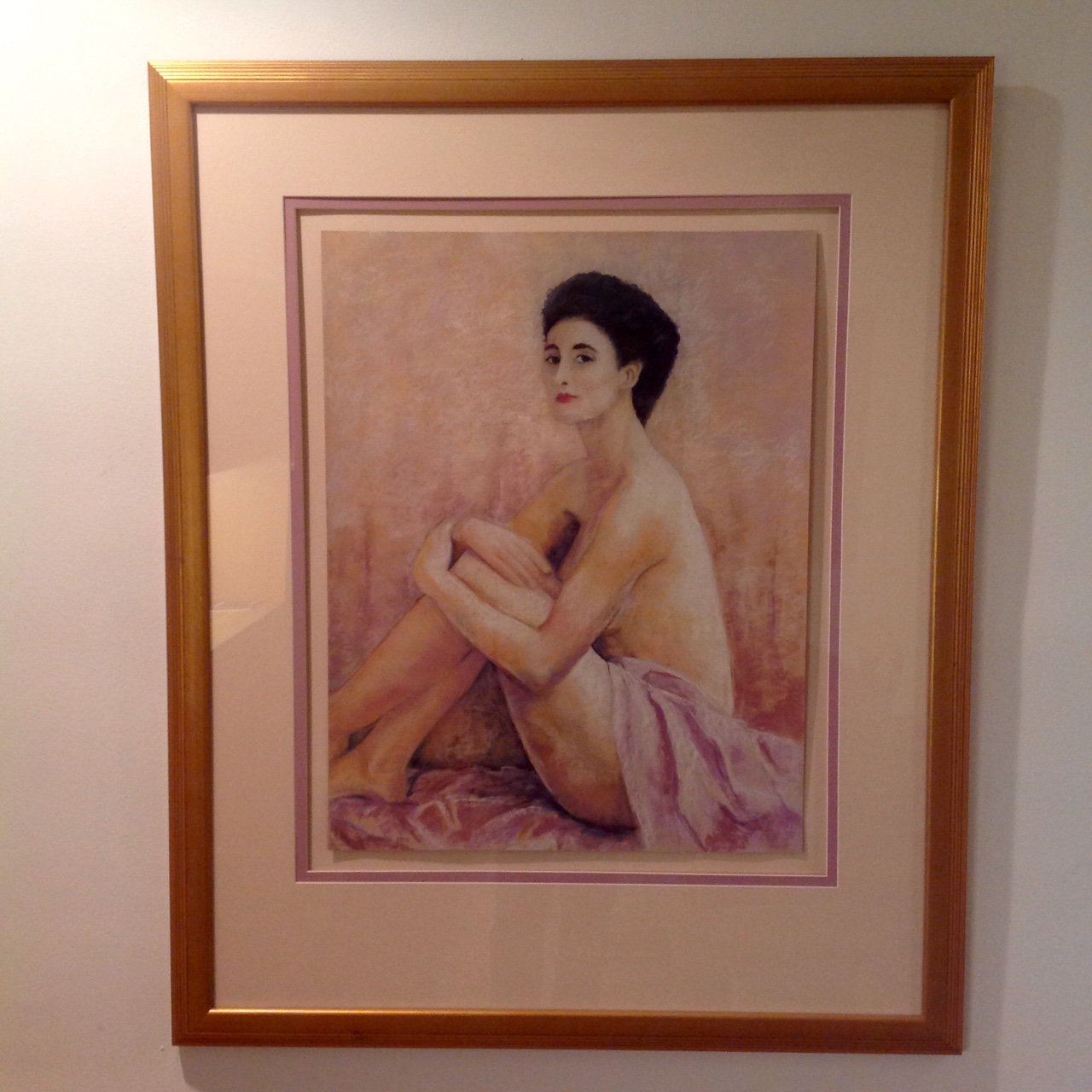
First framed pastel painting, 1988
A: Yes, it was a small head-and-neck portrait of a live model in a figure drawing class at The Art League School in Alexandria, VA. I don’t know what became of it.
I also remember the first pastel painting that I ever framed because it is still hanging in my Alexandria house. It is dated 1988 (see photo) and was made in a one-week workshop with Diane Tesler at The Art League. The workshop was specifically to teach artists how to paint from photographs and it was my first time studying with Diane. I made the mistake of bringing, as reference material, a magazine photograph that was originally a perfume ad in the The Sunday Times Magazine. Diane tactfully explained that it was wrong to use someone else’s photograph instead of my own, but let me do it this one time.
So many years later walking by my painting I still think of Diane. She taught me a valuable lesson: do not use anyone else’s photographs, ever!
Comments are welcome!
Pearls from artists* # 179
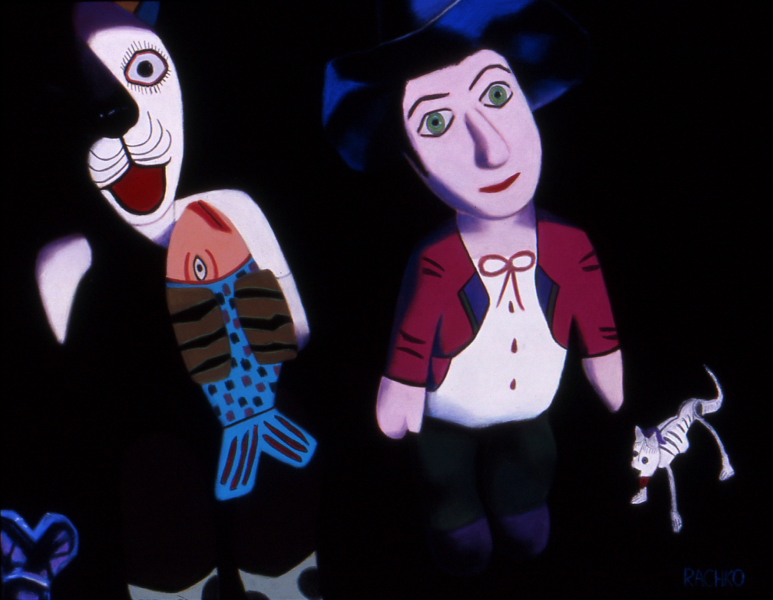
“Offering,” soft pastel on sandpaper, 20″ x 26″
* an ongoing series of quotations – mostly from artists, to artists – that offers wisdom, inspiration, and advice for the sometimes lonely road we are on.
Michael Kimmelman: You studied art in school. You started collecting early.
David Bowie: Yeah, I collected very early on. I have a couple of Tintorettos, which I’ve had for many, many years. I have a Rubens. Art was, seriously, the only thing I’ve ever wanted to own. It has always been for me a stable nourishment. I use it. It can change the way that I feel in the mornings. The same work can change me in different ways, depending on what I’m going through. For instance, somebody I like very much is Frank Auerbach. I think there are some mornings that if we hit each other a certain way – myself and a portrait by Auerbach – the work can magnify the kind of depression I’m going through. It will give spiritual weight to the angst. Some mornings I’ll look at it and go: “Oh, God, Yeah! I know!” But that same painting, on a different day, can produce in me the incredible feeling of the triumph of trying to express myself as an artist. I can look at it and say: “My God, Yeah! I want to sound like that looks.”
“At Heart an Artist with Many Muses,” by Michael Kimmelman, The New York Times, Friday, January 15, 2016
Comments are welcome!
Q: What was the first painting you ever sold?
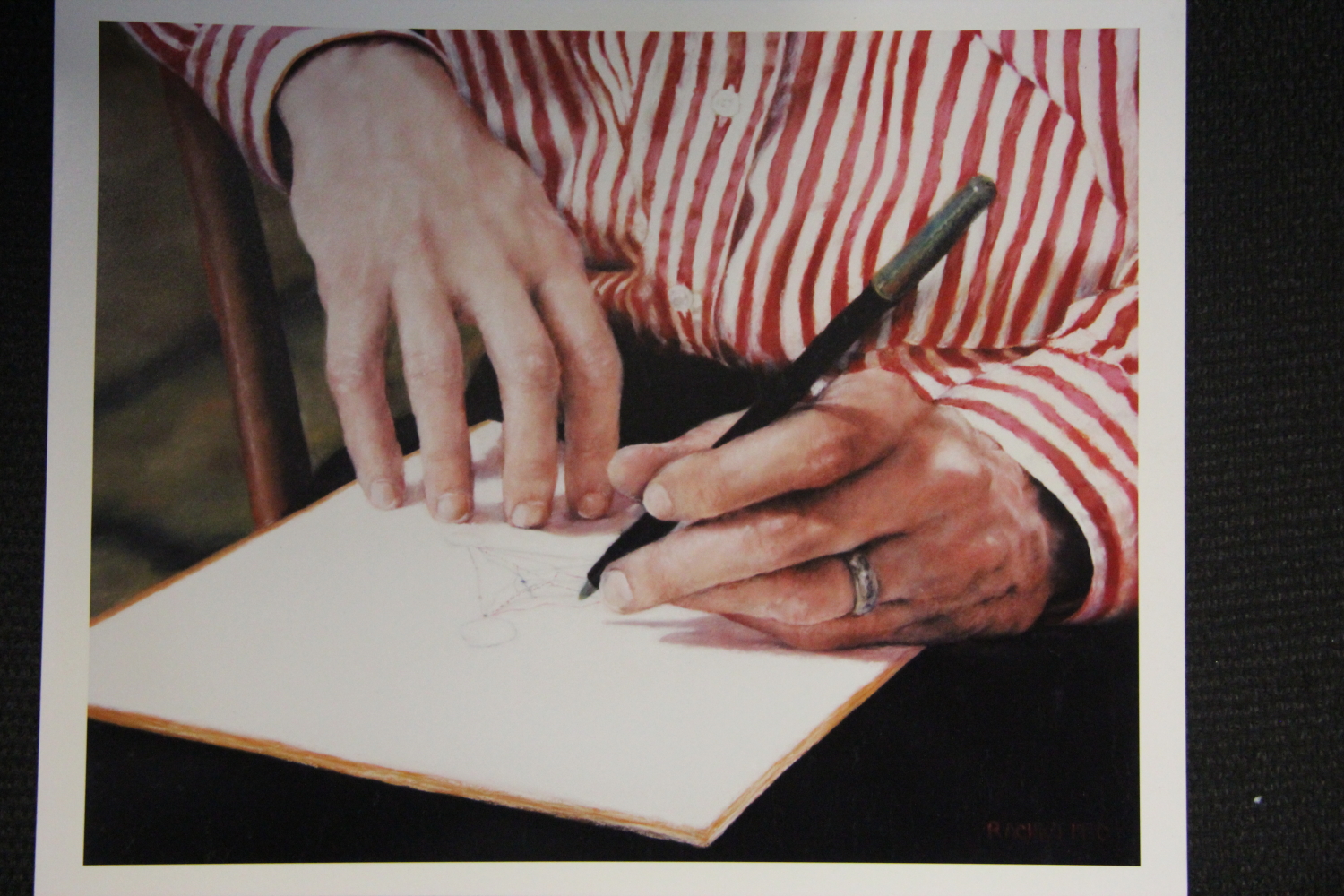
“Bryan’s Ph.D.”, 11″ x 13 1/2″, soft pastel on sandpaper
A: I believe my first sale was “Bryan’s Ph.D.” I made it in 1990 as one of several small paintings created to improve my skills at rendering human hands in pastel. I had recently left the Navy and was building a career as a portrait artist. Bryan, my late husband, was often my model for these studies, not only because it was convenient, but because he had such beautiful hands.
In 1990 Bryan was working on his Ph.D. in economics at the University of Maryland. In this painting he is drawing a diagram that illustrates a theoretical point about “international public goods,” the subject of his research. He was sitting in an old wooden rocking chair in our backyard in Alexandria, VA. I still own the chair and the house. I photographed his hands close-up and then created the painting. I don’t remember which of Bryan’s cameras I used, but it was one that took 35 mm film; perhaps his Nikon F-2. Somewhere I must still have the negative and the original reference photo.
“Bryan’s Ph.D.” is 11″ x 13 1/2″ and it sold for $500 at a monthly juried exhibition at The Art League in Alexandria. I have not seen it since 1990. (Above is a photograph of “Bryan’s Ph.D.” from my portfolio book).
Not long ago the owner contacted me, explaining that she had received the painting as a gift from her now ex-husband. She was selling it because it evoked bitter memories of her divorce. Her phone call was prompted by uncertainty about the painting’s value now. She had a likely buyer and needed to know what price to charge.
I was saddened because I have so many beautiful memories of this particular painting and of an idyllic time in my life with Bryan. He was on a leave of absence from the Pentagon to work on his dissertation, while I was finished with active duty. At last I was a full time artist, busily working in the spare bedroom that we had turned into my first studio.
My conversation with the owner was a reminder that once paintings are let out into the world, they take on associations that have nothing to do with the personal circumstances surrounding their creation. In short, what an artist creates solely out of love, stands a good chance of not being loved or appreciated by others. This is one reason to only sell my work to people I select personally. I ended the telephone conversation hoping that “Bryan’s Ph.D.” fares better in its new home.
Comments are welcome!
Q: When you left the Navy you worked on commission as a portrait artist. Why don’t you accept commissions now?

Barbara’s studio
A: As I have often said, I left the active duty Navy in 1989, but stayed in the Reserves. The Reserves provided a small part-time income and the only requirement was that I work one weekend a month and two weeks each year. Plus, I could retire after 13 more years and receive a pension. (In 2003 I retired from the Navy Reserve as a Commander). The rest of the time I was free to pursue my studio practice.
For a short time I made a living making commissioned photo-realist portraits in soft pastel on sandpaper. However, after a year I became very restless. I remember thinking, “I did not leave a boring job just to make boring art!” I lost interest in doing commissions because what I wanted to accomplish personally as an artist did not coincide with what portrait clients wanted. I finished my final portrait commission in 1990 and never looked back.
To this day I remain reluctant to accept a commission of any kind. So I am completely free to paint whatever I want, which is the only way to evolve as a serious, deeply committed artist.
Comments are welcome!


 barbararachkoscoloreddust.com