Blog Archives
Pearls from artists* # 588

Screen shot from “Barbara Rachko: True Grit” Photo: Jennifer Cox
*an ongoing series of quotations – mostly from artists, to artists – that offers wisdom, inspiration, and advice for the sometimes lonely road we are on.
The structure of the hand is not… “just anything;” the fingers have certain characteristic relationships, certain ranges of relative movement, certain kinds of crossing, torquing, jumping, sliding, pressing, releasing movements that guide the music to come out a certain way. Graceful work uses those patterns and instinctively moves through them and out as we find ever-fresh combinations. The shape and size of the human hand brings powerful but subtle laws into every kind of art, craftsmanship, mechanical work, and into our ideas and feelings as well. There is a continuous dialogue between hand and instrument, hand and culture. Artwork is not thought up in consciousness and then, as a separate phase, executed by the hand. The hand surprises us, creates and solves problems on its own. Often enigmas that battle our brains are dealt with easily, unconsciously, by the hand.
Stephen Nachmanovitch in Free Play: Improvisation in Life and Art
Comments are welcome!
Pearls from artists* # 572

*an ongoing series of quotations – mostly from artists, to artists – that offers wisdom, inspiration, and advice for the sometimes lonely road we are on.
The use of color to paint the Chinchorro mummies is interesting. According to anthropologist Victor Turner (1970), colors are experiences of social relationships. The use of particular colors in prehistory, then, has meaning even if today we cannot comprehend these meanings. Turner said that white, red, and black are the earliest colors produced by humans and they “provide a kind of primordial classification of reality” (Turner, 1970:90). This color trilogy is associated with reproduction, life, and death. Obviously, in the case of Chinchorros, black and red colors predominated. Black is equated with darkness, like the night, invisible yet present. Black is what is hidden, it is a mystical transition (Turner, 1970:109, 89-73). Black represents death, but not the end of a cycle, not an annihilating, rather a change of status and existence (Turner, 1970:71-72). Red on the other hand is equal to membership, change, blood, and social place (Turner, 1970:90). Red can be associated with life, here and in the afterworld.
The use of colors as symbols is rather universal, but the meaning of each color varies from culture to culture. In western societies black may be worn to symbolize mourning, but on other occasions it signifies relevance. The Yahgan Indians in South America used body painting with intricate patterns of black, white, and red to show their sadness and grief when someone died (Gusinde, 1937). Black was the color to symbolize mourning among the Incas (Montez, 1929:222; Zuidema, 1992:23).
Bernardo T. Arrizabalaga in Beyond Death: The Chinchorro Mummies of Ancient Chile
Comments are welcome!
Pearls from artists* # 355

“The Champ,” soft pastel on sandpaper, 26″ x 20″
*an ongoing series of quotations – mostly from artists, to artists – that offers wisdom, inspiration, and advice for the sometimes lonely road we are on.
True art provides us with truth in a manner analogous to science. Its prophetic dimension – its knack for showing us the side of things that our interests blind us to – make it a source of knowledge, even though it is knowledge of a kind that instrumental reason has little time for. The psychologists who revolutionized our understanding of human psychology in the earliest twentieth century drew on two principal sources to build their concepts: the dream life of their patients and the great art of the past. Without this recognition of the primacy of imagination, Freud and Jung could never have drawn their maps of the psyche. Those who work for a better world would do well to follow their example and find the guiding patterns of life in the prophetic artistic works of the past and present. Only art can act as a counter-weight to that uniquely modern mentality that, wherever it becomes the only game in town, seeks to persuade us that the proper goal of human beings is to contain, dissect, and control everything – that even the most persistent mysteries are just problems to be solved.
J.F. Martel in Reclaiming Art in the Age of Artifice: A Treatise, Critique, and Call to Action
Comments are welcome!
Q: As an artist what would you say is your particular ‘superpower’?

Barbara’s studio
A: I have been told that it is my unique way of composing images or, in other words, how I deliberately move the viewer’s eye around the picture. More exactly, it’s the way I combine flat shapes, patterns, angles, forms, modeling, decoration, details, lights, and darks in surprising ways when I make pastel paintings or pick up a camera.
But I think there’s a secondary, more subtle element: my understanding of and sensitivity to using color for psychological effect. The way I use color in pastel paintings is intuitive. This is something I haven’t reflected on very much yet, but will examine in a future post.
Comments are welcome!
Q: Can you talk a little bit about your process? What happens before you even begin a pastel painting?

Barbara in Bali (far right)
A: My process is extremely slow and labor-intensive.
First, there is foreign travel – often to Mexico, Guatemala or someplace in Asia – to find the cultural objects – masks, carved wooden animals, paper mâché figures, and toys – that are my subject matter. I search the local markets, bazaars, and mask shops for these folk art objects. I look for things that are old, that look like they have a history, and were probably used in religious festivals of some kind. Typically, they are colorful, one-of-a- kind objects that have lots of inherent personality. How they enter my life and how I get them back to my New York studio is an important part of my art-making practice.
My working methods have changed dramatically over the nearly thirty years that I have been an artist. My current process is a much simplified version of how I used to work. As I pared down my imagery in the current series, “Black Paintings,” my creative process quite naturally pared down, too.
One constant is that I have always worked in series with each pastel painting leading quite naturally to the next. Another is that I always set up a scene, plan exactly how to light and photograph it, and work with a 20″ x 24″ photograph as the primary reference material.
In the setups I look for eye-catching compositions and interesting colors, patterns, and shadows. Sometimes I make up a story about the interaction that is occurring between the “actors,” as I call them.
In the “Domestic Threats” series I photographed the scene with a 4″ x 5″ Toyo Omega view camera. In my “Gods and Monsters” series I shot rolls of 220 film using a Mamiya 6. I still like to use an old analog camera for fine art work, although I have been rethinking this practice.
Nowadays the first step is to decide which photo I want to make into a painting (currently I have a backlog of photographs to choose from) and to order a 19 1/2″ x 19 1/2″ image (my Mamiya 6 shoots square images) printed on 20″ x 24″ paper. They recently closed, but I used to have the prints made at Manhattan Photo on West 20th Street in New York. Now I go to Duggal. Typically I have in mind the next two or three paintings that I want to create.
Once I have the reference photograph in hand, I make a preliminary tonal charcoal sketch on a piece of white drawing paper. The sketch helps me think about how to proceed and points out potential problem areas ahead.
Only then am I ready to start actually making the painting.
Comments are welcome!
Pearls from artists* # 32
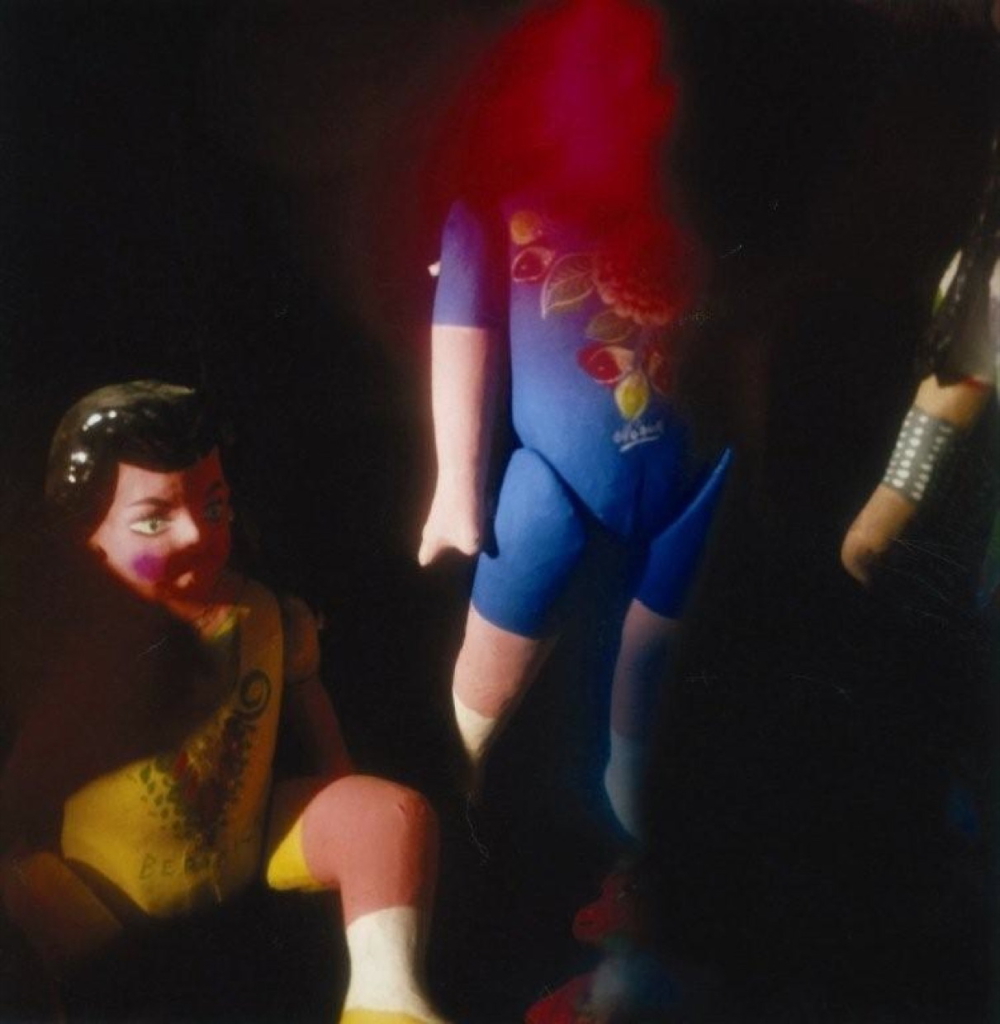
Untitled, 24″ x 24″ chromogenic print, edition of 5
* an ongoing series of quotations – mostly from artists, to artists – that offers wisdom, inspiration, and advice for the sometimes lonely road we are on.
We most certainly need to test ourselves against the most extreme possibilities, just as we are probably obligated not to express, share, and impart the most extreme possibility before it has entered the work of art. As something unique that no other person would and should understand, as one’s personal madness, so to speak, it has to enter into the work to attain its validity and to reveal there an internal law, like primary patterns that become visible only in the transparency of artistic creation. There exist nonetheless two freedoms to express oneself that seem to me the ultimate possibilities: one in the presence of the created object, and the other within one’s actual daily life where one can show another person what one has become through work, and where one may in this way mutually support and help and (here understood humbly) admire one another. In either case, however, it is necessary to show results, and it is neither lack of confidence nor lack of intimacy nor a gesture of exclusion if on does not reveal the tools of one’s personal becoming that are marked by so many confusing and tortuous traits, which are valid only for one’s own use.
Ulrich Baer, editor, The Wisdom of Rilke
Comments are welcome!


 barbararachkoscoloreddust.com